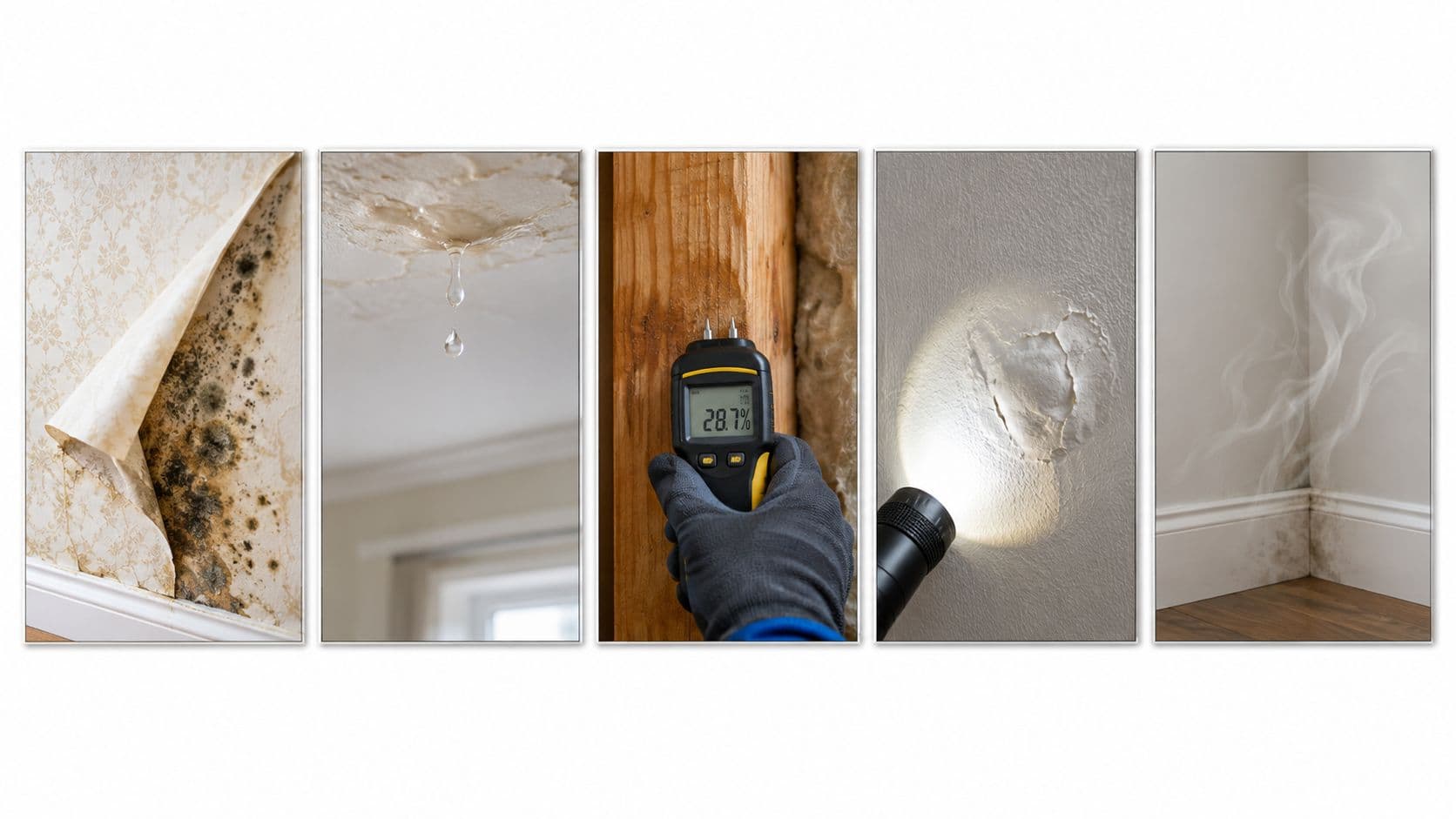
A pipe bursts overnight, a ceiling starts dripping, or a washing machine overflows across the floor. By the time the property owner finds the damage, water may already have moved under flooring, into baseboards, behind drywall, and beneath cabinets. The visible puddle is only the starting point.
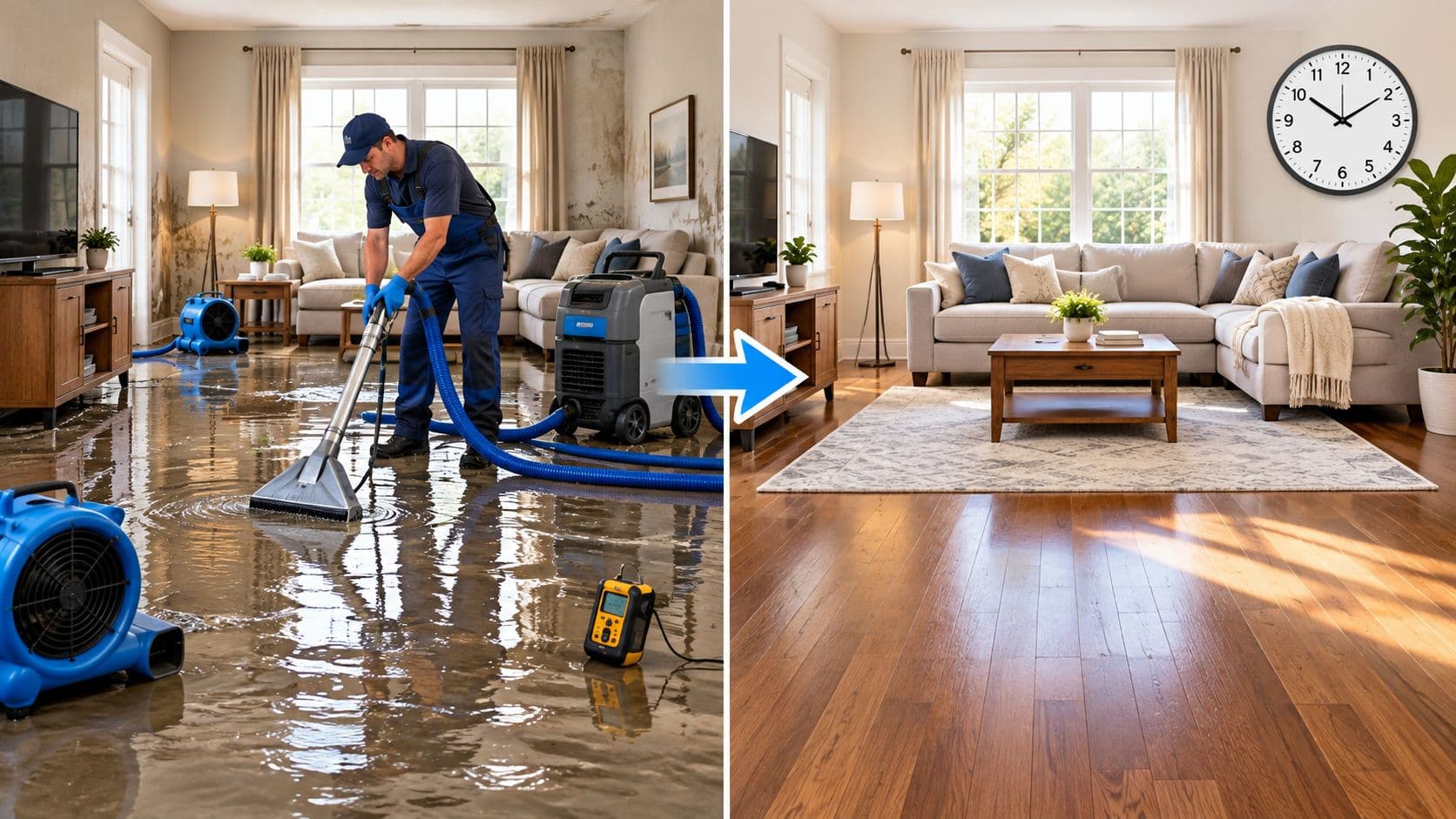
A water removal service does more than pump water from a room. The right response protects people, limits additional damage, measures hidden moisture, creates a defensible insurance record, and separates emergency mitigation from the repairs that come later. The decisions made during the first day often determine whether the property needs targeted drying or extensive material replacement.
Immediate Safety and Mitigation Steps
When water is still entering a home, safety comes before cleanup. A homeowner facing a burst pipe should keep people and pets away from standing water, especially near outlets, appliances, extension cords, or electrical panels. If the affected area can't be isolated safely, nobody should enter it until a qualified professional has assessed the hazard.
If there's no electrical danger, the property owner can shut off power to the affected areas at the breaker. The water source should also be closed, either at the local supply valve or the main water valve. A leaking ceiling, wall, water heater, or appliance may require a plumber after the immediate flow has stopped, but stopping additional water is the first practical containment step.
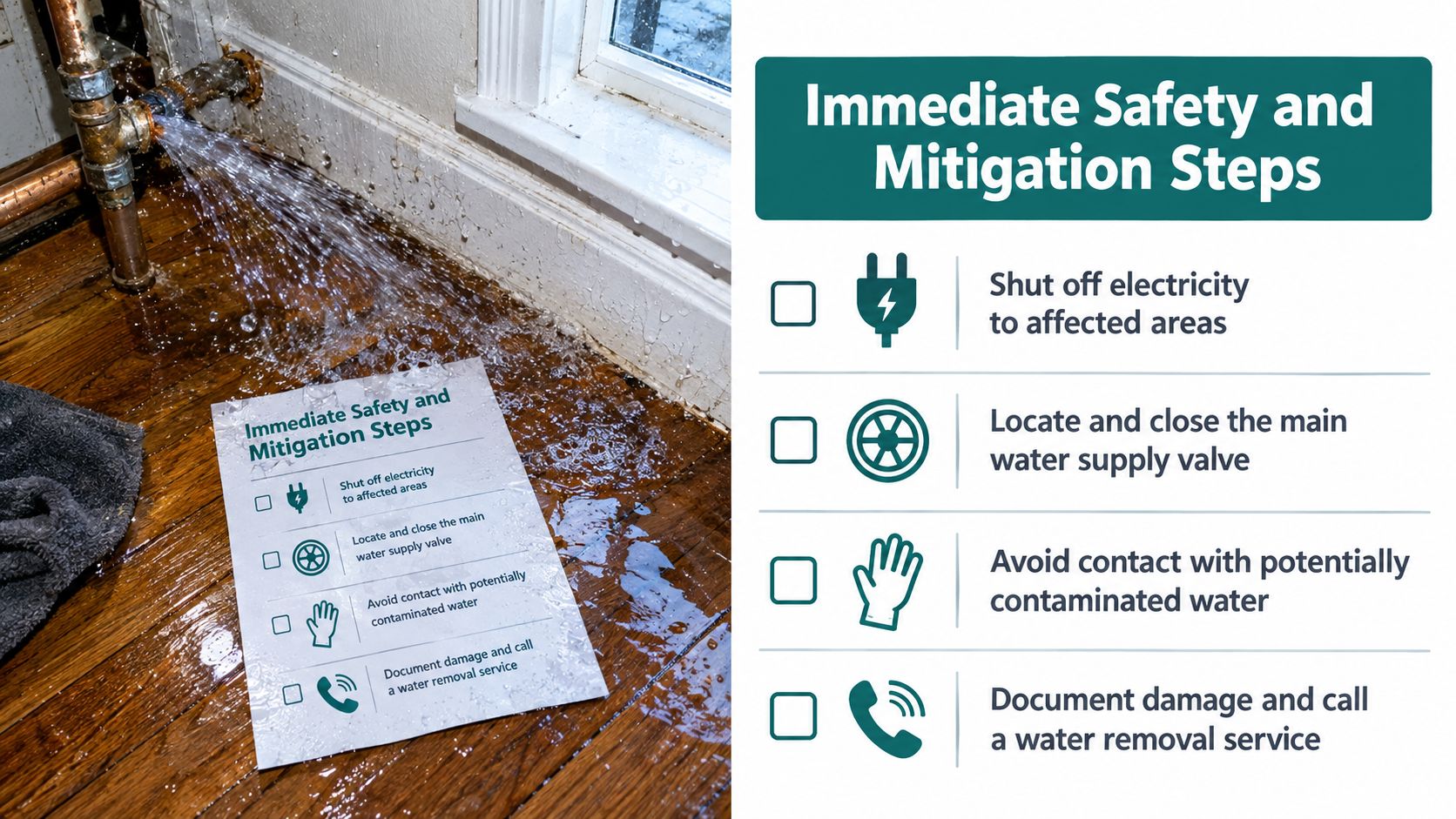
What can be done safely
Once the area is safe, the homeowner can move dry belongings away from the wet zone, place foil or protective barriers beneath furniture legs, and remove loose items from the floor. Towels can absorb small amounts of surface water. A wet vacuum may help with limited clean-water spills, but it shouldn't be used around live electrical equipment or for contaminated water.
Photographs and videos should be taken before contents are moved, including the source, affected rooms, flooring, walls, ceilings, and damaged belongings. The property owner should then contact the insurer and a qualified water removal service. A practical explanation of the first response appears in this guide to water mitigation.
The drying window matters
The EPA's guidance on mold, moisture, and home cleanup says water-damaged areas and items should be dried within 24 to 48 hours to prevent mold growth in most cases. That window is a response threshold, not a guarantee. The EPA also cautions that mold may still have developed even when materials were dried within 48 hours in its water-damage cleanup table.
The DIY boundary ends when water has entered wall cavities, insulation, subfloors, HVAC systems, or concealed framing. Surface towels can't confirm that those materials are dry. A professional crew has the equipment and moisture-reading process needed to determine whether the property is actually stabilized.
The True Cost of Delaying Water Extraction
Waiting often feels financially responsible. A property owner may hope that a small puddle will evaporate, that fans will solve the problem, or that calling a professional will create an unnecessary expense. That calculation fails when water has traveled beneath a finished surface or remained inside an absorbent material.
Water damage has long been a major source of property-loss claims. Chubb has estimated annual non-weather water-damage losses at $1.2 billion and reported that water damage and freezing represent 19.5% of homeowners insurance incurred losses in its water-damage prevention material. The same source cites a historical estimate of $13 billion in North American homeowners insurance payouts from water damage.
Why the visible loss understates the problem
Water can move through seams, flooring joints, insulation, and framing. Drywall may soften from the back, hardwood may swell at its edges, and laminate can separate after water reaches its inner layers. A room can appear substantially improved while moisture remains in places a household vacuum cannot reach.
The financial exposure is also substantial. Nationwide states that water damage represents nearly 23% of homeowners insurance claims and cites a weighted average loss of $17,059 for water-and-freezing claims in the cited material. Those figures include the combined consequences of extraction, drying, demolition, and repair, not just the cost of removing standing water.
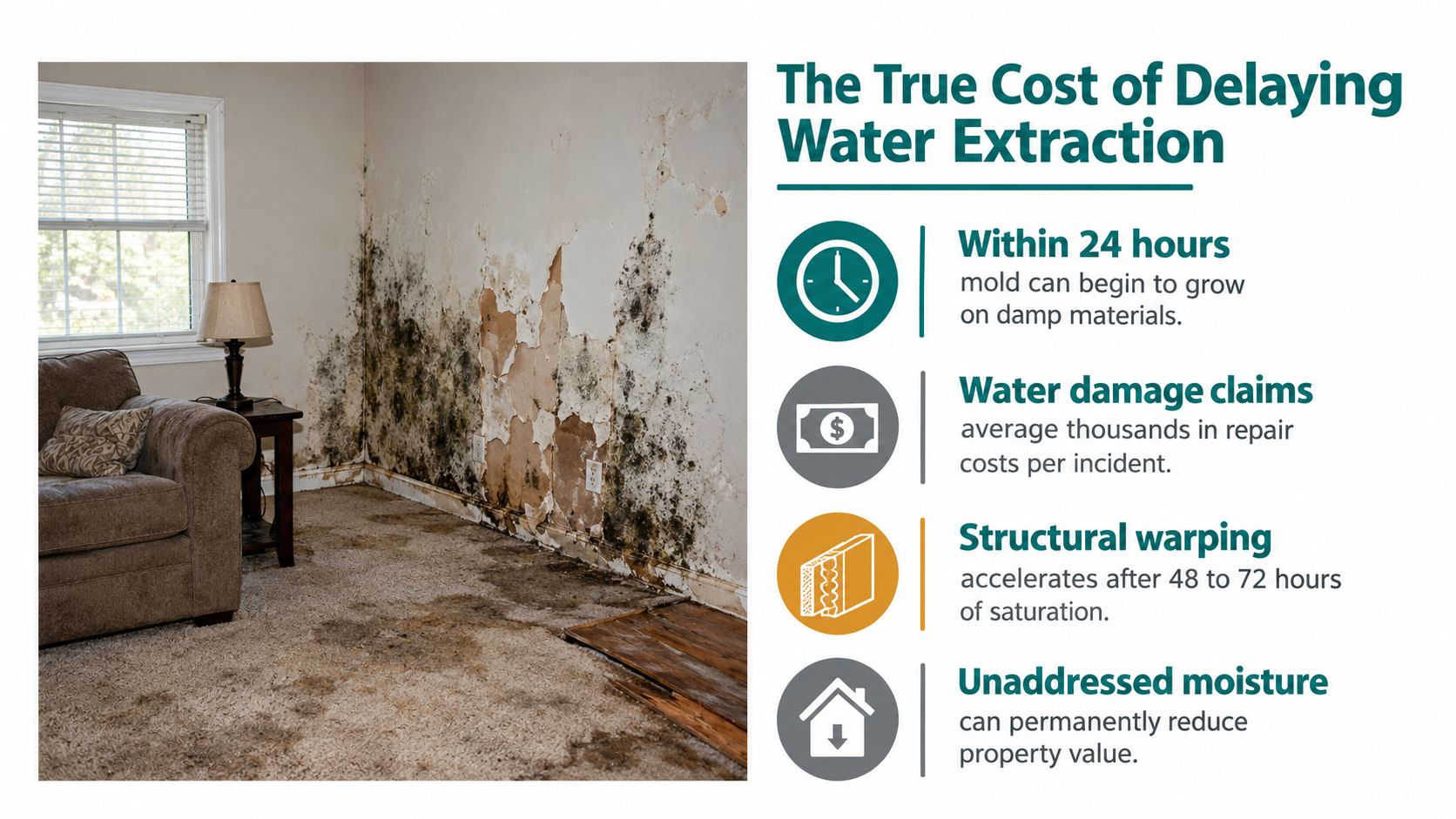
Practical rule: A fast call is usually cheaper than a delayed discovery of wet insulation, swollen subflooring, or damaged drywall behind a finished wall.
Industry estimates place the water damage restoration market near $5.8 billion in 2022, with some 2026 projections near $5.97 billion and a projection of roughly $8.97 billion by 2032. The same market overview identifies water damage restoration as 32.6% of projected U.S. disaster restoration services in 2025, showing why extraction and drying are foundational services rather than niche repairs.
Assessing Water Contamination Levels
The source of the water determines the safe cleanup method. A broken supply line and a sewage backup may both leave standing water, but they don't create the same exposure, handling, containment, or disposal requirements.
Category 1 clean water
Category 1 generally refers to water from a sanitary supply source, such as a broken supply line. It still causes serious building damage, but the initial contamination risk is lower than with wastewater or polluted flooding. A small, isolated spill may be suitable for careful homeowner cleanup if electricity is isolated, the source is stopped, the affected materials are accessible, and drying can begin immediately.
That exception is narrow. Clean water can become more contaminated after sitting in a building, contacting dirty surfaces, or mixing with contents. A crew should assess the area when water has entered porous materials, crossed a large area, or reached concealed construction.
Category 2 gray water
Gray water can contain contaminants and may come from sources such as washing machines, dishwashers, sinks, or overflows involving used water. It requires more than extraction. A professional response may include controlled removal, cleaning, sanitizing, and evaluation of materials that have absorbed the water.
A wet vacuum doesn't make gray water safe. It can spread contaminated liquid through hoses, flooring, or nearby surfaces if the operator lacks suitable protective procedures. The property owner should avoid tracking the water into unaffected rooms and should keep children, pets, and vulnerable occupants away.
Category 3 black water
Category 3 is grossly contaminated water that can contain pathogenic, toxigenic, or otherwise harmful agents. Sewage backups are a clear example. Floodwater can also present serious contamination concerns, but the category must reflect the actual conditions at the loss site. The IICRC weather-related water-damage position statement states that top-down water ingress and wind-driven rain aren't automatically Category 3.
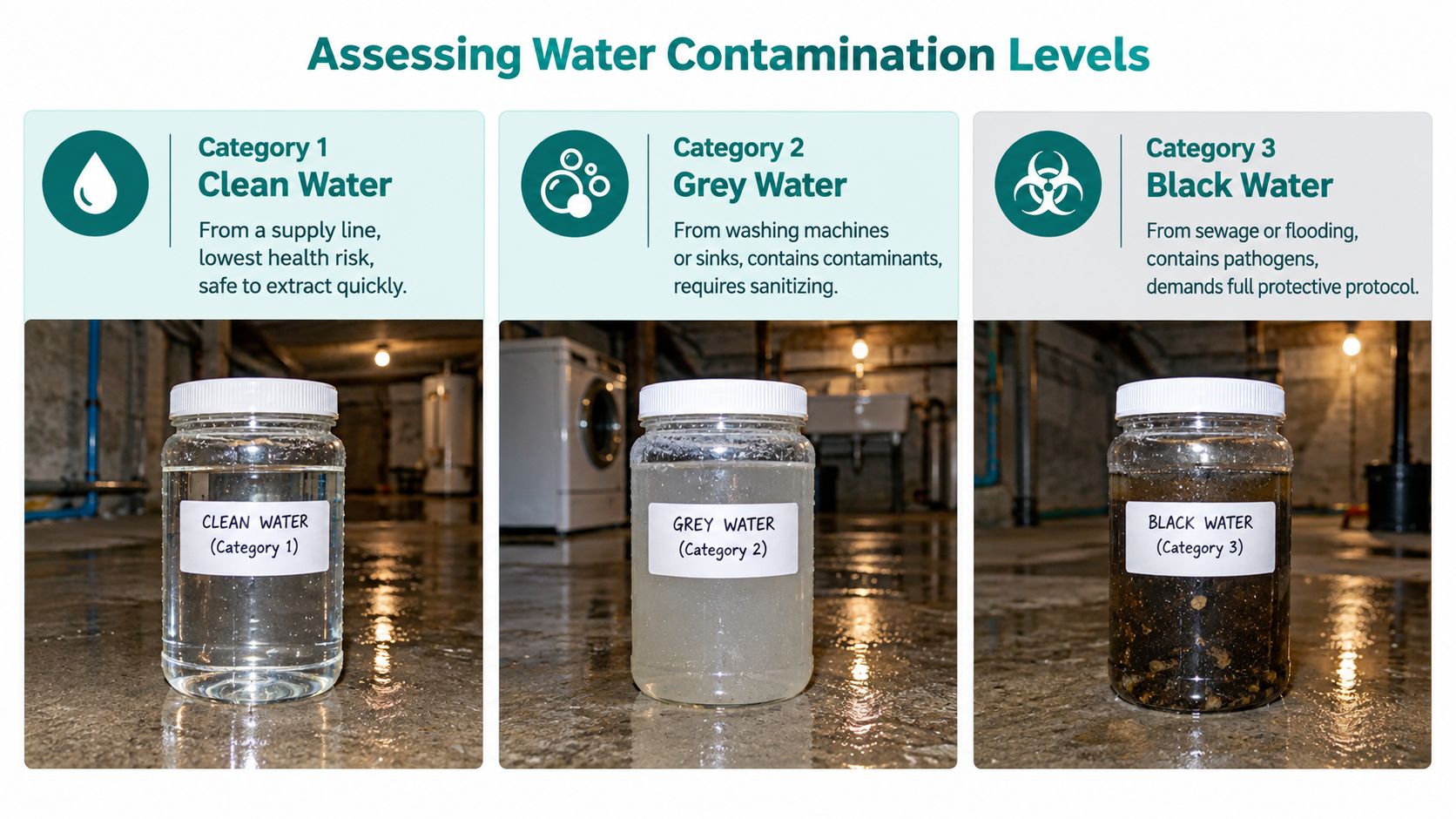
The EPA's commercial and school cleanup guidance limits its 24-to-48-hour advice to clean-water damage. Sewage, chemical pollutants, and biological pollutants require personal protective equipment and containment under the applicable safety guidance.
A homeowner deciding whether professional help is necessary should treat contaminated water, hidden water, electrical exposure, and structural instability as professional-response conditions. A detailed water-damage inspection guide can help identify questions for the responding technician, but it can't replace a safe site assessment.
The Professional Structural Drying Process
Standing water removal is only the first operation. A crew can leave a floor free of puddles while drywall, framing, insulation, or subflooring remains wet. That's why a legitimate water removal service should explain how it will measure and verify drying, not just how quickly it can place fans.
Assessment comes before equipment
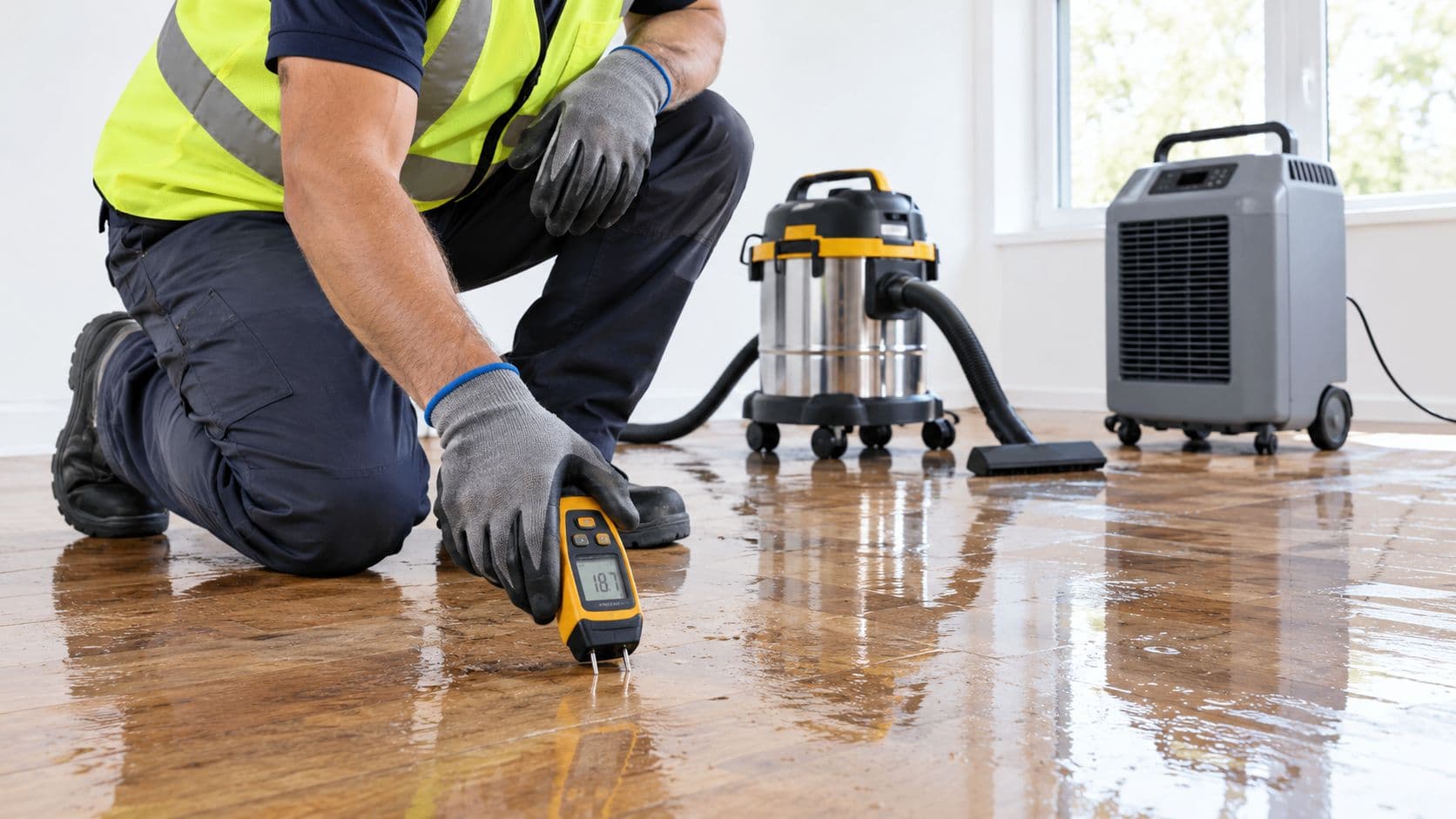
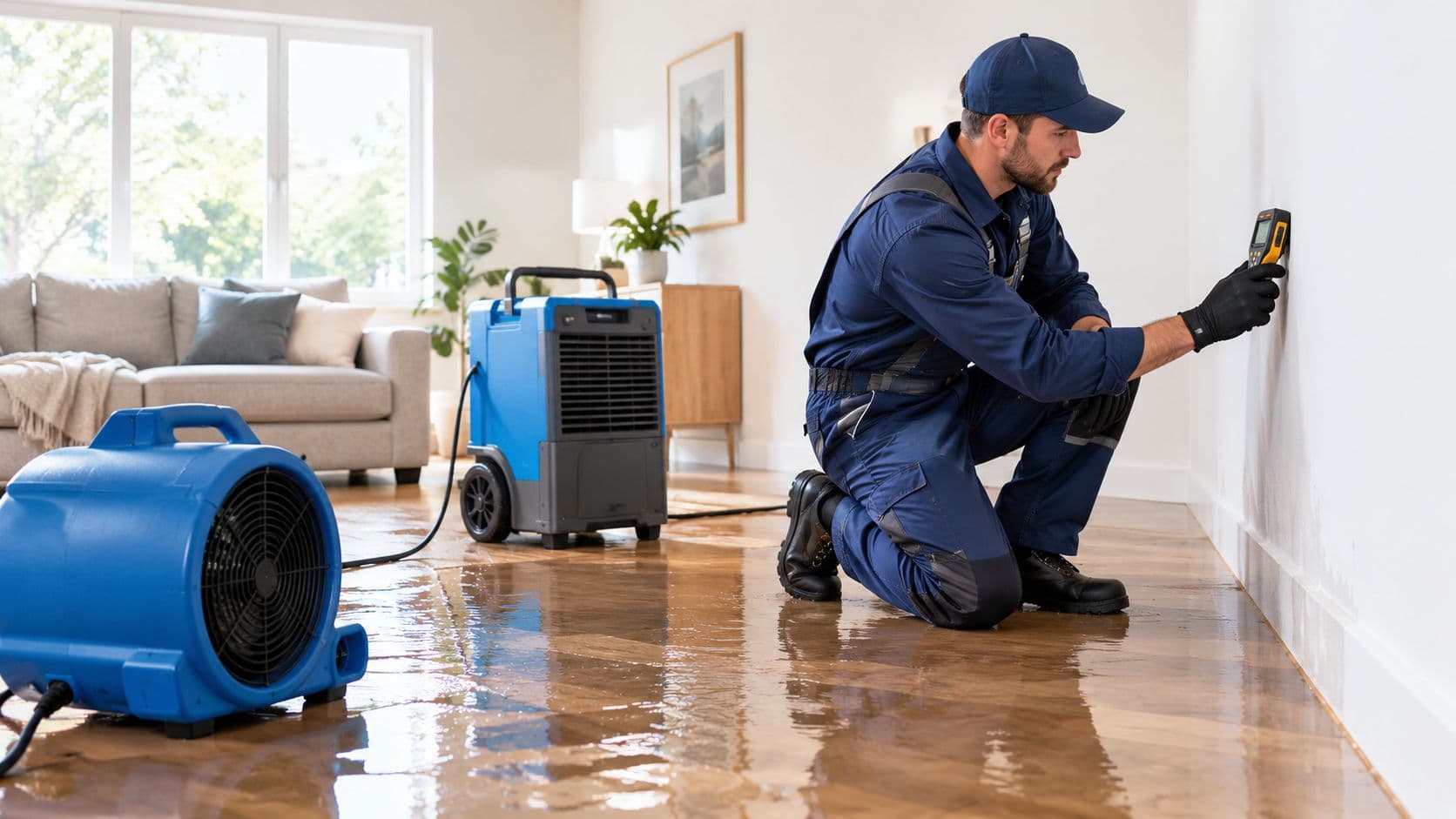
The technician should identify the source, affected materials, water category, and areas where moisture may have traveled. Moisture meters help establish readings in building materials. Thermal imaging may help locate temperature patterns associated with concealed moisture, but it supports the investigation rather than replacing direct moisture measurement.
The crew should record baseline conditions before major demolition or equipment placement. A useful file includes room-by-room observations, photographs, material readings, equipment locations, and the reason for any removal or containment decision.
Extraction changes the drying load
Technicians remove bulk water with pumps, vacuums, weighted extraction tools, or other equipment matched to the volume and category of water. Removing accessible water early reduces the amount that must later evaporate from materials and allows the drying system to work more efficiently.
The next step uses air movement and dehumidification. Air movers increase evaporation at wet surfaces, while dehumidifiers remove moisture from the air. Together, they create a vapor-pressure deficit that encourages trapped moisture to migrate out of materials.
Psychrometrics controls the outcome
Psychrometrics is the measurement-based side of drying. Technicians monitor temperature, relative humidity, and moisture content because those conditions determine whether water will continue leaving the structure or remain trapped. Equipment placement should respond to the readings, not to a generic room size or visual guess.
Drying records should show progress over time. If the readings stop improving, the crew may need to adjust airflow, increase dehumidification, expose concealed materials, or remove materials that can't be dried safely.
A floor that looks dry isn't proof that the structure is dry.
The IICRC standard describes restorative drying as an assessment-based and documented process, with contamination controls for Category 2 or Category 3 intrusions and completion determined by moisture-content readings rather than appearance alone. The IICRC position statement on weather-related water damage supports that measurement-led approach.
The property owner should ask for baseline readings, daily progress readings, equipment records, and final readings against appropriate dry standards. Guidance on drying wet drywall is useful for understanding the process, but concealed drywall and wall assemblies often require professional evaluation.
Understanding Pricing and Service Scope
A water removal estimate should describe the work, not just provide a single attractive number. The cost depends on the water category, affected area, accessibility, amount of standing water, materials involved, contamination controls, equipment, monitoring, demolition, and whether repairs are included.
Available pricing data commonly places clean-water work around $3 to $4 per square foot, gray-water work around $4 to $6.50 per square foot, and black-water work around $7 to $7.50 per square foot. Serious losses can exceed $15,000, depending on structural damage and the repair scope. These ranges appear in consumer water-damage insurance and cost information and should be treated as benchmarks, not a guaranteed quote.
Estimated Water Extraction Costs by Category
| Water Category | Common Sources | Estimated Cost per Sq Ft |
|---|---|---|
| Category 1, clean water | Supply-line breaks and similar sanitary sources | $3 to $4 |
| Category 2, gray water | Washing-machine or sink overflows and used-water releases | $4 to $6.50 |
| Category 3, black water | Sewage backups and heavily contaminated water | $7 to $7.50 |
The table covers extraction-oriented pricing. It doesn't automatically include demolition, antimicrobial cleaning, contents handling, structural drying, reconstruction, specialty trades, or damaged-material replacement.
Mitigation and repair are separate scopes
Mitigation stops the active loss. It usually includes water extraction, material protection or removal, cleaning related to the water event, drying equipment, monitoring, and documentation. Repair rebuilds the property after the structure is stabilized. That may include new drywall, insulation, flooring, cabinets, trim, paint, and other finishes.
A property owner should ask whether the estimate ends at dry-out or continues through reconstruction. A company can perform mitigation without performing the final repair, while another provider may coordinate both phases. Neither arrangement is automatically better, but the scope must be clear before authorization.
Scope check: The estimate should identify what will be removed, what will be dried in place, what will be cleaned, what will be replaced, and what remains outside the quoted work.
A low extraction price can become expensive if it omits moisture monitoring or leaves wet materials behind. A higher estimate may reflect contamination controls, difficult access, contents manipulation, or structural drying requirements. The sensible comparison is between complete scopes, not headline rates.
Navigating Insurance Claims and Documentation
Insurance decisions depend on the policy, the cause of loss, exclusions, endorsements, deductibles, and the facts documented at the property. A sudden burst pipe or appliance leak may be treated differently from long-term seepage or deferred maintenance. The property owner should report the loss promptly and ask the carrier what documentation and emergency actions it requires.
Before moving contents, photographs should capture the source and the full extent of visible damage. Images should show room context as well as close details of swollen flooring, staining, detached materials, damaged belongings, and standing water. A written incident record should include when the problem was discovered, what caused it if known, what was done to stop it, and who was contacted.
Documentation that supports the claim
A professional file should be more detailed than a final invoice. The property owner should expect records such as:
- Baseline readings: Moisture measurements taken before drying or demolition, with the location and material identified.
- Daily drying logs: Temperature, relative humidity, moisture readings, equipment placement, and changes made by the crew.
- Photographic evidence: Images before mitigation, during removal or drying, and after the affected areas reach the required standard.
- Written scope: A clear distinction between emergency mitigation and reconstruction.
- Authorization records: Signed approvals, change orders, and communications about access or material removal.
Digital documentation matters because an adjuster needs to connect the observed damage to the work performed. Without that record, disputes can arise over whether a material was wet, whether demolition was necessary, or whether drying actually reached concealed areas.
Coordinate before the scope changes
The property owner should ask the adjuster whether emergency mitigation can begin immediately, whether a preferred billing process applies, and which expenses require prior approval. The homeowner still controls authorization for work, but emergency actions to prevent additional damage shouldn't be delayed while waiting for a perfect estimate.
Insurance-funded work accounted for about 52.5% of North American disaster restoration revenue in 2025, and industry reporting identifies digital documentation and 24/7 response as increasingly important provider capabilities. The same North American disaster restoration market analysis reports that many restoration firms wait 60 to 90 days for payment, a reality that can contribute to deposits, billing pressure, and scope disputes.
That payment pressure isn't the homeowner's responsibility to solve through vague paperwork. Before work starts, the property owner should confirm who bills the insurer, what amount may be due directly, and how supplements or newly discovered damage will be handled.
Choosing the Right Restoration Partner
A water removal service should be selected for process quality, not for the fastest promise or the lowest opening estimate. During an emergency, a property owner needs a provider that can make the site safe, identify hidden moisture, document the work, and communicate clearly with the insurer.
Questions worth asking before authorization
- Certification: Does the company employ technicians trained under recognized water-damage restoration standards?
- Response: Can the provider respond at any hour when active water threatens the property?
- Equipment: Will the crew use extraction equipment, air movers, dehumidification, moisture meters, and appropriate protective gear?
- Records: Will the company provide baseline readings, daily logs, photographs, and final verification?
- Contamination: Can the provider safely manage gray or black water, including containment and disposal requirements?
- Scope: Does the estimate cover mitigation only, or does it include reconstruction?
- Insurance: Can the billing team communicate with the adjuster without promising coverage or making policy decisions for the carrier?
The provider should explain why drywall, insulation, flooring, cabinets, or subflooring can be dried or must be removed. A technician who treats every loss as a surface cleanup is missing the central issue. The standard is not whether the room looks acceptable. The standard is whether the affected assembly has reached a documented dry condition and can be safely restored.
Use a guided first step
Traditional lead forms can leave a stressed homeowner sorting through repeated calls from providers that may not match the loss. PostDamage uses a single-request referral model, connecting property owners with appropriate local professionals after they describe the situation. The platform provides guidance about water damage, mitigation, restoration, costs, documentation, and the next practical step, while the responding restoration company performs the inspection and work.
A landlord, property manager, renter, or small business owner should prepare the basic facts before submitting a request: the water source, affected rooms, contamination concerns, whether water is still entering, whether electricity is involved, and what photographs are available. That information helps direct the request toward a suitable response instead of a generic sales sequence.
The right partner won't pressure the property owner to authorize undefined work. The company should explain the immediate hazard, document conditions, separate mitigation from repair, and obtain approval before expanding the scope. Those habits protect both the building and the insurance record.
PostDamage helps property owners describe a water loss, understand the difference between extraction and structural drying, and connect with an appropriate local professional through one request instead of five sales calls. Visit PostDamage to start with situation-specific guidance and take the next step before hidden moisture creates a larger repair.