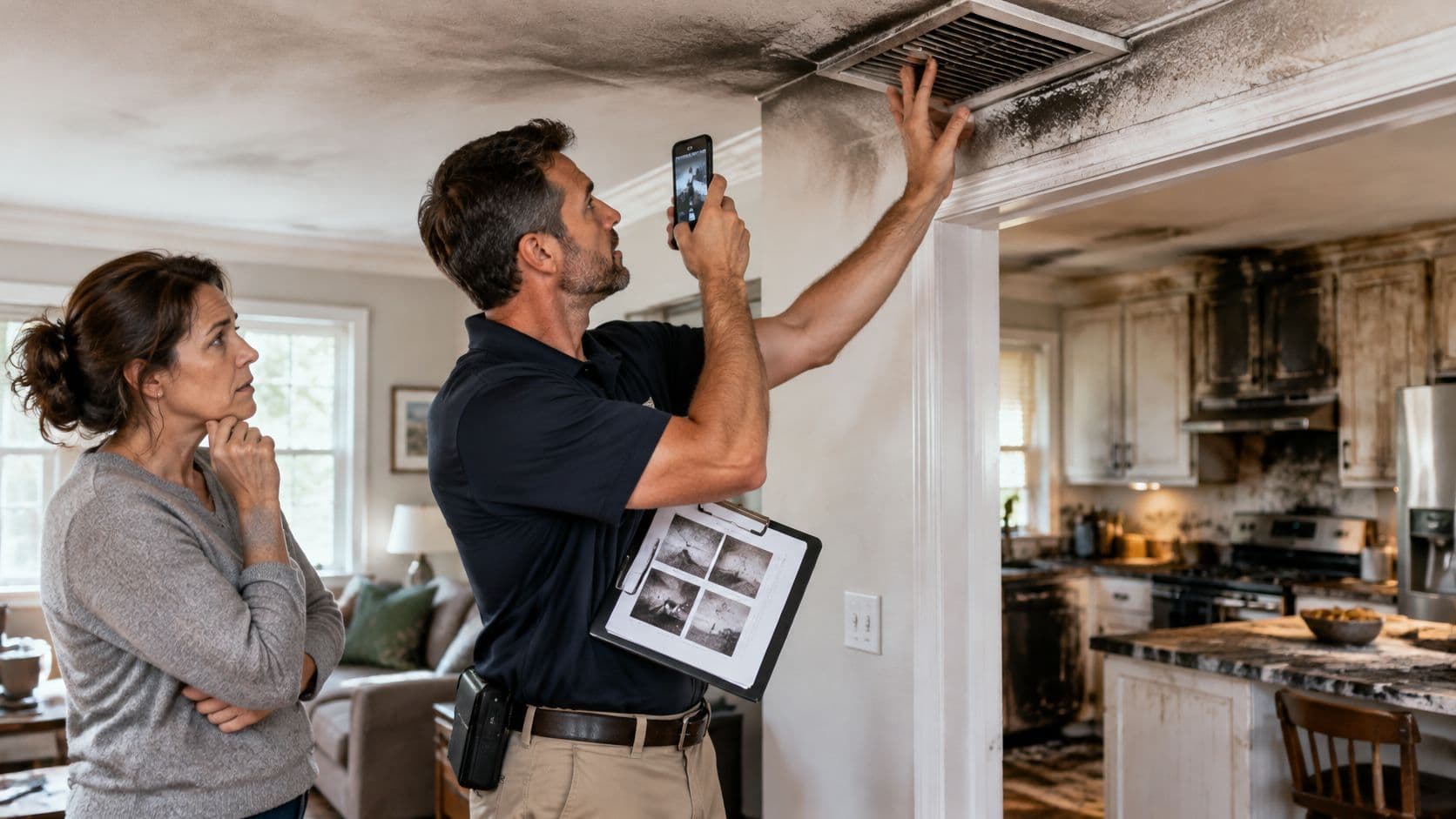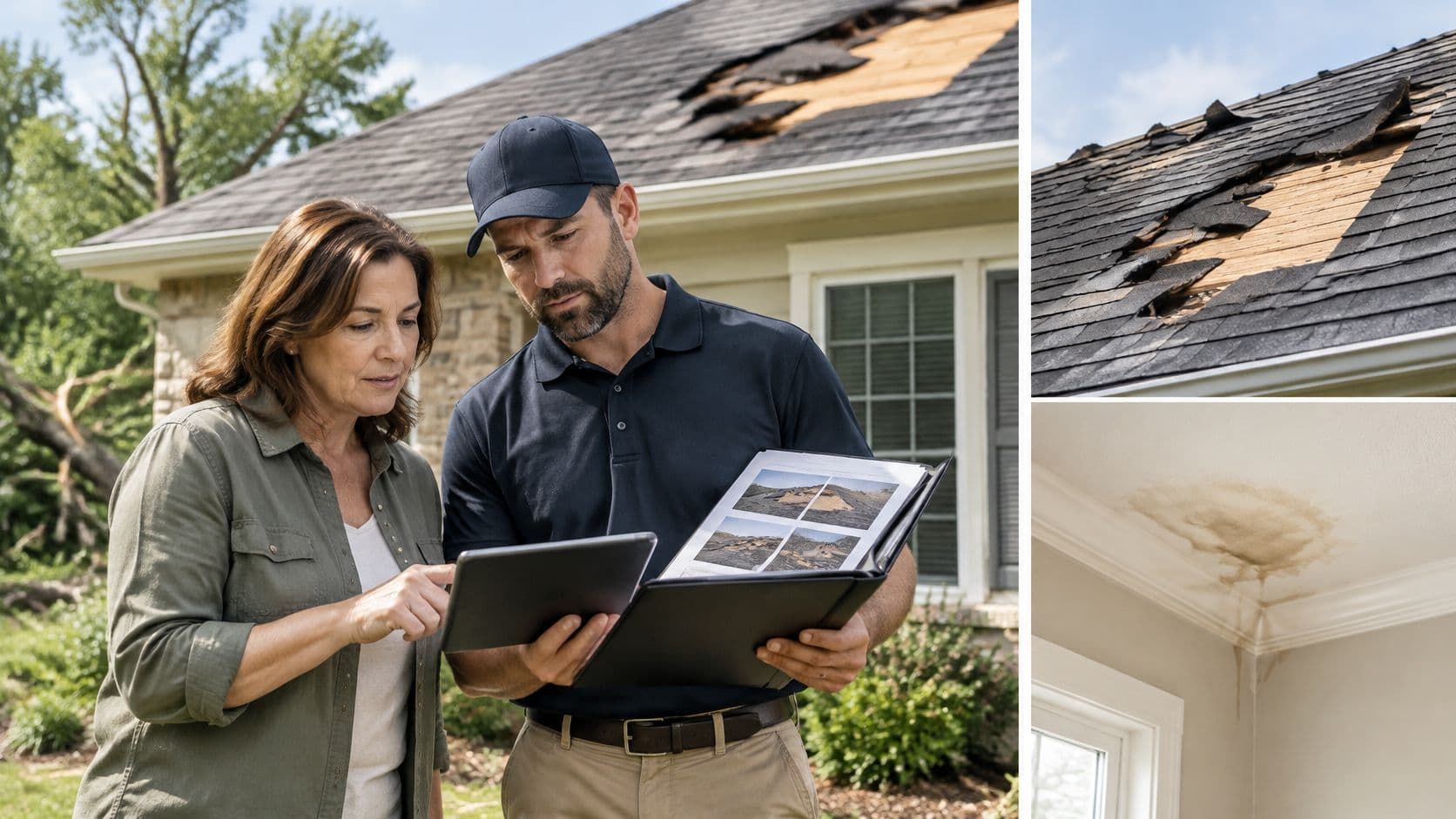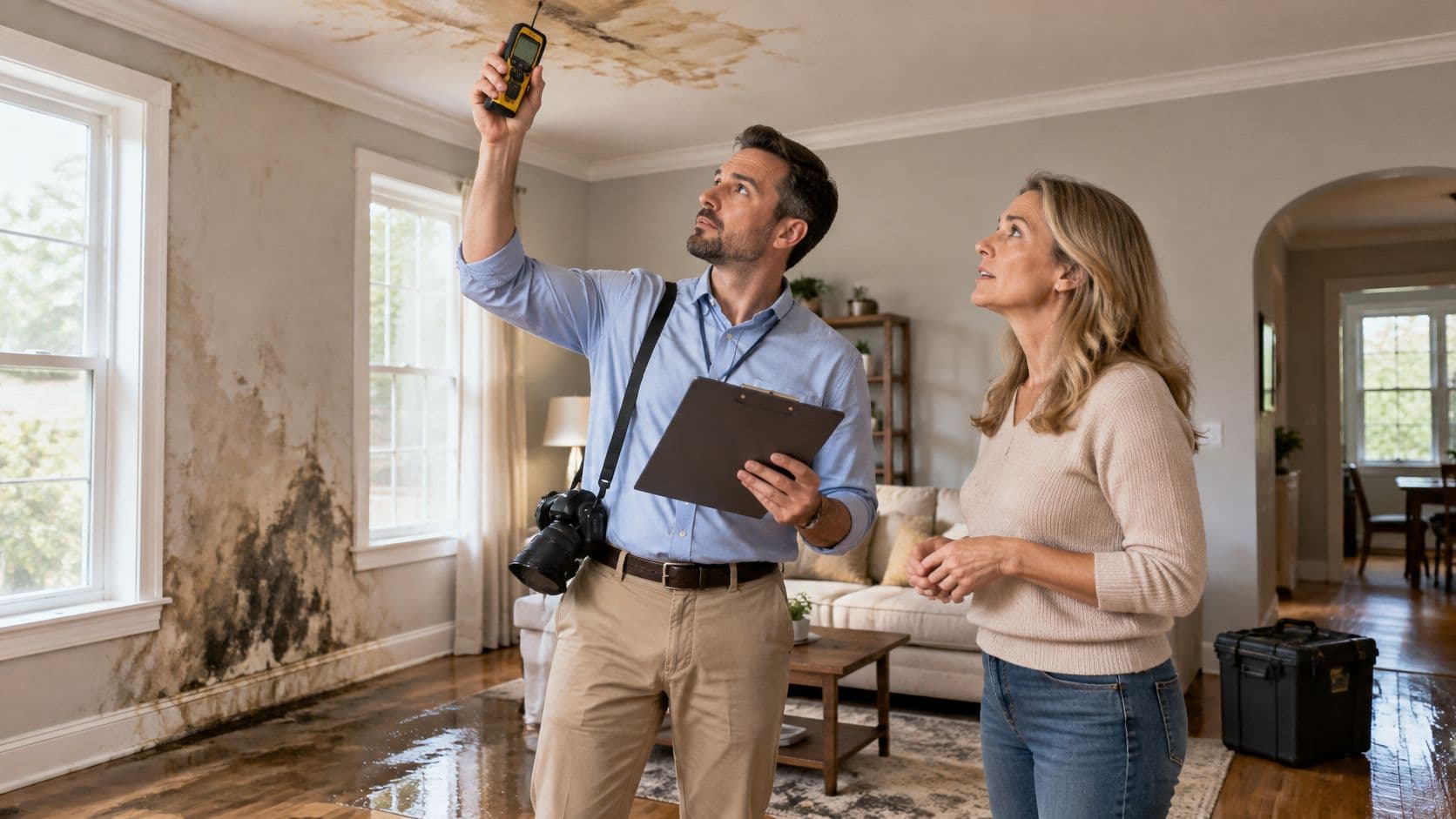
A homeowner wakes to a brown stain spreading across a kitchen ceiling and water pooling under the cabinets. A plumber stops the leak, a drying crew starts work, and then an insurance estimate arrives with lines the homeowner doesn't understand. The question that follows isn't only how much repairs cost. It's which water source caused the loss, which policy section responds, and whether the estimate captured hidden damage.
What a Water Damage Public Adjuster Does for You
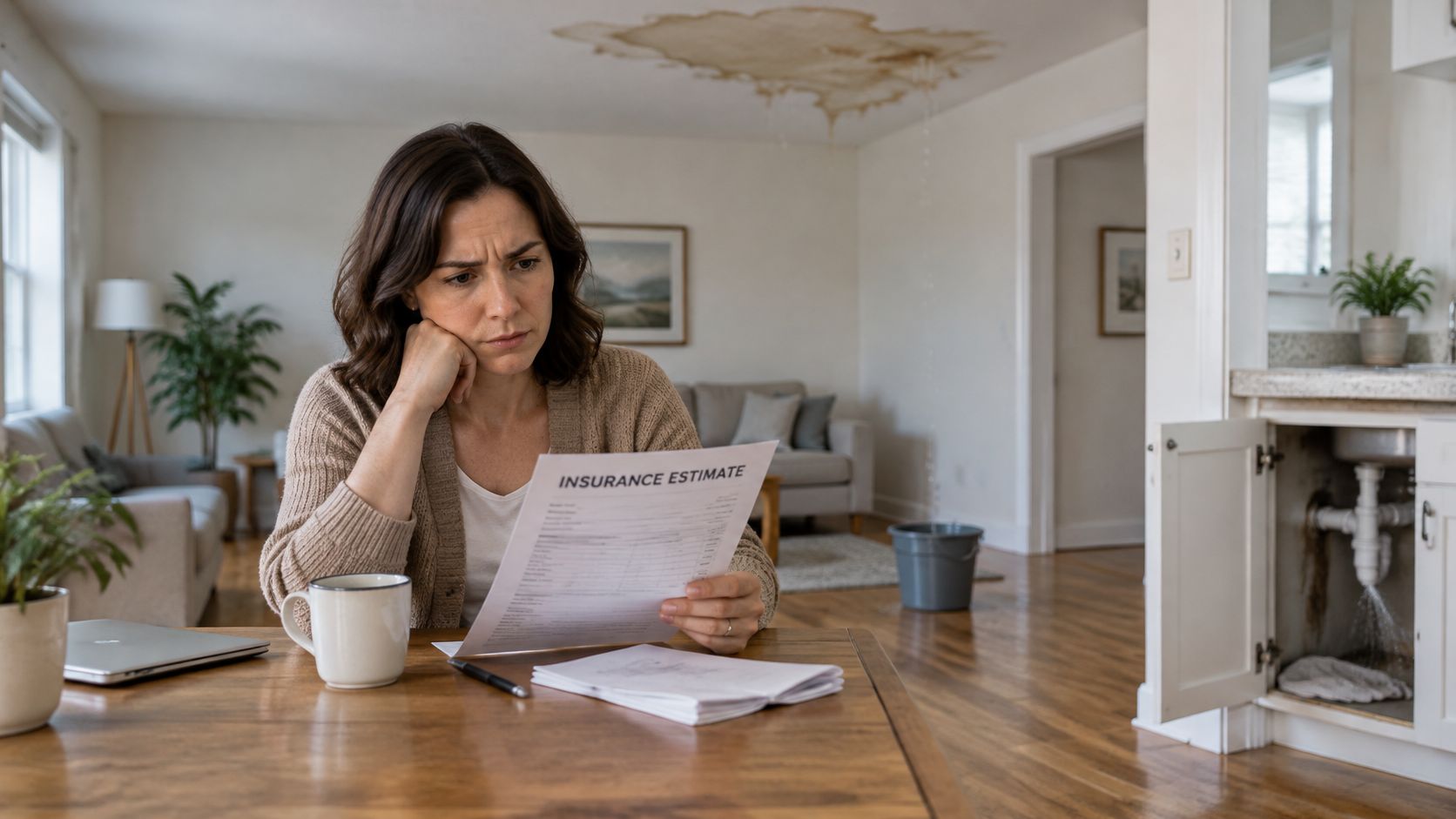
A supply line can fail overnight, soak flooring and cabinets by morning, and leave moisture inside a wall that looks dry on the surface. Days later, the insurer's adjuster may present an estimate for visible repairs while questions remain about subflooring, contents, and temporary housing.
A water damage public adjuster is a licensed professional hired by the policyholder to document the loss, prepare or review the estimate, and negotiate with the insurer. PostDamage provides information about public adjusters, who are professionals that represent policyholders in insurance claim matters within the scope permitted by applicable state law. Licensing and allowed services vary by state, so a homeowner should verify the license before signing anything.
Why Water Losses Deserve Careful Documentation
Water damage and freezing accounted for more than 23% of homeowners insurance claims in 2021, the average water-damage claim across 2017 to 2021 was approximately $12,514, and roughly 1 in 60 insured homes filed a water-damage or freezing claim in a typical year, according to Insurance Information Institute data summarized in U.S. News homeowners claim reporting. Those figures generally exclude flood damage because standard homeowners policies commonly don't cover flooding.
One incident can involve building materials, flooring, cabinets, contents, microbial damage, and temporary living expenses. Payment may depend on the cause, exclusions, deductible, policy limits, and how promptly the homeowner mitigated further damage.
Three boundaries matter from the start. Hiring is optional, a public adjuster can't create coverage the policy excludes, and nobody can guarantee a higher payment. The role is claim advocacy and documentation, not repair work and not legal representation.
Public Adjuster, Insurer Adjuster and Restoration Crew Compared
A homeowner standing in a wet hallway often meets three different professionals within the same week. Each one answers to a different party, and that loyalty shapes every estimate, report and recommendation that follows. PostDamage explains that public adjusters are different from insurance company adjusters, who work on behalf of insurers.
| Role | Works for | How they are usually paid | Main job in a water claim |
|---|---|---|---|
| Public adjuster | The policyholder | Usually a percentage of the settlement, or a flat or hourly fee, depending on state rules and contract | Documents the loss, writes or reviews the estimate, negotiates with the insurer |
| Insurer's adjuster | The insurance company | Salaried or contracted by the insurer | Inspects the damage for the insurer, sets the insurer's estimate and payment position |
| Restoration contractor | The property owner, under a repair contract | Invoice for drying, removal and repairs | Stops the water, dries materials, removes and rebuilds damaged areas |
The insurer's adjuster answers to the insurer, and the public adjuster answers to the policyholder.
Where Confusion Commonly Starts
An insurer may also send an independent adjuster. Despite the name, that person is hired for the insurer's side of the inspection and doesn't represent the homeowner.
A restoration contractor dries, cleans, removes, and repairs damaged property. The crew's invoices, moisture logs, equipment records, and photographs can become important claim evidence. A repair crew documents the work it performs. A public adjuster represents the policyholder's claim.
Confusion grows when a restoration company offers to handle the insurance process. That company may also benefit from a larger repair scope, so keeping the repair contract and the claim representation contract separate makes responsibilities easier to check.
A practical test helps before anyone is hired:
- Contract signer: Ask who signs the agreement.
- Reporting line: Ask who receives instructions and progress reports.
- Payment path: Ask who receives the insurance check and who gets paid from it.
PostDamage, an information and referral platform rather than a public adjusting firm, explains these roles so homeowners can tell claim advocacy apart from repair work and from the insurer's side of the table.
When a Public Adjuster Is Worth Considering
The decision usually turns on two things: the size of the gap between the documented loss and the insurer's offer, and how difficult that gap is to prove. The water's source shapes both, because it determines which part of the policy answers the claim and how much evidence that coverage demands.
| Situation | Worth discussing a public adjuster? | Why it matters |
|---|---|---|
| Small leak, insurer paid in full and quickly | Usually not needed | Little gap exists between the loss and the payment |
| Multi-room loss with hidden moisture in subfloors, framing or cabinets | Often worth evaluating | Hidden layers are easy to omit from a first estimate |
| Insurer estimate far below a contractor's bid | Worth evaluating | A line-by-line comparison shows where the gap sits |
| Claim denied or partly denied | Get a second review before accepting | The denial depends on cause, exclusions and proof |
| Commercial loss with business-income impact | Worth evaluating | Income and extra-expense proof is complex and often underdocumented |
| Flood, sewer backup or seepage with unclear coverage | Review endorsements first | The source of water decides which policy section responds |
| Claim near a policy or statutory deadline | Get advice promptly | Deadlines depend on the policy and state, so they must be confirmed |
None of these rows promise a larger payment. They mark the situations where documentation, rather than effort, is the bottleneck.
Why Larger Losses Become Harder to Prove
Severity trends explain part of this. Claims analyses published across the insurance industry show that large water losses have grown more severe in recent years, with the highest-value claims climbing fastest. A larger loss contains more line items a first estimate can miss: moisture inside wall cavities and under cabinets, structural drying time, mold questions, damaged inventory, code upgrades, relocation costs, and lost income.
Commercial losses add a second layer. Repairing a building does not, on its own, document lost sales, continuing payroll, canceled orders, or the cost of temporary premises. Business-interruption analyses consistently flag water damage as a leading cause of income-loss claims, which is why the income side of a commercial file often needs its own evidence trail.
Fee-versus-gap test: If the likely recoverable gap is small, the adjuster's fee may outweigh the benefit. If hidden damage or income loss is substantial and difficult to document, a professional review becomes easier to justify.
The outcome still depends on the specific policy, the supporting evidence, and applicable law.
Which Policy Section Responds to Each Water Source
A backed-up sewer can ruin a finished basement while the insurer points to a groundwater exclusion. One event, several possible answers. Which policy section pays depends on where the water originated, the path it took, when it entered, and which endorsements were purchased.
Water losses unrelated to weather make up a substantial share of home insurance claims in industry reporting, so this is a common dispute, not an edge case. Homeowners can review whether homeowners insurance covers water damage before assuming a loss fits the standard dwelling section.
| Water source | Policy question to ask | Evidence to gather |
|---|---|---|
| Sudden plumbing or appliance discharge | Is it an accidental discharge covered under the dwelling or contents sections? | Plumber's repair report and time-stamped photos |
| Sump pump failure | Does a water-backup endorsement cover overflow from a failed pump? | Pump service records and photos of the pit and discharge line |
| Sewer or drain backup | Was a sewer or drain backup endorsement purchased? | Municipal sewer information and a plumber's causation report |
| Groundwater or seepage | Does the policy exclude seepage, groundwater or maintenance-related leaks? | Moisture timeline and photos of the entry point |
| Flood (river, storm surge, overland) | Is a separate flood policy in force, and what does it cover? | Flood policy declarations and mitigation invoices |
| Condo or shared building | Does the unit, the master policy or the deductible provision apply? | Master policy declarations, unit-owner policy and the building's deductible terms |
The sump pump row shows how the same basement can produce two different claims. If the pump failed and water backed up through it, the loss may fall under a water-backup endorsement. If rain saturated the soil and water seeped through the foundation wall, many policies treat that as excluded groundwater. Same wet floor, different section, different outcome. When the source itself is disputed, a water damage public adjuster can organize the causation evidence and test the insurer's reading against the policy wording.
Condo, Landlord and HOA Complications
In a condominium, responsibility may shift between the unit owner, building, master policy, and deductible provisions. Pull the declarations for every potentially involved policy before assuming one insurer will pay the full repair bill. Rentals add a second split: the landlord's dwelling policy may respond to the structure while the tenant's contents policy addresses belongings.
Two basements with identical damage can end in opposite outcomes. Trace the water back to its entry point, match that path to a policy section or endorsement, and only then weigh whether professional claim help makes sense.
Documenting Water Damage Before the Adjuster Arrives
Safety comes before documentation. PostDamage advises users to leave unsafe areas before documenting damage and to call 911 or the appropriate utility for fire, gas, electrical, structural, or other immediate hazards, and never to enter standing water or an unstable structure.
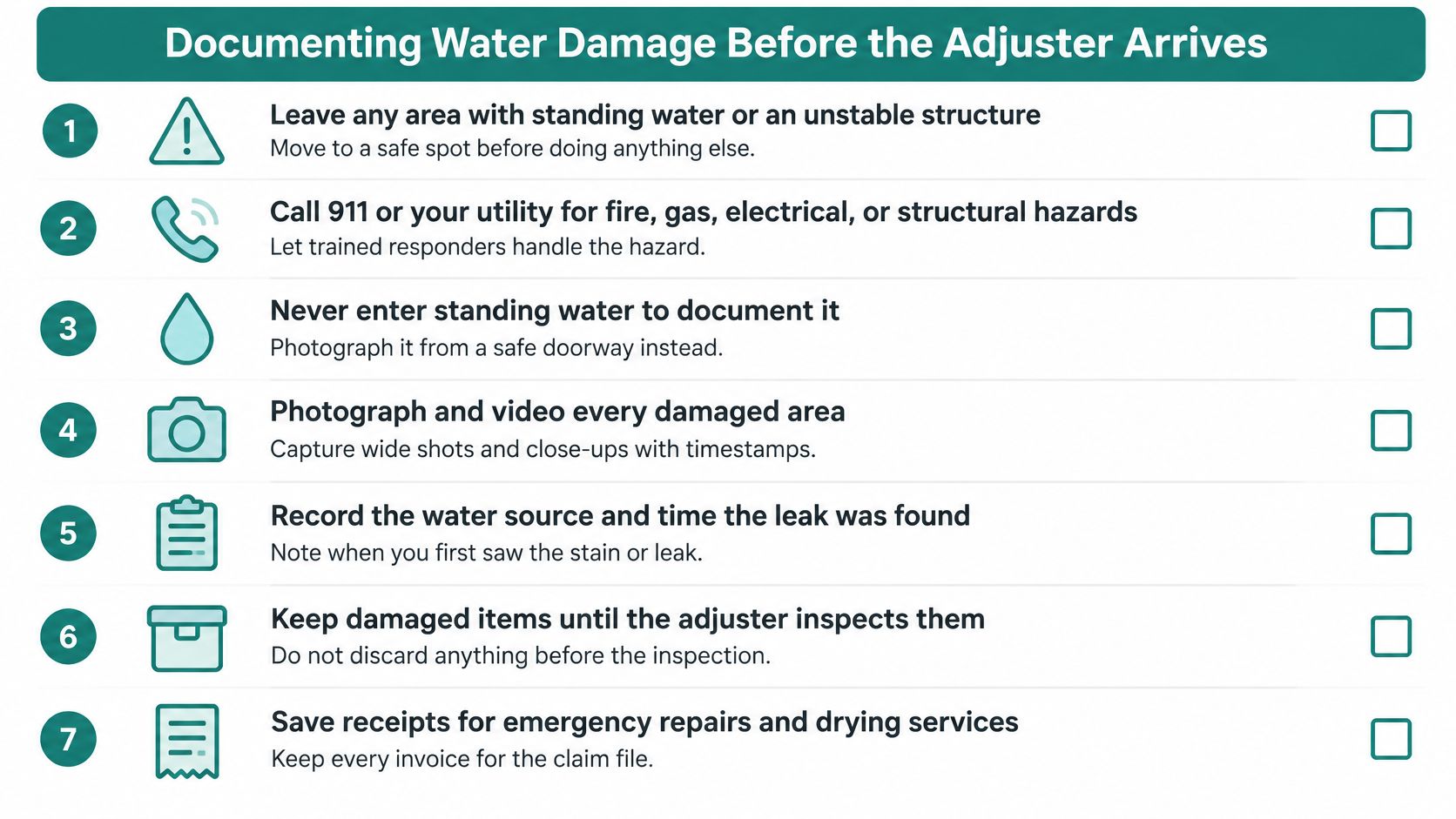
Nine Documentation Steps
- Stop the water source: Shut off the supply when it's safe and keep receipts for emergency shutoff and plumber work, because mitigation is part of the claim record. Guidance on the physical response is available in the water damage cleanup guide.
- Write the timeline: Record when the leak was discovered, which rooms were affected, and the source if known. Timing helps separate a sudden event from a longer-running leak.
- Photograph before cleanup: Capture wide and close photos and video before demolition, including water levels, damaged finishes, appliances, furniture, and contents.
- Measure moisture: Take readings in unaffected control areas and in damaged drywall, flooring, framing, and subflooring. Comparable readings show whether a dry-looking surface still covers a wet assembly.
- Dry within 24 to 48 hours: The U.S. Environmental Protection Agency recommends drying wet materials within 24 to 48 hours because prompt drying generally prevents mold growth, with water extraction, reduced humidity, air movement, and verification of concealed layers, according to EPA guidance on mold, moisture and drying wet materials.
- Retest after drying: Recheck materials with a moisture-measuring device, including carpet underlayment and subflooring. Materials remaining wet beyond 48 hours may require removal and replacement under the same moisture-control approach.
- Build a room-by-room inventory: List dimensions, material assemblies, age, condition, and the proposed repair or replacement method for each area.
- Preserve evidence: Keep representative samples where safe and practical, such as damaged flooring or carpet. Track mitigation, demolition, contents, and repair invoices in separate folders.
- Save communications: Preserve emails, letters, estimates, claim numbers, and notes of insurer instructions so dates and commitments don't rely on memory.
A photograph alone rarely proves moisture inside a wall cavity. A time-stamped moisture-control record connects emergency mitigation to the repair scope and helps distinguish direct water damage from later mold-related deterioration, subject to the policy and applicable law.
How a Public Adjuster Handles a Water Claim Step by Step
A structured claim file gives both sides the same facts to evaluate. PostDamage notes that public adjusters may help with damage documentation, claim estimates, and claim negotiations, depending on their license and applicable law.
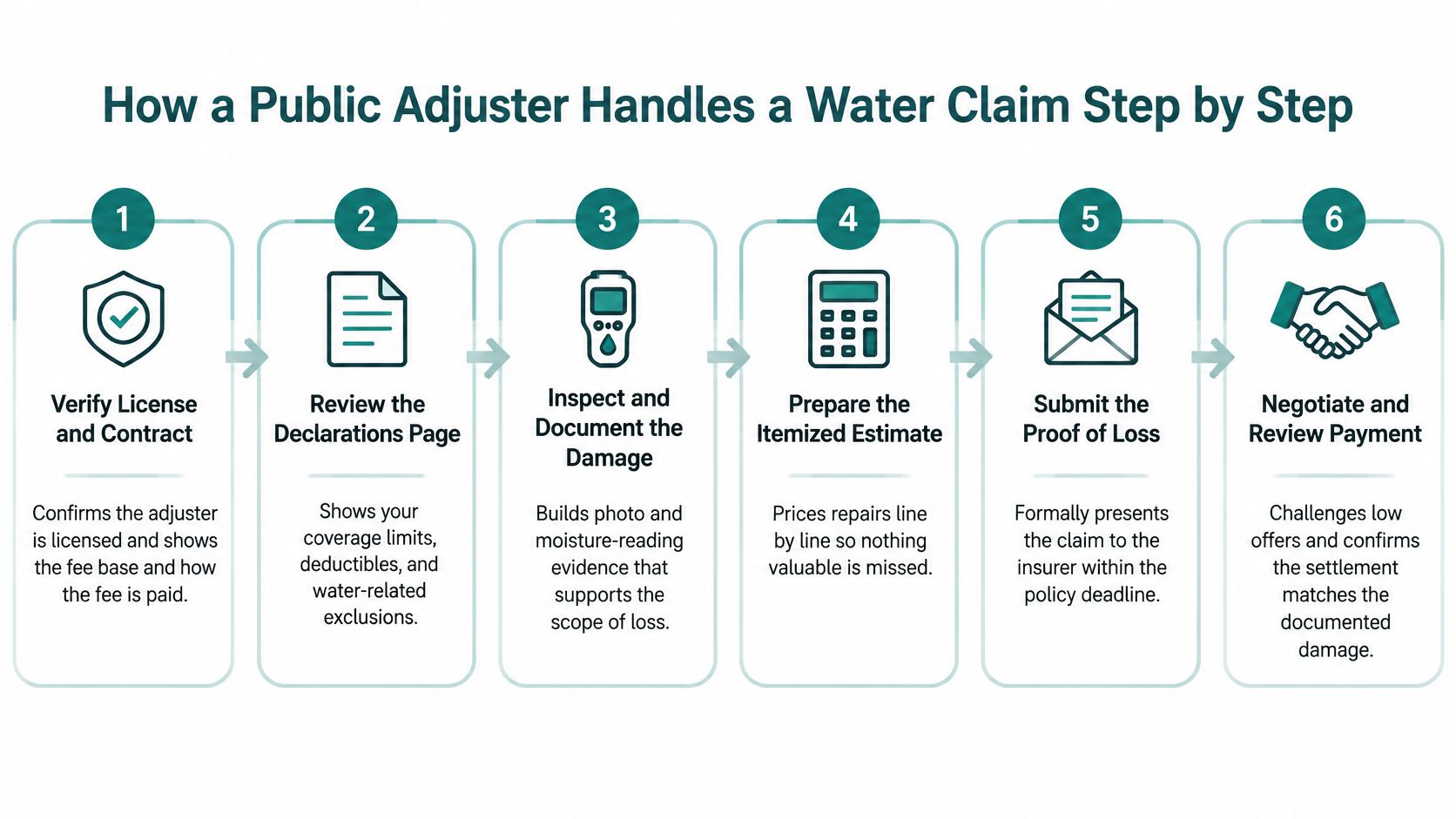
The Claim Workflow
- Verify license and contract: The homeowner confirms licensing and reviews the signed agreement, including who is authorized to communicate with the insurer. Detailed fee terms belong in the contract review covered later.
- Review the policy: The adjuster reads the declarations page and policy form to identify the cause of loss, limits, sublimits, deductible, exclusions, and endorsements. This step prevents time spent pricing damage that the policy may not cover.
- Inspect the property: Moisture readings and photographs are taken at damaged and unaffected locations. The comparison helps show spread into concealed assemblies rather than only visible staining.
- Build the scope: A room-by-room estimate covers materials, contents, mitigation, demolition, and code-related items. FEMA instructs flood claimants to photograph structural damage, water levels, appliances, furniture, and contents before moving or discarding them, and its proof-of-loss package must support both claimed items and dollar amount, according to FEMA guidance on filing a flood insurance claim.
- Compare estimates: The adjuster compares the scope line by line against the insurer's estimate. Differences may involve hidden damage, required tear-out, matching work, contents, or documented emergency services.
- Prepare proof of loss: The claim package organizes estimates, invoices, payment evidence, material receipts, inventories, and photographs. Homeowners handling early filing tasks can review how to file a water damage insurance claim for the policyholder-side sequence.
- Negotiate and identify dispute options: The adjuster presents the documented differences to the insurer. If disagreement persists, the policy may allow a defined dispute process, and legal questions may require consultation with an attorney.
- Review settlement and payment: Depreciation, holdbacks, deductible application, and joint-payee requirements are checked before the file closes. That review confirms how the check is issued and what additional documentation may release withheld amounts.
The workflow doesn't guarantee a particular outcome. Coverage remains controlled by the specific policy, exclusions, causation language, and jurisdictional requirements.
Public Adjuster Fees and What to Confirm Before Signing
Fee math should be concrete before a contract is signed. On a $20,000 payment, a 15% fee equals $3,000. The key question is whether the adjuster's documented work recovers more than that fee after the deductible and depreciation are applied.
Percentage fees are the most common structure, but the exact percentage, any cap, and the base it applies to are set by the contract and the rules of the state where the loss occurred. Two contracts quoting the same percentage can produce very different bills, depending on whether the fee is charged on the whole settlement or only on the increase over the insurer's first offer. A water damage public adjuster should explain the calculation in writing before representation begins.
| Fee structure | How it is usually calculated | What to confirm in writing |
|---|---|---|
| Percentage of settlement | A share of the amount the insurer pays, set by the contract | Whether the base is the total settlement or only the increase, and whether it is before or after the deductible |
| Flat fee | Fixed amount set in the contract | Which tasks it covers, including supplements and reopened claims |
| Hourly rate with cap | Billed for time spent, often with a maximum | Hourly rate, the cap, and how invoices are itemized |
| Emergency-period contract | Signed while special rules may be in effect | Whether your state limits percentage fees after a declared emergency and whether the contract reflects that limit |
That last row trips up homeowners after hurricanes and major storms. A contract signed in the rush right after a loss may sit under different rules than one signed months later, so ask the state insurance department which rule applies before signing.
Written Confirmation Checklist
- Fee base: Confirm whether the percentage applies to the total settlement or only the increase over the insurer's first offer.
- Deductible treatment: Confirm whether the fee is calculated before or after the deductible.
- Supplemental claims: Confirm whether supplements, depreciation recovery, and reopened claims are included.
- Joint checks: Confirm how the fee is paid when an insurer or mortgage company is also named on a check.
- Cancellation window: Confirm the deadline and method for canceling under the contract and state rules.
- Deadlines: Confirm proof-of-loss, supplement, and reopening dates in writing rather than relying on a verbal summary.
The adjuster's license should be verified through the state insurance department. The contract should also state plainly that coverage and a higher payment aren't guaranteed.
A Practical Next Step
Gather the policy, declarations, endorsements, insurer estimate, contractor bid, moisture records, photographs, and mitigation invoices. A line-by-line comparison shows whether the remaining gap justifies professional help or whether the fee would consume the benefit.
The policy section that responds shapes that math. A burst pipe paid under the main dwelling coverage produces a different settlement base than a sewer backup capped by a small endorsement limit, and the same percentage fee takes a different share of each. Settle the coverage question first, then decide whether the fee makes sense.
If the comparison shows a gap worth pursuing, homeowners, landlords, and commercial property owners can use PostDamage to request a connection with a licensed public adjuster for a claim review.