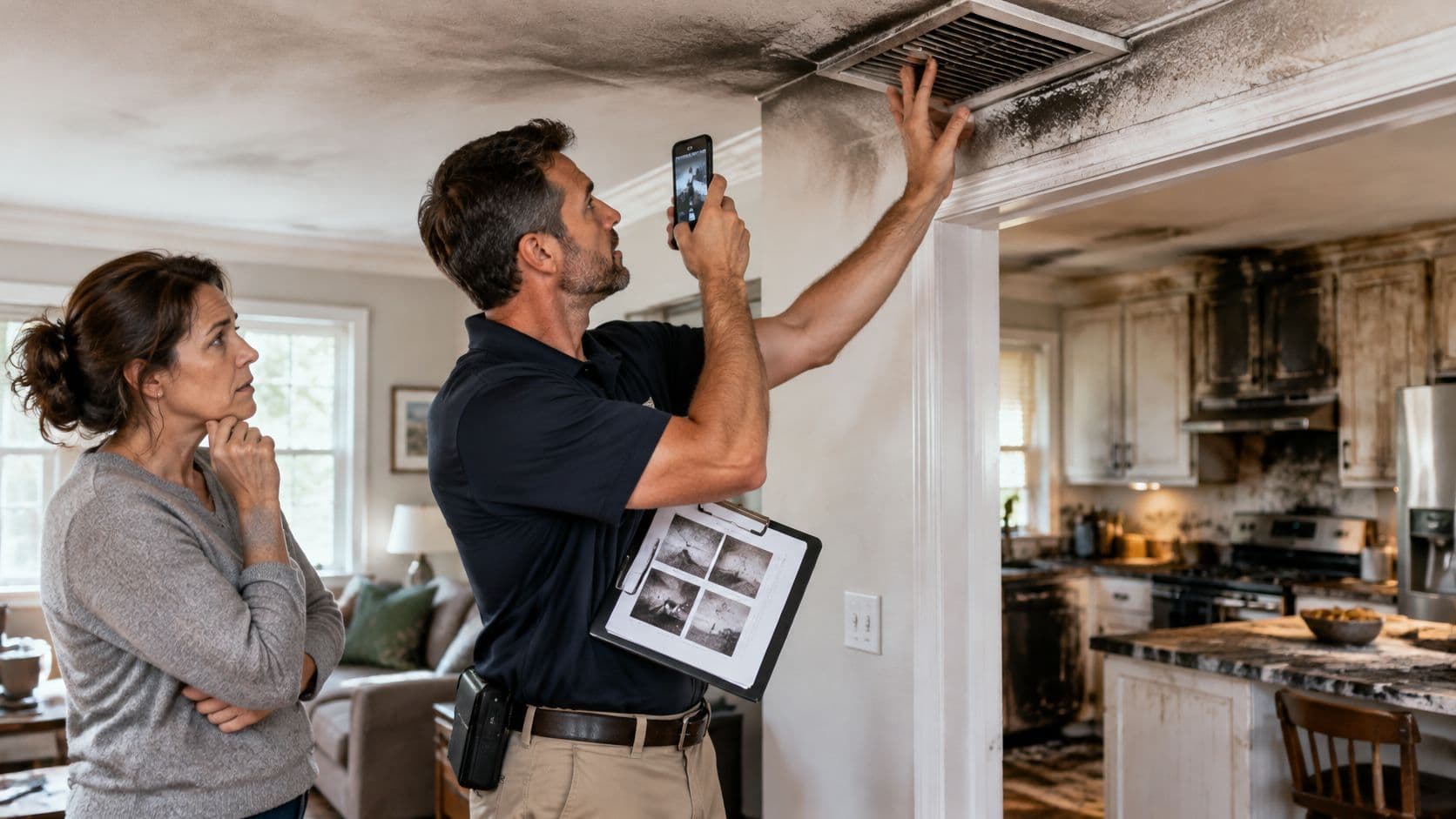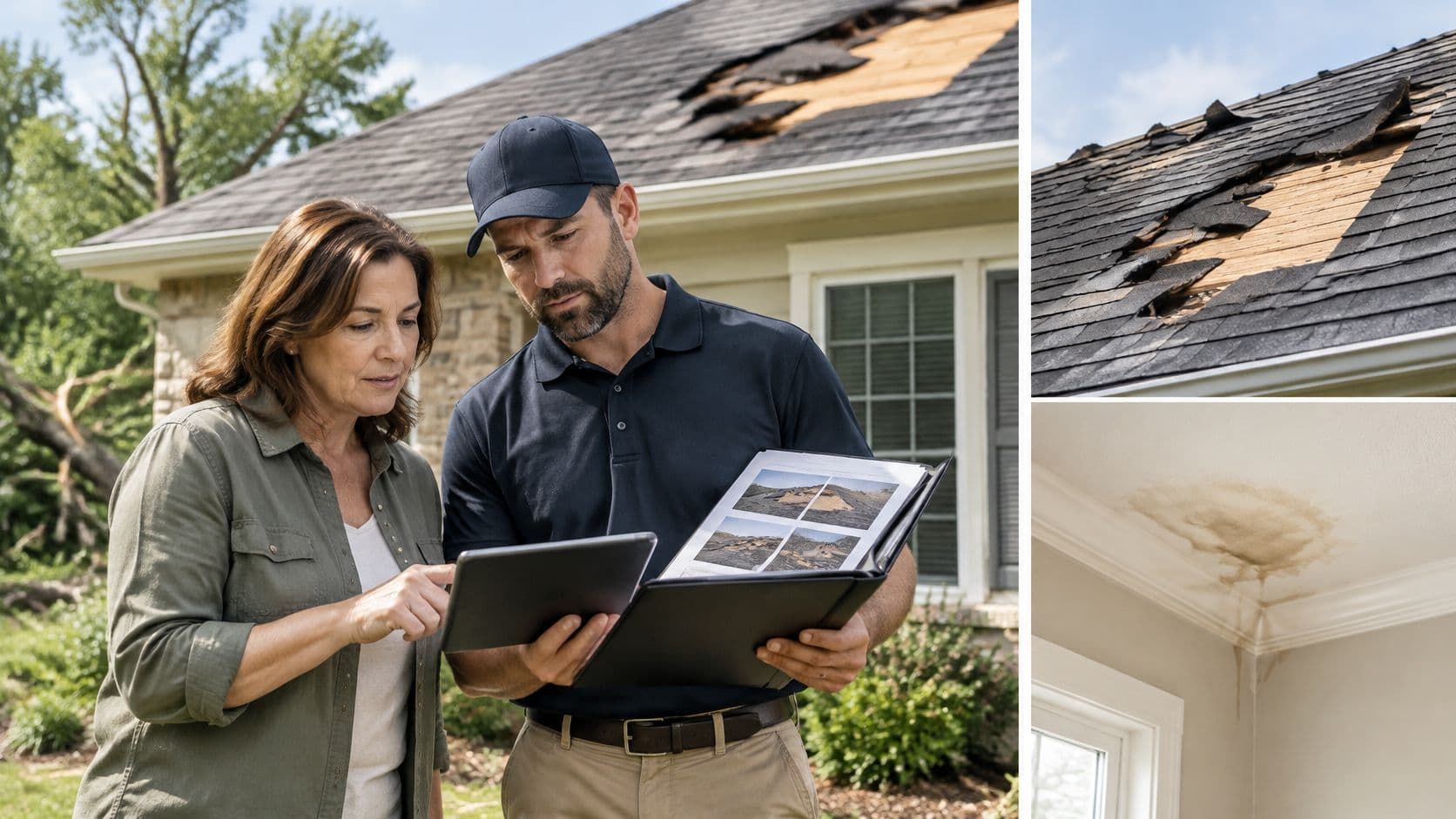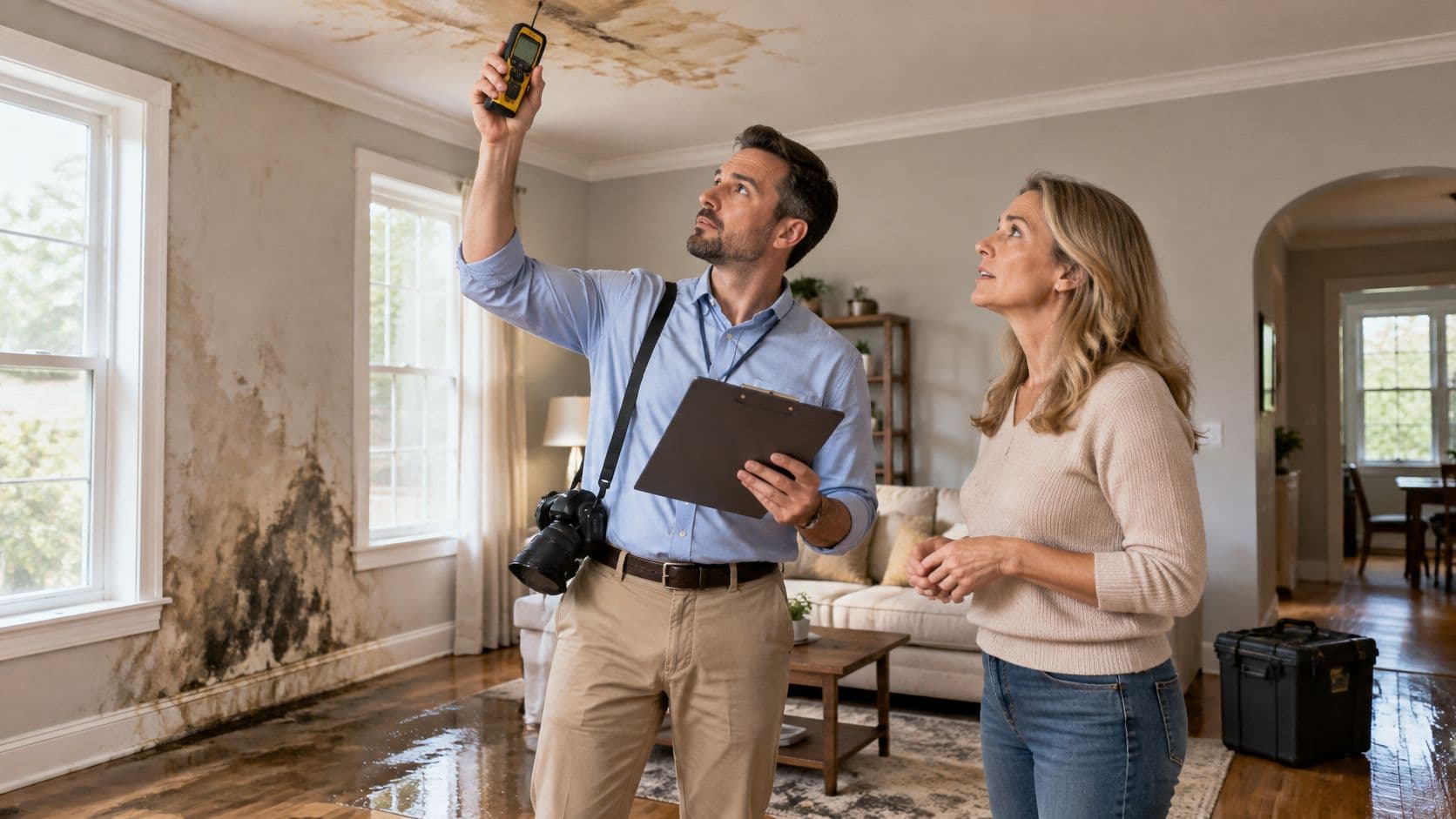
A hailstorm strips shingles from a roof, water stains a bedroom ceiling, and the insurer's first payment arrives far below the roofer's written bid. The homeowner's immediate concern isn't negotiating technique. It's whether the roof can be repaired before more water enters, and how the contractor will get paid.
Hiring a public adjuster for a roof claim can make sense when the dispute involves missing damage, contested storm causation, or an incomplete estimate. But the financial test matters just as much: what money is available now, what remains conditional, and what the adjuster's fee will leave for repairs.
Whether a Public Adjuster Is Worth It for Your Roof Claim
A roof claim becomes harder to manage when the loss extends beyond shingles. NOAA recorded 203 U.S. billion-dollar severe-storm disasters from 1980 through 2024, illustrating the recurring scale of wind and hail losses. A single storm can create several potentially covered categories, including roofing, interior water damage, contents, temporary relocation, and commercial business interruption.
The useful hiring question is whether professional claim assistance addresses a problem large enough to justify its cost.
| Situation | Consider a public adjuster? | Why it matters |
|---|---|---|
| Full roof replacement with interior water loss | Often worth a closer look | Several loss categories and a longer file |
| Claim denied or partly denied for wear and tear | Strong reason to consult | Causation must be shown with evidence |
| Insurer offer far below a written contractor bid | Consider | The valuation gap is the core dispute |
| Commercial roof with business-income losses | Consider, and check commercial licensing | Multiple coverages can apply |
| Insurer silent past policy timelines | Consider | Deadlines may be running |
| Small repair near the deductible | Usually not | Limited proceeds may not justify the fee |
| Clean approved claim matching a written bid | Usually not needed | A homeowner may manage the remaining checklist alone |
Hiring is optional, and PostDamage states that a public adjuster may not be appropriate for every claim. A large contractor bid alone doesn't prove underpayment. The difference could reflect withheld depreciation, excluded work, different quantities, or genuinely missing damage.
A practical self-test
- Size of the gap: How far apart are the insurer's offer and a detailed written bid?
- Number of loss categories: Does the file include only roofing, or also rooms, belongings, relocation, or lost income?
- Time remaining: Which reporting, repair, documentation, or dispute deadlines are approaching?
Coverage, exclusions, deductibles, causation, and deadlines remain governed by the policy and applicable law. An adjuster can help present the claim, but can't create coverage the contract doesn't provide.
Who Works for Whom on a Roof Claim
The insurer's adjuster is the company's hired inspector and claim evaluator. A public adjuster is closer to a coach on the policyholder's side of the table, organizing the evidence and presenting the claim within legally permitted boundaries.
A roofer has a different job: determine the construction work and quote its price. That distinction matters when a contractor offers to handle insurance, because explaining a repair scope isn't the same as being authorized to represent a policyholder.
| Role | Whom they represent | Main job on a roof claim | Payment and conflict to watch |
|---|---|---|---|
| Insurer's adjuster | The insurer | Inspect the roof and write the carrier estimate | Paid by the insurer; estimate reflects the carrier's position |
| Public adjuster | The policyholder | Document damage, present the claim, review and negotiate the estimate | Contract fee; check the fee base and state rules |
| Roofing contractor | Usually the homeowner, as a vendor | Quote and perform repairs | Paid for construction; may benefit from a larger scope |
| Attorney | The policyholder | Advise on legal rights and disputes | Written fee arrangement; permitted terms are governed by state rules and the matter |
The NAIC Public Adjuster Licensing Model Act framework addresses qualifications, licensing, duties, and restrictions for professionals assisting insureds with first-party claims. It's a model, not a nationwide law. The relevant state's enacted rules determine permitted activities, contract requirements, fee limits, and cancellation rights.
Check authority before assigning responsibility
PostDamage distinguishes public adjusters, who represent policyholders within applicable state law, from insurance company adjusters, who work for insurers. Neither title should be inferred from someone's willingness to attend an inspection.
Before signing, the homeowner should verify the state license and identify who will prepare estimates, communicate with the insurer, approve settlement decisions, and arrange construction. A referral between professionals doesn't erase their separate responsibilities or potential financial conflicts.
Why the First Roof Payment Falls Short of the Bill
Consider an older roof with a replacement estimate that appears adequate on paper. The insurer approves replacement, but the homeowner receives only the initial payment and still has to arrange the work.
| Payment component | Treatment | Practical meaning |
|---|---|---|
| Replacement amount | Starting valuation | The approved cost before deductions |
| Depreciation | Withheld or deducted | Potentially recoverable only if the policy allows |
| Deductible | Policyholder's responsibility | Not an amount the insurer ordinarily releases later |
| Initial payment | Amount currently payable | May be insufficient to start or finish construction |
| Recoverable depreciation | Conditional later payment | Requires compliance with repair and documentation conditions |
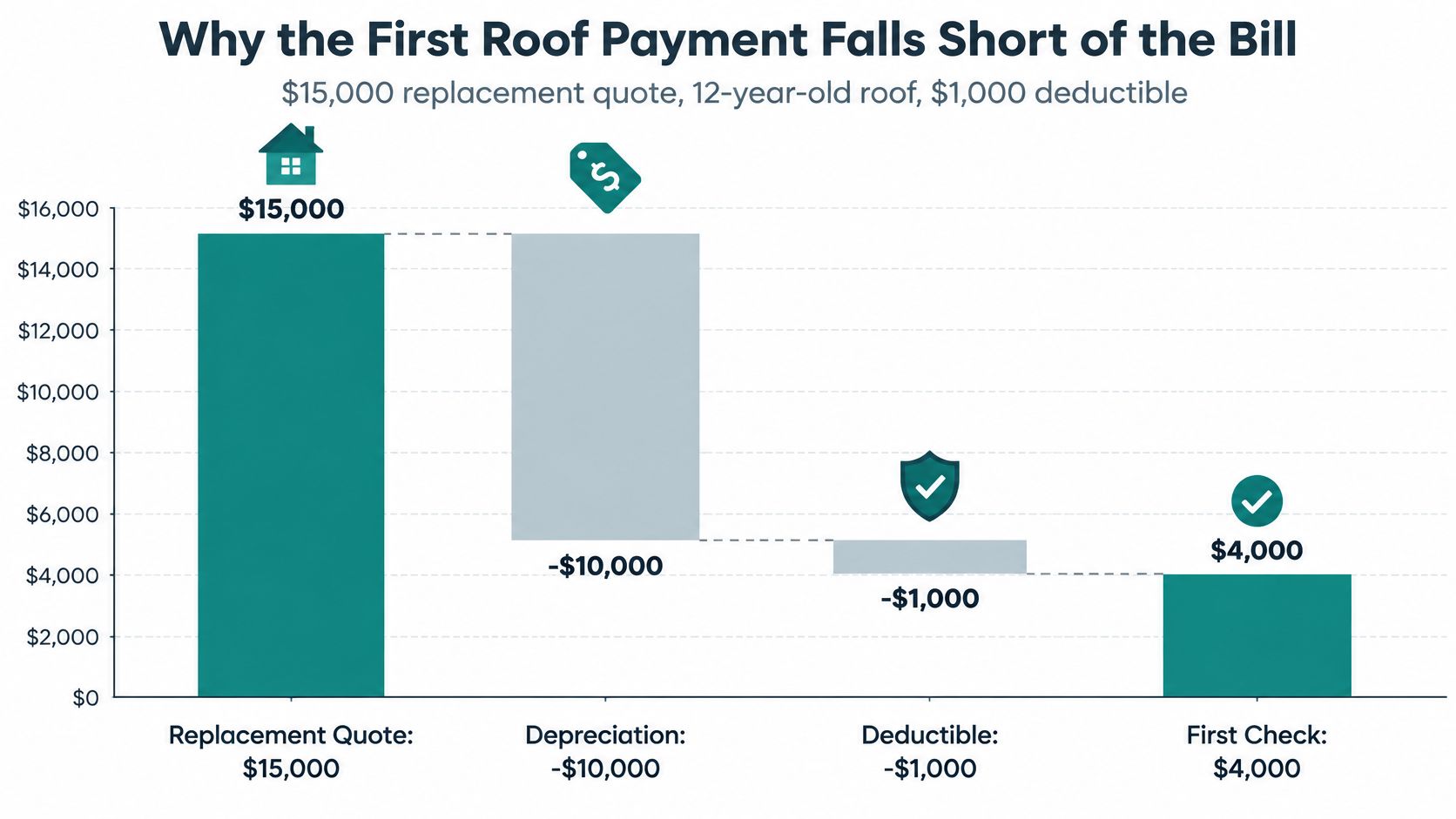
Actual cash value, or ACV, generally means replacement cost minus depreciation. Replacement cost value, or RCV, generally doesn't deduct depreciation in determining replacement value, although the insurer may initially issue an ACV payment and hold back the recoverable portion.
That distinction separates the value of the approved claim from the cash currently available. A roof-specific ACV endorsement or payment schedule can also mean that a deduction isn't recoverable at all.
Plan for the conditional payment
Before committing to a contractor's payment schedule, the homeowner needs written answers to practical questions:
- Upfront funding: Can available insurance proceeds and household funds satisfy the construction contract without assuming an immediate second check?
- Release documents: Does the insurer require a final invoice, proof of payment, completion photographs, or other evidence?
- Deadline: What must be completed or submitted, and by which date?
- Extensions: If construction is delayed, will the insurer confirm any extension in writing?
The declarations page may not reveal the operative roof endorsement. The complete policy also needs to be checked for a percentage wind or hail deductible rather than an assumed flat-dollar deductible.
Cash-flow rule: Approved replacement value isn't the same as money available to pay the contractor today.
If the recovery deadline expires without compliance or an applicable extension, withheld money may become unavailable. A larger estimate won't solve that problem by itself.
How Public Adjuster Fees Are Structured
Public adjuster fees are controlled by the contract and applicable state law. No standard rate applies nationwide, and a fee arrangement must be legally permitted before its financial merits matter.
| Fee structure | How it is billed | Where it fits | What to confirm |
|---|---|---|---|
| Percentage of settlement | A share of the amount recovered | Larger, complex roof claims | Which amount the percentage applies to and any state cap |
| Flat fee | Fixed amount for defined work | Smaller or clearly scoped assignments | Whether supplements, appraisal, or disputes are included |
| Hourly rate | Charges for time worked | Claims with uncertain scope | Estimated hours and a written spending cap |
| Hybrid | Base fee plus percentage or hourly charges | Mixed or evolving assignments | Whether the base fee is credited against other charges |
The contract's fee base can matter as much as its percentage. A fee charged against all proceeds has a different effect from one charged only against additional recovery.
Check the contract in a deliberate order
Identify the money subject to the fee. The agreement should address payments already issued, future supplements, withheld depreciation, and proceeds for related interior or contents losses. Ambiguous language about the settlement needs clarification before signature.
Check legal limits and excluded work. Confirm any applicable state cap and whether appraisal, specialized inspections, expert reports, or litigation require separate charges or another professional.
Match fee timing to insurance timing. Determine whether anything becomes payable before the insurer pays, whether expenses are additional, and how cancellation affects earned fees.
For scale, Verisk figures reported by Roofing Contractor put average U.S. residential roof replacement cost at $17,631 in 2025, and average repair cost at $4,699; each 1% of a settlement equal to that replacement average is $176.31, by arithmetic. Those figures aren't a quote for a particular property or a recommended adjusting fee.
The practical comparison is repair funding after fees, not just the headline settlement. A percentage applied to a small initial payment can produce a very different bill from the same percentage applied to the full recovery.
A written illustration using the actual claim components is more useful than a verbal assurance that the adjuster will pay for the service through better results. No additional recovery is guaranteed, and the contract should remain understandable even if the insurer doesn't increase its offer.
How to Document Roof Damage Before Anyone Inspects It
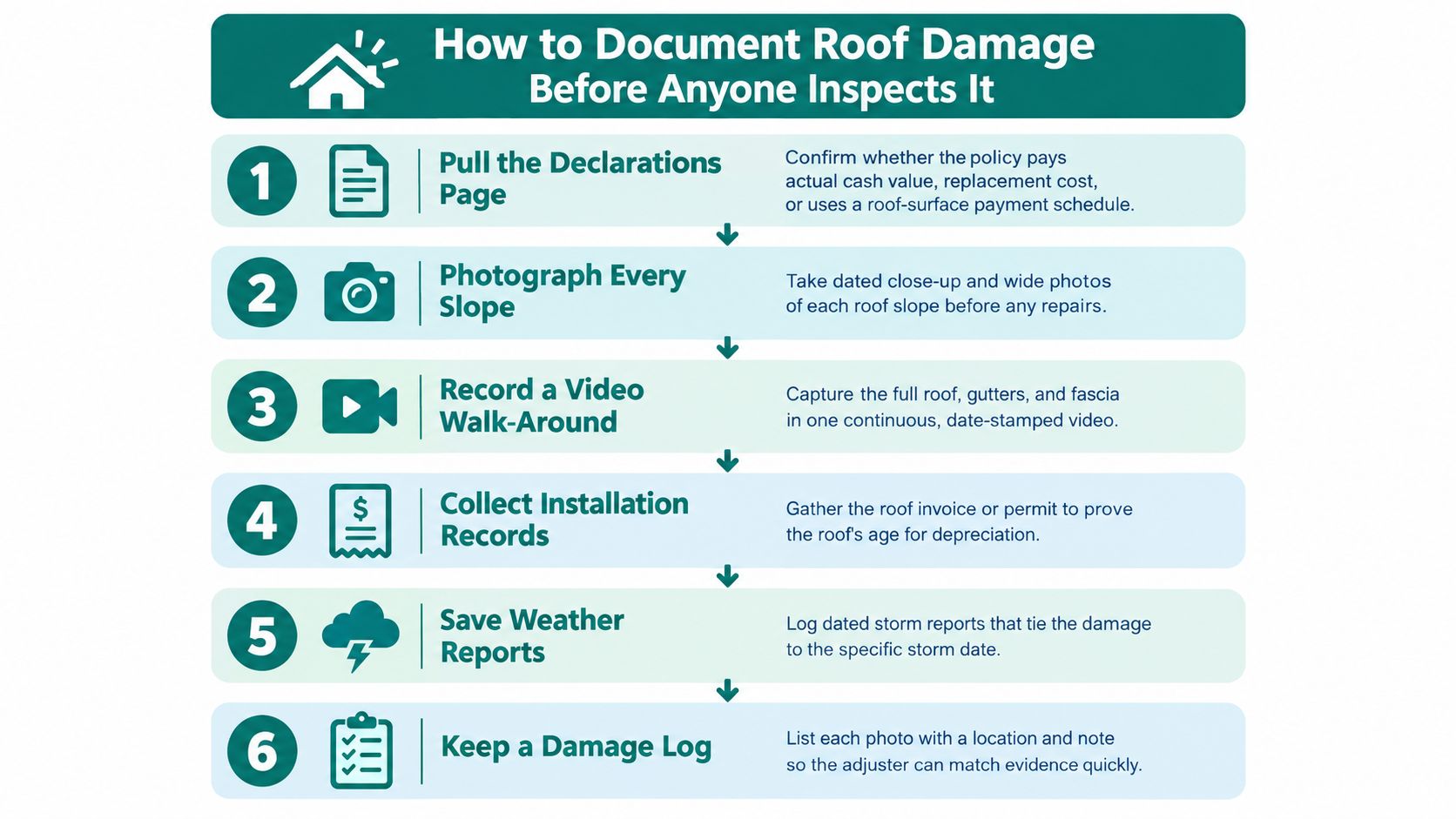
Strong documentation preserves what changed without requiring the homeowner to diagnose roof damage. Photographs should be taken from safe ground-level positions or other safe access points; a damaged roof isn't a suitable place for an untrained inspection.
The IBHS roof codes and standards guidance explains why roof assemblies and location-specific wind requirements matter. A useful claim file therefore captures the entire loss, not merely a close-up of a damaged shingle.
Build a file that another person can follow
Collect the complete policy. Save the declarations page and roof endorsements, marking ACV, replacement-cost, roof-surface-schedule, and cosmetic-damage provisions. The common omission is relying on the coverage summary without the modifying endorsements.
Record the roof's baseline condition. Note material, slopes, approximate age, and known prior problems. Older photographs, installation invoices, permits, inspection reports, and maintenance records help prevent a post-storm photograph from being treated as the whole history.
Photograph broadly before photographing details. Capture each visible slope, then identifiable damage with a scale reference and location note where safe. Tight close-ups without an orientation photograph are difficult to match to the building.
Save dated weather information. Preserve records for the reported storm and relevant surrounding days. A general description of bad weather is less useful than a record tied to the property's location and loss date.
Document interior damage and mitigation. Photograph ceiling stains, affected rooms, belongings, tarps, and emergency work, retaining receipts. The frequent gap is showing the roof while overlooking the water's path indoors.
Collect written inspection findings and estimates. Ask for measured quantities, identified conditions, repair recommendations, and supporting photographs. Keep invoices and original files rather than only screenshots of totals.
Maintain a communication log. Record claim reporting, inspections, calls, emails, submissions, and promised follow-ups. A brief written confirmation after a telephone conversation reduces disagreement about what was requested.
Keep related losses connected
Interior photographs should identify the room and its position beneath the roof. Emergency work should have before-and-after images when safely available, so necessary mitigation doesn't remove the only record of the original condition.
For landlords, HOAs, and commercial owners managing multiple roofs, the same naming system and inspection standard should apply to every building. Separate folders by property, roof area, and inspection date prevent inconsistent records from multiplying disputes.
Separating Storm Damage From Wear and Code Upgrades
A storm date and damaged neighboring homes don't establish that every condition on a particular roof came from that storm. The useful question is what physical evidence connects a specific condition to a sudden event rather than deterioration, installation defects, or an earlier unresolved problem.
The distinction remains important during widespread events. Climate Central reported 21 severe-storm events among 23 U.S. billion-dollar weather and climate disasters in 2025. Event scale establishes context, not coverage for an individual roof.
| Evidence | Supports sudden storm damage | Points toward wear or excluded cause |
|---|---|---|
| Pre-storm photos | Intact shingles before the event | Existing cracks, granule loss, or prior patches |
| Damage pattern | Concentration on exposed slopes with fresh impact marks | Uniform condition across slopes consistent with age |
| Timing of leaks | Leaks and staining begin after a dated storm | Older stain rings or leaks predating the storm |
| Repair history | No documented earlier problem at the affected location | Repeated patching or an unresolved earlier claim |
| Code requirements | Documented repair trigger and applicable ordinance-or-law coverage | No documented requirement or no applicable coverage |
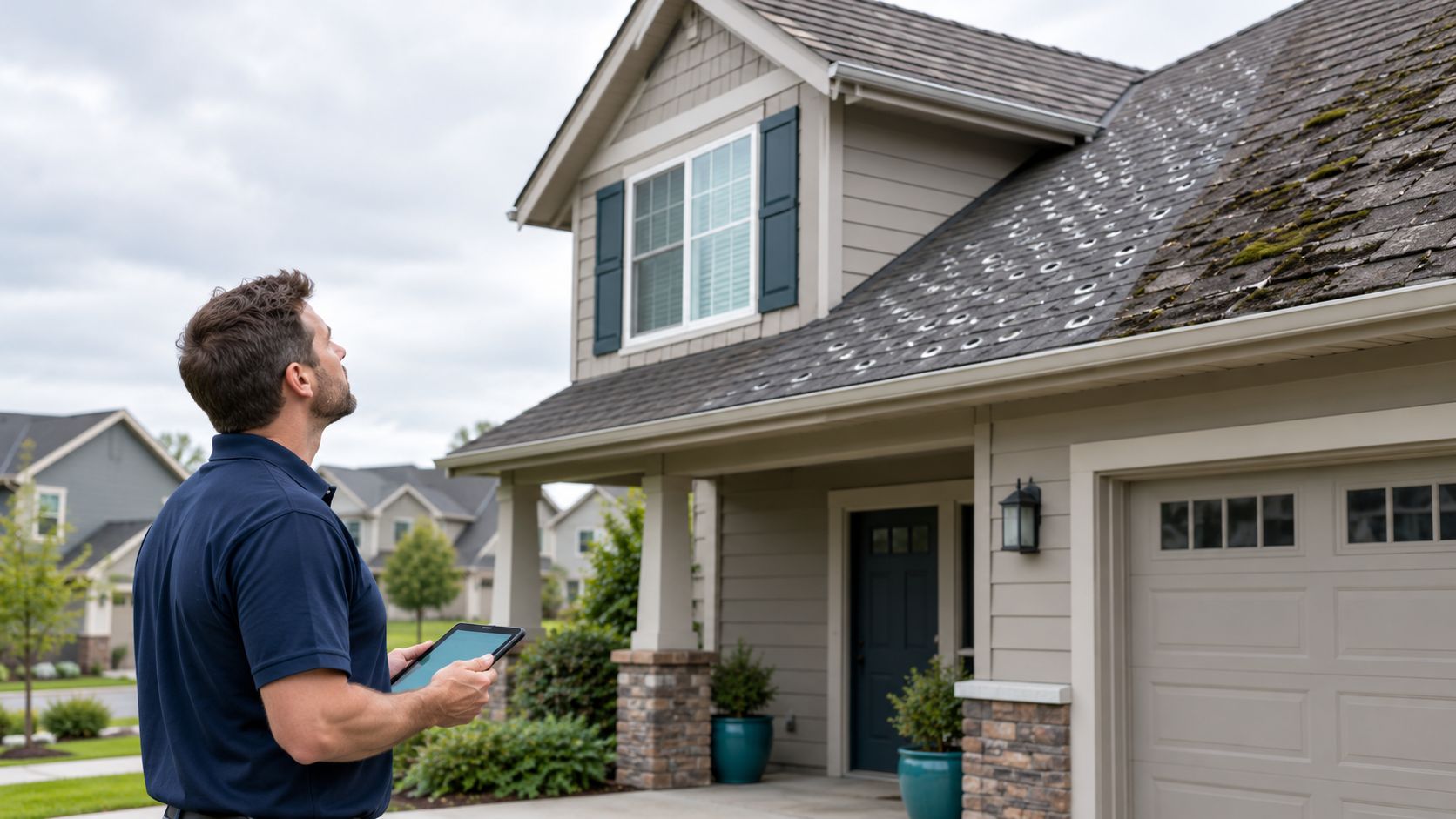
These are investigative clues, not automatic conclusions. Hail exposure can differ across slopes, and marks on gutters or other soft metals can support the investigation without proving functional damage to shingles. Likewise, prior repairs don't automatically defeat coverage for new damage.
A persuasive causation explanation identifies the condition, its location, the likely mechanism, and the evidence supporting that conclusion.
Separate required construction from covered construction
Edge securement, underlayment, flashing, and similar items need a documented reason for inclusion. Code-upgrade payment requires applicable ordinance-or-law coverage and a triggered requirement, not merely a contractor's preference for a better assembly.
General storm damage repair guidance can help organize immediate concerns, but the claim still needs property-specific proof. Storm-versus-wear disputes should be answered through photographs, inspection findings, and repair history rather than competing opinions alone.
Working Through the Insurer's Estimate and Disputes
A disputed roof estimate should be separated into causation, physical scope, and valuation. An argument about whether wind damaged a slope needs different evidence from an argument about missing flashing or an inadequate labor allowance.
The Insurance Information Institute's homeowners insurance handbook explains policy and settlement distinctions that make the complete contract, depreciation treatment, and repair documentation important. Roof age can affect settlement treatment, but age alone doesn't answer whether storm damage is covered.
Put each disagreement into writing
Confirm claim ownership. Record the claim number, assigned adjuster, preferred submission method, and current outstanding requests. Written confirmation helps prevent documents from reaching the wrong person.
Obtain the itemized carrier estimate. Request measured quantities, labor, waste, accessories, deductions, and code-related entries. A payment letter alone doesn't show the construction assumptions.
Compare matching line items. Mark differences as scope, price, or omission. For a coverage exclusion, request the insurer's written explanation and the policy language relied upon.
Submit a supported supplement. Pair each requested change with photographs, measurements, an inspection finding, or an invoice. A higher contractor total without item-level support rarely identifies the actual disagreement.
Request a clear payment breakdown. Reconcile the insurer's stated valuation with issued payments, deductions, and conditional amounts. Flag discrepancies rather than assuming every unpaid dollar is a disputed repair item.
Calendar the remaining conditions. Track required completion evidence and submission deadlines, saving proof of delivery. A supplement request shouldn't be assumed to suspend another obligation.
Escalate the specific unresolved issue. Request supervisory review or reinspection where appropriate, and examine any appraisal provision before invoking it. Appraisal isn't a universal solution to coverage disputes.
Negotiation discipline: Each requested dollar should connect to an identified repair item or documented loss, not merely a preferred settlement total.
A licensed public adjuster may run this process within state-law limits. The homeowner's file remains useful whether representation is hired or the claim is handled directly.
An initial position may be reviewable through policy procedures, but no reversal is guaranteed. For a stalled or disputed claim, insurance claim help is an option to explore without assuming every disagreement requires representation.
Vet an Adjuster and Confirm Your Next Step
The strongest reason to hire isn't an aggressive sales pitch. It's a clear explanation of the disputed issues, the evidence needed, the work included, and the financial effect of the contract.
A careful hiring decision should survive the following checks.
- Verify an active license. Confirm the public adjuster's status with the relevant state insurance department rather than relying on a business card.
- Read the fee terms. Identify the fee base, applicable state restrictions, additional expenses, and excluded services.
- Confirm cancellation rights. Locate the cancellation period, required delivery method, and address for written notice.
- Define the engagement. Establish whether representation includes the roof alone or also interior, contents, ordinance-and-law, and commercial business-income losses.
- Ask about conflicts. Request disclosure of contractor referrals, financial relationships, and any arrangement that could affect recommendations.
- Identify the actual file handler. Obtain a written opening work plan, inspection arrangements, communication expectations, and responsibility for submissions.
- Check references and regulatory history. Request relevant references and available complaint or disciplinary information from the regulator.
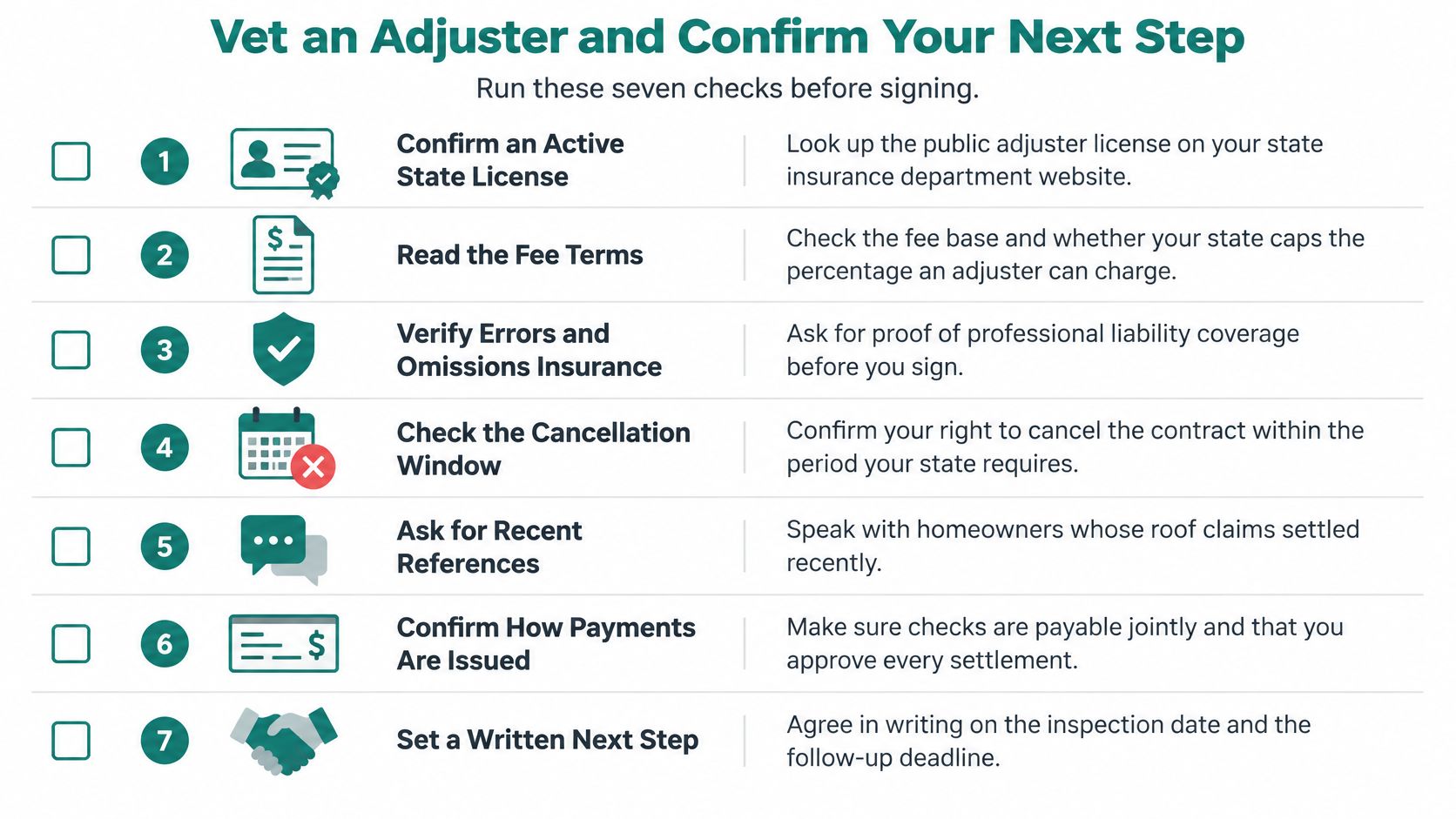
Payment handling also deserves a written explanation. The contract should identify how checks, authorizations, and fees will be handled without assuming a particular joint-payee arrangement applies to every claim.
Choose the right kind of review
A dispute centered on legal rights, litigation, or interpretation beyond an adjuster's permitted role may warrant an attorney. PostDamage's roof damage lawyer resources distinguish that route from adjusting assistance.
For a claim review, the practical next step is to prepare a short summary: the difference between the offer and written bid, the nearest deadlines, and the main unresolved issue. The roof insurance claim help request is free, takes about one minute, and carries no obligation to hire.
PostDamage is an independent information and referral platform, not an insurer, adjusting firm, law firm, or contractor. Its content is general information, not legal, insurance, or claims advice; professional availability, eligibility, services, and fees vary by location and provider, and neither a referral nor a particular outcome is guaranteed.
Need help with a homeowners insurance claim? PostDamage can help connect property owners with a licensed professional where available. For a denied, delayed, or potentially underpaid roof claim, visit PostDamage to request a review with the insurer's estimate, contractor bid, and known deadlines ready.