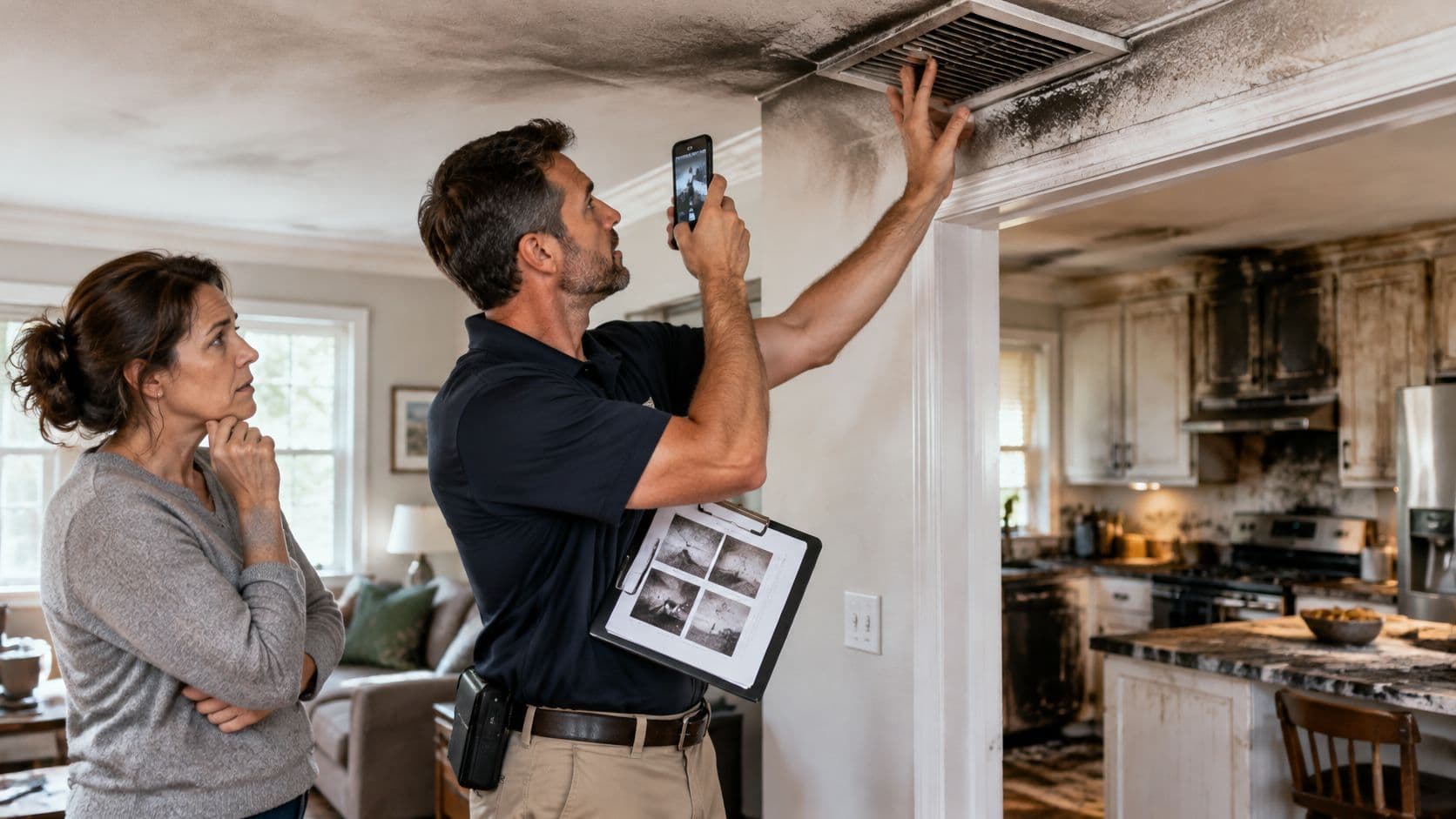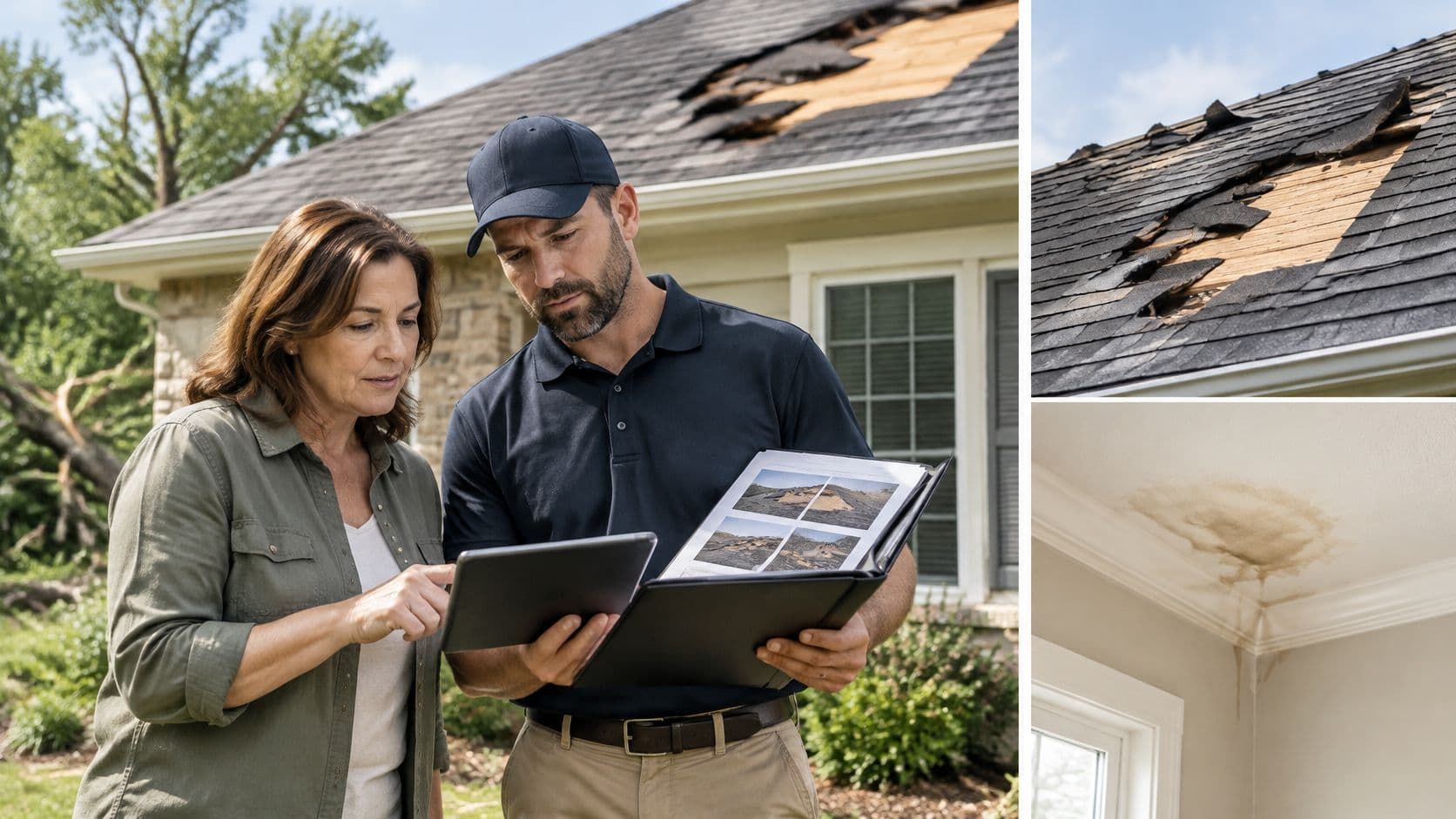
The storm has passed, a tarp covers part of the roof, and water has stained a bedroom ceiling. A contractor has left an estimate, the insurer has assigned an adjuster, and someone else is offering to handle everything for a percentage. Before anyone signs anything, two questions matter most. Which individual losses belong in the claim, and what rights would a signature transfer?
Who a Public Adjuster Works For
After a storm, the insurer may assign an adjuster to inspect the reported damage. A property owner may also consider hiring a public adjuster. The titles sound similar, but the two professionals represent different parties.
A public adjuster represents the policyholder in an insurance claim, within the scope allowed by state law. The insurer's adjuster works on behalf of the insurance company. A useful comparison is two people reviewing the same loss from different sides of a transaction: one represents the property owner, and the other represents the insurer.
| Factor | Public Adjuster | Insurer Adjuster |
|---|---|---|
| Who they represent | The policyholder | The insurance company |
| Who pays them | A fee set by the signed contract and state rules | The insurer, as its employee or contractor |
| Licensing | Licensed under state law; rules vary by state | Licensed or employed under the insurer's process |
| When they usually appear | After a claim is filed, often when the owner wants help | Assigned soon after the loss is reported |
| Main goal | Document and present the policyholder's loss | Evaluate the claim for the insurer |
| Who speaks to the insurer | The public adjuster, under a signed agreement | The insurer's adjuster speaks to the owner directly |
Hiring a public adjuster is optional, and it may not suit every claim. Before signing an agreement, understand its fee and what authority it gives the adjuster to act on your behalf.
What a Public Adjuster Does on a Storm Claim
A public adjuster works largely as a translator. The insurer speaks in policy language and estimate line codes. The homeowner speaks in leaks, lifted shingles, and wet ceilings. The public adjuster's job is turning one into the other without losing detail.

Work usually begins with a joint inspection. The adjuster walks the property with the owner, notes visible and hidden damage, and checks areas owners often skip, such as flashing, window openings, and interior moisture paths.
From Inspection to Estimate
Next comes the estimate, reviewed or written line by line. Each damaged item gets a scope entry, a quantity, and a price, so disagreements narrow to specific lines instead of one lump sum. Missing items, such as code required work or damaged contents, become visible at this stage.
The adjuster then organizes photos, receipts, invoices, and inventory records into a proof of loss package. A strong file links every line item to evidence rather than presenting a folder of unnamed pictures.
Presentation, Negotiation, and Supplements
After the contract is signed, the public adjuster notifies the insurer of representation, and claim communications route through that adjuster. The scope gets presented, disputed items get negotiated, and the owner receives updates without managing every call.
When repairs expose hidden damage, the adjuster prepares a supplemental claim for the additional scope. Rotten decking under torn shingles is a common example, since nobody sees it until tear off begins.
A public adjuster cannot change policy terms, decide coverage, or guarantee a higher settlement. The policy and the insurer still control outcomes.
Duties also vary with license and state law. Some owners hire a public adjuster only for estimate review and handle the remaining steps directly, which suits smaller or partly disputed claims.
Storm Losses That Go Beyond the Roof
A storm can damage more than shingles. Wind, hail, fallen trees, and water intrusion may affect several parts of a property, and each loss may require different supporting records. The National Association of Insurance Commissioners disaster claim guide recommends asking about separate storm deductibles, keeping receipts, preparing a property inventory, and confirming claim deadlines.
| Loss Category | Typical Examples | Evidence to Keep |
|---|---|---|
| Dwelling and roof | Shingles, flashing, siding, gutters | Dated photos, roofer report, pre-loss images |
| Detached structures | Sheds, garages, fences | Photos, build or purchase records |
| Interior water damage | Ceilings, drywall, flooring after a roof breach | Photos before tear-out, moisture readings |
| Personal property | Furniture, electronics, clothing | Itemized inventory, receipts, photos |
| Temporary housing | Lodging and meals while the home is unlivable | Receipts, plus records showing why the home could not be lived in |
| Spoiled food | Refrigerated and frozen goods after power loss | Itemized list, photos of the appliance |
| Debris removal | Fallen trees and limbs | Invoices, photos taken before cleanup |
| Code upgrades | Updates required during rebuilding | Local code references, contractor estimate |
| Business interruption | Lost income for commercial properties | Revenue records, payroll, expense logs |
| Separate deductibles | Wind, hail or hurricane deductible | Declarations page showing each deductible |
The source of the damage matters when sorting losses into claim categories. Rain entering through a wind-created opening is different from rising floodwater, long-term wear, or delayed maintenance. Dwelling damage and personal property are also distinct categories, so a payment for one does not necessarily account for the other.
For commercial properties, business interruption concerns lost income, not just physical repairs. Revenue, payroll, and expense records can help show the business impact. PostDamage's storm damage repair guidance covers wind, hail, fallen trees, and roof damage.
For each claimed loss, identify what was damaged, when it happened, and which record connects it to the storm.
How to Document Storm Damage Before Repairs Begin
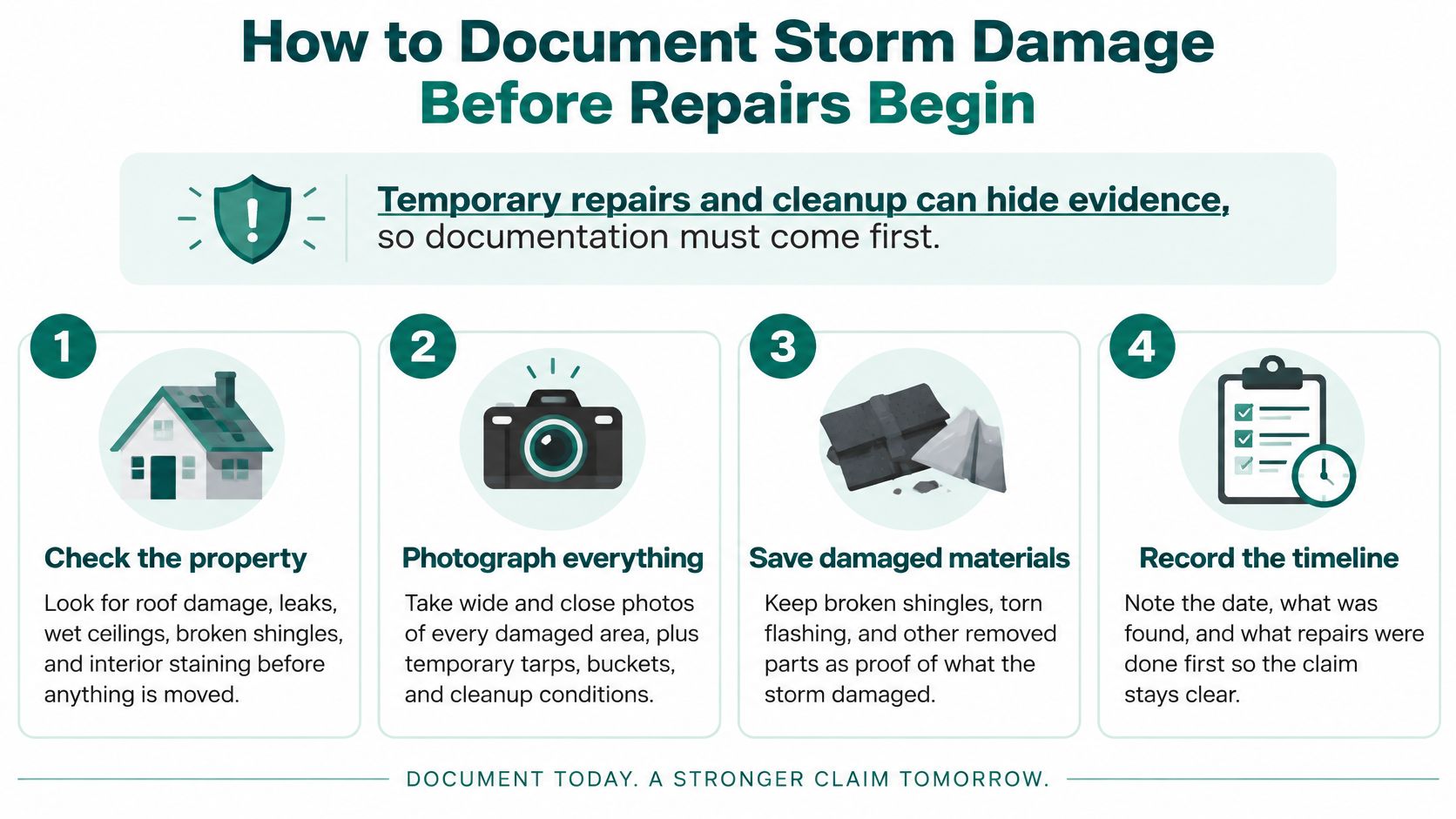
Temporary repairs and cleanup can hide evidence, so documentation must come first. Once wet drywall goes into a dumpster, nobody can photograph it again.
Safety and the First Record
- Check safety first: Anyone facing gas, electrical, or structural hazards should leave the area and call 911 or the utility. Nobody should enter standing water or an unstable structure to take pictures.
- Photograph wide, then close: Exterior and interior video with date stamps comes first, starting with wide shots that show each room or elevation. Close ups follow, capturing serial numbers, lifted shingles, and water lines.
- Record the basics: The exact loss address, reported date and time, and storm type belong at the top of the file. Those details anchor every later document.
Weather Evidence and Paper Trail
- Gather independent weather data: The NOAA climate data overview for insurance use explains that NOAA's Storm Events Database records storm type, timing, location, magnitude, estimated damage costs, and photographs, and that insurers use these datasets to validate claims. NOAA precipitation estimates can also help analyze whether rainfall intensity plausibly contributed to interior water entry after roof or envelope failure. Weather confirmation doesn't establish coverage on its own, but it creates a reproducible evidence trail.
- Keep emergency repair invoices: Dated bills for tarping, board up, and water mitigation show the owner acted to prevent further damage. Photos taken before tarping preserve what the tarp now covers.
- Build a contents inventory: Each damaged item needs a description, age, purchase price, and receipt where available. Bank statements or old photos can support items without receipts.
Reporting and Preserving Materials
- Report promptly and log calls: The claim number should be obtained in writing, and every call logged with date, name, and summary. Deadlines confirmed in writing prevent later disputes about timing.
- Keep damaged materials: Torn shingles, broken flashing, and ruined flooring sections should stay on site until the insurer inspects, where safe and practical. Discarded materials often become disputed materials.
A complete file ties every photo to a line item and a date. That structure helps whether the owner handles the claim alone or hires a public adjuster for storm damage later.
When a Public Adjuster Is Worth Considering
Two contrasting cases clarify the decision better than any rule of thumb.
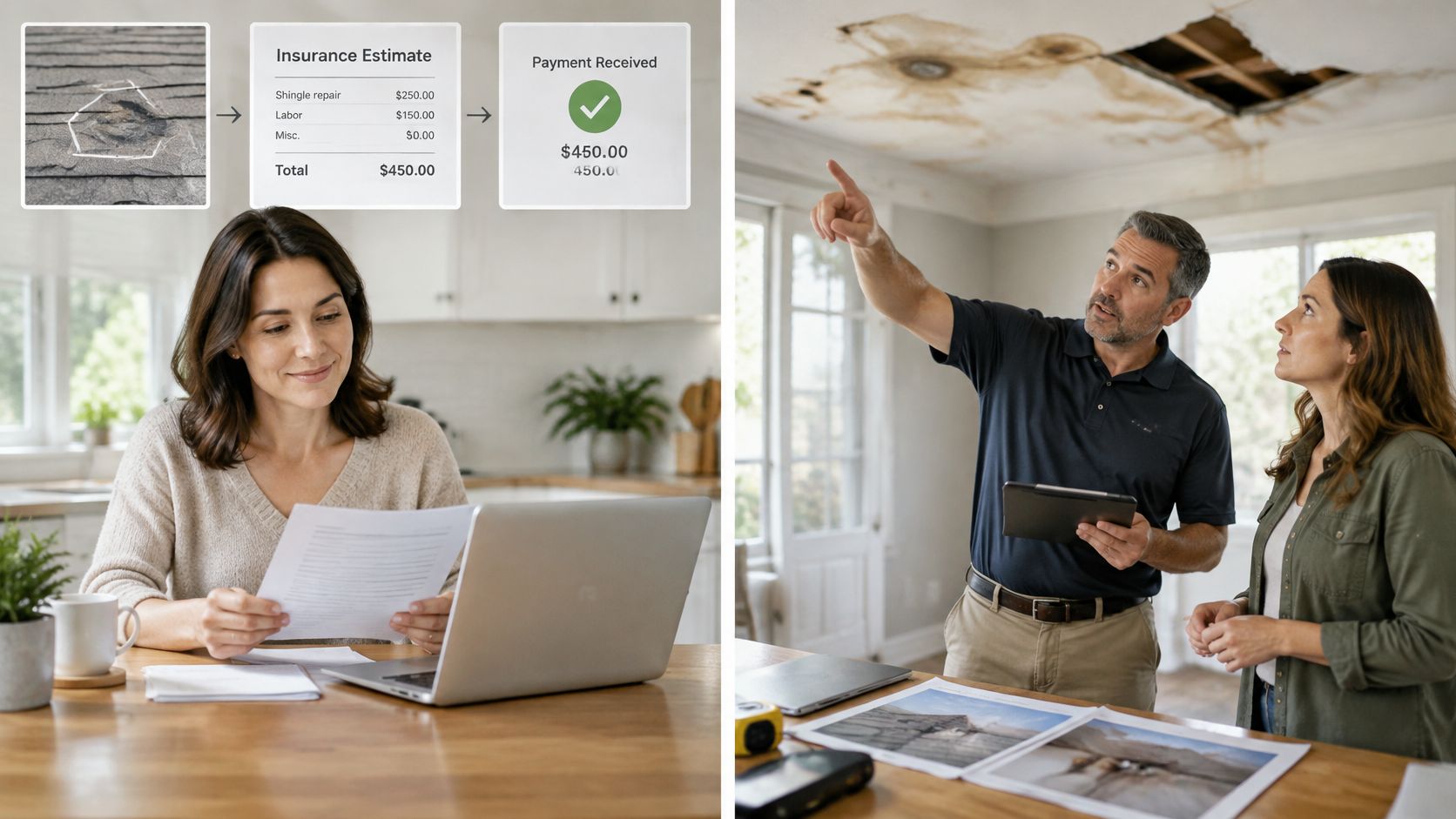
Say a homeowner loses a few shingles in one wind event. The roofer's repair price is clear, the insurer's estimate matches it closely, and payment arrives promptly. That owner can usually handle the claim directly, perhaps with a careful read of the estimate before accepting.
Now consider a different house after the same storm. Roof damage let water into ceilings and walls, furniture is ruined, and the insurer's estimate omits code upgrades. The insurer also argues the interior damage came from flood rather than wind. Professional review may pay off there, because several loss categories and a causation dispute stack together.
Criteria That Tilt the Decision
- Number of loss categories: Dwelling, contents, housing, and code items together multiply paperwork and error risk.
- Claim size versus deductible: A loss barely above the deductible leaves little room for any fee.
- Disputed causation: Wind versus flood or wear arguments need stronger technical documentation.
- Multiple buildings: Rental portfolios, HOA property, and multifamily buildings stretch one owner's capacity quickly.
- Business interruption: Lost income claims require financial records most owners rarely assemble.
- Unusual endorsements: Special policy additions change what qualifies and how it's valued.
- Time and paperwork capacity: Owners juggling displacement, work, and repairs may value delegation itself.
Commercial owners should weigh lost income and multi unit exposure more heavily than a single family homeowner would. Owners comparing options can review insurance claim help before deciding how much support a particular claim needs.
A second opinion on an estimate is a valid middle option between going it alone and signing a full representation contract.
No single answer fits every claim. The right choice depends on complexity, dispute level, and the owner's ability to manage the file, not on storm headlines.
Fee Structures and Contract Terms to Check
A percentage can sound simple until the contract defines what it applies to. Public adjuster fees may be based on a percentage, a flat amount, or an hourly rate. The agreement should spell out the fee, the work covered, and whether the percentage applies to the total settlement or only to amounts added through negotiation. That distinction affects how much of any increase remains after the fee.
| Term | What It Controls | Question to Ask |
|---|---|---|
| Fee basis | Whether the fee is a percentage, flat amount, or hourly rate | Does the fee apply to the total settlement or only to added amounts? |
| Scope of agreement | Which claim, property, and dates the contract covers | Does it include supplements, appeals, and disputes? |
| Cancellation | Whether and how the owner may end the contract | What does the contract say about cancellation? |
| Assignment of benefits | Whether insurance payment rights transfer to a vendor | Am I being asked to sign over claim payments? |
| License | Whether the representative holds a current state license | Can I verify the license with the state regulator? |
| Payee and communication | Who receives checks and speaks to the insurer | Who will be listed as payee on the insurer's payment? |
The Assignment of Benefits Risk
After a major storm, a contractor or restoration vendor may ask an owner to sign an assignment of benefits, which can transfer insurance payment rights to the vendor. The NAIC consumer guidance on post-storm agreements advises policyholders to read agreements carefully and cautions against signing away benefits without understanding the terms.
A public adjuster represents the policyholder within the scope allowed by state law. A repair vendor performs work under a separate agreement. Before signing either document, read who receives insurance payments, what work the agreement covers, and how it can be ended. Keep a copy of every signed form, and do not sign a blank one.
Questions to Ask a Public Adjuster Before Hiring
A storm claim can include several losses, and a detailed estimate does not automatically mean every item belongs in the claim. Ask how the adjuster will distinguish storm-related damage from pre-existing conditions, and what documents support each estimate line.
- License status: Is the adjuster licensed in this state, and how can I verify the license with the state regulator?
- Recent storm experience: How many storm claims have you handled in the past two years, and have you handled claims in this area?
- Contractor relationships: Do you work with a particular contractor or receive referral fees from vendors?
- Written fee terms: Will you provide the fee terms in writing before the first inspection?
- Inspection and estimate: What will you inspect, and can you explain how the estimate connects each claimed loss to the storm?
- Communication plan: Who will communicate with the insurer, and how will I receive updates?
- Limited scope option: Can the engagement cover an estimate review only?
- References: Can you provide references from policyholders whose claims have recently closed?
Notice how the adjuster handles uncertainty. Ask what happens if the cause of a loss is disputed, or if a document is missing. Answers should be clear enough to compare with the written agreement.
Pressure to sign at the first meeting is a warning sign, especially if the adjuster says the offer expires before you can read the contract or ask questions. Take time to review the wording and make sure it matches what you were told.
Choose Your Next Step Before Signing Anything
Before deciding who should represent you, sort out which losses belong in the storm claim. A roof estimate may not account for interior water damage, fallen trees, or other property losses. Check the insurer's estimate against the damage you documented, then confirm the deductible and any claim deadlines in the policy.
If the estimate addresses the documented losses and no major dispute remains, you may be able to handle the claim yourself. Multiple types of damage, disputed causes, missing code-related items, or commercial income losses may make professional claim assistance worth considering. Keep photos, receipts, and claim correspondence together, and confirm deadlines in writing.
For disputes that raise legal questions, review when to consult a storm damage lawyer. Legal representation is different from claim adjustment. A signature can also transfer rights or authorize work, so read the full document and understand its scope before signing.
PostDamage is an independent information and referral platform, not an insurance company, public adjusting firm, law firm, or restoration contractor. It does not directly adjust, negotiate, or settle claims. Property owners with a denied, delayed, or underpaid claim can request professional assistance; qualified inquiries may be connected with relevant professionals where available.