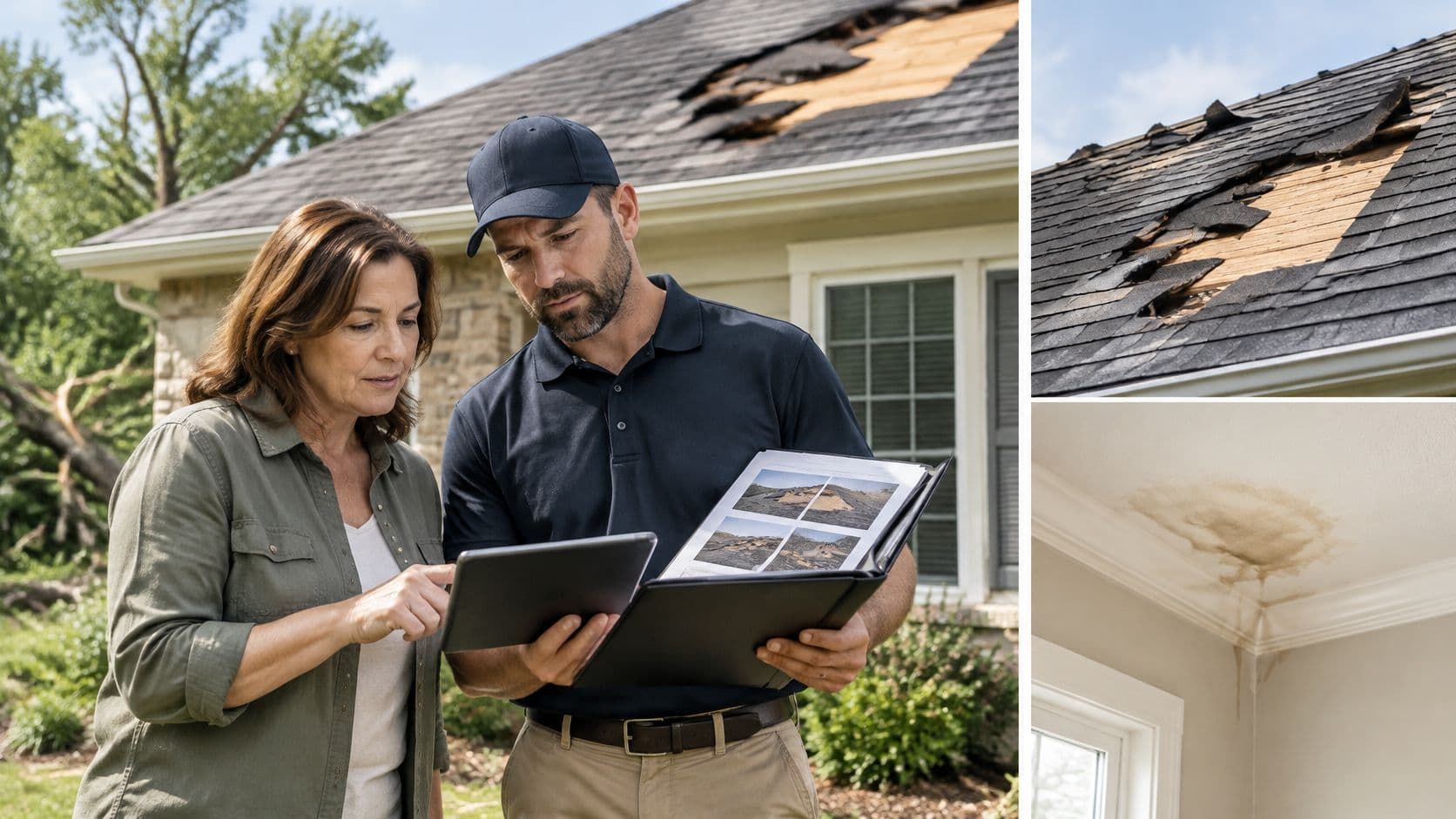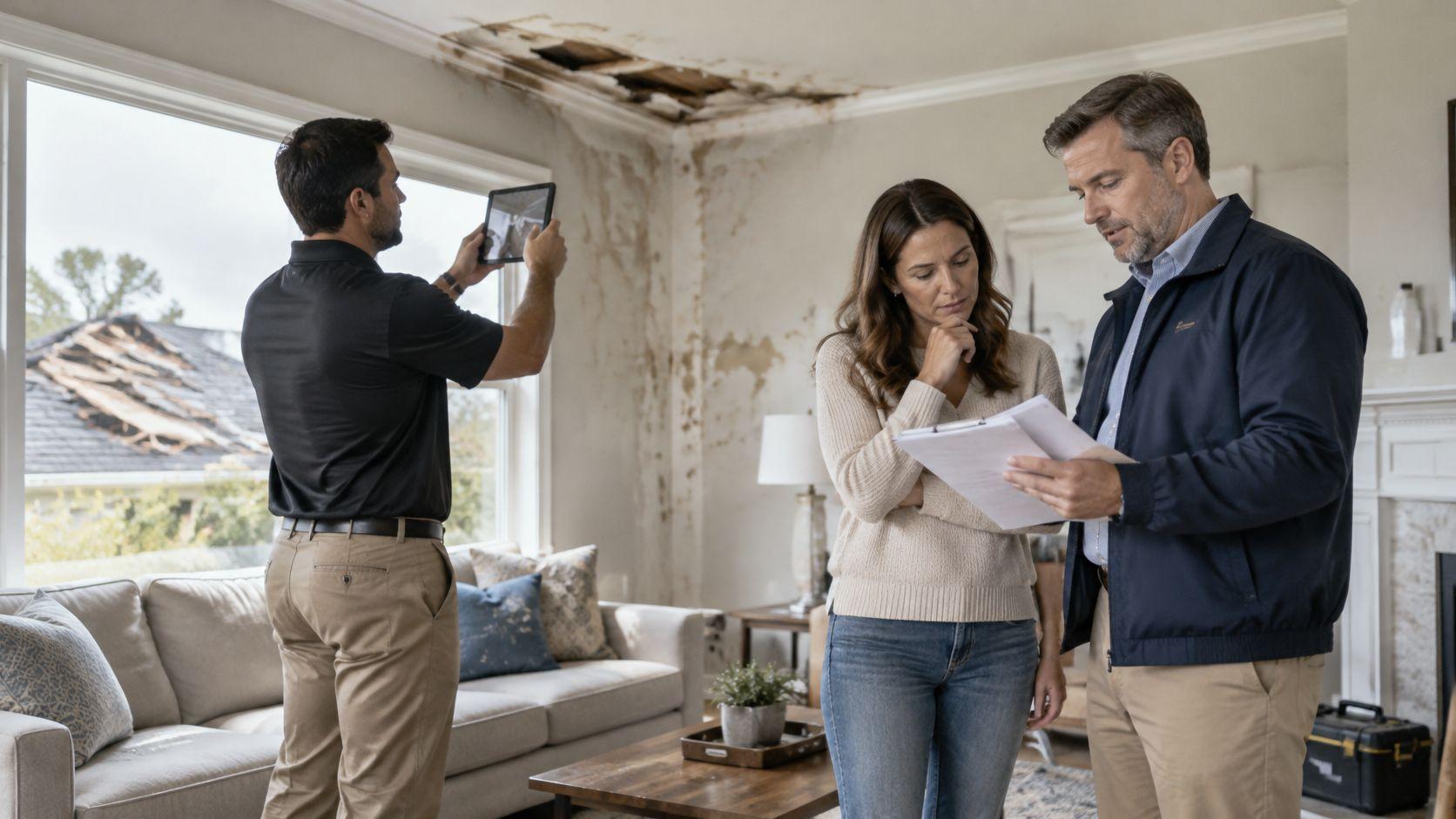
Hail is still melting in the gutter, and there's a brown ring spreading across the ceiling of the back bedroom. The storm passed an hour ago. You've got a phone in one hand and a bucket in the other, and the first real question isn't who fixes it.
It's what this is.
A ceiling stain from wind-driven rain that came through a torn ridge vent, a ceiling stain from a river that crested two streets over, and a ceiling stain from a supply line that's been seeping since spring look identical from the hallway. They fall under different coverage, different deductibles, and sometimes different policies entirely. Get the cause wrong and the repair estimate, however accurate, answers a question nobody asked.
Storm damage restoration is a repair process and an evidence process at the same time. In most cases the repair can wait a day. The evidence usually can't. What follows is the order that keeps both intact, from the first hour through the point where an adjuster reads your file.
The First 48 Hours After a Storm
A ceiling bulging under trapped water is a load waiting to drop, not a documentation opportunity. Leave any unsafe area before you photograph it. Call 911 or the appropriate utility for fire, gas, electrical, structural, or other immediate hazards. Never enter standing water or an unstable structure. Safety comes before documentation, and it comes before cleanup.
Once the building is safe to walk through, the next two days run on a fairly fixed clock. Each phase has one job.
| Window | Priority action | Why it matters |
|---|---|---|
| Immediately | Confirm the area is safe; shut off power or gas only if it is safe to do so | Hazards come before any inspection or cleanup |
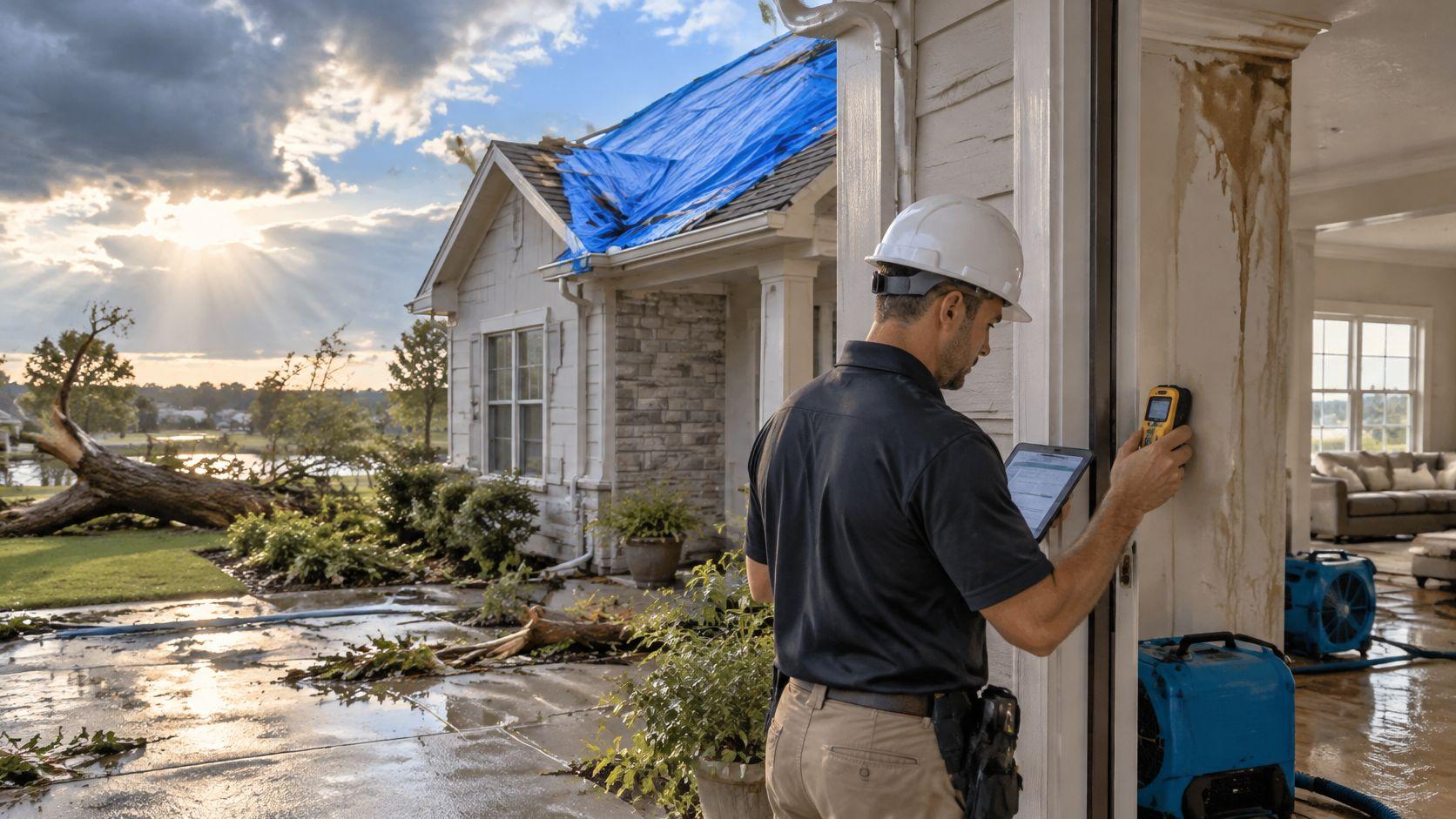
| First few hours | Stop the water source with a temporary cover and photograph damage from outside | Limits new damage and records the entry points |
| First 24 hours | Begin water extraction and air movement; keep damaged items for inspection | Drying starts before materials stay wet |
| Within 24 to 48 hours | Finish drying saturated materials and log moisture readings | Drying in this window helps prevent mold growth |
| First week | Report the claim, keep mitigation receipts and logs, request an inspection | Creates the record the claim depends on |
The drying window is the only real deadline
Water intrusion after a storm is a building-science problem with a clock attached, not a surface cleanup task. The EPA guidance on mold, moisture and your home advises drying water-damaged areas and materials within 24 to 48 hours, because mold usually will not grow when wet or damp materials are dried inside that window. Miss it and the job changes character. It stops being drying and becomes remediation, which costs more, takes longer, and produces a much harder claim conversation.
Mitigation and reconstruction are separate decisions
Emergency mitigation stops further loss. Reconstruction restores the building. Those are two scopes, two timelines, and often two parts of the same claim file. Tarping a roof and extracting water from a hallway is reasonable work to authorize while coverage is still being worked out, because the alternative is a bigger loss for everyone. Committing to a full rebuild before the adjuster has seen the damage is a different decision, and it is the one that causes trouble.
Drying itself should be measured, not eyeballed. Repeated readings compared against unaffected material of the same type do more for a claim than any description of how wet something felt.
The four things to write down today
Before anything is carried to the curb, capture the facts that disappear first. Time of loss and roughly when water first entered. Roof and opening locations, meaning which slope, which vent, which window failed. Affected rooms, listed by name rather than "upstairs." And every emergency action taken, with times, from the tarp going up to the first fan running.
Those four notes are what later settle the cause of loss: where the water came in, and when. A photo taken before you move anything is worth more than the receipt you collect afterward. The receipt proves you paid for a tarp. The photo shows the opening the tarp covered.
For a step-by-step version of the water side of this sequence, see what to do when your house floods.
Types of Storm Damage and What Each Needs
The same wet drywall can belong to a wind event or to a flood. The same thin shingles can be fresh hail or ordinary age. Cause of loss is what separates those outcomes, and each damage type below needs its own evidence.
The United States is where storm claims pile up fastest. NOAA's Billion-Dollar Weather and Climate Disasters database records 403 U.S. events with combined costs above US$2.915 trillion, counted in inflation-adjusted dollars and spanning severe storms, tropical cyclones, flooding, wildfires, winter storms and drought, according to the NOAA National Centers for Environmental Information. A declared event doesn't create one claim. It creates thousands at once, all chasing the same adjusters, engineers, dumpsters and shingle supply.
Munich Re's 2025 disaster assessment put worldwide economic losses from natural disasters at about US$224 billion, with insurers covering roughly US$108 billion, and weather-related events accounted for 92% of total losses and 97% of insured losses, per Munich Re's natural disaster figures for 2025. Weather-related losses make up most of the property insurance workload.
| Damage type | Typical cause | Usual restoration work |
|---|---|---|
| Wind damage to roof and siding | Strong straight-line winds | Tarping, shingle or panel replacement |
| Hail damage | Hailstorms | Roof, window and siding replacement |
| Fallen tree damage | Uprooted or broken trees | Tree removal and structural repair |
| Wind-driven rain intrusion | Rain forced through damaged openings | Drying and interior finish removal |
| Flood or surface water | Rising water or ground runoff | Water extraction, drying and removal of porous materials |
| Mold after storm water | Moisture left in materials | Containment and remediation |
| Contents and inventory | Water or debris reaching belongings | Cleaning, disposal and replacement |
Where owners most often misclassify the damage
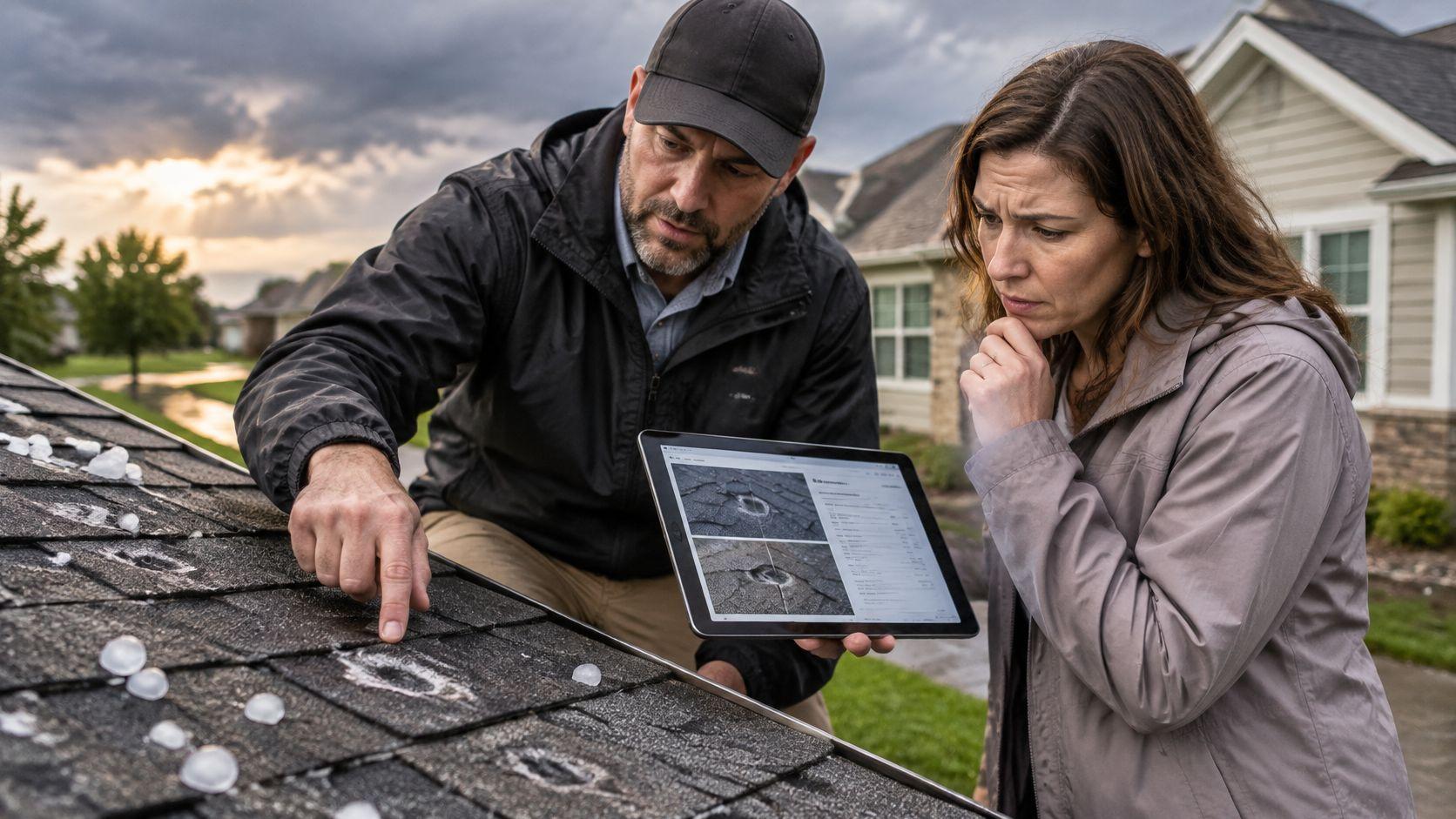
Hail is the classic case. A slope-by-slope inspection finds impact marks on the south and west faces and none on the north, which is exactly what a wind-driven hail event looks like. An owner who reports "the roof is damaged" without that pattern hands the adjuster an easy argument that the granule loss is age. Photograph each slope separately and count the hits in a defined area rather than describing them.
Wind-driven rain is the second trap. Rain forced through a failed seal belongs to the wind event that broke the seal. Water that rose from the ground belongs to a flood, and standard homeowner policies handle those two very differently. Same wet drywall, different claim.
One storm, several types of damage, one file each
A single afternoon can produce torn shingles, water through a gable vent, a downed oak on a fence, and mold three weeks later. I track each type as its own line item with its own photos and its own cause. Bundling them into "storm damage" flattens the distinctions that decide what's covered, and a missed item is almost impossible to add later.
A tree the wind uprooted is storm impact. Mold that appears weeks afterward is moisture left in materials after that water, not a separate weather event. Name the cause on each line, or the later damage gets treated as unrelated wear.
How Professionals Dry a Storm-Soaked Building
The finish line isn't a surface that feels dry. ASHRAE's chapter on drying water-damaged buildings states that wet surfaces should be returned to their background moisture content to limit additional structural damage and mold growth, and it notes that mechanical drying may require portable fans and dehumidifiers, with HVAC adjustments assisting under suitable conditions, as set out in the ASHRAE Handbook guidance on water damage. Visible dryness tells you nothing about the wall cavity behind the paint.
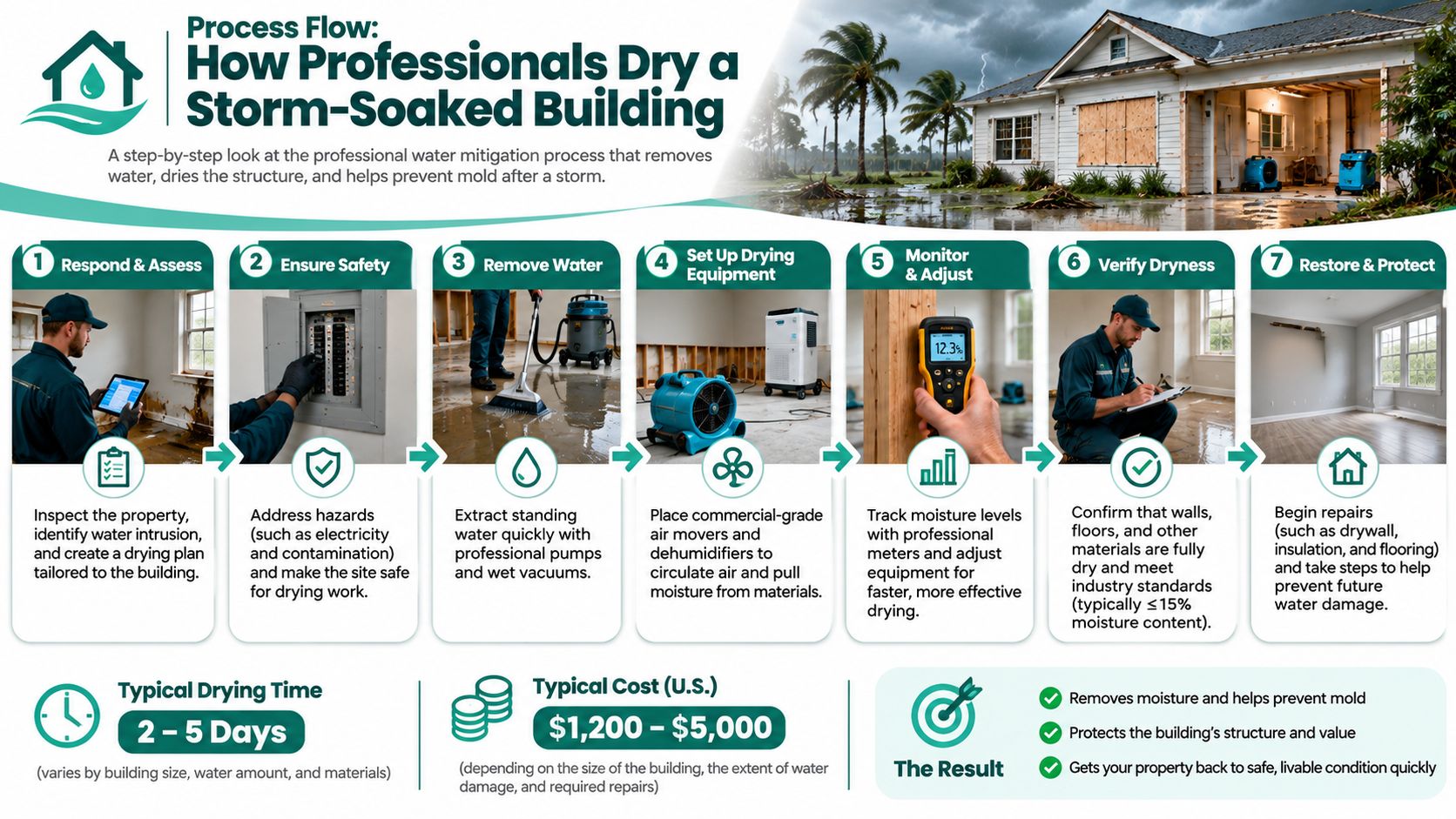
The sequence below is the order that works. Each step exists to make the next one measurable.
- Stop the moisture source. A tarp over an open roof or a board over a broken window. Until new water stops arriving, every reading you take is fiction.
- Extract standing water. Wet vacuums and extraction equipment remove bulk water that air movers would otherwise just spread around the room.
- Remove saturated porous materials that won't dry in place. Carpet padding, soaked drywall near the floor line, and some insulation fall into this group. Document each piece before it goes out the door.
- Set air movers and dehumidifiers, and adjust HVAC where conditions allow. Airflow speeds evaporation, dehumidification removes the moisture from the air so it stops resettling in materials, and closed doors get their own equipment.
- Take initial moisture readings and map affected materials. Pin-type and pinless meters on drywall, framing and subfloor, marked on a simple floor plan. This becomes the baseline every later reading is compared against.
- Check concealed cavities, subfloors and framing, and confirm electrical and structural safety before equipment runs. Wet insulation inside a wall and a saturated rim joist both dry far slower than the drywall face. Unstable ceilings and compromised roof framing get resolved before anyone plugs anything in.
- Log daily readings and equipment placement, then compare final readings with unaffected material of the same type. The comparison, not the absolute number, is what proves the assembly is dry and the building is safe to rebuild.
Practical rule: A drywall reading means nothing on its own. It means something next to the reading from the same material in a room the storm never touched.
Those logs do double duty. They tell a contractor when the structure is ready for reconstruction, and they draw the line between emergency mitigation and later rebuild work on the claim. For a fuller treatment of extraction, drying equipment and what each phase costs in time, the water damage mitigation breakdown walks through the same sequence in more detail.
Documenting Evidence That Settles the Cause of Loss
A ceiling stain appears the morning after a thunderstorm. The owner files it as storm damage. The insurer's first note calls it a long-term leak, or flood, or maintenance. Owners usually ask why their storm claim is being treated as flood, wear and tear, or maintenance. One wet ceiling can sit under several causes, and each cause can carry a different exclusion, endorsement, deductible, or limit. Wind-driven rain, flood, sewer backup, surface water, hail, and resulting mold are not interchangeable on a policy. Non-peak perils, meaning events other than named hurricanes, are driving a growing share of that exposure. Munich Re reported that non-peak perils produced about US$166 billion in global losses and approximately US$98 billion in insured losses in 2025, while severe thunderstorms generated about US$56 billion in U.S. losses including US$42 billion insured, according to Munich Re's 2025 natural disaster reporting. Ordinary convective storms, not headline hurricanes, are where most of these arguments start.
| Cause of loss | Policy area it often falls under | Evidence that settles it |
|---|---|---|
| Wind or hail | Windstorm or hail coverage, sometimes with its own deductible | Impact marks, dated photos and weather reports |
| Wind-driven rain | Depends on whether covered wind created the opening | Entry points and the pattern of water damage |
| Flood or surface water | Often excluded from standard homeowner policies | Flood source, water line and high-water records |
| Sewer backup | Often a separate endorsement | Backup source and timing of the event |
| Long-term leak or deterioration | Wear-and-tear or maintenance exclusions | Age of the damage and prior repair records |
| Resulting mold | Often limited or excluded | Moisture history and when damage began |
Take a slow leak that has been staining a bathroom ceiling for months, then a storm hits the same week. The insurer can treat the whole loss as deterioration. The owner can treat the whole loss as the storm. Neither reading is automatic. Old damage usually shows tide rings, rusted fasteners, soft decking, and a paint-over from an earlier repair. Storm damage usually shows a fresh opening, debris in the direction of the wind, and wetting that starts at that opening and tracks downhill. Date both. A weather report for the storm day, photos of the opening before any tarp, and the prior plumber's invoice for the old leak let an adjuster split what the storm added from what was already failing. Mold that follows either path needs its own timeline: when the material first got wet, and how long it stayed wet.
Build a cause-of-loss evidence map before demolition
Every item on this list has to be captured before the material it describes leaves the property.
- Storm direction and entry points, photographed from outside and inside, so the path of water is traceable rather than asserted.
- Damaged roofing and building materials, kept in a pile or set aside for the adjuster's inspection rather than hauled away on day one.
- Weather records, meaning local weather-station data or a dated hail report for the address on the day in question.
- Prior repair records, so new damage can be separated from deterioration that predates the event.
- Interior damage, documented room by room before any demo begins.
- Contents, itemized with proof of value such as receipts, bank or card statements, or photographs.
- Mitigation paperwork, kept together in one folder: invoices, equipment logs, moisture readings and dated repair estimates.
Paying for a repair does not establish coverage
Careful owners get caught here after doing the right thing for the building. Authorizing mitigation and paying for it protects the property while the cause of loss is still open. The invoice shows the work happened and what it cost. Coverage still depends on the policy and on the evidence above. A contractor's scope prices the repairs the building needs. What the policy owes is a separate question, answered from the cause, the endorsements, and the deductible.
If a step removes or changes evidence, photograph and log it first. I would rather delay a haul-off by a day than lose the only sample that shows whether the opening is new.
On the claim side, the sequence for submitting, tracking, and supplementing is set out in this guide to filing a water damage insurance claim, including how to keep the documentation chain intact when the scope grows after the first inspection.
When a Licensed Public Adjuster Helps
A ceiling stain after a storm can be written up as wind-driven rain, as flood, or as a roof that was already worn out. The label that sticks is the cause of loss, and it decides whether the policy pays.
A licensed public adjuster works for the property owner, not the insurer. The company adjuster is paid to evaluate the claim for the carrier. A public adjuster is paid to organize the owner's file and argue that version of the loss. Compensation is commonly a share of the amount recovered. Arrangements differ by contract and by the rules that apply where the property sits, so the fee, the basis, and what happens if the claim stays unpaid should be confirmed in writing before anyone is hired. That cost only makes sense when the dollars in dispute are large enough to cover it.
The question is whether this claim, at this size and with this dispute, justifies professional help.
Help earns its cost when the file is already a fight. An outright denial is an argument about cause, coverage, or proof. The useful response is policy language and evidence, not a second opinion from another roofer. A stalled claim is different: weeks with no inspection, no estimate, or no return call, after the drying window has already closed. A settlement well below the documented damage, one that skips rooms, code items, or contents, calls for a supplement built on the owner's records. When storm, flood, and wear and tear are all being argued from the same stain, someone has to put those competing causes into one coherent file. Large losses belong on this list too: many rooms, several building systems, or a commercial property with business interruption and inventory in the claim.
A small, clearly storm-caused loss with a fair first estimate and prompt payment does not need that layer. Three missing shingles, an obvious cause, and an insurer number that matches a contractor's bid leave almost nothing for a fee to improve.
Residential and commercial files split here. A homeowner's claim usually turns on one structure, a deductible, and a coverage question. A commercial claim adds business interruption, lost income, tenant relocation, equipment and inventory valuation, and often a lease or a lender with a stake in the outcome. Those files are heavy on paper by nature. A weak one costs operating months, not a couple of weeks.
A public adjuster can organize evidence, scope what was missed, and prepare a supplemental claim. No one can override a policy exclusion, and no outcome is guaranteed.
Take Your Next Step on a Storm Claim
The record you hand over this week is the storm the carrier will pay from. Cause of loss is still the question that splits the file: the same opening can be treated as wind, as flood, or as wear that predates the event. What matters now is a written escalation, on a clock.
- Within the first week after you report. Confirm the claim number in writing, state the cause you are asserting, and ask which other causes remain under review. Save each reply with the date and the name of the person who sent it.
- When the estimate arrives. Match it to your photos and repair scope, line by line. Put every omitted item in writing, cite the photo that supports it, and send that package as a supplement. A phone complaint does not sit in the file the same way.
- If the payment comes in short. Name the gap and the line it came from, and ask which policy provision produced the reduction. You need that answer in writing before you argue the number.
- If the claim is denied, delayed, or the cause stays disputed. Send one dispute letter: the cause you assert, the evidence for it, what was paid, and what is still open. Ask for a written reconsideration. I would not rely on a verbal assurance. A reassigned adjuster may never hear it.
That sequence takes time, and outside help is a cost choice. A licensed public adjuster can carry the supplement and the cause-of-loss argument. The trade-off is their fee against a carrier number that may already match the damage. No one can override an exclusion, and no outcome is guaranteed.
Homeowners, landlords, and commercial owners dealing with a denied, delayed, or underpaid claim can share the damage type, ZIP code, name, phone number, email, and what they can safely observe. PostDamage is an independent information and referral platform, not an insurance company, public adjusting firm, law firm, or restoration contractor. It does not perform restoration or adjusting. It connects qualified inquiries with licensed public adjusters where available. Payment still depends on the policy, its exclusions, the cause of loss, and applicable law.
If the property is still unsafe, leave before you add to the file. Call 911 or the utility for fire, gas, electrical, or structural hazards, and do not enter standing water or an unstable structure.