
The storm has passed, but the claim paperwork has started. A homeowner has an insurer's estimate, a contractor's repair proposal, and an offer from someone promising to handle the claim. Each person seems to describe the same damage differently, and it's unclear who represents whom or what extra help would cost.
The public adjuster vs insurance adjuster distinction starts with representation, not inspection skills. Understanding that distinction helps property owners compare estimates, evaluate a proposed fee, and decide whether a separate professional would add enough value.
Public Adjuster vs Insurance Adjuster at a Glance
| Factor | Public adjuster | Insurance adjuster (company or independent) |
|---|---|---|
| Represents | The policyholder | The insurer |
| Paid by | The policyholder, commonly a percentage of the settlement | The insurer; no adjusting fee charged to the policyholder |
| Main job | Documents the loss, prepares the claim, and negotiates for the policyholder | Investigates the loss, checks coverage, and recommends the insurer's position |
| Decision authority | Negotiates; doesn't approve or deny the claim | Makes recommendations; doesn't independently approve or deny the claim |
| Must the insurer accept their estimate? | No; the insurer may send its own adjuster | No; the estimate remains subject to the insurer's review and claim decision |
| Can change what the policy covers? | No; can't create coverage the policy excludes | No; applies the policy as the carrier interprets it |
Both professionals may inspect the same damage, but they work from opposite sides of the claim. Representation explains whose claim position each professional prepares. It doesn't establish that either professional's estimate is automatically accurate.
FEMA's guide to identifying advocates after a flood distinguishes the insurer-side adjusting role from a public adjuster engaged to assist the policyholder. FEMA describes practical inspection work such as contacting the policyholder, collecting information, taking photographs, and helping with claim paperwork.
Company and independent adjusters work for the insurer
A company adjuster, also called a staff adjuster, is an insurance-company employee. An independent adjuster is a contractor engaged by the insurer, rather than an employee.
The word independent causes understandable confusion. It describes the adjuster's employment arrangement, not neutrality between the insurance company and the property owner. Both types work inside the carrier's claims process.
The person inspecting the property may also be different from the person reviewing the file or communicating the carrier's coverage position. Property owners should establish who handles inspection questions, who handles payment questions, and where supporting documents should go.
Practical rule: A job title alone doesn't establish whom an adjuster represents. The hiring relationship does.
A public adjuster prepares the policyholder's position
A public adjuster is engaged by the property owner to help prepare and negotiate the policyholder's claim. That work can involve coverage analysis, damage documentation, repair scope, and pricing, within the authority permitted by applicable state law and the signed contract.
Hiring that professional doesn't replace the insurer's claims process. The carrier still reviews the claim, requests supporting information, and reaches its own position. A public adjuster provides separate representation rather than becoming the claim's final decision-maker.
Consider a hypothetical homeowner whose roof and upstairs rooms suffer storm damage. The carrier sends an adjuster to inspect, photograph the affected areas, and prepare findings for the insurer. The carrier pays that adjuster.
The homeowner separately hires a public adjuster to assemble damage records and negotiate the homeowner's position. The homeowner pays for that service under the contract, even though both professionals walk through the same rooms and examine the same roof.
Before allowing an unfamiliar professional to proceed, the property owner should establish:
- Who engaged the professional: The insurer, the policyholder, or another party.
- Who pays for the work: Payment arrangements should be clear before services begin.
- What authority the professional has: Inspection, estimating, negotiation, and claim decisions aren't interchangeable responsibilities.
What Each Adjuster Checks in Your Claim
The technical work overlaps considerably. Both adjusters need a defensible explanation of what happened, what was damaged, what repairs are necessary, and how the policy applies. The difference is whose submission or evaluation they're preparing.
The Maryland Insurance Administration's damage-estimating guidance explains the distinction between insurer-employed or insurer-contracted adjusters and public adjusters hired by policyholders. A separate estimate gives the owner another documented position, not an automatic entitlement to that amount.
Parallel reviews of the same loss
The insurance adjuster investigates the cause and extent of damage, checks applicable coverage, and estimates repair or replacement costs. The evaluation also accounts for policy limits, deductibles, and other provisions affecting payment.
The public adjuster reviews applicable coverage from the policyholder's side and prepares supporting documentation. Depending on the loss, that can include building damage, contents, additional living expenses, extra expenses, and business-interruption calculations.
A useful claim file separates these issues rather than treating the loss as one undifferentiated total:
- Building damage: Measurements, materials, repair methods, and affected areas.
- Contents damage: Item descriptions, condition, ownership evidence, and replacement support.
- Displacement or operating expenses: Receipts and explanations connecting expenses to the covered loss.
- Income losses: Financial records supporting the claimed interruption and its duration.
Cause also matters. A stained ceiling establishes visible damage, but not necessarily where the water entered or when the problem began. The distinction is especially important in a water damage insurance claim, where an estimate needs to connect the damaged materials with the reported event.
A restaurant fire shows where totals split
Consider a restaurant with fire-damaged cooking equipment, spoiled inventory, smoke-affected finishes, and an interruption to operations. The insurer's adjuster evaluates those claimed categories against the policy, including repair scope, valuation provisions, and limits.
A public adjuster may build a separate equipment schedule, reconcile inventory records, document cleanup and repairs, and prepare the business-income calculation. The insurer may investigate the same categories; neither role should be reduced to buildings alone or income alone.
Differences can emerge over whether equipment can be repaired, how much inventory was present, or how long covered repairs should reasonably take. A lost-sales total also isn't interchangeable with a supported business-income loss calculation.
Actual cash value and replacement cost can create another apparent disagreement. An estimate reflecting depreciation may look lower than replacement pricing even when both documents describe the same damaged property; payment terms determine whether and how additional amounts become payable.
Residential claims generally emphasize the dwelling, personal property, and displacement expenses. Commercial claims can add equipment, stock, extra expenses, income calculations, and continuity issues that require a different set of records.
What Each Adjuster Costs You
Illustrative fee calculations, not quoted fees
| Settlement | Fee at 10% | Fee at 20% | Fee at 30% |
|---|---|---|---|
| $10,000 | $1,000 | $2,000 | $3,000 |
| $50,000 | $5,000 | $10,000 | $15,000 |
| $100,000 | $10,000 | $20,000 | $30,000 |
These hypothetical calculations show settlement multiplied by an assumed contract percentage. They aren't a statement that any particular rate is available, lawful, or appropriate for a particular claim.
Hiring provides a financial gain only when the added recovery exceeds the fee and related costs. A larger gross settlement isn't enough by itself.
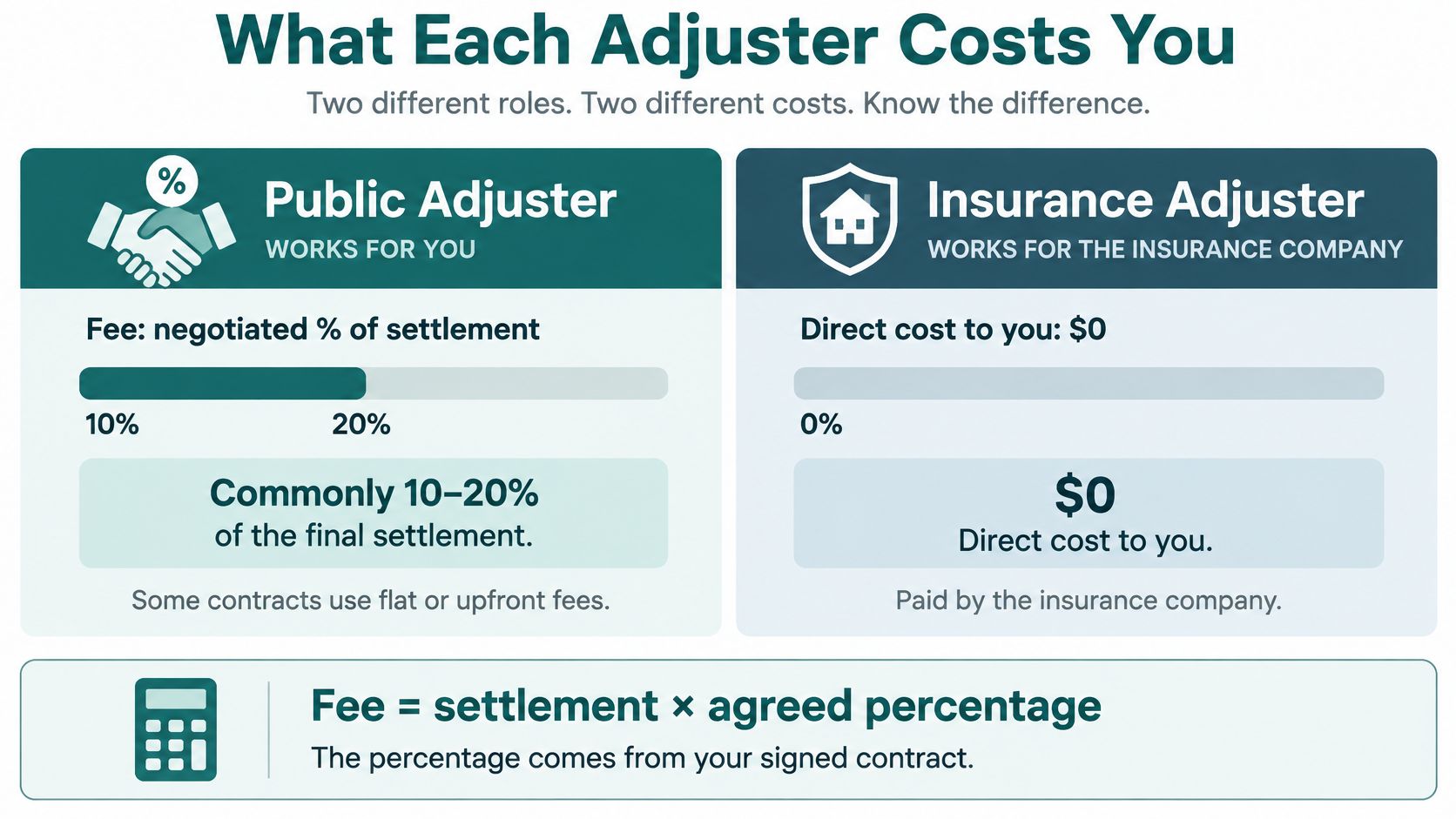
The Maryland Insurance Administration's estimating-the-damage guide explains the central payment distinction: public adjusters charge the policyholder for their services, while insurer-side adjusters are paid by the insurance company. Public-adjuster contracts commonly use a negotiated settlement percentage, although other fee structures exist.
The visual comparison illustrates the payment mechanisms; the signed contract and applicable state rules determine the actual charge.
Calculate the net result, not just the increase
The public adjuster's fee generally comes from claim proceeds rather than being automatically added to the insurer's payment. That means a property owner must consider how much remains available after the fee.
Using the hypothetical middle row, a final settlement of $50,000 with a 20% fee leaves $40,000 before other costs. If the existing offer was already $40,000, that outcome merely breaks even financially; the added recovery must exceed $10,000 to produce a gain.
That example assumes the percentage applies to the entire settlement. A contract charging only on additional recovery produces different arithmetic, so the fee basis matters as much as the percentage.
The useful comparison is the amount the owner would retain without hiring against the amount retained after hiring, not the headline settlement totals.
Read the fee terms before signing
State rules can restrict fees and contract terms. A percentage presented in a brochure or conversation shouldn't substitute for checking the applicable requirements and the written agreement.
The contract review should establish:
- Fee basis: Whether the charge applies to gross proceeds, additional recovery, or specified claim categories.
- Existing payments: Whether amounts already offered or paid are included.
- Other charges: Whether expenses, upfront payments, or separate service charges apply.
- Cancellation rights: How cancellation works and what obligations remain.
- Written rate and licensing: Whether the agreement identifies the professional, applicable license, and agreed compensation.
Administrative help and reduced paperwork can have value, too. Those benefits should be considered separately rather than presented as proof that hiring will increase the owner's net recovery.
When Hiring a Public Adjuster Makes Sense
A public adjuster is most useful when there's a specific documentation, valuation, or negotiation problem to solve. The size of a settlement alone doesn't answer whether the service is worthwhile.
Hiring is optional, and a straightforward claim may not require separate representation. PostDamage helps property owners understand when a public adjuster may be appropriate and offers insurance claim help for claims that have been denied, delayed, or paid below expectations.
A substantial documented gap
Consider a homeowner whose contractor identifies omitted roof components, interior damage, and necessary access work. The carrier's estimate doesn't include those items, and the homeowner has difficulty organizing the supporting material.
A public adjuster may help turn that disagreement into a supported supplemental submission. The strongest reason to consider hiring isn't dissatisfaction with the offer; it's a potentially material gap supported by measurements, photographs, repair explanations, and applicable coverage.
A delayed or denied claim also requires diagnosis. Missing records, disputed causation, and an exclusion raise different problems, and not every problem can be resolved through a higher estimate.
An agreed, limited repair
For a small, single-item loss, the carrier's estimate may already match a reliable repair proposal. If the scope is complete and the valuation is understood, there may be little additional recovery available to offset a fee.
The owner may still need to submit receipts or answer questions, but those tasks alone don't establish a need for paid representation. An adjuster shouldn't have to discover a disagreement merely to justify being hired.
A commercial loss with connected financial issues
A business with damaged equipment, inventory losses, and interrupted operations faces more than a construction estimate. Multi-location property losses can also require separating records by site, policy provision, and affected activity.
Professional assistance may be valuable when the owner can't reconcile equipment schedules, stock records, repair timing, and business-income calculations. The service being evaluated should match those actual needs rather than rely on a general promise of a better payout.
Decision filter: Is there a meaningful gap after fees, does the claim require specialized work, and has the insurer explained its position in writing?
Those questions distinguish an unresolved claim problem from an unwelcome but well-supported outcome. No precise fee comparison is possible until the owner understands both the proposed services and the existing offer.
Why Two Adjusters Can Reach Different Numbers
Why can the insurer's estimate be lower even when both adjusters inspected the same damage? Often, the disagreement concerns scope, pricing assumptions, policy interpretation, or evidence, rather than professional loyalty alone.
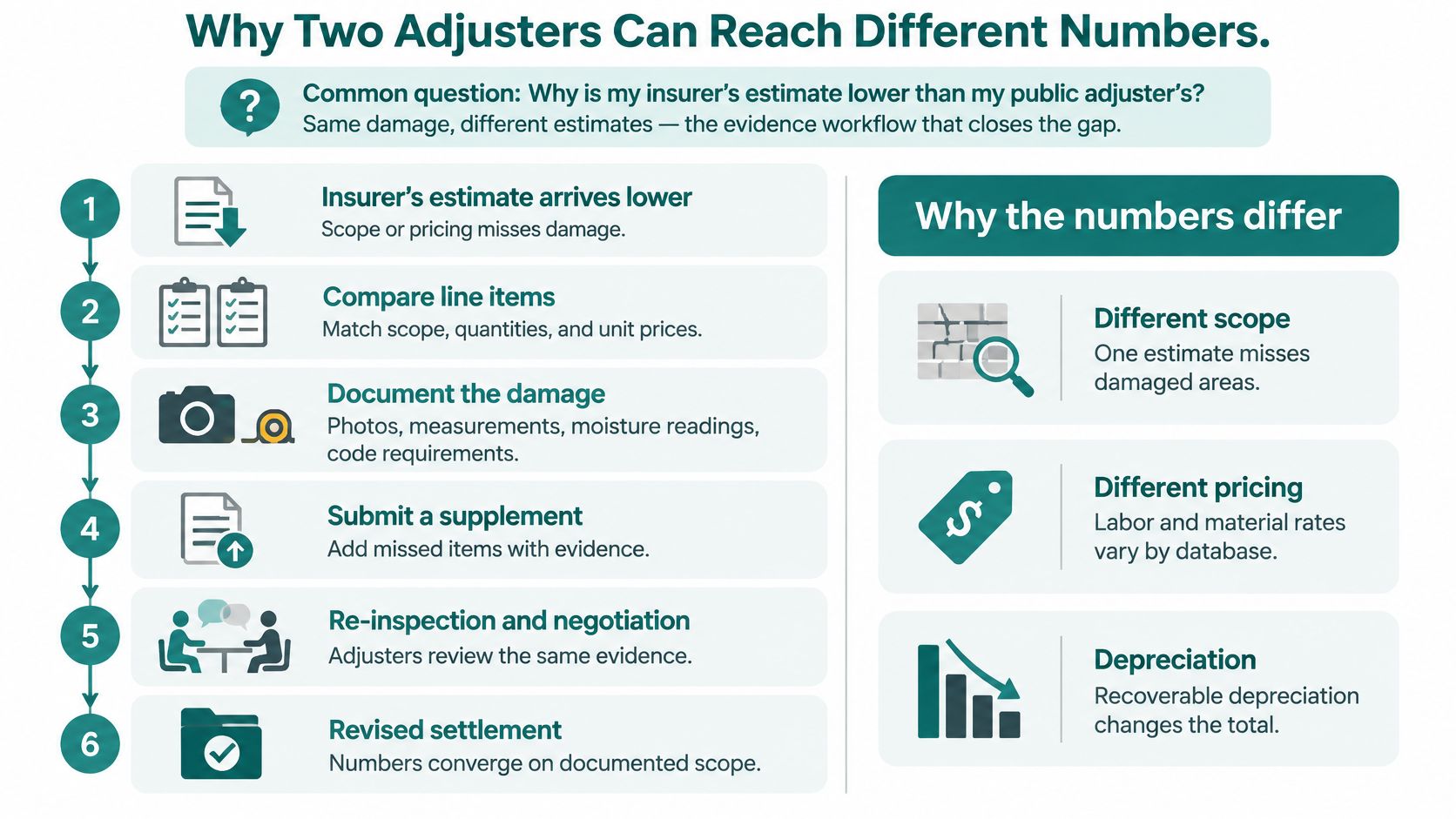
One estimate may include repairing a wall while another includes replacing its damaged layers and removing fixtures for access. Different quantities, material specifications, labor assumptions, or depreciation treatments can produce different totals without either adjuster deliberately misrepresenting the loss.
Separate damage questions from coverage questions
Storm and wildfire claims can combine difficult causation and repair issues. Swiss Re's analysis of global natural-catastrophe losses examines the significance of wildfire, severe storms, and other secondary perils, providing context for why careful event-specific documentation matters.
For an individual property, the questions are concrete. Did wind create an opening before rain entered, or did water enter through an existing defect? Are damaged materials repairable, is matching disputed, and does applicable coverage address required code upgrades?
Concurrent causes can complicate the analysis, too. A contractor's explanation of physical damage and a carrier's explanation of coverage should be compared separately rather than collapsed into an argument over the final price.
The following visual shows how evidence can support review and negotiation, although a revised settlement isn't guaranteed.
Build an evidence trail that addresses the disagreement
Preserve pre-loss photographs and maintenance records. Earlier photographs can help distinguish recent damage from pre-existing conditions. Images taken only after cleanup may establish neither the original condition nor the full loss.
Obtain weather and contractor documentation. Event information supports timing, while a contractor's written explanation connects observed damage to proposed work. A nearby storm alone doesn't prove that every damaged component failed because of that storm.
Separate emergency mitigation from permanent repairs. Keep drying records, temporary-protection invoices, disposal records, and reconstruction proposals organized by purpose. Combining them can hide duplicated work or make necessary emergency expenses harder to evaluate.
Compare estimates line by line. Match rooms, exterior elevations, trades, quantities, materials, depreciation, deductibles, and excluded items. Comparing only bottom-line totals conceals the actual disagreement.
For water losses, an organized record of discovery, reporting, mitigation, and damage photographs helps establish the sequence described in how to file a water damage insurance claim.
A stronger estimate still can't create excluded coverage. Licensing requirements, fee rules, appraisal rights, and claim deadlines are jurisdiction-specific, so the appropriate response must fit both the policy and applicable law.
Choose the Right Adjuster Before You Sign
Confirm licensing and identity. Check the proposed public adjuster's license through the applicable state insurance regulator, including status and the name matching the agreement. For insurer-side personnel, establish the professional's role and any applicable licensing requirements.
Get the fee basis in writing. The agreement should explain how compensation applies to existing payments, additional recovery, and different claim categories. A verbal percentage without a defined base isn't enough to evaluate cost.
Check cancellation rights. Read the cancellation provisions and any required notices before agreeing. Keep a complete copy of the signed contract rather than relying on a summary.
Compare written estimates. Identify the actual disputed work, valuation assumptions, and coverage questions. A sales conversation about an inadequate offer isn't a substitute for a documented comparison.
Keep the complete claim record. Retain estimates, letters, photographs, receipts, contracts, and submission confirmations. Record important conversations in dated notes and request written clarification of material positions.
Protect the claim while evaluating help
Considering representation doesn't suspend policy duties or deadlines. Unless the carrier changes its position, its existing written position remains the one requiring a response, and the owner should continue tracking requests, notices, and required submissions.
A promise that a professional will handle everything shouldn't replace a clear assignment of responsibilities. The owner should understand who submits documents, who receives correspondence, and what information the owner must still supply.
Hire a public adjuster when the documented gap, complexity, or dispute reasonably justifies the contracted cost. Rely on the insurer's adjuster alone when the loss is limited, the scope is agreed, and separate representation offers little identifiable benefit.
Match assistance to the property and problem
Homeowners may need help organizing building damage, contents, or displacement records. Businesses may need a professional experienced with equipment, inventory, and business-income documentation, not merely residential repair estimates.
PostDamage is an independent information and referral platform, not an insurer, public adjusting firm, law firm, or restoration contractor, and doesn't directly adjust, negotiate, or settle claims. Coverage depends on policy terms and applicable law; professional availability, eligibility, services, and fees vary by location and provider, and neither a referral nor a particular outcome is guaranteed.
PostDamage can help connect homeowners with licensed professionals and businesses with experienced, licensed professionals for property insurance claim assistance. Property owners can visit PostDamage to submit a free, no-obligation review request that takes about one minute, without needing to know which type of professional to contact first.