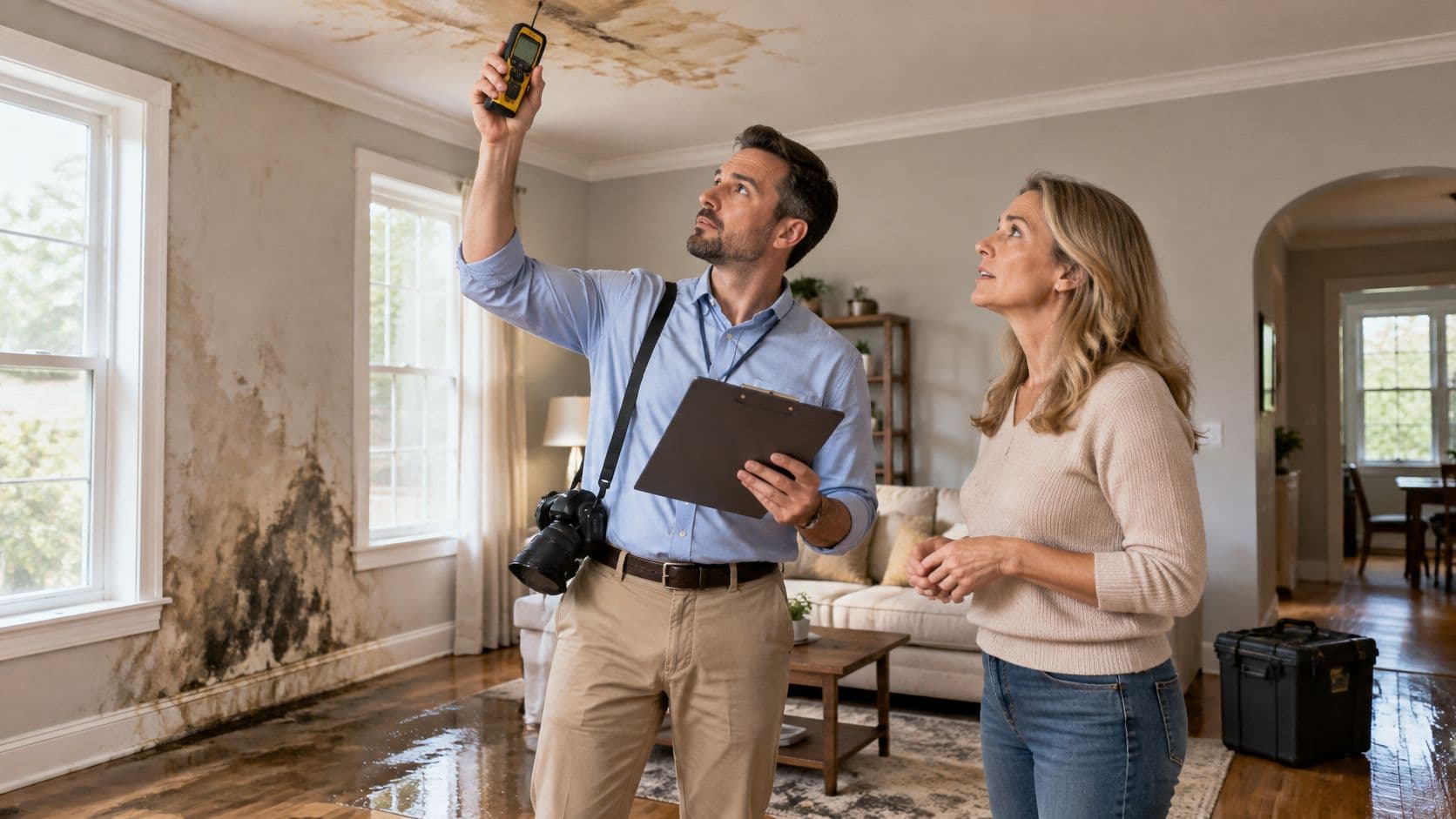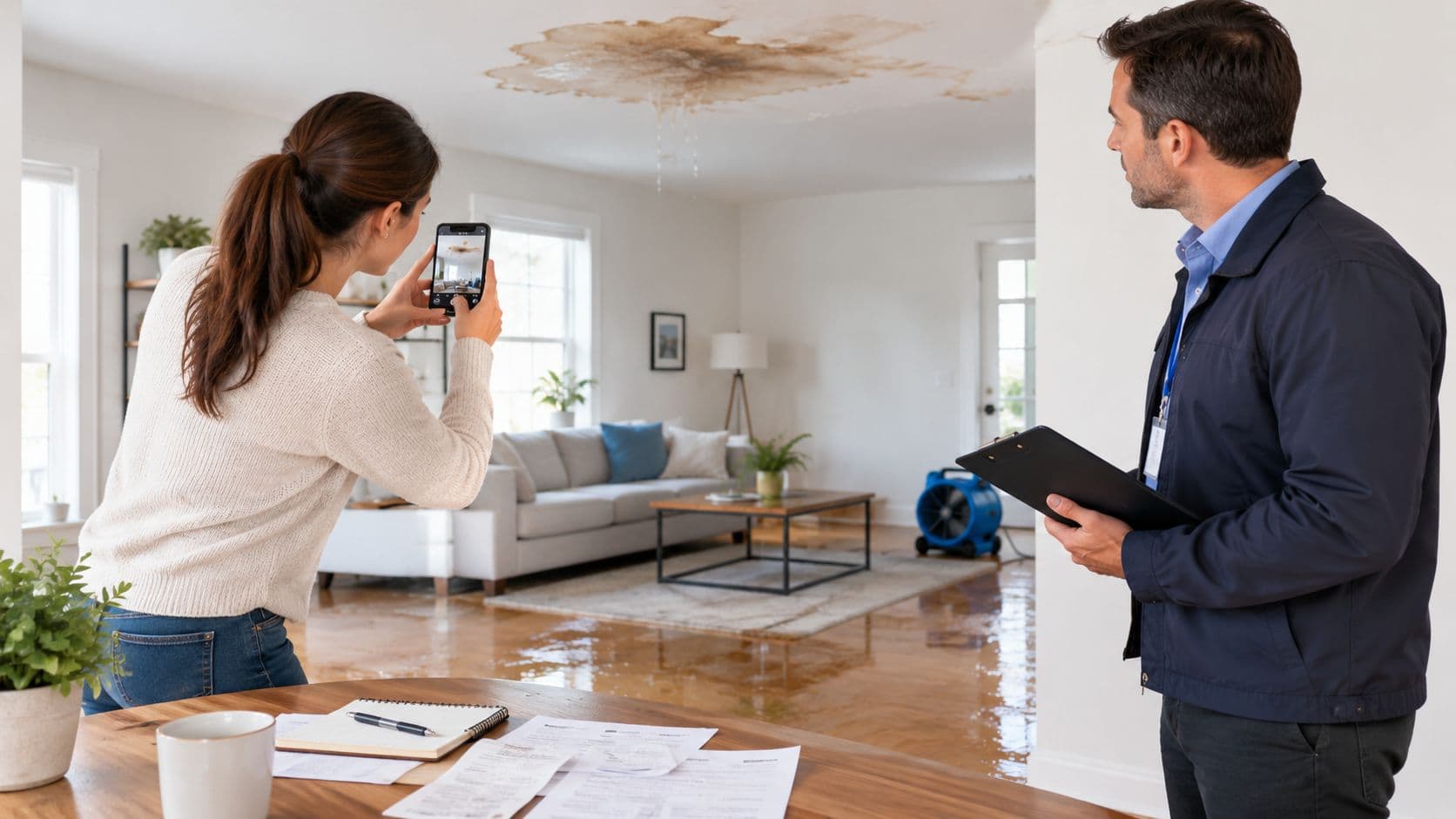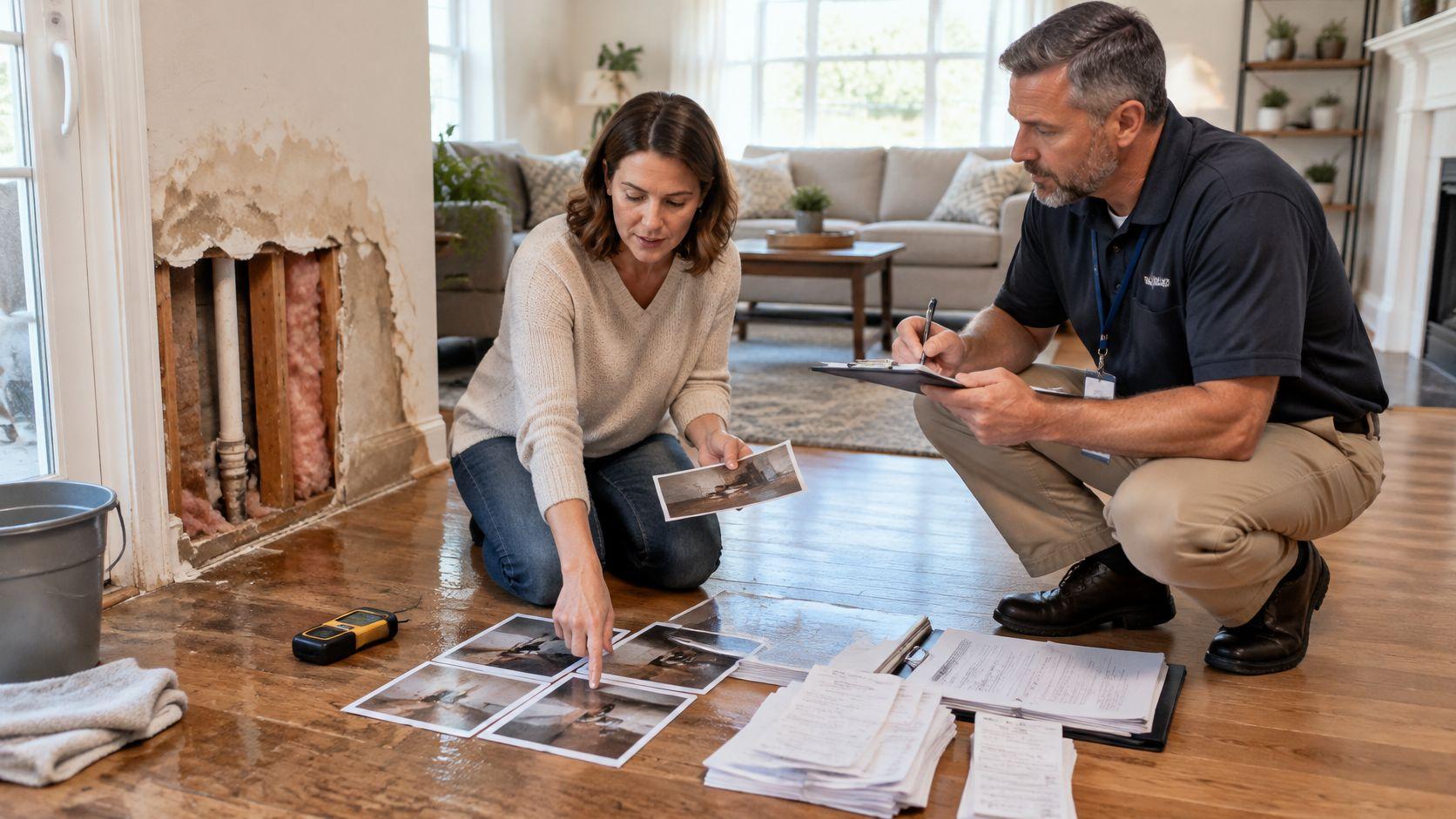
The water's been shut off, the flooring is wet, and the insurer has assigned an adjuster. Meanwhile, a contractor wants permission to remove damaged materials, and the homeowner doesn't know what can safely wait. Dealing with an insurance adjuster after water damage starts with identifying the water source, not negotiating a settlement total. The right evidence helps establish both whether coverage applies and what repairs belong in the claim.
Why the First Adjuster Visit Shapes Your Payout
Water losses involve meaningful money. Industry data summarized in the Insurance Institute for Business & Home Safety's interior-water white paper found that approximately one in every 60 insured homes filed an interior-water-damage claim during 2016–2020.
For an individual homeowner, the concern isn't the industry average. It's whether the inspection captures wet insulation behind drywall, damaged cabinet bases, affected belongings, and the emergency work already performed.
The first visit is an evidence-gathering appointment, not a casual conversation about what a settlement might look like. The adjuster's observations become a starting point for the insurer's estimate and coverage evaluation.
What the inspection needs to establish
- Cause of loss: Where the water originated, how it entered, and what supports that explanation.
- Damaged property: Which building materials and personal belongings sustained damage.
- Mitigation expenses: What emergency work was performed and why it was necessary.
- Valuation: How repair quantities, pricing, and depreciation were calculated.
- Coverage treatment: Which policy provisions, exclusions, deductibles, and limits apply.
The initial estimate isn't necessarily the final scope. Concealed damage may require additional documentation after authorized openings, and an omitted item can be submitted for review.
Still, incomplete records make disagreements harder to resolve. A room described merely as wet gives the estimator less useful information than photographs and measurements identifying each affected material.
Practical rule: The homeowner's strongest position is a documented explanation of the loss, not a demand for a larger number.
Coverage ultimately depends on the policy and applicable state law. The priorities are straightforward: act safely, document carefully, and compare the estimate with the coverage terms.
Steps to Take Before the Adjuster Arrives
Safety comes before photographs or insurance paperwork. PostDamage advises occupants to leave unsafe areas before documenting damage, call emergency services or the appropriate utility for immediate hazards, and never enter standing water or an unstable structure.
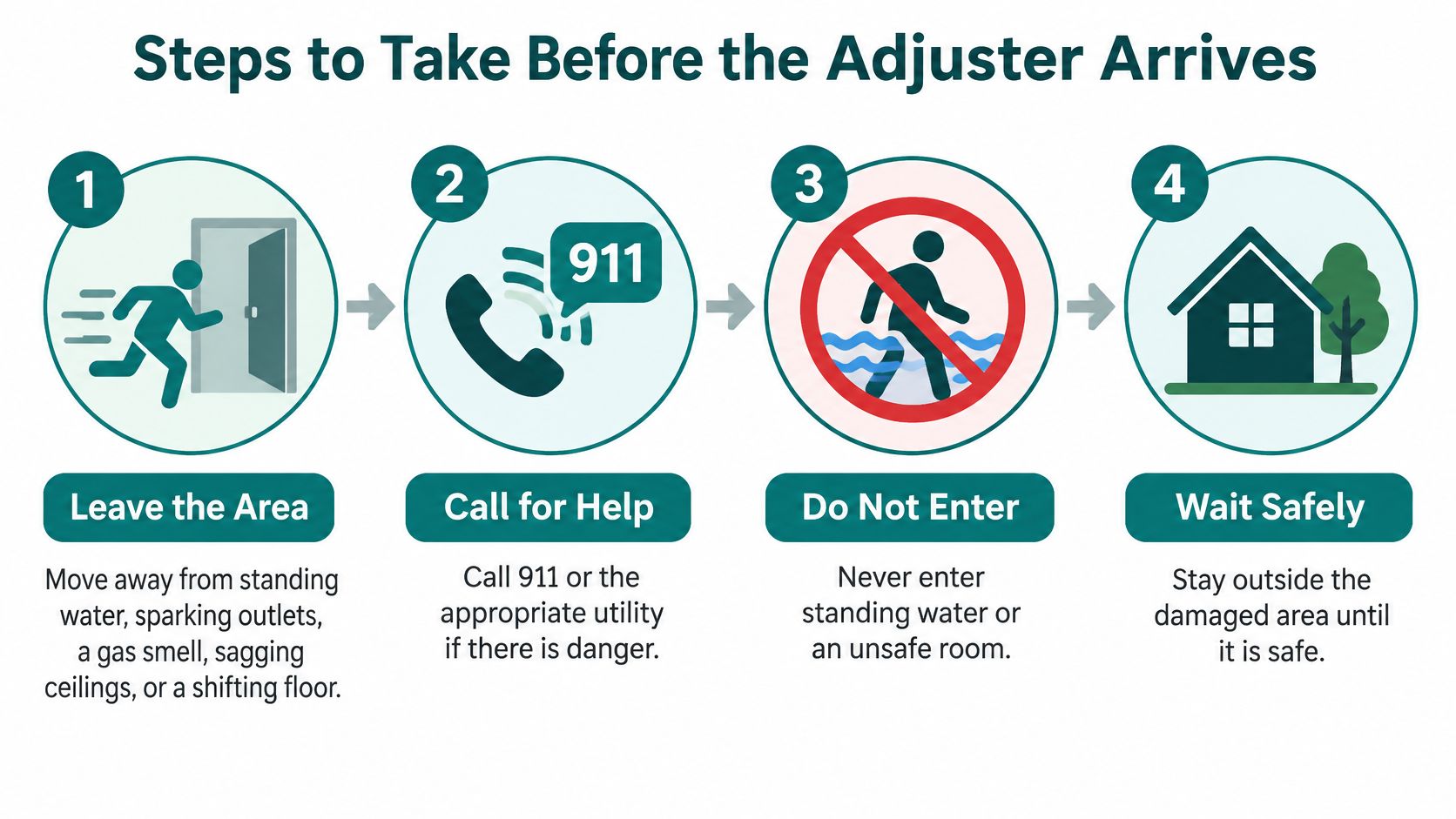
Follow a safety-first sequence
Leave hazardous areas. Standing water, sparking outlets, a gas smell, sagging ceilings, or a shifting floor require distance and appropriate emergency help. Nobody should cross a flooded room to reach a breaker or retrieve belongings.
Stop the source only when safely accessible. Closing a fixture valve, appliance supply, or main water valve can limit additional damage. The common mistake is treating access to the shutoff as more important than electrical or structural safety.
Arrange reasonable emergency mitigation. Qualified help may be needed for extraction, controlled drying, or temporary weather protection. Keep the authorization and itemized receipts, and distinguish emergency work from an agreement for permanent reconstruction.
Notify the insurer promptly. Record the claim number, assigned contact, and expected inspection arrangements. Waiting until cleanup is finished can leave the insurer without a clear picture of the original conditions.
Photograph conditions when the area is safe. Capture damage before belongings move or materials are removed whenever practical. Throwing away wet drywall without recording its location and condition removes useful evidence, but photographs should never delay necessary safety work.
Create a single claim folder. Put the claim number, insurer's contact information, and a short timeline at the front. Scattered texts, loose receipts, and photographs stored across different phones make later estimate comparisons unnecessarily difficult.
Emergency work and permanent repairs serve different purposes. The former limits further loss; the latter restores the property after the repair scope is understood. A broad reconstruction contract signed during an emergency can blur those costs and create commitments before coverage is clear.
The water damage mitigation guide explains that emergency phase in more detail. Homeowners should retain copies of everything signed, including equipment authorizations and disposal permissions.
When the adjuster calls, the homeowner should have the claim number, folder, and written discovery timeline ready. Unknown facts can remain unknown until a qualified inspection establishes them.
Check the Cause of Loss Before Accepting the Scope
The same swollen flooring can result from a failed dishwasher line, groundwater entering through a foundation, or a backed-up drain. Those scenarios require different coverage arguments, even when the repair work looks similar.
The National Association of Insurance Commissioners' homeowners insurance guidance explains that plumbing and roof leaks are typically covered, while flood, groundwater, rain runoff, and snowmelt generally aren't covered under standard homeowners policies. The event's cause and the policy wording matter more than the label water damage.
Typical coverage by water source
| Water Source | Typical Treatment | Evidence to Preserve |
|---|---|---|
| Sudden plumbing or appliance failure | Typically covered | Failed part, plumber report, timeline |
| Roof leak | Typically covered, subject to cause and exclusions | Photos of the roof opening, weather dates, roofer report |
| Flood | Generally not covered under standard homeowners policies; separate flood coverage may apply | Water-depth photos, flood coverage documents |
| Groundwater seepage | Generally not covered | Foundation photos, moisture history |
| Rain runoff or snowmelt | Generally not covered | Weather records, entry-point photos |
| Sewer or drain backup | Commonly excluded unless an endorsement applies | Backup timing, endorsement check, plumber report |
This table is a sorting tool, not a coverage determination. A policy may distinguish damage caused by escaping water from the cost of fixing the failed component itself.
Before the meeting, review the declarations page and obtain the listed endorsements. The homeowners water-damage coverage guide provides additional context for that review.
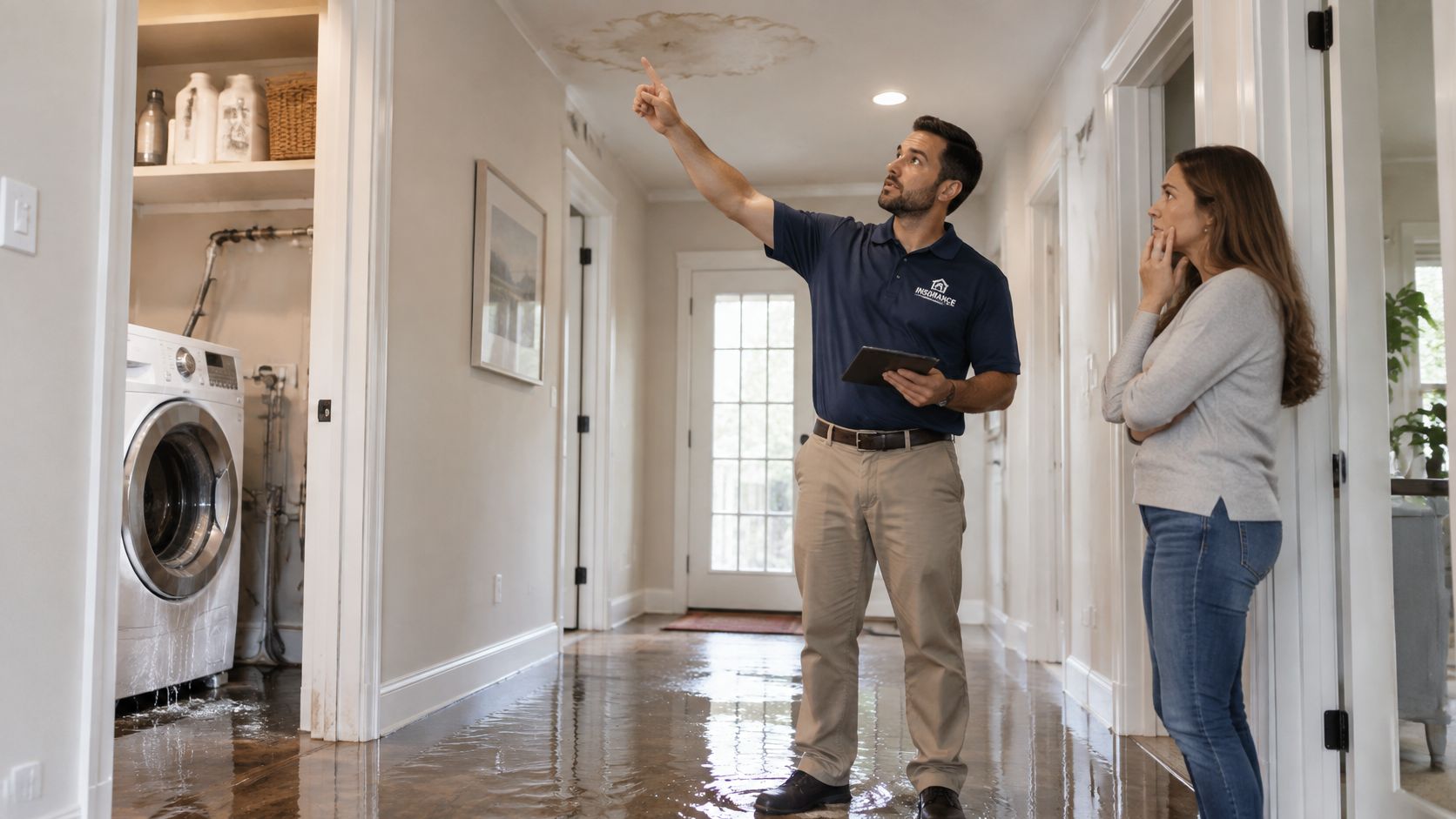
Preserve evidence of the source
Photograph the failed component before disposal, and ask the plumber or mitigation contractor to record observations separately from assumptions. A report identifying a split supply hose is more useful than a general statement that the kitchen flooded.
Record discovery conditions, relevant weather, and the sequence of events. Avoid unsupported descriptions such as longstanding seepage or homeowner negligence. Accuracy matters, including disclosing known prior conditions, but speculation doesn't help establish causation.
Stopping the leak and preserving evidence aren't competing goals. Safe mitigation can proceed while the failed part, photographs, and contractor findings remain available for review.
If the insurer disputes the source or identifies an exclusion, request its written causation theory, the policy provision relied upon, and the applicable endorsement list. Respond to that explanation with source-specific evidence rather than arguing about flooring prices before the coverage question is clear.
Document Damage and Expenses for Your Claim File
An adjuster can only estimate reliably from the damage and supporting information made available. A photograph showing a wet room establishes less than a record identifying damaged drywall, insulation, flooring, cabinetry, electrical components, and contents separately.
The NAIC's claims-process guidance recommends documenting damage, preserving items for inspection when possible, and obtaining the adjuster's name and contact information. A useful claim file connects each damaged item to its location, condition, and associated expense.
Evidence to collect and why it matters
| Evidence | What to Capture | Why It Matters |
|---|---|---|
| Photos and video | Every affected room, surface, appliance, and item before moving or discarding | Shows direct damage before cleanup changes it |
| Room-by-room inventory | Quantity, brand, model or serial number, age, purchase source, replacement cost | Supports the contents portion of the claim |
| Damaged material samples | Representative pieces kept when safe, with dates | Lets the adjuster verify materials and condition |
| Moisture readings and drying logs | Dated readings from every drying visit | Supports drying scope and duration |
| Invoices and receipts | Emergency mitigation, repair proposals, hotel and relocation costs | Separates emergency costs from permanent repairs |
| Communications log | Emails, call notes, adjuster name and contact details | Records discussions and unresolved questions |
Make the evidence usable
For each damaged material, take a wide photograph showing its location and a close photograph showing its condition. Use filenames that identify the room and subject rather than leaving the adjuster to interpret an unexplained image collection.
The contents inventory should distinguish damaged belongings from unaffected property. Record estimated replacement cost, preserve available receipts, and explain missing purchase information rather than inventing it.
Material samples can help identify flooring quality, cabinet construction, or insulation type. Keep representative pieces only when safe, label their locations, and avoid retaining contaminated materials inside occupied areas merely for insurance purposes.
If health or safety requires disposal, photograph the item in place and record why removal couldn't wait. Contractor notes, disposal records, and safe representative samples can help explain what was removed.
Drying records should identify the location and material measured, not just contain unexplained readings. Ask the mitigation contractor for visit logs that connect equipment use and drying decisions to site conditions.
Separate immediate physical damage from later deterioration. For example, record the original wet flooring separately from changes observed during drying, without guessing when concealed damage began.
A call log should record who spoke, what was discussed, and what remains unresolved. Follow-up emails are stronger than relying solely on handwritten recollections of verbal assurances.
Permanent repairs and final releases should wait until the scope, depreciation, deductible, and relevant exclusions are understood. Everything belongs in one dated claim file organized by room, with shared expense records clearly labeled.
Walk Through the Inspection and Reconcile the Estimate
Coverage approval doesn't establish that the repair estimate is complete. LexisNexis findings reported by Reinsurance News show that non-weather water-loss severity rose 63.16% from 2019 to 2025. A careful scope comparison serves a homeowner better than a general complaint that an offer seems low.
The water source still shapes which estimate lines deserve a fight. A loss the adjuster recorded as a sudden burst pipe supports a different supplement than one treated as long-term seepage, so confirm the source classification before comparing line items.
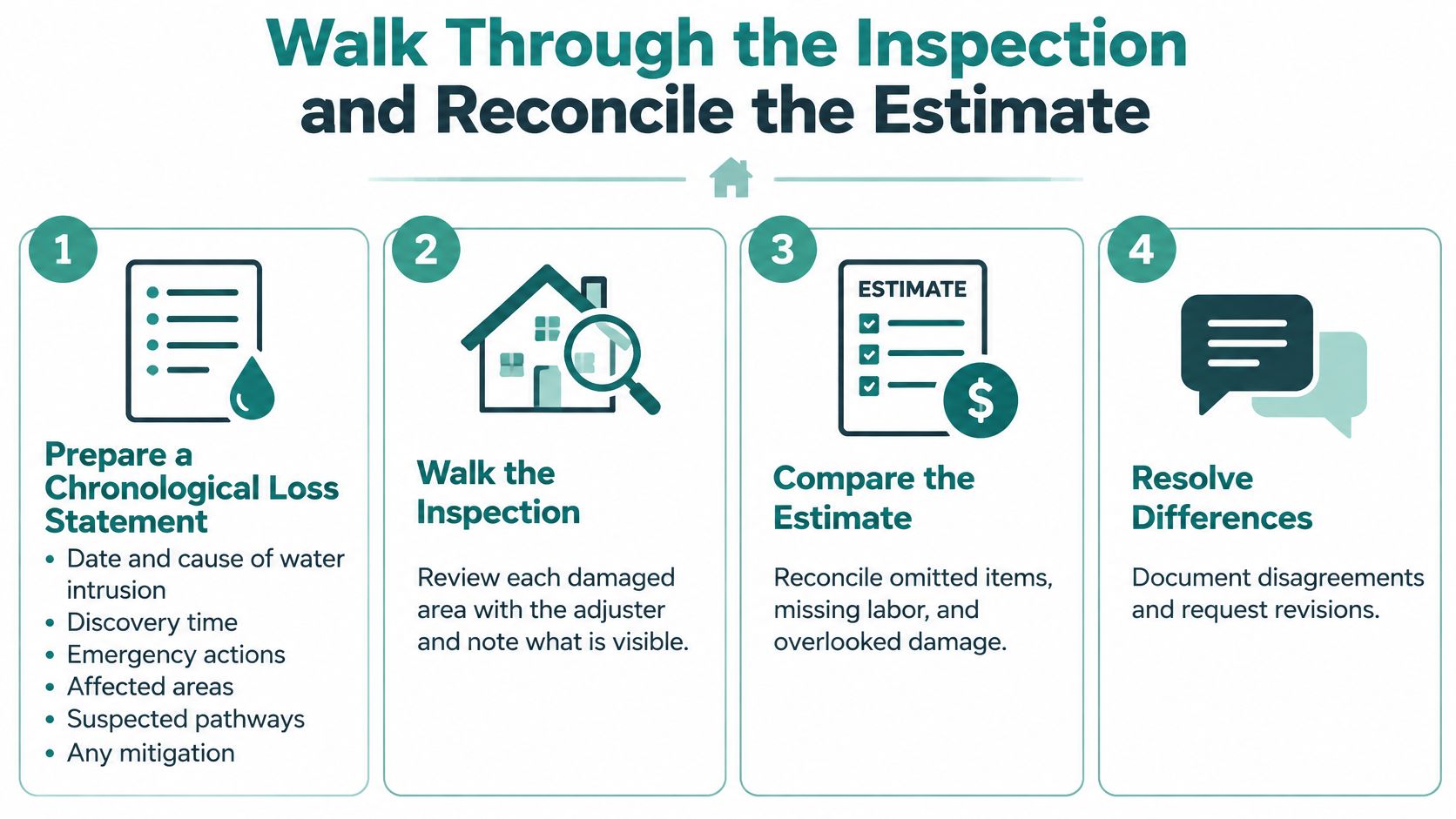
Turn the inspection into a scope review
Prepare the chronological loss statement. Include the discovery time, known or suspected source, emergency actions, affected areas, water pathways, and prior unrelated conditions. Distinguish observed facts from matters still under investigation.
Walk each affected assembly. Ask that drywall, insulation, flooring, cabinetry, electrical components, and contents be recorded separately. Point out contractor findings without presenting suspected concealed damage as already confirmed.
Request written explanations. Disputed causation, excluded work, depreciation, and pricing assumptions should be identifiable in the insurer's response. Ask what additional evidence would support reconsideration.
Compare quantities before totals. Request the complete estimate and policy basis, then check it against the contractor's scope. Include containment, testing, rebuilding, matching materials, permits, and applicable coverage for code-related work.
Submit a numbered supplement package. Match each requested change to photographs, measurements, invoices, or policy language. Document newly discovered conditions during authorized work before those conditions are covered again.
Track delivery and responses. Retain submission confirmation, request a written answer to each disputed item, and confirm telephone discussions by email. Keep emergency mitigation invoices separate from reconstruction estimates.
Estimate lines to compare and the evidence to send
| Estimate Line | Question to Ask | Evidence to Send |
|---|---|---|
| Demolition and drying | Do removal quantities match the contractor scope? | Moisture logs, photos, measurements |
| Concealed damage | Are wall cavities, subfloor, and insulation behind affected materials accounted for? | Opening photos, moisture readings |
| Code-required upgrades | Does the scope include work local code requires for the repair? | Permit records, code citations |
| Labor rates and overhead and profit | Do the rates and percentages match local written bids? | Written bids, rate sheets |
| Additional living expenses | Are increased lodging and meal costs during repairs included? | Dated receipts, normal-expense comparison |
A contractor's estimate is evidence of repair needs and pricing. Coverage still depends on the policy, so support each disputed line with the documentation above rather than relying on the bid alone. Ask the contractor to explain each difference in missing work, quantities, or pricing before comparing totals, since a higher number earns credibility only when it shows what the insurer's scope left out.
The water damage restoration cost guide can help homeowners identify cost categories worth checking. Overhead, profit, matching, code upgrades, and living expenses must still be evaluated under the applicable policy.
For flood claims, FEMA's policyholder forms include a proof of loss requiring a signed statement of the amount claimed with supporting documentation. For a large or disputed loss, legal or licensed public-adjuster review before signing a proof of loss or release can help identify unresolved scope and valuation issues.
Escalate a Denial or Stalled Claim
Start with the insurer's written position. A denial or partial denial should identify the policy language and facts the insurer relied upon; if that explanation is missing, request it before submitting a rebuttal.
Compare the letter with the loss timeline, contractor findings, and written causation explanation. The response should address the insurer's actual reasoning, not assume every disagreement is a low-estimate problem.
Separate coverage from valuation
- Coverage disagreement: The insurer says the water source or resulting damage is excluded. The response needs evidence addressing causation and the cited policy language.
- Amount disagreement: The insurer accepts coverage but disputes quantities, pricing, or repair methods. The response needs a line-item comparison and supporting repair evidence.
- Mixed disagreement: Some damage is accepted while other damage is attributed to an excluded condition. Ask the insurer to identify which materials and costs fall into each category.
For an incorrectly recorded condition, request a reinspection with the contractor present. A numbered rebuttal should connect each requested correction to a photograph, measurement, invoice, or relevant policy provision.
For an amount dispute, check whether the policy contains an appraisal clause and review its procedure before invoking it. Appraisal generally addresses valuation rather than deciding whether a water source is covered, although its permitted scope can differ under policy language and state law.
A complaint, reinspection request, or continuing negotiation shouldn't be assumed to extend a policy or legal deadline.
Respond to delay without losing the record
When the insurer provides no reasoning or appears to miss applicable response requirements, request supervisory review and a written status explanation. If that doesn't resolve the problem, a written complaint to the state insurance department can present the timeline and unanswered requests.
Keep copies of the complaint, attachments, and reply. The complaint process isn't a substitute for legal advice or a guarantee that the department will determine coverage.
Calendar applicable proof-of-loss, appraisal, repair-completion, and lawsuit deadlines. Confirm the policy requirements and state rules before sending a final response, and seek qualified legal advice promptly when a deadline or coverage interpretation is uncertain.
Decide Whether to Bring In a Public Adjuster
Hiring a public adjuster is optional, and it may not suit every claim. A small loss with an established cause and a largely accurate estimate may be manageable through a focused supplement rather than professional representation.
Public adjusters represent policyholders within the scope permitted by state law. They may help organize documentation, prepare estimates, and negotiate claim issues, but they can't guarantee coverage or a particular payout.
Handle it yourself or bring in help
| Situation | Reasonable First Move | When to Add Professional Help |
|---|---|---|
| Small loss, clear cause, estimate close to bids | Reconcile line by line and send a focused supplement | Optional, not required |
| Disputed cause or excluded water source | Request the written causation theory and preserve evidence | Recommended before responding |
| Large, documentation-heavy residential loss | Build the full inventory and claim file | Consider a licensed public adjuster |
| Commercial property or business interruption | Track lost income and keep invoices separate | Consider a licensed commercial public adjuster early |
| Proof of loss or release to sign | Read scope, depreciation, and deductible terms | Get legal or licensed adviser review first |
The trade-off is between handling the file personally and paying for assistance with a demanding process. Before signing an engagement, review the proposed scope, fee arrangement, cancellation provisions, and licensing requirements applicable in the state.
A professional becomes more useful when the problem extends beyond collecting another contractor bid. Competing causation opinions, extensive contents inventories, repeated scope omissions, or substantial documentation requirements can justify earlier involvement.
Commercial claims add another layer. A repair estimate alone won't explain lost income, interrupted operations, or the relationship between restoration progress and business reopening.
Choose the next action by the unresolved issue
PostDamage helps property owners understand when hiring a public adjuster may be appropriate. An insurer's adjuster works on the insurer's behalf, so independent assistance serves a different role.
The practical next move is to identify the matching situation in the table, complete the supporting file, submit the appropriate supplement or rebuttal, and obtain a written response. If the remaining dispute requires policy interpretation or legal action, an attorney may be the more appropriate professional.
PostDamage offers insurance claim help for property owners whose water-damage claim was denied, delayed, or paid less than expected. Homeowners seeking assistance can visit PostDamage to request a connection with a licensed professional. PostDamage is an information and referral platform and doesn't directly adjust, negotiate, or settle claims.