
The denial letter arrives while the tarp is still on the roof, the kitchen floor is still damp, or the shop is still closed. It cites an exclusion, disputes the cause, or offers far less than the repair estimate, and the deadline to respond may already be running from the date printed on the page. Learning How to Appeal Insurance Claim Denial decisions starts with slowing that moment down. The strongest response isn't a quick phone call or a general complaint. It's a dated, evidence-backed appeal that answers the insurer's stated reason and preserves the record while emergency work continues.
How to Appeal a Denied Property Claim Step by Step
A denial can cover the whole claim or only part of it, and a partial denial still leaves the unpaid portion open to appeal.
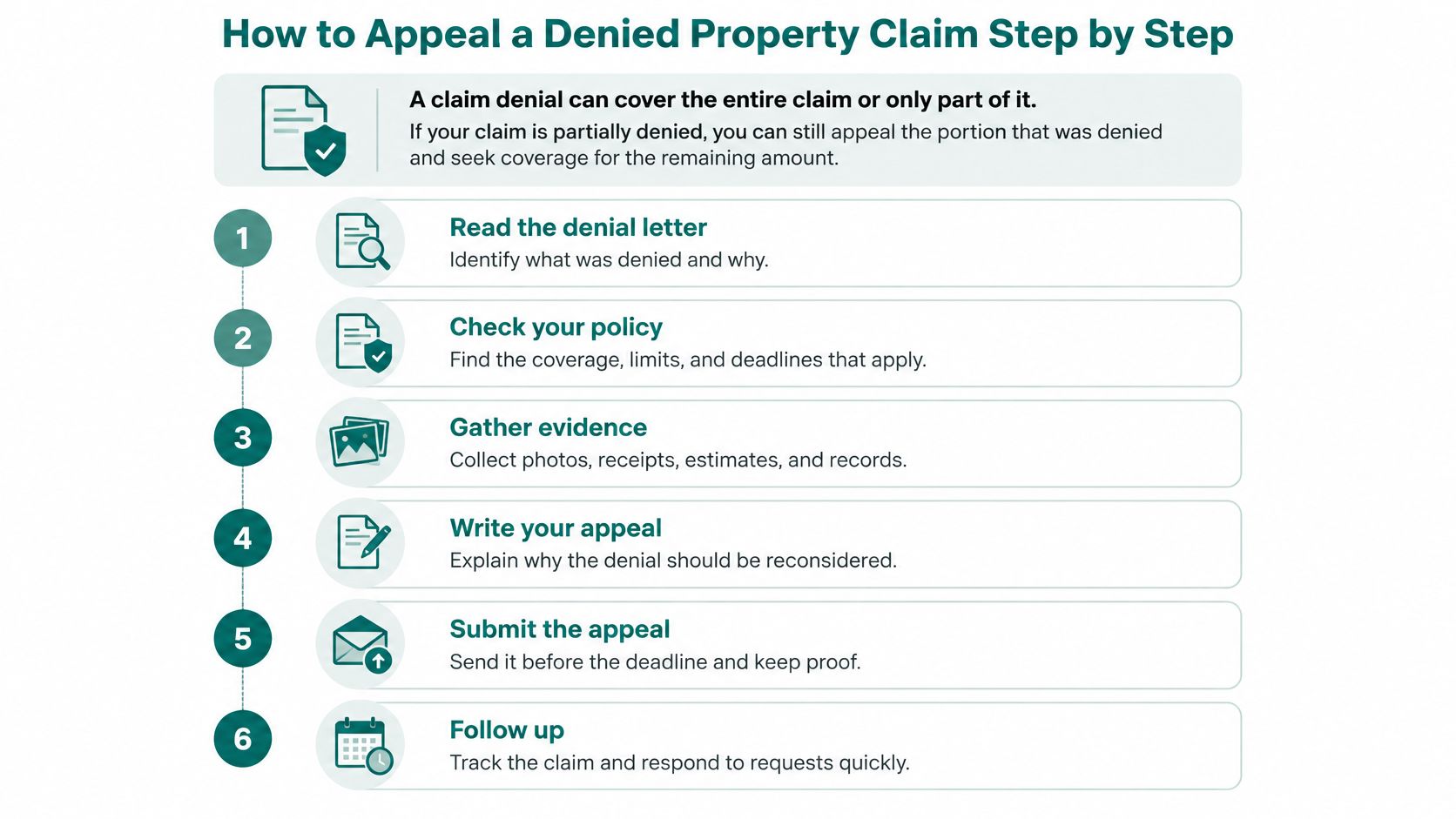
- Read the denial letter line by line. Note the stated reason, every policy section cited, and the date written on the letter. That wording defines what the appeal must answer.
- Calendar the deadline from the letter date. Don't count from the day the envelope was opened. Check the policy and state rules for the controlling window, because homeowners and commercial policies don't all use the same period.
- Request the complete claim file. Ask for the adjuster's estimate, photographs, inspection notes, and any engineering or moisture reports. The file shows what the insurer examined and what it may have missed.
- Compare estimates line by line. Mark every omitted room, quantity difference, pricing gap, depreciation item, and denied category. A broad claim that the payment is too low gives the adjuster no specific line to reconsider.
- Gather evidence for each disputed point. Match photographs, invoices, reports, and competing estimates to the exact denial reason rather than sending an unsorted folder.
- Send a written appeal and keep proof. State the requested remedy, ask for a written response by a stated date, and retain a complete copy with proof of delivery.
Common Slips That Weaken the Appeal
Phone calls leave no reliable record of what was promised or requested. Confirm important conversations in writing the same day. An appeal without a specific requested remedy also tends to draw a generic reply that restates the original decision.
Before sending step six, the folder should contain the denial letter, declarations page, insurer estimate, dated photos, policy provisions at issue, and an indexed set of exhibits.
That folder becomes the working record for reconsideration, appraisal, a regulator complaint, or professional review. Keep it organized from the start, because rebuilding dates and missing invoices later is harder once repairs are underway.
Match Each Denial Reason to the Evidence That Answers It
Different denial reasons require different proof. A valuation dispute needs pricing reconciliation, while a causation dispute needs evidence linking the damage to a covered event at a specific time.
| Denial reason | What the insurer is saying | Evidence that answers it |
|---|---|---|
| Coverage exclusion | The damage type or cause falls under an excluded peril | Exact policy language, endorsements, and a dated loss chronology showing a covered peril |
| Causation | The damage came from wear, gradual leakage or a pre-existing condition | Moisture or engineering report, dated photos, and contractor notes on the cause |
| Late notice | The claim was reported after the policy's notice window | Record of when the damage was discovered, first notice to the insurer, and the reason for any delay |
| Scope | Only part of the damage was accepted | Room-by-room itemized estimate with quantities, labor and materials |
| Valuation or depreciation | The payment is lower than your estimate | Line-by-line reconciliation, replacement cost documentation, and code-upgrade costs |
| Proof of ownership or loss | The insurer disputes items or amounts | Inventory with purchase records, receipts, photos, and approximate ages of items |
| Missing documentation | The insurer says the proof of loss was not received | Signed proof of loss, index of submitted records, and proof of delivery |
Start With the Policy Language, Then the Facts
Quote the exact insuring agreement, exclusion, endorsement, deductible, and loss-settlement provision the insurer relied on before arguing the facts. A FEMA technical clarification on flood claim filing periods also reflects the wider point that deadlines vary sharply by product and jurisdiction, with NFIP appeals generally requiring filing within 60 days and a 180-day period identified for certain flood-claim litigation or statutory appeal contexts. The same source framework separates coverage, causation, valuation, and procedure because each needs different proof.
For causation, build a dated chronology from discovery through mitigation, inspection, and repair. Pair it with contemporaneous photos, moisture or engineering findings, contractor notes, and invoices. That sequence matters on gradual-leak disputes, which readers can also explore through guidance on water damage insurance coverage and claim issues.
For valuation, reconcile quantities, unit prices, depreciation, actual cash value, replacement cost, and code-required work line by line. For business losses, document revenue, continuing expenses, payroll, restoration milestones, the waiting period, and the period of restoration separately.
If a piece of evidence can't be tied to a specific sentence in the denial letter, it probably belongs in background, not at the center of the appeal. The appeal is ready when every disputed line has a policy citation, a factual answer, and a labeled exhibit.
Preserve Evidence by Claim Type Before Repairs Begin
The central conflict is simple. The owner must stop further damage, but removing debris or making permanent repairs too early can make causation and scope harder to prove.
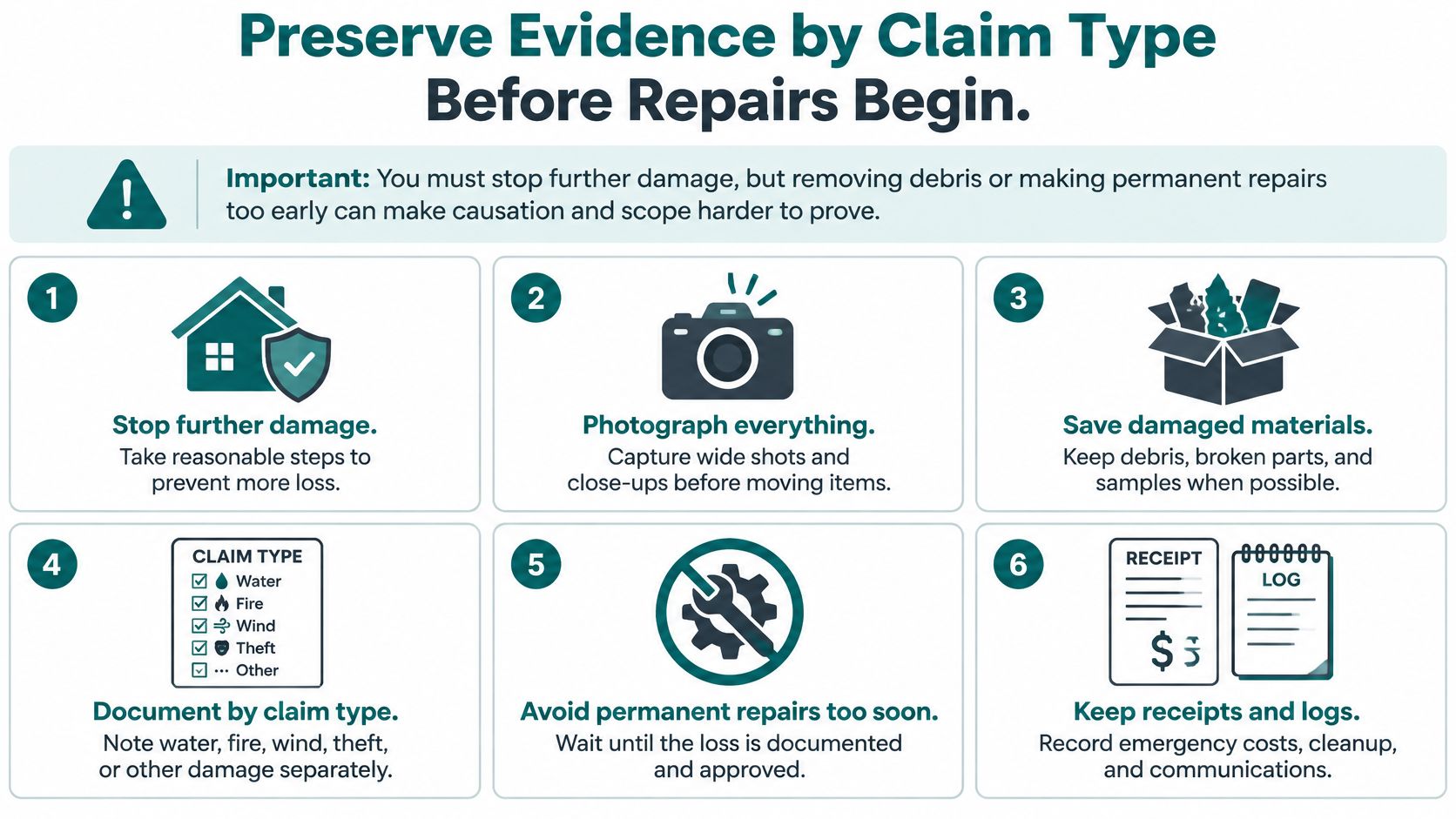
NAIC consumer guidance on documenting property losses warns policyholders to document losses before removing debris or belongings, preserve damaged items when possible for inspection, and avoid permanent repairs before inspection because repairs may prevent adequate examination. The guidance also supports keeping receipts and records of improvements. Emergency stabilization and permanent reconstruction should therefore be treated as separate stages.
Preservation Checklist Before Destructive Work
- Photograph and video every stage: Capture wide views and close-ups before debris, flooring, drywall, or contents are moved.
- Retain materials where safe: Keep damaged items or representative samples for inspection when storage doesn't create a health or safety hazard.
- Save mitigation records: Keep invoices, drying logs, moisture readings, and engineering reports with dates and locations noted.
- Notify the insurer in writing: Before destructive or permanent work, state what's proposed and ask for written confirmation if inspection can't happen promptly.
- Log communications: Record who authorized emergency work, when access was offered, and what the insurer requested.
Adjust the Record to the Claim Type
- Water: Moisture logs, the identified leak source, drying records, mold remediation records, and the sequence described in guidance on filing a water damage insurance claim
- Fire and smoke: Photos of residue on surfaces, a contents inventory with approximate ages, cleaning invoices, and records separating burned from smoke-affected areas
- Roof, wind, and hail: Date-stamped photos of shingles and each slope, weather reports for the storm date, and earlier roof repair records
- Business interruption: Revenue for comparable months, payroll, continuing expenses, restoration milestones, and the policy's waiting period
Policy wording and local law control the timing and duties for each item. When safety requires immediate removal, photographs, retained samples, and written notice help show what existed before conditions changed.
Write an Appeal Letter the Insurer Has to Answer
A usable appeal letter reads like an indexed response, not a narrative of frustration. The adjuster should be able to find each disputed point, the policy language, and the supporting exhibit within seconds.
Header and Opening Statement
Start with the claim number, policy number, property address, and the date printed on the denial letter. Add one sentence stating that the decision is disputed in whole or in part and that written reconsideration is requested. Identify whether the request concerns coverage, scope, valuation, depreciation, a procedural issue, or a combination.
One Short Section for Each Disputed Issue
Follow the order used in the denial letter. In each section, quote the exact provision the insurer relied on, state the factual point in dispute, and cite the exhibit that answers it, such as Exhibit 4, day-two moisture readings or Exhibit 7, itemized roofing estimate.
Name a specific remedy for each issue. The letter can ask the insurer to reconsider named estimate lines, pay a stated amount for a defined repair, revise depreciation, or reinstate coverage for a named item. A general statement that the decision is unfair doesn't tell the adjuster what decision to make instead.
Requests That Force a Complete Reply
Make three direct requests near the end of the letter.
- Complete claim file: Request the estimate, photos, inspection notes, and reports relied on for the decision.
- Estimate basis: Ask for the quantities, pricing source, depreciation method, and scope assumptions behind disputed lines.
- Written reasoning: Ask for policy citations and factual reasons for any part that remains denied.
Request a re-inspection or reconsideration meeting when the dispute turns on physical facts that photographs can't settle. Attach a paginated exhibit index so the insurer can't credibly claim that records were missing or impossible to locate.
The same complete file also helps if the dispute moves beyond the insurer. The NAIC guide to filing an insurance complaint explains that state departments maintain consumer-complaint systems and that the NAIC publishes reports based on information supplied by state insurance departments, including common closed and confirmed complaints. A complaint isn't automatically an appeal, lawsuit, or appraisal, so policy deadlines still control.
An appeal that quotes the policy and answers the stated reason is stronger than one that objects in general.
Flood Claims Under NFIP: The FEMA Appeal Route
The first task is confirming that the policy is a National Flood Insurance Program policy. NFIP claims follow a federal pathway, so the FEMA appeal is the governing channel even where a state insurance complaint would normally apply.
For NFIP claims, the FloodSmart guide to appealing a claim states that the policyholder must submit a written appeal to FEMA within 60 calendar days of the date on the insurer's decision letter. Count from the date written on the decision, not the date it was read. That date controls the sequence: secure the letter and its envelope as claim evidence before cleanup or repair work alters the property, and never assume a later date applies without written confirmation.
What the Appeal Packet Should Contain
- Complete denial letter: Include every page of the final written determination, including a partial denial.
- Policy and claim identification: List the policy number, claim number, insured property, and date of loss.
- Policy provisions in dispute: Identify the specific provisions and estimate lines being challenged.
- Plain explanation of disagreement: State whether the issue is coverage, causation, scope, valuation, depreciation, or missing documentation.
- Evidence organized by line item: Label each exhibit so it matches the disputed room, item, quantity, or cost.
Under 44 CFR 62.20, the federal regulation governing NFIP claim appeals, FEMA identifies relevant evidence including the proof of loss, room-by-room itemized estimates showing quantities and unit costs, replacement-cost documentation, and adjuster reports. Personal-property inventories should include approximate ages. Real-estate appraisals should exclude land value. Photographs should show interior and exterior direct physical flood damage clearly, which is one more reason documentation comes before demolition.
Build the Packet Around Reconciliation
Create a coverage-and-damages matrix before drafting. Place the insurer's line, quantity, unit cost, depreciation, and stated reason beside the competing estimate and the exhibit that supports each row. Unsupported aggregate demands are weak because they never show which quantity or price is wrong. A line-level matrix does.
The federal regulation governing NFIP claim appeals provides that FEMA issues an appeal decision in writing within 90 days after all information has been submitted, so confirm the current regulation and the governing policy before relying on that timing. A longer period may apply in certain litigation or statutory contexts. Treat the FEMA submission as a concise, evidence-indexed appeal with a specific requested remedy: a defined dollar amount, a revised scope, or a coverage determination the record supports.
Escalation Routes and Deciding Whether to Get Help
Each escalation route answers a different question. A regulator tests how the claim was handled, an appraisal panel prices the loss, and an attorney interprets the contract. The strongest file in the wrong forum still loses, so match the route to the decision it can make.
| Route | What it can decide | What it cannot do | Use it when |
|---|---|---|---|
| Written reconsideration with the insurer | The insurer reviews new evidence and states its reasoning in writing | Cannot bind the insurer without a supported change | First step after a denial or underpayment |
| State insurance department complaint | The regulator investigates whether the insurer followed claim-handling rules | Cannot rewrite policy language or set the full property value | The insurer is slow, unresponsive or appears to have investigated poorly |
| Appraisal clause, if the policy has one | A panel resolves the disputed amount of loss | Usually does not decide coverage questions | The disagreement is about price or scope, not whether the loss is covered |
| Licensed public adjuster | Documents damage, prepares an estimate and negotiates within state law | Cannot guarantee a higher settlement | The claim is large or complex, or you lack time to manage it |
| Attorney | Advises on coverage and litigation options | Cannot override contract deadlines | The denial appears wrongful or a deadline to sue is near |
Understand the Regulator Limit
A state insurance department can investigate an insurer that unfairly delays or denies a claim and can take enforcement action when claim-handling rules are broken. State insurance departments report meaningful recoveries through complaint handling: Maryland stated that its 2025 Rapid Response Program closed 2,207 complaints and recovered nearly $6 million, while its formal property-and-casualty complaints unit closed 8,480 and recovered nearly $11.4 million.
Those figures show practical value, not a promise that a complaint will value the loss. Regulators generally don't act as replacement adjusters, rewrite policy language, or independently determine the full value of damaged property. A complaint also shouldn't be assumed to stop a contractual suit deadline. File it to obtain written explanations, expose delay or inadequate investigation, and create a record, while the underlying proof of loss is still developed on a separate track.
Apply a Simple Decision Test
The deciding factor is the file itself. If the denial turns on one or two documented facts, such as a missing estimate line, an omitted room, or a receipt, a policyholder can often send the appeal directly within the window because the evidence already in hand answers the stated reason. If the dispute involves a large valuation gap, business income, hidden damage, or a contested cause of loss, licensed professional help deserves consideration, including the options explained under insurance claim help for denied or underpaid claims.
Sequence matters as much as selection. Request written reconsideration first, because it forces the insurer to put its reasoning on record. A department complaint can run alongside it rather than waiting for a final answer, and appraisal only makes sense once coverage is conceded and price is the remaining fight. PostDamage, an information and referral platform rather than an insurer or adjusting firm, explains that public adjusters are different from insurance company adjusters, who work on behalf of insurers, and that hiring one is optional and may not be appropriate for every claim. Fees and permitted practice vary by state.
Before escalating, confirm the letter date, the policy wording, and the local rules that govern each route. Ask the insurer to confirm any response date in writing, set a follow-up date, and decide in advance what happens if the reply is vague or late. An escalation plan with a calendar behind it protects the record; one driven by frustration burns the window.
If a denied, delayed, or underpaid property claim needs an evidence review before the next deadline, PostDamage offers an insurance claim help service and can help property owners understand whether a licensed public adjuster may be appropriate. The review request is free, takes about one minute, and carries no obligation, but PostDamage does not guarantee insurance outcomes, settlements, or payouts.