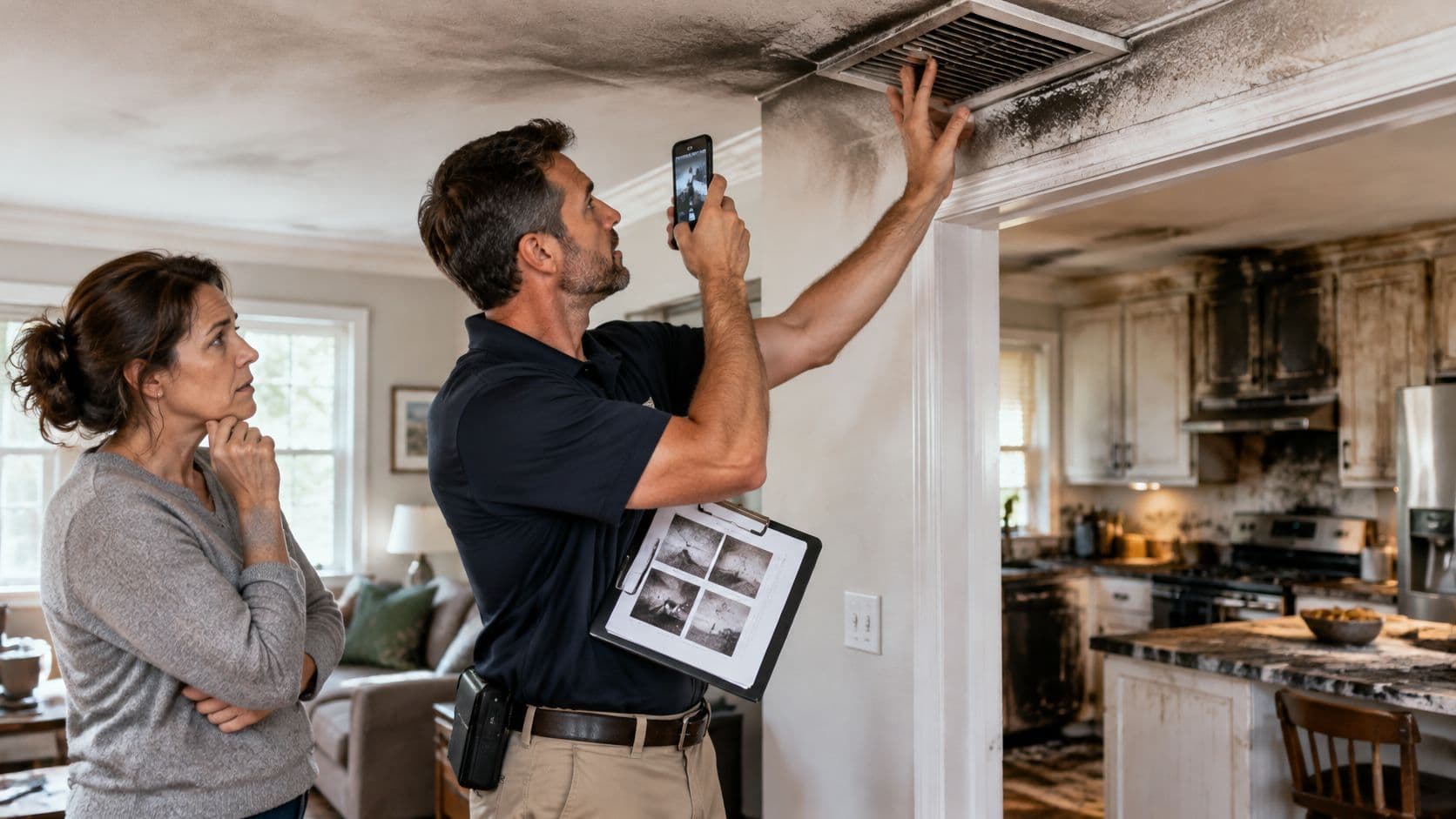
Across all reporting U.S. underwriters, 37.4% of 8.8 million homeowners claims were closed without payment in 2023, according to Weiss Ratings. A share that large makes a denial letter feel like the end of the claim. Often it is only the end of the first pass.
Closed without payment and a true coverage denial are different outcomes. The file may sit under the deductible, the claim may have been withdrawn, or the carrier may have stopped because proof never arrived. A nonrenewal months later is a third event, about the next policy term, not this loss.
When a home insurance claim denied notice arrives, the useful first move is a claim-status audit. Copy the stated reason, match it to the loss date and the peril the policy names, and gather only the papers that answer that sentence. Nothing in the audit guarantees payment. It does stop a homeowner from fighting the wrong problem.
Sort the Denial Before You Challenge It
In the ZIP codes already facing the heaviest climate risk, carriers are also refusing to renew more policies. U.S. Treasury data covering 246 million policies found that nonrenewal rates in the highest climate-risk ZIP codes were approximately 80% higher than in the lowest-risk ZIP codes, while average claim severity was about $24,000 versus $19,000. Higher severity and higher nonrenewal travel together. Neither figure decides whether this claim was handled correctly.
A nonrenewal is a decision about future coverage. It is not proof the earlier claim was mishandled, and a denial doesn't automatically explain or prevent that later notice. Cancellation ends the policy on the date the notice states. A post-loss coverage dispute asks whether this event is payable. Those are four different paper trails.
The National Association of Insurance Commissioners separates claims that were not paid from denials based on inadequate documentation or a loss treated as pre-existing. A closure without payment can be damage below the deductible, a withdrawn claim, or incomplete information. Read the letter for that stated basis. The ratios compare carrier conduct across jurisdictions. They don't rule on one homeowner's file.
What the letter is actually saying
Collect the denial letter, the provisions it cites, the adjuster estimate, photographs, expert reports, claim notes if the carrier will release them, and any renewal or nonrenewal notice. Set each page against the loss date and the named peril. A failed supply line and rising floodwater can share a photo and still belong on different contracts. Check whether homeowners insurance covers water damage before labeling the peril excluded.
Practical rule: Mark one primary row. A deductible calculation is not a causation essay.
| Letter result | Usual meaning | First documents to request |
|---|---|---|
| Coverage denial | Insurer says this loss is not covered | Denial letter and cited exclusions |
| Closed without payment | File closed, not always a coverage denial | Closure reason, deductible math, withdrawal notes |
| Inadequate documentation | Insurer says proof was missing | Proof-of-loss status, photo log, estimate request |
| Pre-existing damage | Insurer says damage predates the loss | Inspection notes, prior repairs, date-stamped photos |
| Causation dispute | Insurer names a different cause | Weather record, expert notes, room photos |
| Excluded peril | Policy leaves out that cause of loss | Endorsements and flood versus homeowners forms |
| Deductible or depreciation | Payment reduced or zero after policy math | Declarations page and actual cash value calculation |
| Partial denial | Some items paid and others refused | Line-item estimate and denied lines only |
| Nonrenewal or cancellation | A future coverage decision, not this loss | Nonrenewal notice, claim history, and loss date |
On the matching row, note the denial date, the cited policy language, the adjuster estimate, the photographs, and any renewal notice. Check each item against the loss date and the peril named in the letter. Write the dispute only after that one row is marked. Complaint paths and remedies still differ by jurisdiction, so the audit sorts the problem. It doesn't replace the policy or state law.
How to Challenge a Denied Home Claim
Start only after the audit gives the letter one primary classification: coverage denial, closure without payment, documentation gap, deductible or depreciation result, partial refusal, or a later nonrenewal. Aim the packet at the one sentence the carrier wrote.
The first pass stays short on purpose.
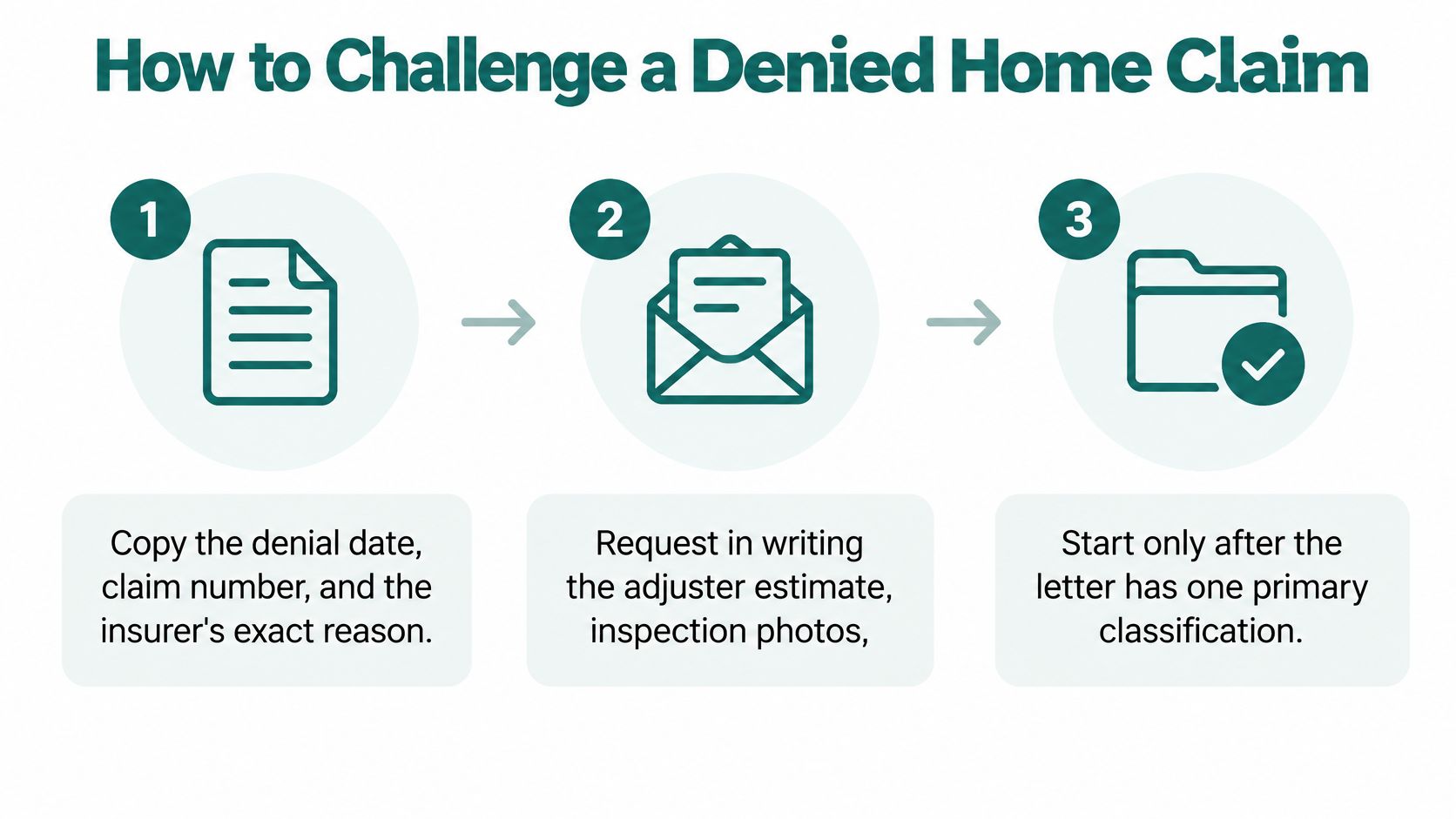
- Copy the denial date, claim number, and the insurer's exact reason. Put that sentence at the top of a blank page. A paraphrase can answer a problem the carrier never raised, so the reviewer has nothing to correct.
- Request the file in writing. Ask for the adjuster estimate, inspection photos, claim notes where the carrier will release them, and the policy provisions relied on. A dated request shows what was asked for and when.
- Build one row per denied item. The columns are the policy provision, the observed damage, the quantity, the photo or report, and the result requested. On a partial denial, include only the refused lines. Paid lines stay out of the argument.
- Draft a short dispute that answers only that reason. If the letter says wear and the photos show a storm-opened roof, say that and attach the dated pictures. If the letter says proof was missing and the file shows no written request for that proof, say that instead. Don't add a second theory.
- Attach estimates that show quantities and unit costs. A lump sum gives a reviewer nothing to accept line by line. Squares of roofing, feet of drywall, and a unit price are what an estimate review uses.
- Send one packet with dated delivery confirmation. Keep a full copy, including the index. If a page goes missing later, the receipt shows what left the house.
- Escalate only if the result doesn't change. Move from the assigned adjuster to a supervisor, then to the path the policy names. That path may be appraisal, a state insurance-department complaint, or litigation. A flood policy uses a different sequence, so a homeowners deadline shouldn't be borrowed for it. No step on this list guarantees payment.
A page that can be finished today
A same-day outline has five lines. The denial sentence. The documents requested. The matrix of denied items. The one fact that answers the sentence. The delivery method. Stop there until the carrier replies.
If the policy includes appraisal, invoke it in writing only where the policy allows it. Otherwise file a complaint with the state insurance department where the home is located, and attach the matrix plus the denial letter. Deadlines and complaint procedures vary by state, so the local rule has to be confirmed before filing. A department complaint creates a record and can require a written response; a technical question about how a roof was built belongs to the policy path that can examine it.
Deadlines and the File You Should Keep
Find four dates before another letter goes out. Each one can end the dispute for a different reason, and none of them is "whenever the repairs finish."
| Date | Where to find it | Why it can end the dispute |
|---|---|---|
| Loss date | Declarations page and first claim report | Anchors the covered period and the named peril |
| Notice date | Claim acknowledgment and first written notice | Late notice can give the insurer a defense |
| Denial or closure date | Denial letter or closure notice | Starts the 60-day NFIP appeal clock |
| Proof-of-loss or suit-limitation date | Policy conditions section | A missed date can bar recovery entirely |
Loss date shows whether the policy was in force and which peril is being named. Notice date matters because late notice can give the carrier a defense even when the damage is real. Denial or closure date is the date printed on the letter, not the afternoon the email was opened. Proof-of-loss or suit-limitation date sits in the conditions. Miss it, and recovery can be barred even if the loss was covered.
Homeowners forms and commercial property forms set their own notice, proof-of-loss, appraisal, and lawsuit deadlines. The policy in hand, and the law where the property sits, control those clocks. A commercial building with a business-income endorsement can carry a different suit limitation than the house next door. Read the conditions, not a memory of a typical form.
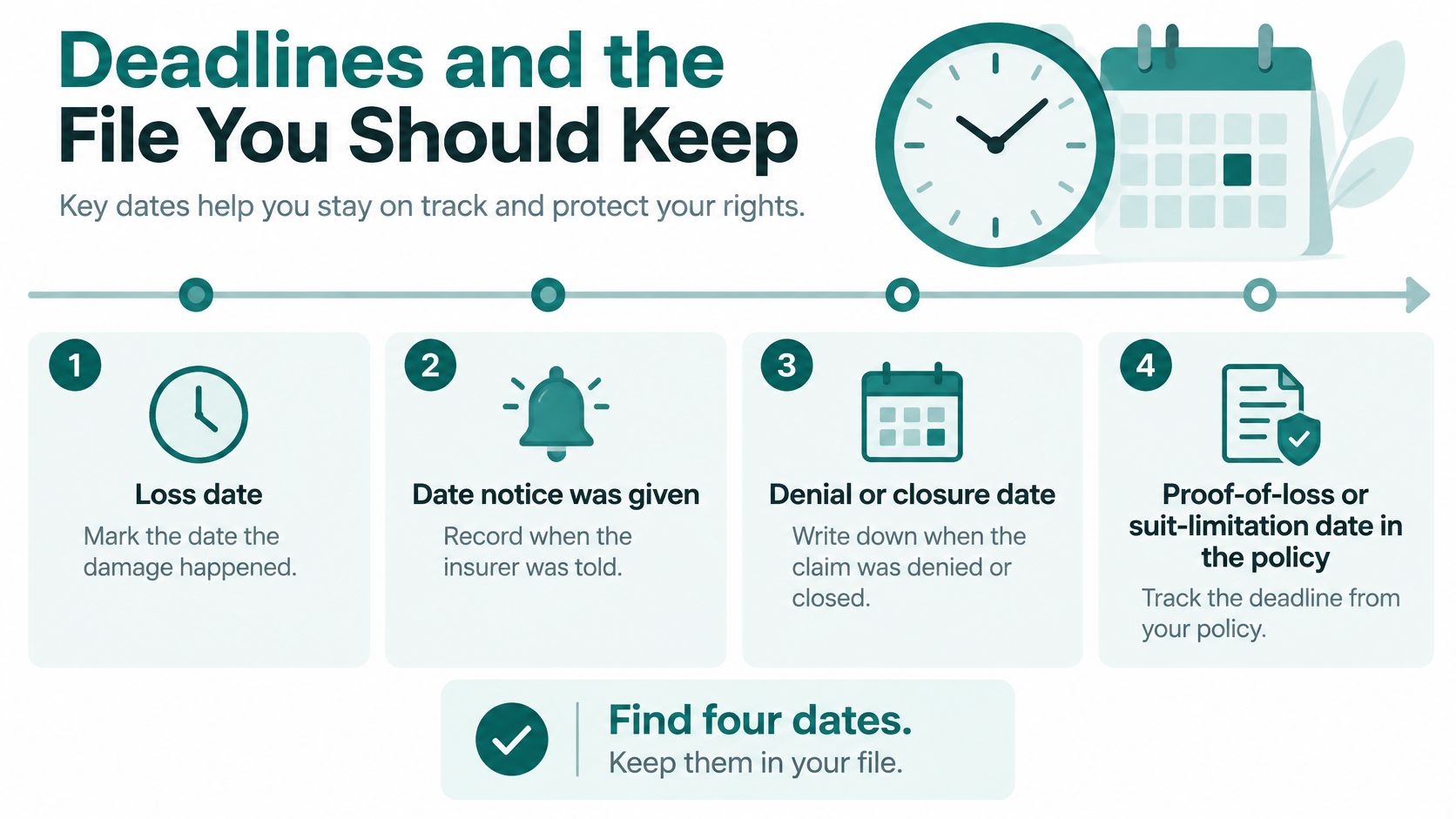
Put the four dates on one calendar. Save the delivery receipt for every submission on the same page.
Flood claims run on a separate clock
A denied or partly denied National Flood Insurance Program claim has its own sequence. Ask the assigned adjuster to explain the determination, request supervisor review, contact the insurer's claim representative, and, if the dispute is still open, send a written appeal to FEMA. The FEMA claims manual requires that appeal within 60 days of the denial letter. Missing the deadline can eliminate the federal appeal route.
The appeal should identify the policyholder, property address, policy number, contact information, denial date, disputed issues, prior communications, and the specific policy or factual disagreement. Useful enclosures include the denial letter, the submitted proof of loss, room-by-room estimates with quantities and unit costs, contractor estimates, preliminary and final adjuster reports, photographs, drying logs, and a contents inventory with approximate ages.
A general complaint is weaker than claim-specific proof. Map each denied line to the policy provision, the observed damage, the estimate quantity, a photograph or expert note, and the resolution requested. Keep dated delivery confirmation for every submission. That 60-day path belongs to NFIP flood claims. It is not the deadline printed in a standard homeowners or commercial property policy.
Damage Evidence That Supports the Dispute
After Sandy in 2012, nearly 75,000 flood-insurance claims were filed by New Jersey homeowners. The same reporting tracked that wave to early July 2017: the National Flood Insurance Program had paid 58,055 policyholders a combined $3.9 billion, while 6,532 claims had been rejected and closed without payment, and approximately 1,500 additional cases remained in litigation more than two years after the storm.
Paid, closed without payment, still in litigation: one catastrophe, three different claim statuses. That spread matters because the evidence that answers a true coverage denial is different from the paperwork that reopens a file closed for missing documents. The recurring Sandy fights were flood exclusions, alleged pre-existing damage, storm surge versus another cause, and disagreements over inspections and payment amounts. A denial figure without claim type, policy form, and causation is only a headline. The practical lesson is to record the scene while it still exists.
Match the photos to the peril
A kitchen supply line fails overnight. Photograph the source, the water line on the walls, and each wet room before drying starts. Keep the contractor's drying logs and moisture readings. Filing a water damage insurance claim is clearer when those readings exist, because dried drywall looks ordinary a week later.
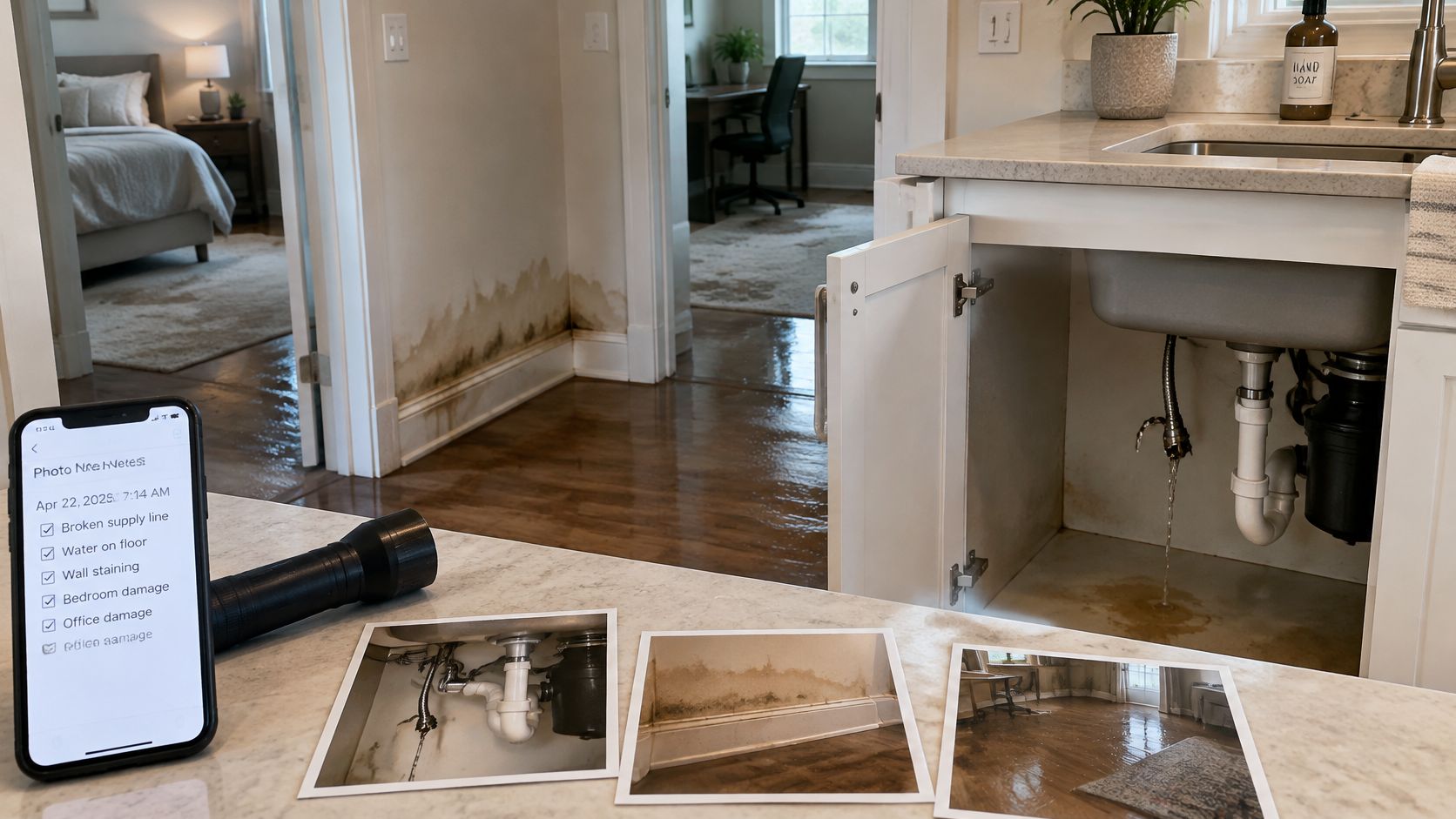
Fire and smoke leave a different record. Photograph soot on walls and ceilings before any cleaning. List damaged contents with approximate age, brand, and replacement cost. Smoke that traveled into closets disappears from the file if the list stops at the burned room.
Wind, hail, or a fallen tree shows up on slopes and stains. Photograph each roof slope, interior ceiling stains, and nearby collateral such as fences or gutters. Tie the loss date to a dated weather report so the event can't be slid to a different week.
Theft or vandalism needs an outside record. File a police report and attach the contents list, with purchase proof where it still exists. Without the report, the file often stalls on whether a theft happened at all.
Answer a different cause with dated observations
When the letter names long-term seepage and the homeowner believes the release was sudden, the next request is the carrier's inspection notes. The answer is a dated expert report, or a contractor's note that separates fresh staining from old discoloration. Arguing the category in the abstract doesn't move the line item.
The status audit can change what counts as evidence at all. If the letter turns out to be a deductible or depreciation result rather than a refused coverage, dated repair invoices and proof of completed work carry the dispute further than another round of damage photos. Matching the proof to the actual status is faster than building a bigger pile of the wrong documents.
Label every photo with the date, the room or roof slope, and the denied line item it supports.
A picture of "the house" doesn't answer a refused line for the north slope or the hallway ceiling. The label does that work before anyone argues about it.
Mistakes That Stall a Claim Dispute
A verbal "we'll take another look" never lands in the claim file. Log every call with the date, the person's name, and what was promised. If it isn't written down, treat it as unsaid, and send a short note the same day that restates the promise. That habit prevents a later argument about a commitment nobody can find.
Make reasonable temporary protection, such as tarping a roof or extracting standing water, but photograph the damage first and keep every receipt. Skipping the photos to get the house dried is how a real loss turns into a documentation problem. Skipping the tarp is how a small opening becomes a second loss the policy may not treat the same way.
The indexed packet and the line-by-line estimate comparison are covered in the challenge steps; run them in that order. The mistakes that stall a dispute even after those steps are done right look different.
Keep the tone factual and short. Each message names the one denied item and the document that answers it. A long history of phone frustration buries the sentence a reviewer needed, and it doesn't change a causation finding. The same rule holds whatever the audit turned up: a true coverage denial, a closure without payment, or a depreciation result that only reads like a refusal.
Answer the sentence in the denial letter; ignore the frustration with the carrier.
The last stall is waiting for a perfect file while a deadline runs. If a date that can bar the claim is close, send what exists with delivery confirmation rather than holding out for a complete binder.
Choose Your Next Move After the Denial
The audit already names the next move, and each status wants a different one. A closure without payment or a missing document is clerical: finish the written response, attach the proof, and watch the dates. A deductible or depreciation result is math, so re-run the numbers against the declarations page before treating it as a denial. A nonrenewal notice sits outside the claim entirely, so the move there is lining up new coverage before the term ends. A professional can't create photographs that were never taken, and a small, clear-cut file rarely needs outside help.
A true coverage denial is different. When the fight is about cause, repair scope, a large estimate, or a payment far below damage that is still visible, a licensed public adjuster may help with documentation, estimates, and negotiation where state law allows. Hiring one is optional and isn't useful for every claim. A public adjuster represents the policyholder, a different role from the adjuster the insurance company sends.
PostDamage offers a free insurance claim help review that takes about a minute and carries no obligation, for property owners whose claim was denied, delayed, or paid less than expected. It connects owners with licensed public adjusters and isn't an insurance company, public adjusting firm, or law firm, so no outcome is promised.
Need help with a homeowners insurance claim? PostDamage can help connect you with a licensed professional. Coverage still depends on the policy and the law that applies to that property.
A denied claim reads like a verdict until the file shows which kind of no it is.