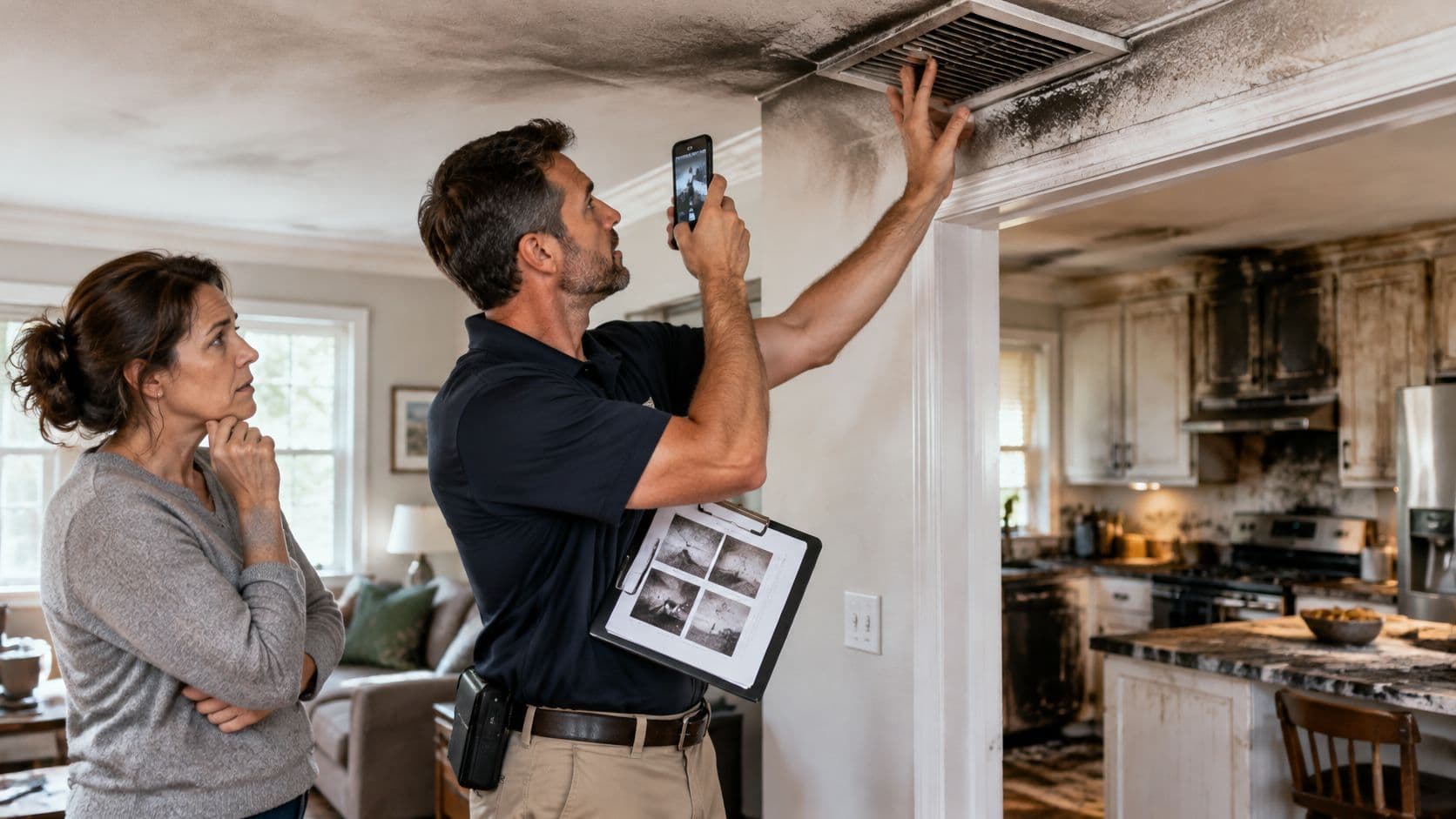
Water is still drying, a contractor's card is on the kitchen counter, and the insurer's first estimate doesn't come close to the repair quotes stacked beside it. Someone at the door says they can handle the claim for a percentage. Someone on the phone says the check is already in process. Signing anything in that moment feels risky, and waiting feels just as risky.
Hiring a public adjuster for insurance claim representation can help when the loss is large, the scope is disputed, or the paperwork is getting ahead of the property owner. It can also shrink the net recovery on a small claim that would have paid quickly without help. The difference rarely sits in the headline fee. It sits in who is representing the claim, what the percentage applies to, whether the license checks out, and whether the damage file can prove every line item.
Who Does What on Your Property Claim
After a storm, several people may knock, call, or follow up online within days. Titles sound similar, but the jobs point in different directions. A public adjuster is hired by the policyholder and represents the policyholder's claim within the scope state law allows. The insurer's staff adjuster works for the insurer, inspects the loss, and builds the company's estimate and coverage position. One answers to the person who owns the damage. The other answers to the company writing the check.
Property owners who want the lay of the land before talking to anyone can start with insurance claim help and then verify any individual who offers to take over the claim. PostDamage itself is an information and referral platform that connects property owners with licensed public adjusters rather than adjusting claims.
Sorting the Roles at Your Door
| Role | Works for | Can negotiate for you | How paid |
|---|---|---|---|
| Public adjuster | You, the policyholder | Yes, within state law | Fee set by contract and state rules |
| Insurer staff adjuster | The insurer | No | Paid by the insurer |
| Licensed attorney | You | Yes, in legal matters | Hourly, flat or contingency, per engagement |
| Independent appraiser | You, on valuation disputes | Limited to the amount-of-loss question under the appraisal clause | Flat or hourly fee in the engagement agreement |
| Contractor | Their own business | Usually not as a claim representative | Contract price for repairs |
| Referral platform | Information and referral | No, does not adjust, negotiate or settle claims | Not part of claim settlement |
A contractor can price repairs and explain construction scope. Pricing the work and representing the claim are different jobs, and the second one requires a license in most states. An attorney handles legal disputes, coverage litigation, and deadlines tied to suit. An appraiser fits a narrower fight about the amount of loss, and only when the policy's appraisal clause applies.
Catastrophe claims represented 42% of all U.S. home-insurance claims in 2024, while catastrophe losses represented 64% of total losses, according to LexisNexis Risk Solutions. High claim volume pulls legitimate adjusters, out-of-area firms, roofers, and referral representatives into the same neighborhood at the same time, which is why a business card alone tells a property owner almost nothing.
Practical rule: The person whose job is your claim is the person whose name and license appear on your contract.
That rule cuts through doorstep pitches. If a representative can't produce a license number, or the contract names a company but no licensed individual, the property owner doesn't yet know who's accountable for estimates, deadlines, and conversations with the insurer. Ask first, sign later.
What the Fee Takes and What the Contract Locks In
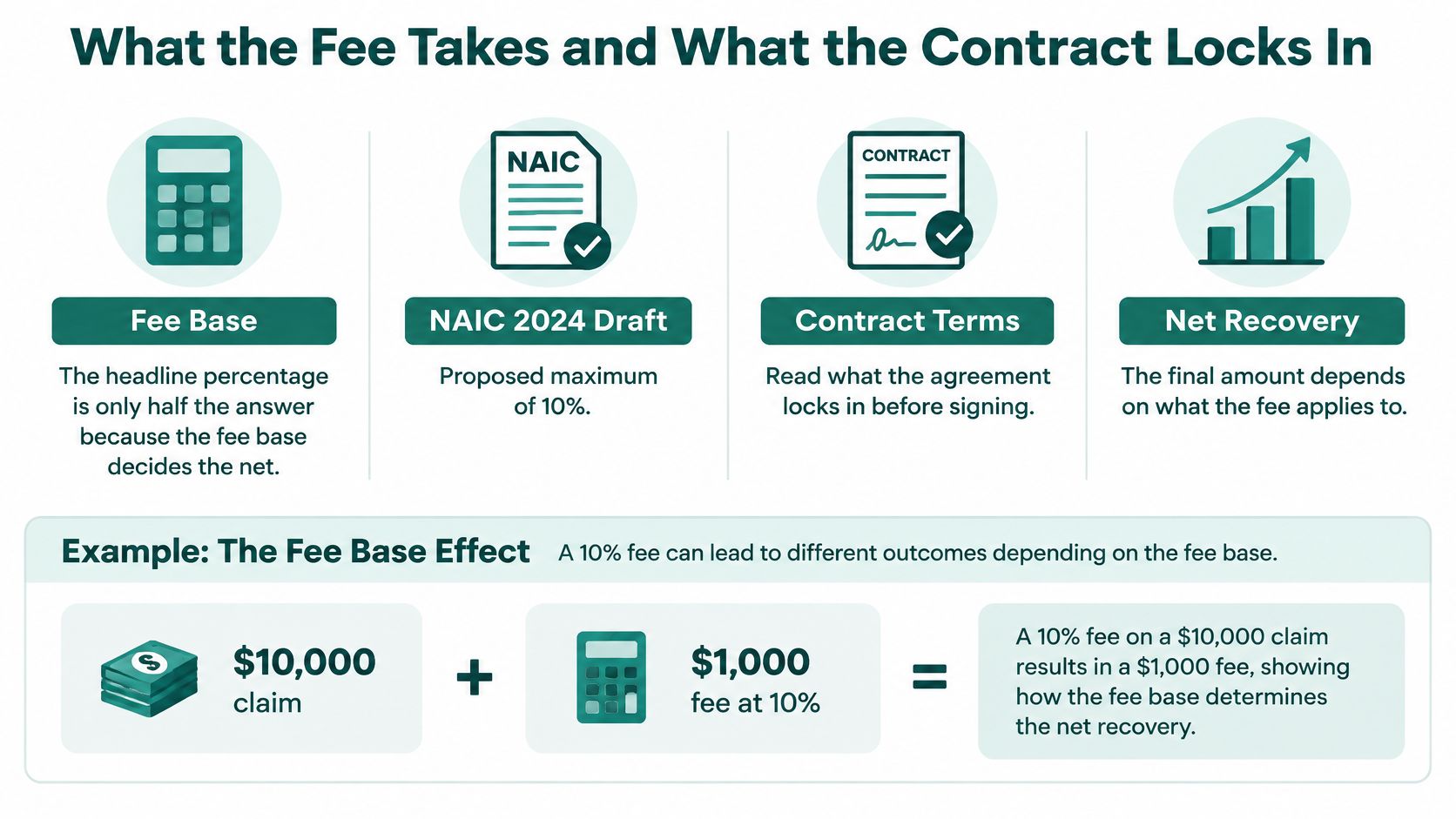
The headline percentage is only half the answer because the fee base decides the net. A 10% fee on the full settlement and a 10% fee on only the increase above the insurer's first offer produce very different outcomes, even though both contracts can be described at the door as "10%."
Regulators have been tightening the frame around that compensation. The National Association of Insurance Commissioners model laws project history shows the Producer Licensing Task Force adopted a review charge on May 31, 2023, and the Market Regulation and Consumer Affairs Committee adopted a draft revision on November 19, 2024. The 2024 draft proposed a maximum fee of 10% for catastrophic claim settlements and 15% for other insurance claim settlements. Those figures are model-law recommendations, not automatically applicable nationwide. Each state sets its own licensing, contract, cancellation, and fee rules, so a property owner should confirm the current limit with the state insurance department before relying on any number quoted during a sales conversation.
The Same Percentage, Two Different Nets
The following numbers are purely hypothetical and show arithmetic, not a promised result. Say the insurer first offers $40,000 and, after further documentation and negotiation, the total settlement reaches $58,000. The gross increase is $18,000.
- Fee on the full settlement: A 10% fee on $58,000 is $5,800, leaving $52,200 before deductibles, mortgage company handling, repair costs, and any other amounts the policyholder owes.
- Fee on the increase only: A 10% fee on the $18,000 increase is $1,800, leaving $56,200 on the same gross settlement.
- The comparison that matters: The first structure costs $4,000 more than the second, despite an identical headline percentage and an identical final check from the insurer.
A higher gross number can also disappoint if the fee reaches money that was never disputed. If the insurer had already agreed to pay most of the claim before the contract was signed, a fee on the full recovery charges the policyholder for dollars that were already coming. That's why the contract's definition of recovery deserves more attention than the percentage printed in larger type.
Which Checks Count Toward the Fee
| Payment category | Often fee-bearing? | Question to settle in writing |
|---|---|---|
| Gross settlement total | Commonly, depending on contract wording | Is the percentage applied to the full check? |
| Additional money secured above the first offer | Sometimes | Does the fee apply only to the increase? |
| Undisputed amount paid before negotiation | Only if the contract includes it | Is this amount excluded from the fee? |
| Depreciation released later | Only if the contract includes it | Is the release treated as new recovery? |
| Advance or emergency payments | Only if the contract includes it | Does an advance count as part of the settlement? |
| Business-interruption proceeds | Only if the contract and coverage include it | Does the contract cover this category at all? |
Every row should get a yes or no answer in the signed agreement, not in a verbal summary. Supplemental payments create the same issue months later. If hidden damage is found during repairs and the insurer pays more, the owner needs to know whether that later payment is inside the original contract, outside it, or covered only while the agreement remains active.
Contract Terms That Control the Exit
State consumer guidance shows how specific these protections can be. The Pennsylvania Insurance Department public adjuster guidance warns that the policyholder pays the public adjuster and should ensure the fee is affordable, and it says policyholders can request copies of estimates and supporting documents. Florida consumer guidance cited on that page adds that a written contract is required, the adjuster cannot accept a settlement without the policyholder's approval, and consumers have a 10-day cancellation period.
Other states write different cancellation windows, disclosure forms, and solicitation limits. The signed document should state the adjuster's full name and license number, the fee percentage, the exact fee base, when the fee is earned, when it's collected, and how either side ends the agreement. It should also say who keeps copies of estimates, photos, and correspondence if the relationship ends.
- If the insurer denies the claim: Does the contract owe a fee on zero recovery, charge for expenses, or end without payment?
- If the contract ends mid-claim: Is a fee still claimed on payments received afterward, and for how long?
- If little work is performed: What deliverables are promised, including an inspection, a written estimate, and documented insurer contacts?
- If payments arrive in stages: Is the fee taken from each check, billed after receipt, or calculated once the claim closes?
- If an attorney becomes necessary: Are legal fees separate from the adjuster fee, and could both percentages apply to the same dollars?
A bigger gross settlement isn't automatically a better outcome if fees, delay, and contract obligations consume the gain.
PostDamage states that hiring a public adjuster is optional and may not be appropriate for every claim. That's the right starting assumption. The useful comparison is the expected additional net recovery after fees, waiting time, contractor scheduling effects, and any obligation that survives termination, not the largest settlement figure anyone can project at the kitchen table.
Delay has a cost even when it doesn't appear on an invoice. A family paying for temporary housing, or a landlord losing rent, should ask how quickly the adjuster will inspect, deliver an estimate, and respond to the insurer. A low fee with slow follow-through can cost more than a higher fee with a complete file submitted promptly. Neither outcome can be known in advance, but service timelines and reporting duties can be written into the conversation before signing.
How to Verify a License Before You Sign
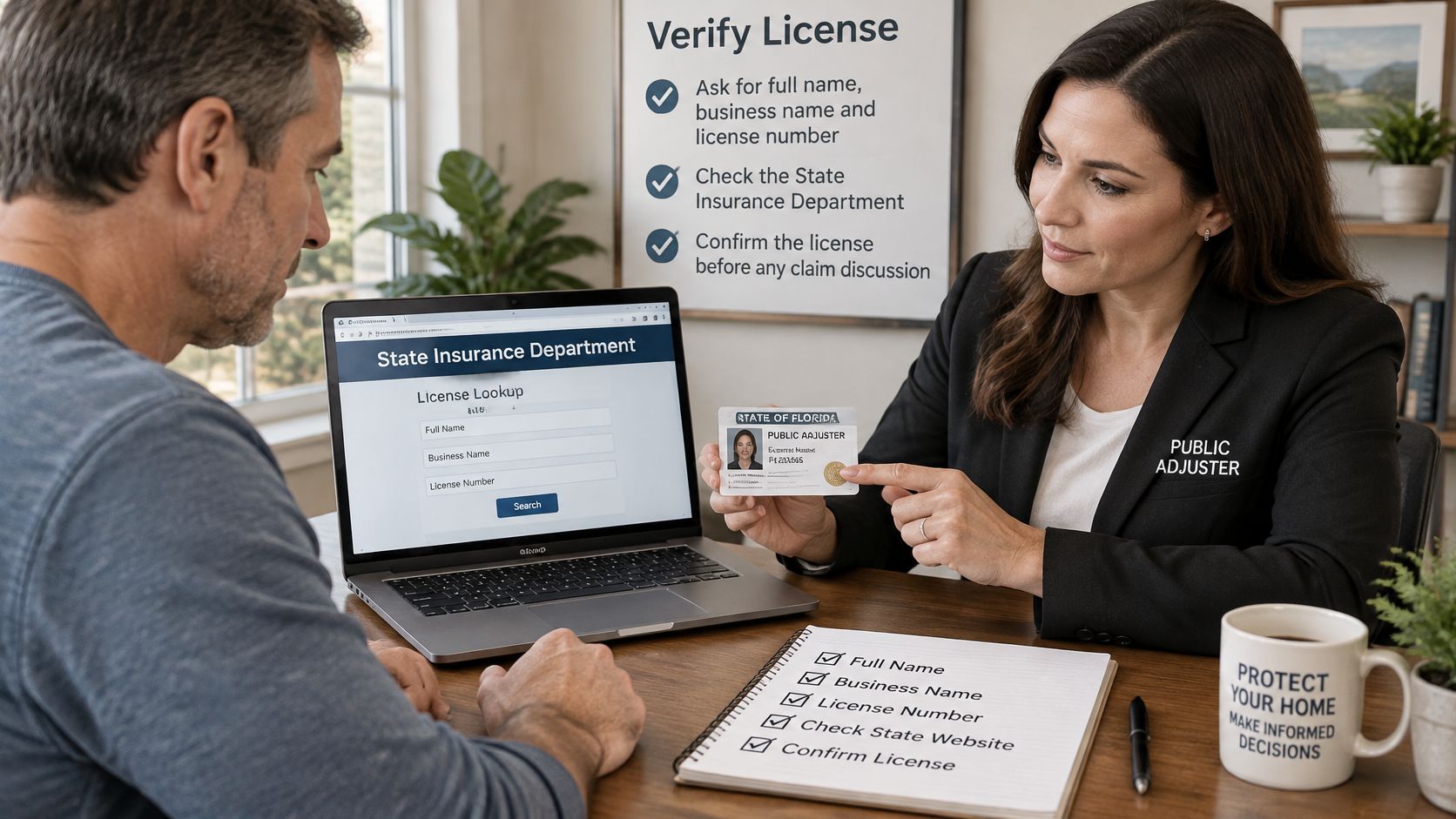
The license must cover the state where the damaged property sits, and the person handling the claim must be the individual named on that license. A credential earned in one state does not travel automatically with a company truck, and a firm's license does not cover an unlicensed employee knocking on doors. Verification takes minutes and prevents the most basic mistake: signing with someone who has no legal right to negotiate the claim.
A Six Step License Check
- Get the identifiers first: Ask for the adjuster's full legal name, business name, and license number before discussing damage details.
- Use the regulator's lookup: Search that name and number in the state insurance department's professional lookup system.
- Confirm active status and state: Check that the license is active and covers the state where the property is located.
- Match the contract: Confirm the agreement shows the same license number that appeared in the lookup.
- Protect settlement authority: Read every signature page and reject wording that hands over authority to accept a settlement without the owner's approval.
- Ask how contact began: Note whether the person knocked after the loss, was referred by a contractor, or responded to a request, then check whether state solicitation rules restrict that contact.
Regulators don't phrase the rules identically. A Rhode Island Department of Business Regulation consumer alert states that acting as a public adjuster without a license is unlawful and says contracts should include the adjuster's license number. Other states go further, requiring a written contract and disclosure of cancellation rights before work begins.
Red Flags Worth Pausing For
- Pressure after a catastrophe: Urgency to sign before reading the contract at home is a warning, not a service feature.
- Blank or incomplete pages: Missing fee terms, dates, or license information leave room for later disputes.
- Unclear fee base: A representative who can't state which payments count toward the fee hasn't explained the cost.
- Settlement authority requests: Documents that let someone else accept the insurer's offer remove the owner's final say.
- Contractor claim negotiation: A repair company offering to negotiate coverage without a public adjuster license crosses a regulatory line in many states.
When two candidates look ready, compare them on concrete terms. Put their fee base, written cancellation terms, and any financial tie to a contractor side by side. A lower headline percentage can still leave the policyholder with fewer dollars if its fee base sweeps in payments the insurer already owed, so ask each candidate to state that base in writing. Ask how many claims each handled in that state last year, and who will personally attend inspections.
If the license can't be verified in about ten minutes, don't sign. Legitimate professionals expect the check and usually make it easy.
Document the Damage Before Anyone Negotiates
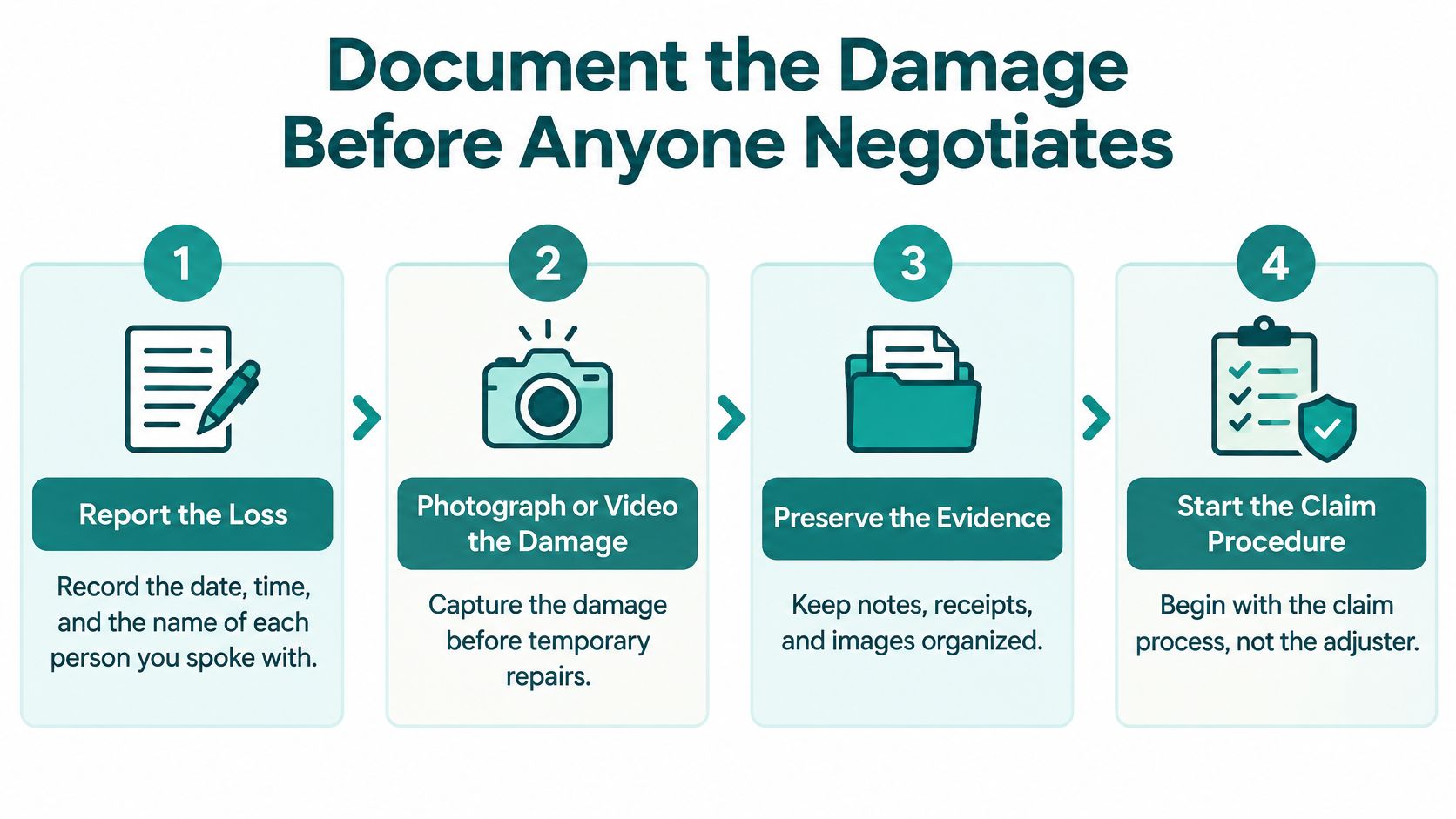
Negotiation doesn't create evidence. It uses evidence that already exists, and the strongest files start before anyone argues about price. A public adjuster can organize the record, but photos taken after demolition or receipts thrown away during cleanup can't be recreated with the same credibility.
Build the Claim File in Order
- Report the loss promptly: Record the date, time, claim number, and the name of each person spoken with.
- Photograph before repairs: Capture wide room views and close damage details before temporary repairs or demolition, where it's safe to enter.
- Separate damaged property: Keep damaged items apart from undamaged property so the boundary of the loss stays clear.
- Inventory room by room: List each item with quantity, age, purchase price, condition, and proof of purchase when available.
- Save mitigation receipts: Keep invoices and receipts for tarping, board-up, water extraction, drying, and other emergency work.
- Collect repair scope: Gather contractor estimates, measurements, material specifications, and a written scope of work for each area.
- Request the insurer's estimate: Ask for the estimate and a written explanation for each disputed or omitted line.
- Track every deadline: Calendar policy notice requirements, document requests, inspection dates, and any sworn proof of loss deadline.
Water losses move especially fast because drying and tear-out can erase the original condition within days. Owners working through that sequence can review how to file a water damage insurance claim while keeping photos and moisture records tied to each room.
Flood claims show how formal the proof burden can become. Under the FEMA training material for the National Flood Insurance Program, the policyholder must provide prompt notice, separate damaged from undamaged property when feasible, prepare an inventory, and submit a signed, sworn Proof of Loss generally within 60 days of the loss unless a written extension applies. FEMA's form also calls for building specifications, detailed repair estimates, and a detailed contents inventory when contents are claimed. Other policies set different deadlines and forms, so the governing policy controls.
File standard: Every disputed line item needs a photo, a measurement or quantity, a price source, and a short written reason it belongs in the scope.
That structure helps an insurer validate the amount instead of guessing. Unsupported quantities, missing ownership records, or a lump-sum contractor quote with no room breakdown invite reductions because the reviewer can't test causation, depreciation, limits, or deductible application. A licensed public adjuster may help coordinate the package, but the insured remains responsible for deadlines and for the accuracy of sworn statements.
New damage found after work begins should be documented as a separate supplemental item, with fresh photos before it's covered or removed. Date the discovery, name the person who found it, and connect it to the original loss in writing. Clean supplemental documentation is easier to review than a revised total with no trail.
Commercial Claims and Business Interruption Evidence
This section is a sidebar for business owners and commercial property managers. Homeowners can skip it without losing the thread. Commercial claims often turn less on the visible repair and more on whether income loss can be proved month by month.
The IRS Tax Guide for Small Business describes business-interruption insurance as coverage that can pay lost profits when a business is shut down by fire or another covered cause. Insurers don't pay that category from a simple estimate of sales that might have occurred. The calculation has to separate revenue trends, avoided variable costs, continuing expenses, extra expense, saved expenses, and the restoration period defined by the policy.
Evidence by Loss Category
- Lost income: Monthly financial statements, general ledgers, sales reports, point-of-sale data, tax returns, budgets, and the pre-loss revenue trend.
- Extra expense: Mitigation invoices, temporary location rent, equipment rental receipts, overtime records, and costs incurred to shorten the shutdown.
- Continuing payroll and fixed costs: Payroll registers, rent payments, loan obligations, service contracts, and utility bills that continued during closure.
- Equipment and inventory: Purchase records, serial numbers, inventory counts, photos taken before disposal, repair assessments, and salvage notes.
- Restoration period: Contractor schedules, permit applications and approvals, inspection records, supplier lead times, and correspondence showing repair progress.
The cause-and-effect test decides whether those numbers belong in the claim. The reduction in income must tie to covered physical damage and the policy's time-element terms. General market decline, earlier underperformance, a lost customer unrelated to the shutdown, or a supply problem that began before the loss can weaken or defeat that link if they aren't separated from the damage-related decline.
Coverage structure can cap even a mathematically sound calculation. Sublimits, waiting periods, coinsurance requirements, and a defined restoration period may reduce recoverable amounts or exclude the first days of loss. A restaurant, retailer, or multifamily operator should read those terms before projecting a recovery from gross sales figures.
A commercial public adjuster can help reconcile the insurer's calculation against accounting records and operating data, but records preserved from the date of loss onward matter most. Save daily sales reports, reservation or occupancy data, cancellation notices, and communications about temporary space. Reconstructing those records later is slower and usually less persuasive.
Decide Whether a Public Adjuster Fits Your Claim
The right answer changes with claim size, dispute type, and the owner's capacity to build the file. Hiring help makes the most sense when the expected additional recovery plausibly exceeds the fee and the cost of waiting. It makes the least sense when the insurer has already paid most of a simple claim and only a small, explainable gap remains.
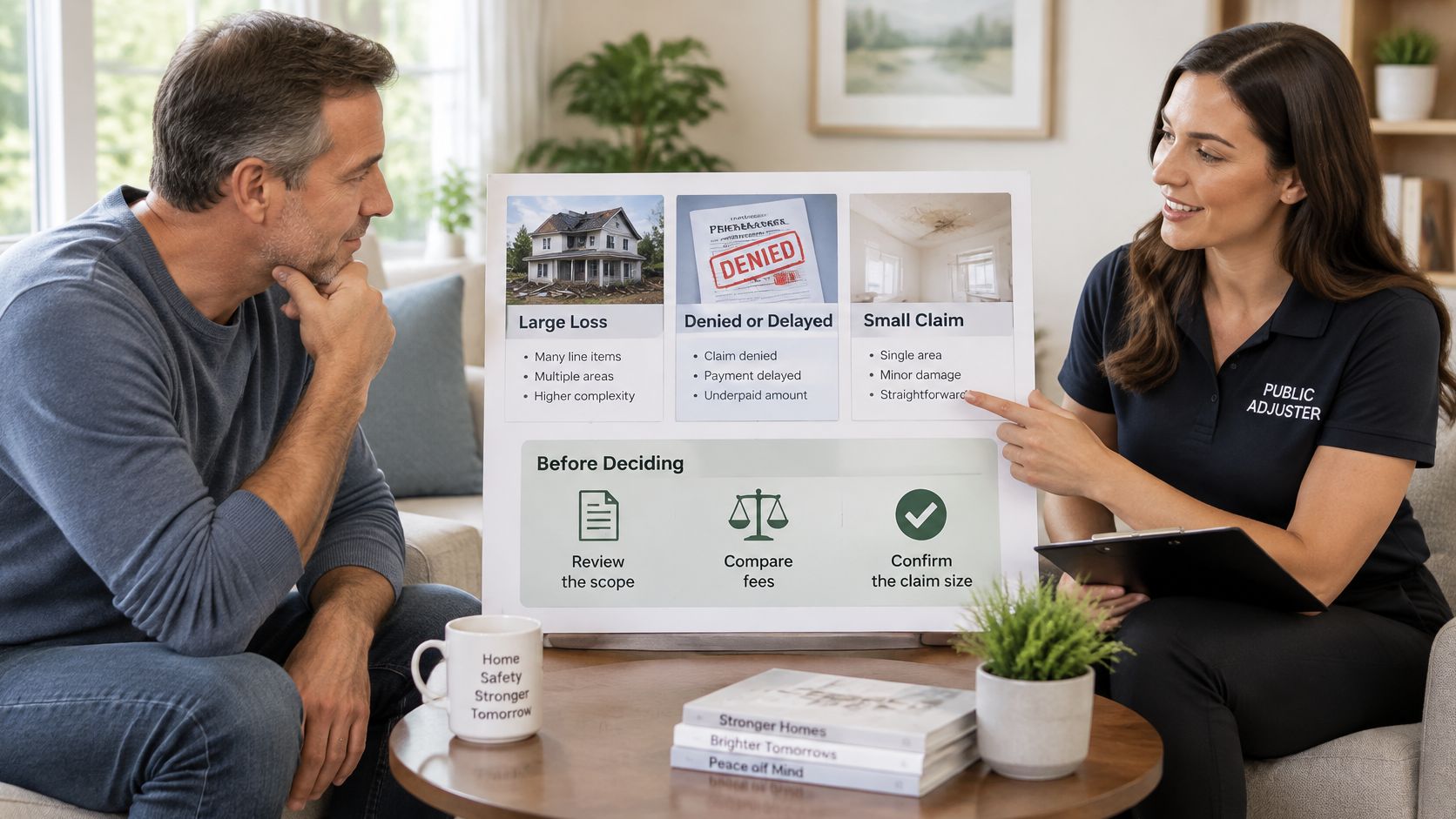
Hire or Not Verdict by Situation
| Situation | Consider a public adjuster | Start on your own first |
|---|---|---|
| Large loss with many line items | Strong case for help when scope is hard to track | Possible if you can document every area |
| Denied, delayed or underpaid claim | Worth a professional review | Request the insurer's written position first |
| Small single-area claim with fast payment | Usually not worth the fee | Proceed directly with the insurer |
| Commercial claim with business interruption | Strong case for a commercial specialist | Start income records immediately either way |
| Disputed cause or coverage question | Consider with input from an attorney | Review the policy language and denial letter |
| Undisputed payment received, small gap remaining | Usually not worth the fee | Ask for a line-by-line explanation of the gap |
Coverage questions should be read against the actual policy, not assumptions from a neighbor's claim. Owners unsure whether a plumbing leak, appliance failure, or surface water event is covered can compare the denial letter with guidance on whether homeowners insurance covers water damage and then decide whether the dispute is factual, financial, or legal.
Judge the contract by net recovery: the settlement minus the fee, minus anything the contract charges on early exit, minus whatever the added delay costs in temporary housing, storage, or lost business income. A fee base applied to the entire settlement takes a share of money the insurer had already offered, whereas a fee base applied only to the increase leaves the original offer untouched. Two contracts quoting similar percentages can leave very different amounts in your pocket.
Three Checks Before Deciding
- Run the net math: Compare the plausible additional recovery after the proposed fee base with the cost of delay and any surviving contract obligation. Ask whether the fee covers only new money or the full settlement.
- Verify and read: Check the license, then read the cancellation, settlement approval, fee timing, and document return terms.
- Set a review date: Choose a date to review the insurer's written position and decide whether professional help still adds value.
Need help with a homeowners insurance claim? PostDamage offers an insurance claim help service for property owners whose claim was denied, delayed, or paid less than expected. The review request is free, takes about one minute, and carries no obligation. Professional availability, services, and fees vary by location and provider, and no outcome or settlement increase is guaranteed.