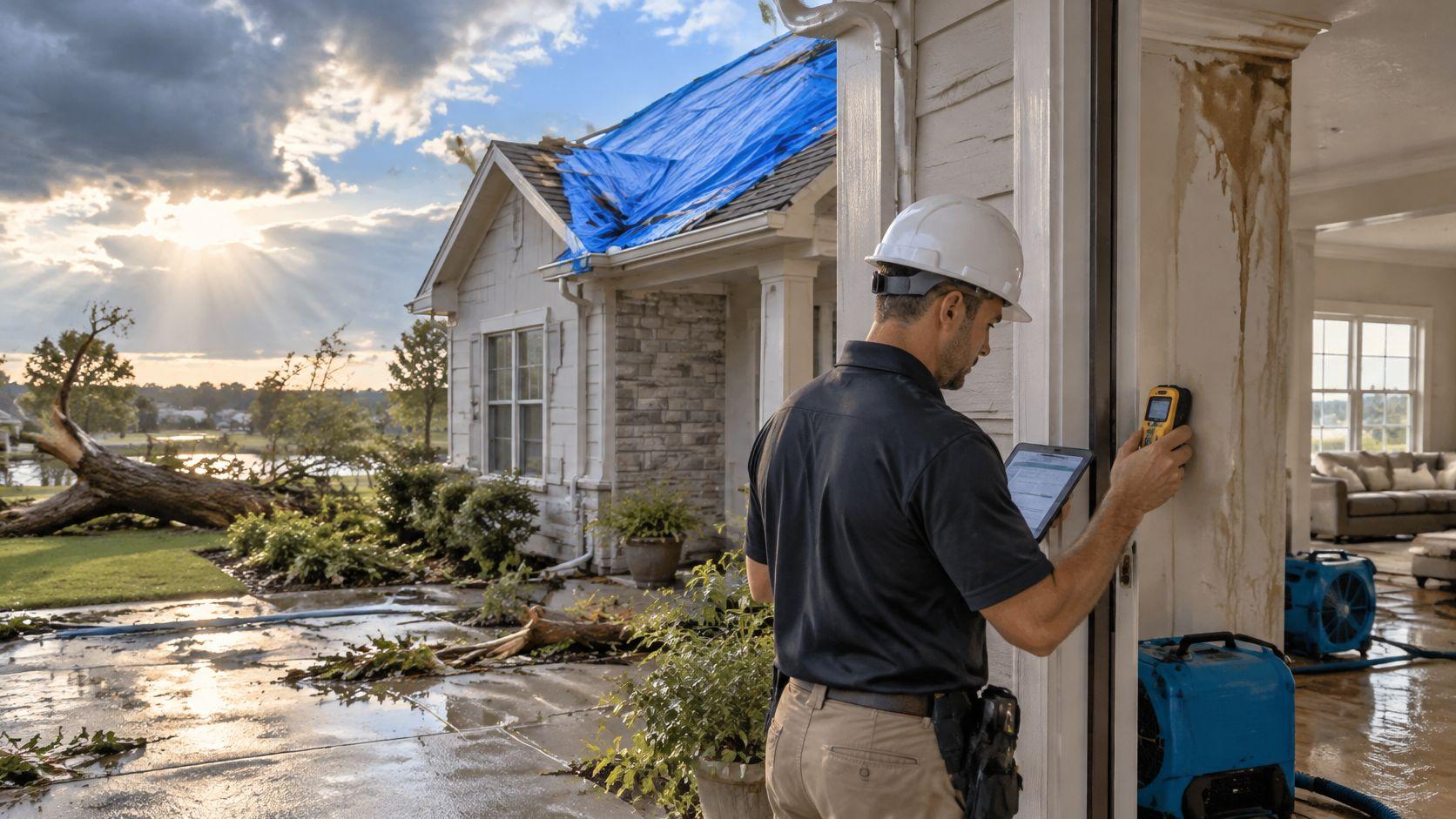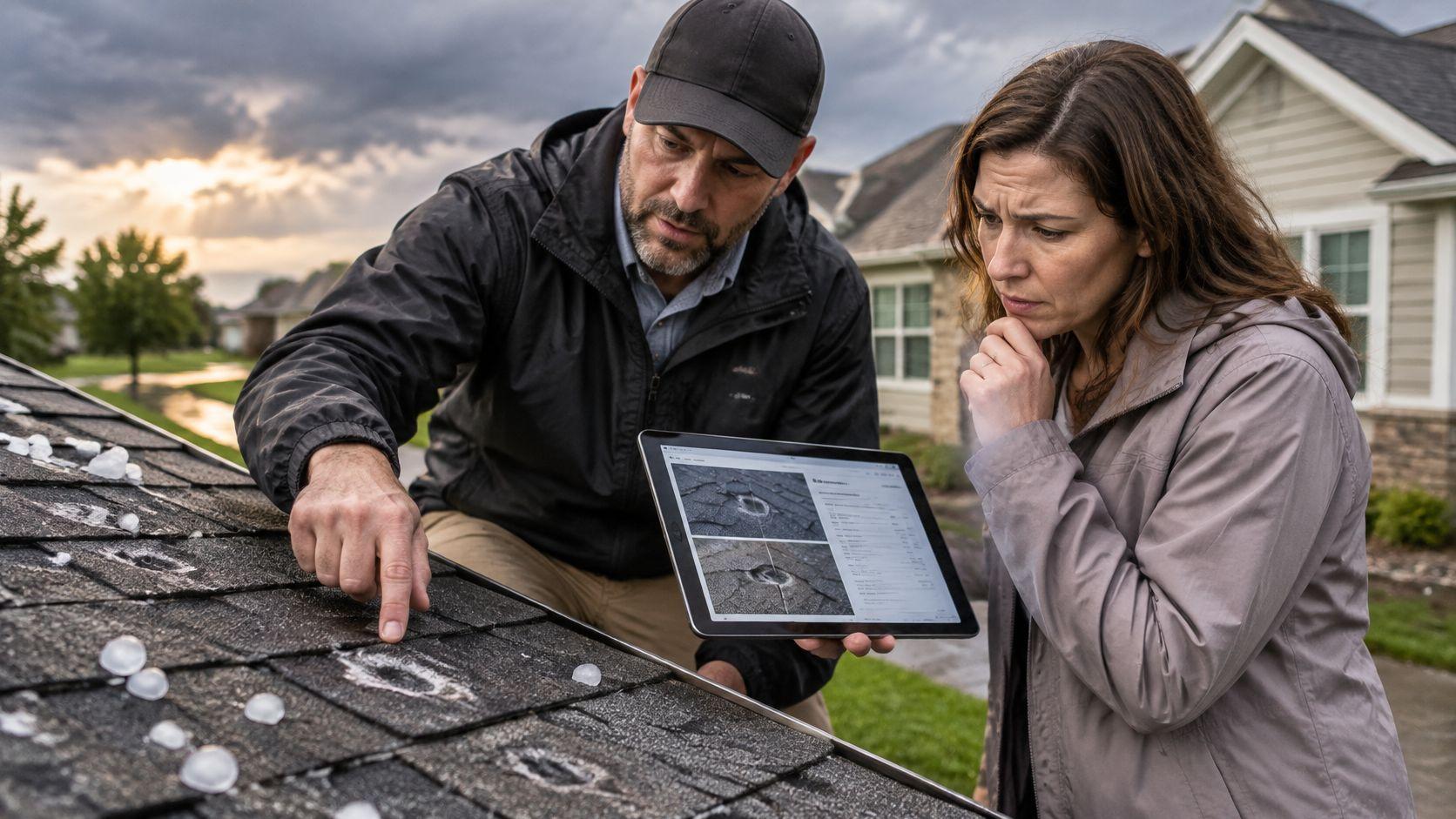
The tarp is still on the garage, the gutters look like someone worked them over with a hammer, and the estimate from the insurance company's field adjuster runs to two pages. It covers part of one slope, a few screens, and not much else. The contractor who walked the roof counted dents on all four slopes, crushed ridge caps, and a skylight seal that's now letting water into the ceiling below.
That gap is where most hail arguments begin. It's also why so many owners start searching for a public adjuster for hail damage before they've answered a more basic question: is this claim worth pursuing at all after the deductible comes out of it?
Hail rewards preparation and punishes assumption. The following walks through what a public adjuster does, how to build evidence that survives scrutiny, how to spot what's missing from an estimate, and how to run the arithmetic that tells you whether to file, negotiate, or walk away.
What a Public Adjuster Does After Hail Damage
A public adjuster is a licensed professional who represents the policyholder in an insurance claim, within the scope state law permits. That's the entire distinction. The adjuster the carrier sends to your kitchen table works for the carrier and is paid by the carrier. A public adjuster works for the owner of the building and is paid under a contract with that owner.
The core work follows a predictable arc. The adjuster inspects the damage rather than reading someone else's report, documents it with dated photographs and measurements, then either builds an estimate from scratch or reconciles the insurer's estimate against the installed roof system and the damaged building components. From there the claim gets presented to the carrier and the valuation gets negotiated, line by line, until the scope matches the physical evidence or the dispute moves somewhere more formal.
Hiring one is optional, and it isn't appropriate for every claim. A small, well-documented loss on a newer roof with a modest deductible rarely justifies a fee.
Who does what on a hail claim
| Role | Works for | Who pays | Main job on a hail claim |
|---|---|---|---|
| Public adjuster | Policyholder | Fee set by contract and state law | Documents damage, builds or reviews the estimate, negotiates with the insurer |
| Insurer adjuster | Insurance company | Insurer | Inspects the property and values the loss for the insurer |
| Roofing contractor | Property owner | Property owner | Prices the repair; not a coverage advocate |
A contractor is essential to the claim, but a contractor's job ends at the repair price. Contractors don't argue causation, don't read depreciation schedules, and don't negotiate policy language, and asking one to do so puts them in a role they aren't paid for.
Practical rule: read the fee clause before you read anything else in the agreement, because it changes the arithmetic more than any other term.
Before signing anything, get straight answers to three questions: how the fee is calculated (a percentage of the settlement or a flat amount), whether that fee applies to the first payment or only to amounts recovered after the initial offer, and whether the adjuster holds a current license in the state where the property sits. A fourth question is worth asking too: who handles the file day to day if the person in your living room isn't the one writing the estimate.
Why Hail Claims Get Disputed and Underpaid
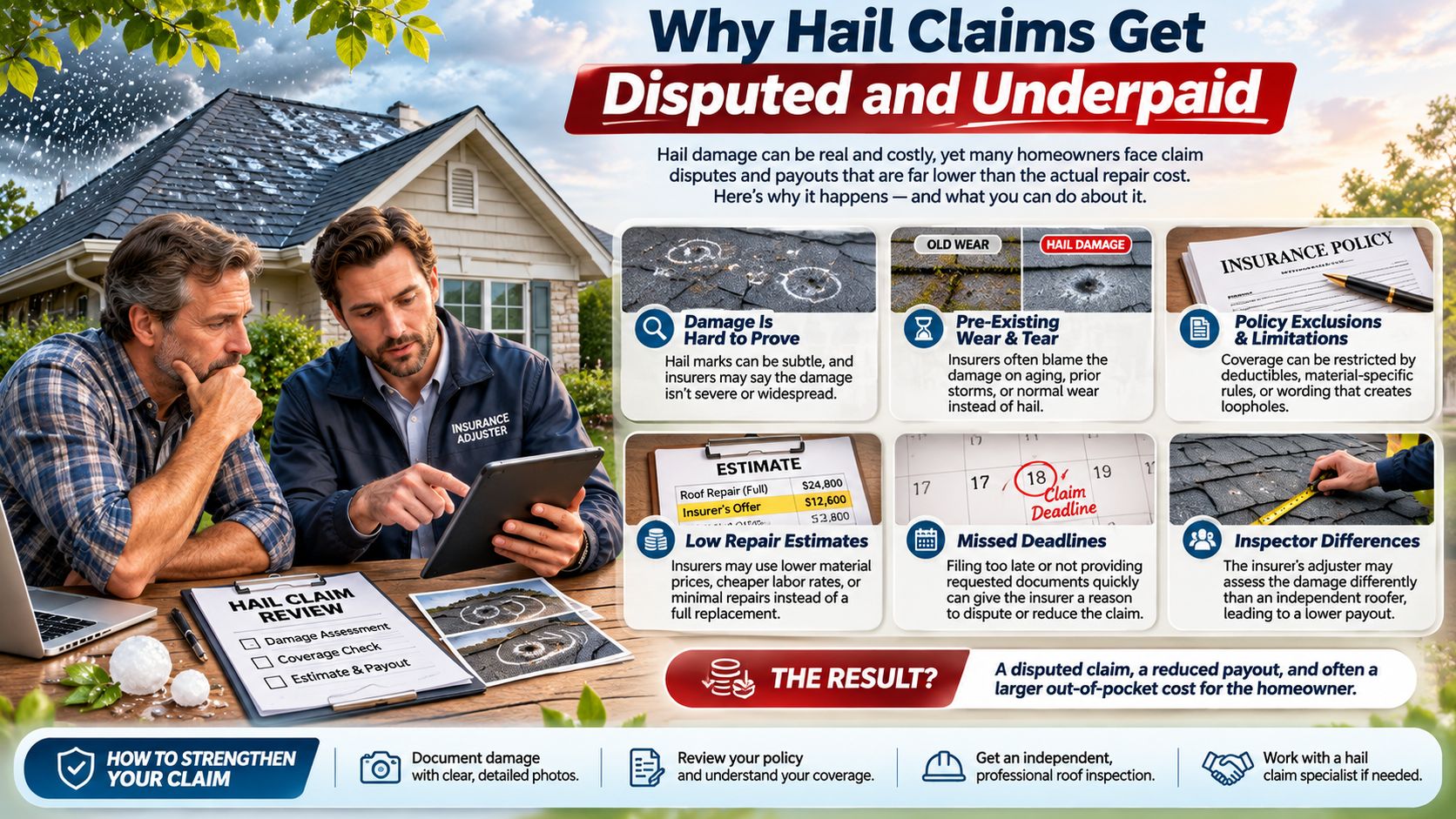
Most hail disputes come down to one of three arguments, and knowing which one you're in determines what evidence you need.
The scope is incomplete. The insurer scopes one slope or one elevation because that's where the inspector spent the most time. Nobody measured the rest of the roof, so nobody priced it.
The cause is disputed. The carrier's inspector calls the marks cosmetic, or attributes them to age, wear, foot traffic, or a prior storm outside the policy period. That's a causation fight, not a damage fight, and it requires weather records, maintenance history, and roof age documentation.
Depreciation eats the payment. The estimate applies recoverable depreciation that only comes back after the work is completed, so the first check looks nothing like the cost of the repair.
Scale explains why so many of these arguments exist at all. Wind and hail accounted for 42.5% of homeowners' claims in 2023, and the average homeowners' claim severity that year was $20,062, according to Insurance Services Office data summarized by the Insurance Information Institute. A single event can reach roofing, siding, gutters, windows, exterior structures, interior finishes, and personal property at the same time, which means one storm can produce five separate valuation arguments on one property.
The money is not shrinking. U.S. hail-loss costs in 2024 ran 19% above the seven-year average, according to LexisNexis Risk Solutions, and State Farm reported paying more than $5.6 billion in hail-related claims in 2025, according to the insurer's newsroom release. Volume of that size produces compressed inspections, template estimates, and a lot of owners holding a number they can't reconcile with what their roofer told them.
A public adjuster can organize and present a complex claim and push back on a thin scope. No adjuster can guarantee coverage or a higher settlement, because coverage is decided by the policy and the law of the state where the loss happened.
How to Build the Hail Evidence File
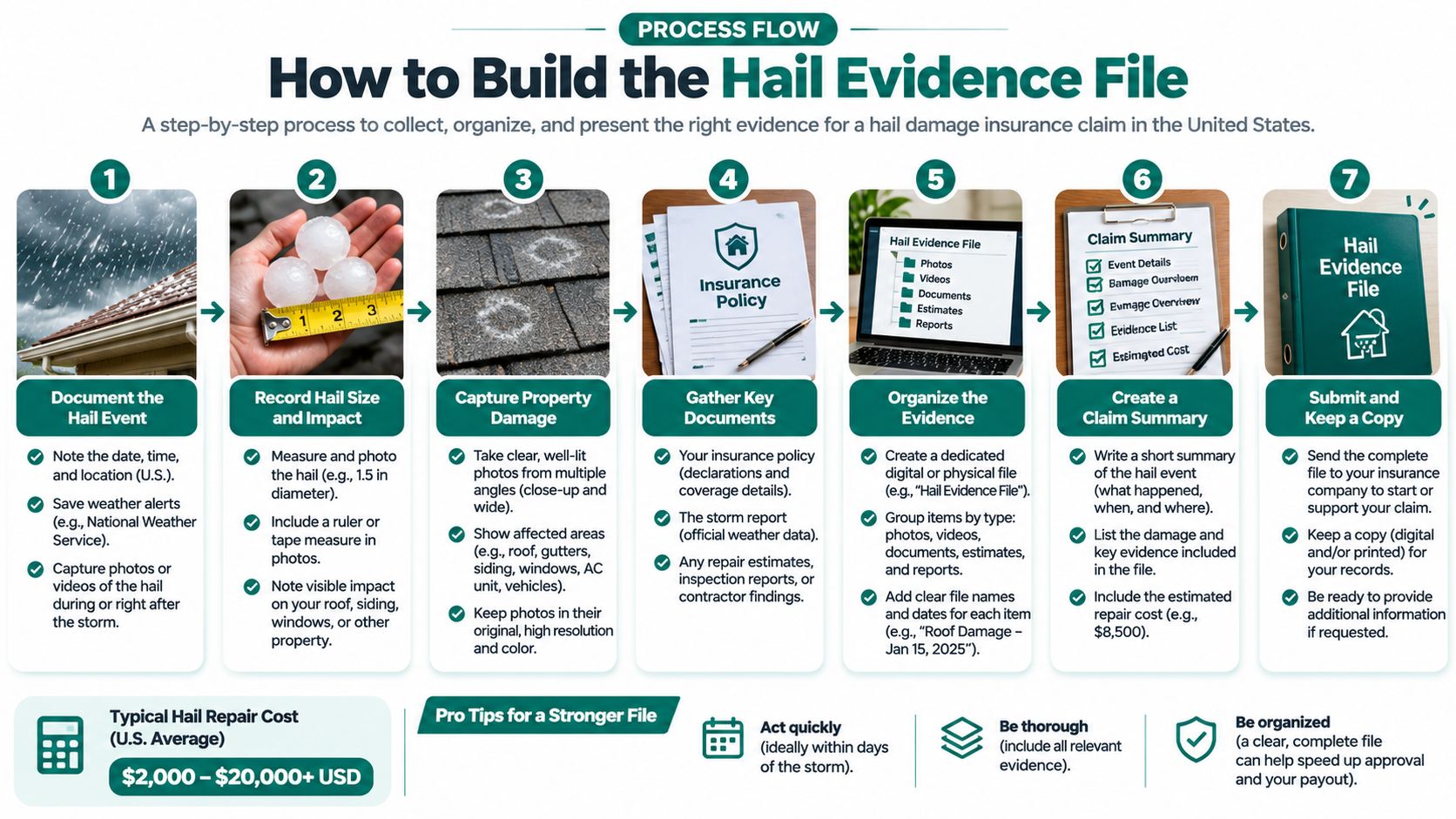
Every hail claim is a documentation contest disguised as a damage inspection. Build the file in this order, and the rest of the process gets easier.
Photograph every roof slope, elevation, and run of gutter. Take wide shots to establish location and close-range shots with a tape measure or coin for scale. Shoot the same slope twice if the light is bad. A missing image of one slope is the easiest way for that slope to disappear from the estimate.
Verify the weather for the loss date. The National Weather Service Storm Prediction Center defines severe hail as at least 1 inch in diameter, a threshold raised from 0.75 inch in 2010, and it recorded 5,432 qualifying hail events nationally in 2025, according to the Insurance Information Institute's hail statistics. Pull the report nearest the property and note the size and date, because a claim without a dated storm anchor is a causation argument waiting to happen.
Record the roof's identity. Manufacturer, product line, approximate age, impact rating if known, prior repairs, and maintenance invoices. This turns "old roof" into a documented, verifiable system.
Keep every temporary-repair invoice. Tarping, patching, and water extraction are covered costs in many policies, and the receipts prove the damage was active.
Map the damage on a roof plan. Sketch the footprint, number each slope, and mark what was found where. Adjusters work slope by slope and number by number; a diagram in the file forces the estimate to follow the same geometry.
Inventory everything that isn't the roof. Interior stains and ceilings, insulation, siding, window screens, detached garages and sheds, patio covers, HVAC fins. Photograph each with the date it was observed.
Build a separate commercial file. Business income records, tenant improvement costs, equipment exposure, and access restrictions belong in their own folder. Mixing them into the roof claim buries them.
The one-page summary is what everyone asks for first: date of loss, storm verification, roof description, number of slopes with damage, headline findings on other components, and the total documented scope. PostDamage's insurance claim help resources cover how that summary gets used once a claim is open.
Telling Cosmetic Marks From Functional Roof Damage
A roofer climbs down and points to granule loss peppered across the south slope. The carrier's adjuster calls it cosmetic. On the north slope, the same storm cracked two shingles around a plumbing vent and dented the valley. The label each mark gets decides how much of the loss reaches the estimate.
Hail testing labs draw the same line. Research protocols fire manufactured ice balls at asphalt shingles to reproduce the impact energy and physical properties of natural hail, then score dents, tears, and granule loss as separate damage modes. That split drives most cosmetic-versus-functional disputes, because a surface mark and a broken shingle carry different consequences for the claim.
| Damage mode | What it looks like | Why an insurer may judge it differently |
|---|---|---|
| Granule displacement | Dark, sandy patches where granules are gone; mat not exposed | Roof may still shed water, so it gets priced as wear or cosmetic |
| Dents without fracture | Soft spots that give under thumb pressure; no visible break | Hard to prove functional loss unless the mat is compromised |
| Fractured or torn shingles | Cracks, missing tabs, exposed mat, granule loss at the fracture | Clear leak pathway, usually accepted once documented per slope |
| Loosened shingles | Tabs lifting or seals broken after impact | Often attributed to age or installation rather than hail |
| Damaged flashing and vents | Dented, displaced, or unsealed metal penetrations | Frequently omitted as "minor" even though it's a leak point |
A defensible inspection maps damage by slope and asks whether each defect affects the shingle's ability to shed water. Counting hits per square misses that question. Scattered granule loss on every slope with intact weatherproofing is a different file from six fractured shingles around two vents and a valley. The first may not justify a claim at all. The second documents functional loss with a clear repair scope.
That classification feeds the deductible math. Written up as cosmetic, a roof-only loss can fall below the deductible before negotiation starts. Functional findings across slopes, soft metals, and detached structures are what turn a marginal file into a whole-property claim worth pursuing.
A laboratory protocol compares products under controlled impacts, while claim decisions still rest on the site inspection. A photo of hailstones on the lawn proves a storm happened nearby and says nothing about the north slope. If the file holds only ground photography and a weather report, the claim is exposed. Reconstruction professionals and adjusters both work from slope-level findings, and PostDamage's storm damage repair guidance covers how that inspection sequence feeds into a repair plan.
Finding Missing Items in a Hail Estimate
An estimate has one job: describe the work required on the system that's on the roof. Anything less is a negotiation position, not a valuation.
Start with the installed system. Manufacturer, product line, age, impact rating, underlayment type, flashing details, ventilation, and any code-required accessories. Then compare that against what the estimate prices. UL 2218 Class 4 requires a flexible roofing product to stay functional after two impacts in the same location from 2-inch steel balls, and FM 4473 does the equivalent with frozen ice balls for rigid coverings, per IBHS's commercial roof best practices. Both are test benchmarks. Neither guarantees a roof survives a real storm, because natural hail varies in density, shape, velocity, angle, and concentration.
Estimate components to verify
| Component | What to verify | Common omission |
|---|---|---|
| All roof slopes | Whether every hail-affected slope is scoped | Only the most visible slope is included |
| Ridge caps and hip caps | Damage and replacement method | Left out of the scope |
| Soft metals (drip edge, vents) | Condition and replacement | Treated as minor or ignored |
| Skylights | Damage and seal integrity | Not listed |
| Gutters, screens, siding, windows | Dents and functional damage | Treated as cosmetic |
| Detached structures | Roofs and exterior surfaces | Not inspected |
| Code-upgrade items | Local code requirements | Not priced |
| Interior moisture | Staining, insulation, drywall | Separated from the roof claim |
| Commercial losses | Business income, equipment, tenant improvements | Documented separately or not at all |
Each blank row is a negotiation point, not a catastrophe. The way to raise it is with a component-level estimate that shows the item, the quantity, and the reason it's required, submitted alongside the photographs that support it. "The estimate missed things" is an argument. "Slope 3 has four fractured shingles at the ridge and the ridge cap on that slope isn't in your scope, here's the photo and the quantity" is a position the carrier has to answer.
Commercial owners carry a second layer: business interruption, equipment exposure, and tenant improvements documented apart from the roof cover itself. Mixing lost income into a roofing line item is the fastest way to have the whole thing questioned.
A complete estimate is not a longer one. It's one where every line traces back to something visible on the building.
Running the Deductible Break-Even Check
A roof can look beaten up and still produce a claim too small to justify the work. According to Insurify's analysis of hail and insurance costs, 10% of homeowners reporting severe-weather roof damage said they did not file because the deductible was too high, 31% of affected homeowners estimated their roof damage at $5,001 to $15,000, and average wind and hail deductibles exceeded $7,700 in Texas, Massachusetts, and New Jersey.
Those figures explain a lot of silence after storms. A percentage deductible on a modest loss can absorb most or all of the payment before anyone argues about shingles.
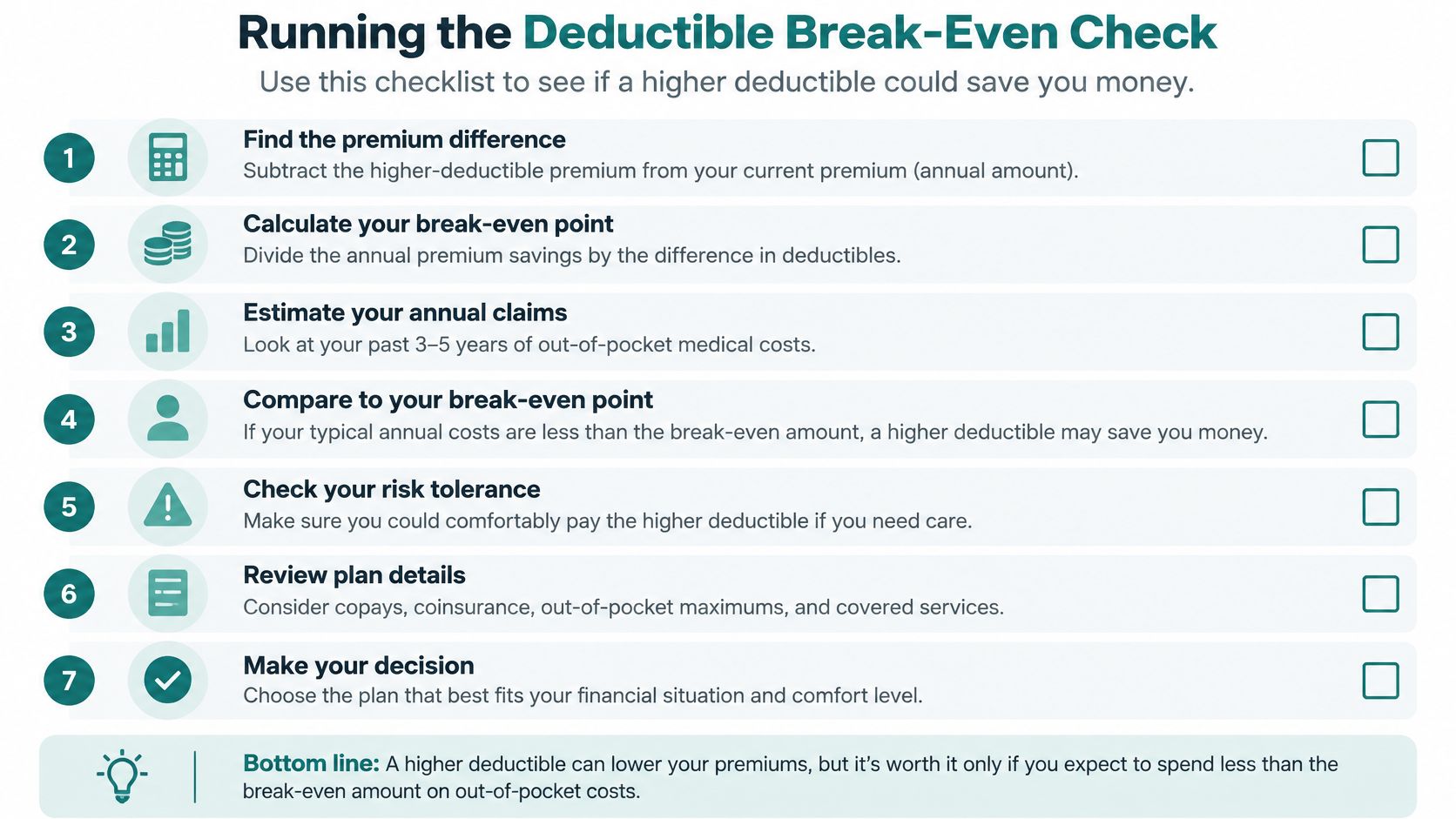
Deductible break-even worksheet
| Input | Where to find it | Question it answers |
|---|---|---|
| Wind and hail deductible | Declarations page | Is it a flat amount or a percentage of coverage? |
| Covered repair scope | Documented estimate | Does it include every affected slope and component? |
| Depreciation holdback | Estimate line items | How much is recoverable only after repair? |
| Secondary damage | Interior, siding, gutters, screens | Does it change the total scope? |
| Code-upgrade costs | Estimate and local requirements | Are required upgrades included? |
| Prior claims and renewal | Claims history and insurer | Could a payment affect renewal terms? |
| Public adjuster fee | Signed contract | Is it a percentage or flat fee, and what is the net after it? |
| Net recovery | Calculated from the rows above | Is the claim worth pursuing after deductible, depreciation and fee? |
The arithmetic in a worked example
Take a hypothetical policy: a 2% wind and hail deductible on a $250,000 dwelling limit is $5,000. Suppose the documented covered scope comes to $9,000. That leaves $4,000 after the deductible. If the estimate holds back $2,000 in depreciation that's recoverable only after repairs are complete, the first payment lands at $2,000 before any fee. An adjuster charging 10% of the $4,000 recovery takes $400, leaving $3,600 to weigh against the time, inspections, and paperwork of pursuing the claim.
Change one input and the answer flips. Add interior ceiling staining, damaged screens and gutters, or a code-required upgrade, and the covered scope climbs well past the deductible, at which point the fee becomes a small fraction of a much larger recovery.
That is the key decision point. A marginal roof-only loss may pay little or nothing, while a properly documented whole-property scope can change the economics entirely. The worksheet compares options and exposes the break-even point; the policy and state law control the outcome.
When Hiring a Public Adjuster Makes Sense
The fit is situational, not categorical. PostDamage helps visitors understand when hiring a public adjuster may be appropriate, and the honest version of that answer starts with the file, not the storm.

Situations where hiring is worth the fee:
- The estimate omits components the worksheet already identified. Missing slopes, ridge caps, soft metals, or code items mean the scope needs rebuilding, and rebuilding takes expertise.
- Causation is contested. If the carrier's report attributes the damage to age or wear, the argument becomes technical and evidence-heavy.
- The loss spans multiple building systems. Roof, siding, windows, gutters, interior finishes, and personal property in one event is a coordination problem as much as a valuation one.
- It's a commercial property with income and inventory exposure. Business interruption and tenant improvements need their own documentation and their own negotiation.
- The owner can't manage the documentation. Time, roof access, and the sheer volume of photographs are real constraints.
Situations where it usually isn't:
- The documented covered loss is small relative to the deductible.
- Damage is confined to a single minor component.
- The insurer's estimate already matches the documented scope line for line.
The fee test: divide the fee by the expected recovery. If the fee consumes a large share of a small net payment, the claim is doing work for the adjuster rather than the owner.
The fee reduces net recovery and must be calculated before signing, not after the first check arrives. PostDamage prioritizes visitors with active claims, substantial property losses, denied or underpaid claims, or a clear need for professional claim assistance, and its site information is general rather than legal, insurance, or claims advice. Coverage litigation is a separate question from adjustment, and an attorney handles it.
Questions for any candidate: Where are you licensed? Is the fee a percentage or flat, and does it apply to the first payment? What's the scope of representation in writing? Who holds the documentation, and will I get copies on request?
Handling Denials, Low Offers and Supplements
A denial or a thin offer feels final. It usually isn't. Work the three paths in order, from least to most formal.
Reconcile first. Put the insurer's estimate beside the documented scope, line by line, and label every difference as missing, underpriced, or attributed to wear. That single comparison table tells you which argument you're having.
Supplement when new damage appears. Hidden sheathing, rotted decking, code-required ice barrier, or a discovered leak path during tear-off are legitimate supplemental items. Submit them with dated photographs and invoices rather than a phone call. When a single state's carriers field volume like the 82,498 storm claims reported for 2025 by the Kansas Insurance Department, supplements are routine business, not an accusation.
Escalate deliberately. Read the policy's appraisal, dispute, and notice provisions before demanding anything. Denials of coverage, as opposed to disputes about value, generally belong with an attorney, and PostDamage maintains roof damage attorney resources for that path.
Attribution is the hard part. Cotality estimated that damaging hail of at least two inches affected more than 600,000 U.S. single- and multifamily homes in 2025, representing about $177 billion in reconstruction cost value, per the Cotality severe convective storm risk report. With that much loss in play, claim quality depends far less on the storm date alone than on causation evidence: weather verification, dated photographs, roof age, prior repairs, collateral damage, contractor scope, and policy language.
No public adjuster can guarantee approval or a higher payment. Deadlines and notice requirements come from the policy and state law, and owners should confirm them in writing rather than trusting a verbal timeline.
Confirm Your Claim Plan Before You Sign
Signing a public adjuster contract locks in the fee basis, so confirm the plan before the paperwork. Check the wind and hail deductible on the declarations page, close out the evidence file slope by slope, and hold a written repair estimate with component quantities. Then read the fee agreement itself: confirm whether the fee applies to the entire claim payment or only to recovery above the carrier's current offer, and confirm the adjuster is licensed in your state.
If the numbers work, the signing conversation gets easier because you already know the target. If they don't, you've saved a fee and kept a clean file for a supplement later.
Need help with a homeowners insurance claim? PostDamage can help connect you with a licensed professional. Need help with a commercial property insurance claim? PostDamage can help connect your business with an experienced, licensed professional.
PostDamage is an independent information and referral platform, not an adjusting firm, an insurance company, or a law firm, and referral availability varies by location and situation. Its insurance claim help service is aimed at owners whose claim was denied, delayed, or paid less than expected, and it can connect qualified residential and commercial inquiries with licensed professionals where those referrals are available. Send three things first: the dated photographs, the declarations page, and the current estimate.