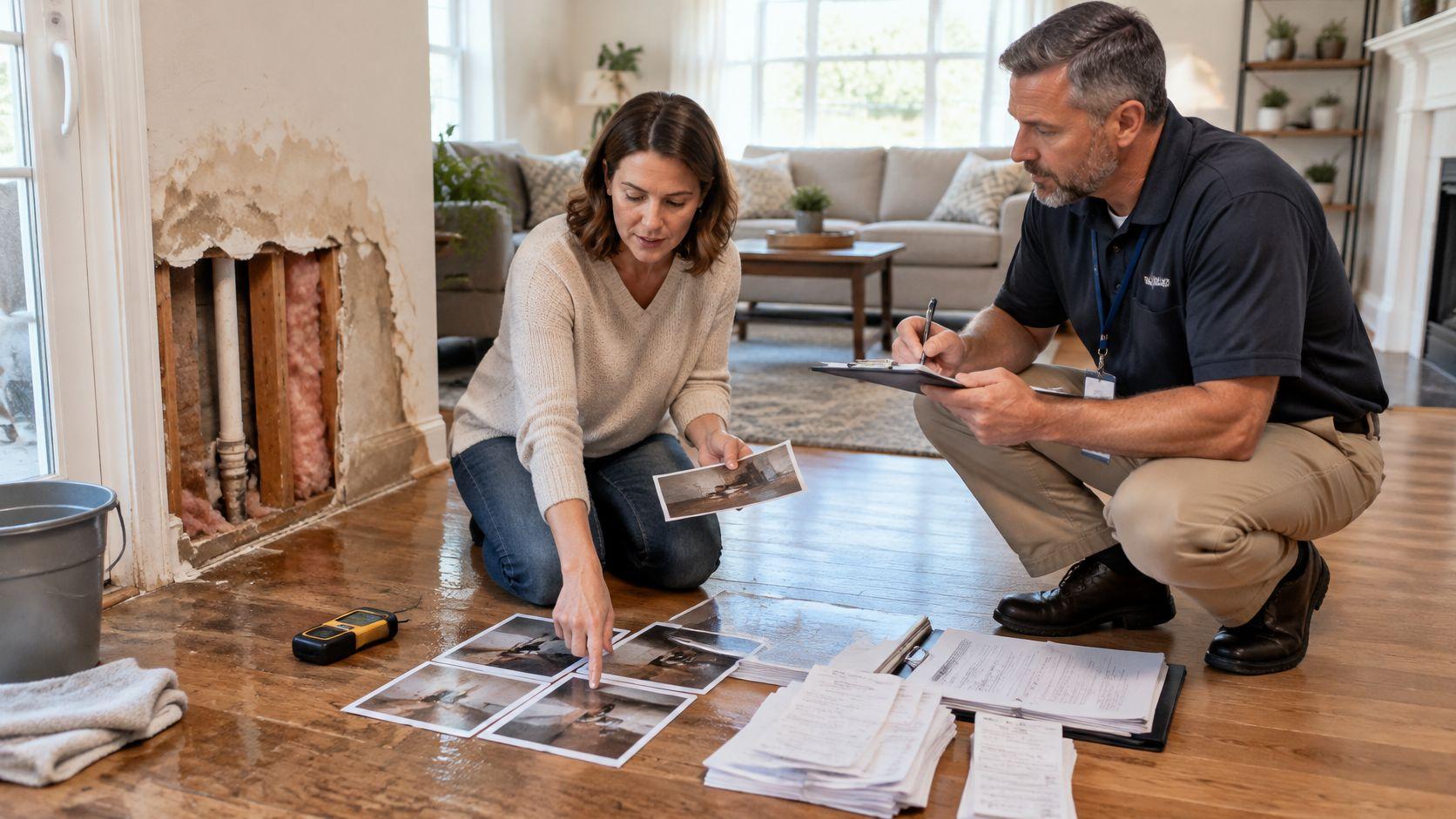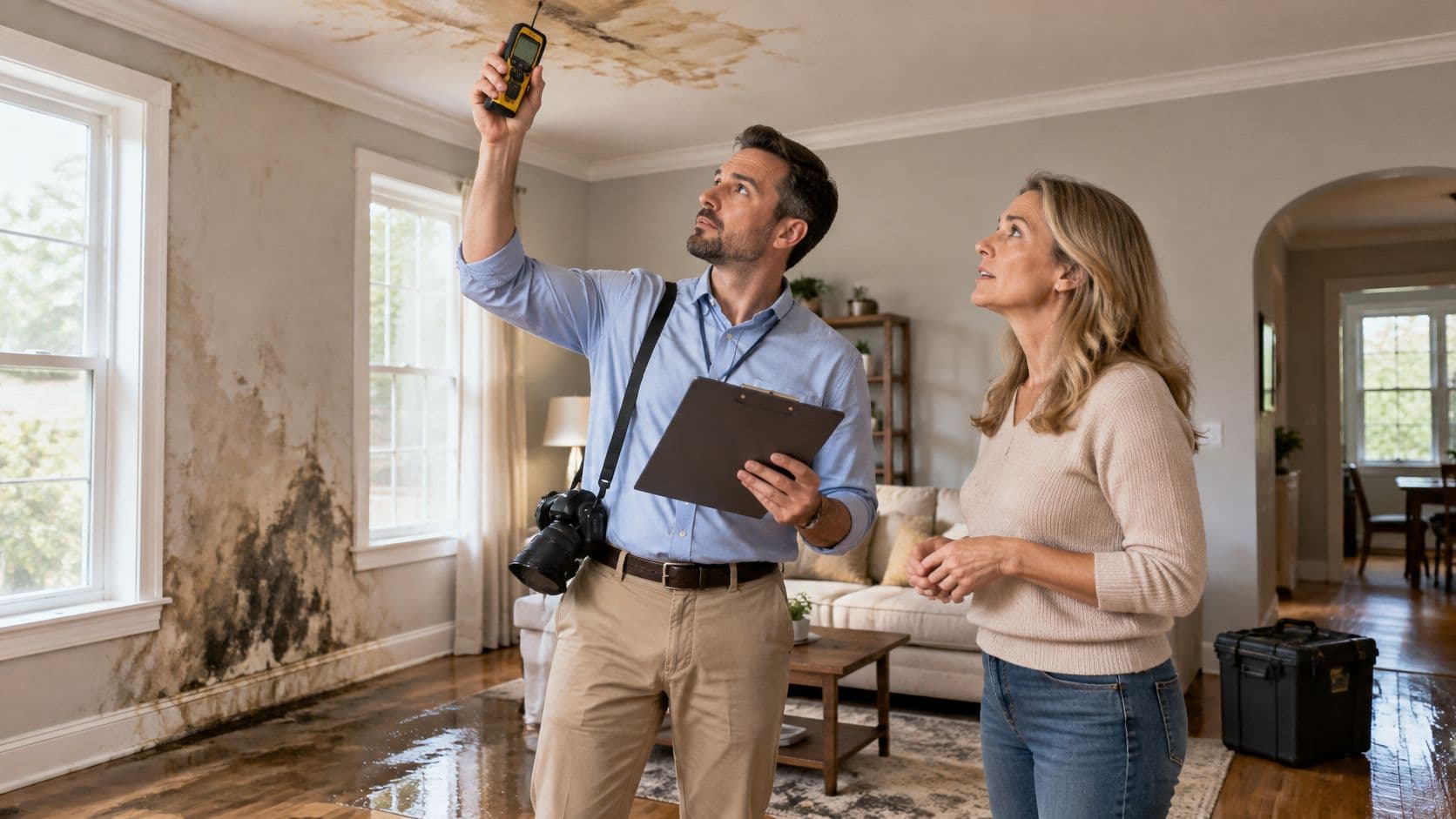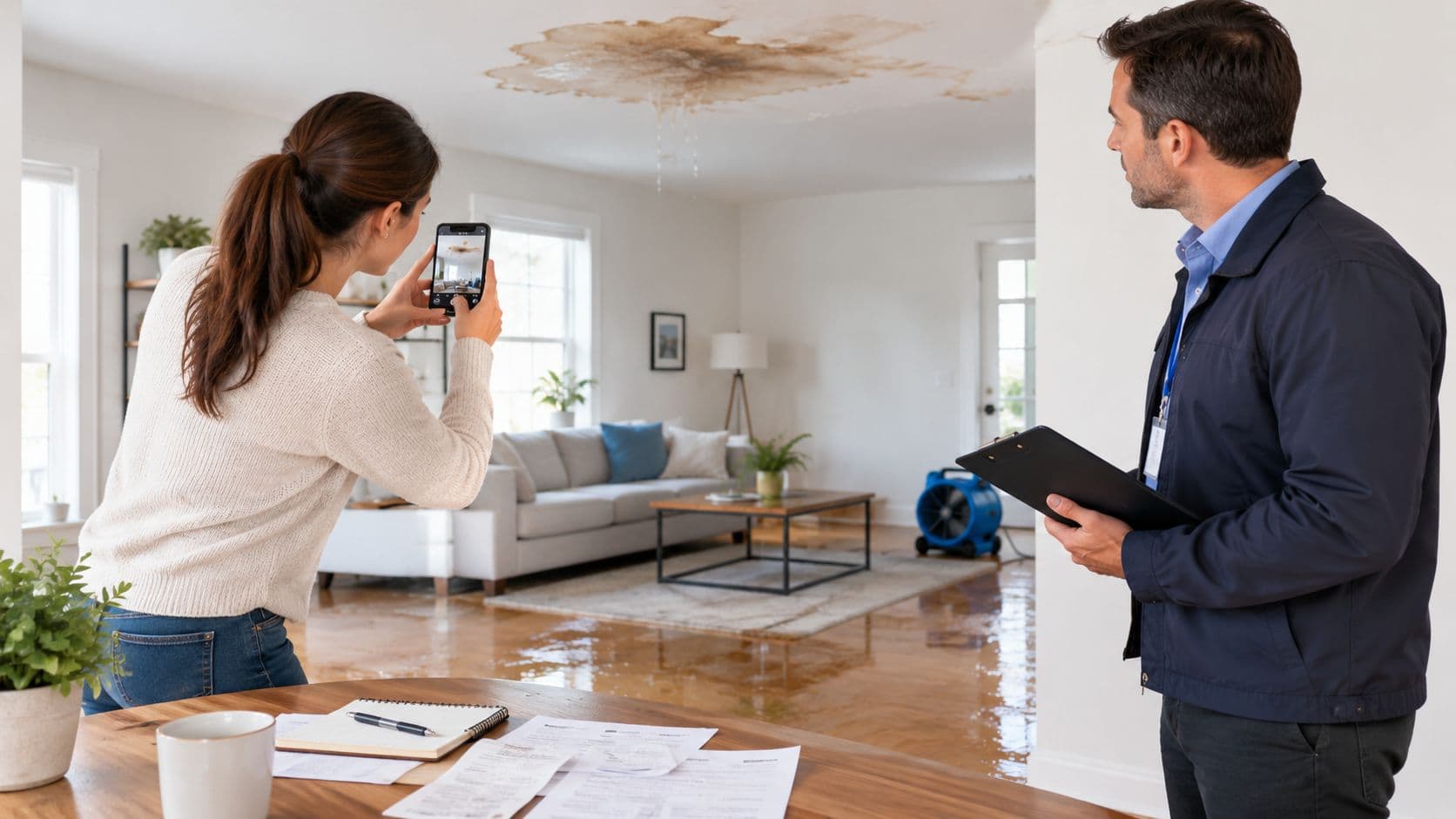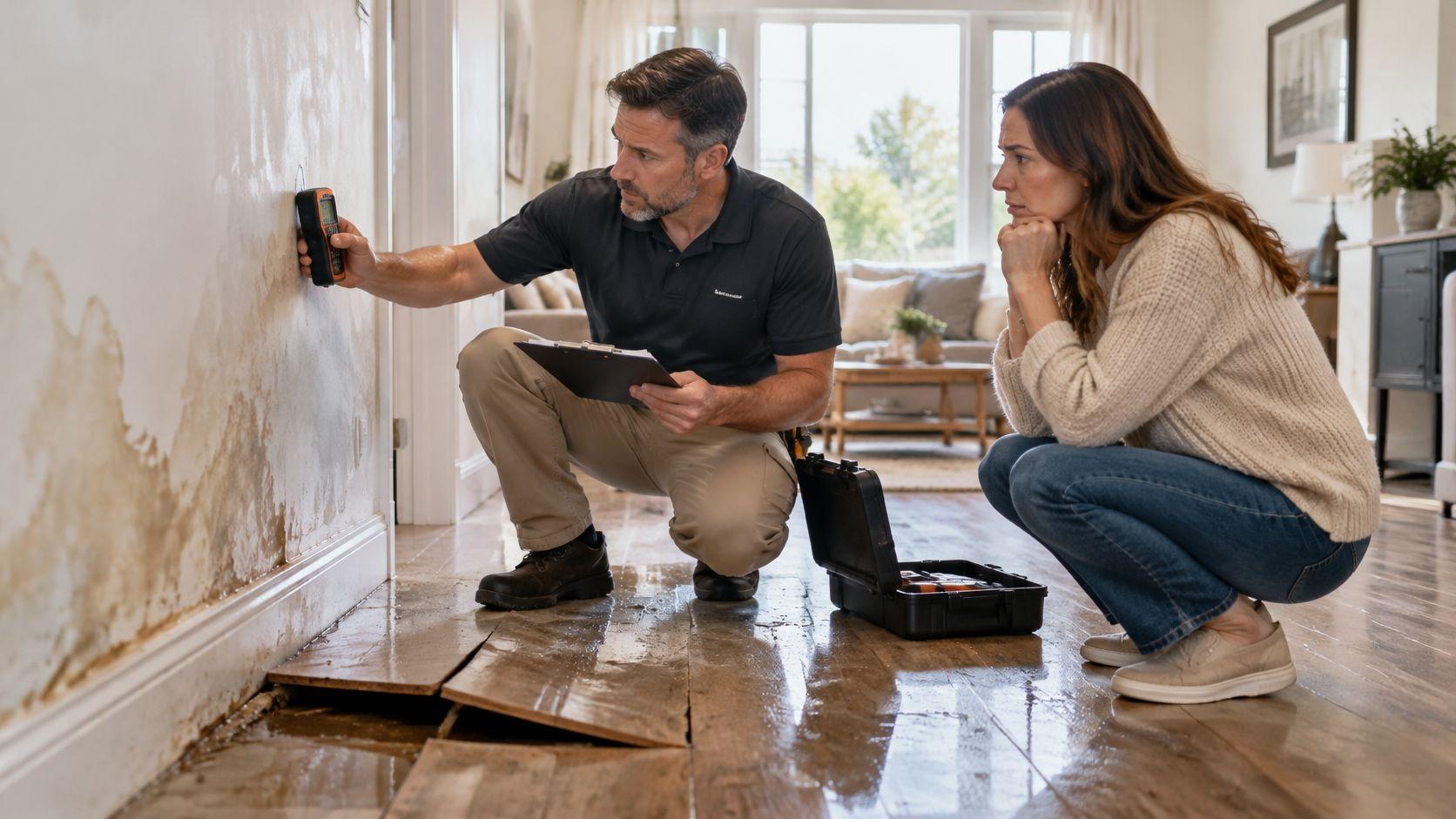
The ceiling stain has stopped spreading, but the drywall gives under your thumb and the carpet squelches when you cross it. The plumber has been and gone. Now you're holding a claim number in one hand and a phone in the other, trying to work out whether the next call goes to your insurer or to someone who works for you.
Water claims run fast at the front and slow at the back. The cause of the water decides which policy responds before anyone is hired, and the first two days decide how much of the loss can still be proven. Get that order wrong and a straightforward covered loss becomes an argument about seepage, mold or flood.
A public adjuster helps with part of that, not all of it, and not on every claim. What follows is the honest sorting: which water losses justify the fee, which don't, and what the work looks like when it's done properly.
When a Public Adjuster Is Worth Hiring for Water Damage
Hiring a public adjuster is optional. It isn't right for every claim, and the fee arrangement is the reason. Public adjusters are typically paid a percentage of what the claim recovers, so the arithmetic only works when there's a real gap between what the insurer has offered and what the policy owes. On a small, clean, obviously covered loss, that gap usually doesn't exist.
Water losses are common enough that most households will face one eventually. Figures from the Insurance Information Institute, cited in the IBHS interior water white paper, put it at roughly one in every 60 insured U.S. homes filing a property-damage claim for water damage or freezing between 2016 and 2020. Average claim severity across 2019 to 2023 was $17,059, per the same source. That's the range where a percentage fee starts to matter, and also the range where a thin estimate leaves thousands unclaimed.
The table below does the sorting faster than any argument.
| Claim situation | Public adjuster worth considering? | Main reason |
|---|---|---|
| Loss below your deductible | Usually not | Fees may exceed any benefit you can recover |
| Sudden leak, cause agreed, estimate complete | Optional | A careful review of the estimate may be enough |
| Estimate skips hidden moisture or drying | Often | Scope and documentation need work |
| Claim denied or cause disputed | Often | Coverage analysis and expert reports matter |
| Flood or sewer backup with unclear coverage | Evaluate carefully | Coverage may be limited even with professional help |
| Commercial loss with business interruption | Often | Income and continuing-expense calculations are complex |
Three questions settle most decisions.
- How large is the loss compared with the deductible? If the recoverable amount is small, a percentage fee eats most of the difference.
- Is the cause of the water agreed? A burst supply line everyone accepts is a documentation exercise. A disputed cause is a coverage fight.
- Does the estimate cover every area and material the water reached? If drying, contents or cabinetry are missing, the file needs work before it's negotiated.
Answer those three and the choice usually makes itself. Where the loss is substantial, the cause is contested, or the estimate is visibly thin, professional help can earn its fee. Where the loss is modest and the cause is obvious, it usually can't.
How the Water Source Changes Your Coverage Path
Water damage isn't one category. A burst supply line, a roof that opened in a storm, a sewer backup, surface flooding and groundwater seeping through a foundation each raise a different coverage question, and some of those questions have no favourable answer under a standard homeowners policy. Sorting the source before hiring anyone is the single highest-value decision in the whole process.
| Water source | Coverage question to answer | What to document |
|---|---|---|
| Burst pipe or appliance leak | Is the event sudden and accidental under interior-water provisions? | Failed part, timing, plumbing or appliance records |
| Roof leak or wind-driven rain | Did a covered peril create the opening before water entered? | Roof photos, storm data, repair invoices |
| Sewer or drain backup | Does the policy cover backup, or does it require an endorsement? | Backup source, water category, endorsement page |
| Surface flooding | Is flood covered under a separate NFIP or private flood policy? | Flood event date, elevation evidence, flood policy declarations |
| Groundwater seepage | Is seepage excluded or limited under the policy? | Foundation photos, moisture readings, prior seepage history |
Collect that documentation from a safe position. Leave any unsafe area first, call 911 or the appropriate utility for fire, gas, electrical, structural or other immediate hazards, and never enter standing water or an unstable structure to get photos or moisture readings.
Four filing outcomes
1. Sudden pipe or appliance failure, or a roof opening from a covered storm. This goes on the homeowners or commercial property policy. Keep the emergency drying invoice separate from the proof of cause, because they answer different questions.
2. Surface flooding that meets the flood definition. This goes on an NFIP or private flood policy. Standard property policies commonly exclude flood, and FEMA states that NFIP policies cover flood-related water damage while not all water damage qualifies as flood damage, as set out in FEMA's NFIP media toolkit.
3. Mixed facts. Wind opening a roof during a flood, or a sewer backup during surface flooding, means filing both and documenting each cause separately. A typical dispute looks like this: the insurer attributes the interior damage to the excluded flood, the owner attributes it to the covered wind that opened the roof, and the claim turns on which cause produced which damage. Two causes together do not automatically produce coverage that neither produces alone.
4. Seepage, maintenance, or a water sublimit. A sublimit can sit as low as $5,000, $10,000 or $15,000 per loss, according to FEMA's NFIP media toolkit. Notice may still be required, but nobody can raise that cap or erase that exclusion by arguing harder.
A public adjuster can document causation, separate covered from excluded damage and identify endorsements. A public adjuster cannot create coverage where an exclusion or a sublimit applies, and any professional who implies otherwise is selling something the policy doesn't contain.
Flood underinsurance makes the declarations page the first document to pull. A 2025 study cited in FEMA's NFIP media toolkit estimated that 70% of annual U.S. flood losses, about $17.1 billion, would be uninsured, and that 88% of at-risk households are underinsured. Whether a homeowners policy responds to a water event at all is a separate question from whether it responds to a flood, and the guide to what homeowners insurance covers on water damage works through that exclusion language.
Before any call with the insurer, pull four pages: the declarations page, the endorsement schedule, the water-damage and seepage exclusions, and the sublimit table. Those four pages tell you which policy gets the claim, which endorsements raise or cap the payout, and which causes are excluded outright. Everything else in the conversation follows from that reading.
What a Public Adjuster Does on a Water Claim
The basic difference is who the adjuster answers to. A public adjuster represents the policyholder and works within the scope permitted by applicable state law. The adjuster the insurance company sends works on behalf of the insurer and reviews the claim for that company. Same job title, opposite sides of the table.
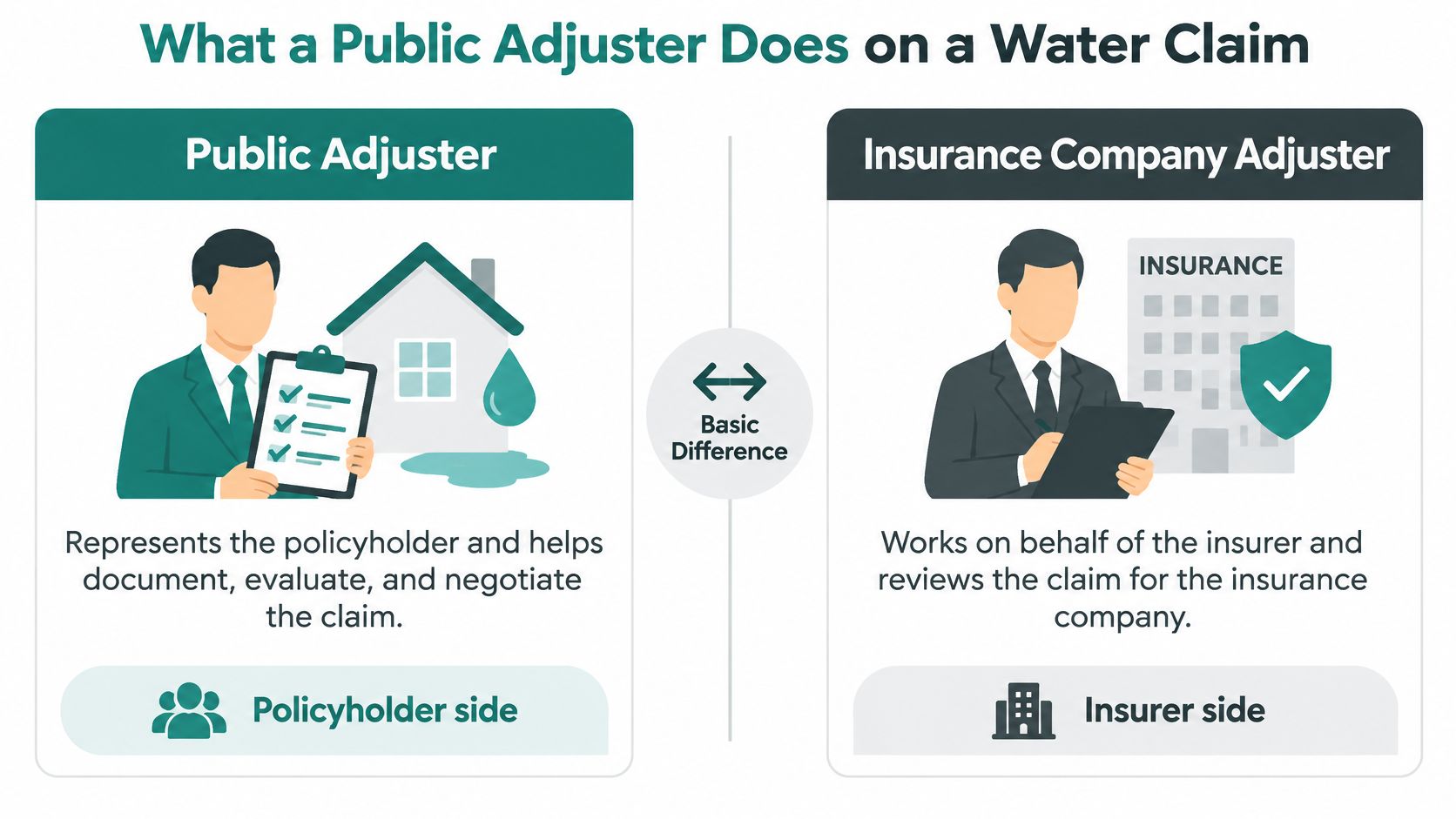
Where the two roles part ways
On a water claim, the work is concrete. Depending on the license, a public adjuster may help with damage documentation, claim estimates and claim negotiations. In practice that looks like reading the insurer's moisture report and noting which rooms were never tested, or preparing an independent estimate that lists demolition, drying, contents and reconstruction as separate line items instead of one lump sum.
It also means attending the reinspection when hidden damage turns up, and putting every request and objection in writing so the file has a paper trail rather than a phone log.
For a homeowner, the scope tends to be dwelling damage plus additional living expenses: the hotel, the meals, the extra mileage while the house dries out. For a commercial owner, it's income loss, equipment, inventory and the restoration timeline that drives how long the interruption lasts.
The limit worth hearing early: a public adjuster can't change what the policy covers, and no professional can guarantee an outcome. The policy and applicable law still control.
Ask any candidate three things before signing: which specific claim tasks appear in the written scope of services, how and when they get paid, and whether they hold a current state license for the location of the property. A license for the right state is not a formality. It's the thing that makes the representation legitimate.
Documenting Water Damage Before Repairs Begin
The first two days are an evidence window that closes whether or not anyone is ready for it. The U.S. Environmental Protection Agency recommends drying wet, non-moldy materials within 24 to 48 hours to reduce mold risk, while also identifying and correcting the moisture source, per the EPA's guide to mold, moisture and your home. Delay the drying and a contained leak becomes damage to drywall, carpet, insulation, cabinetry and contents, all of which lands in the same claim file.
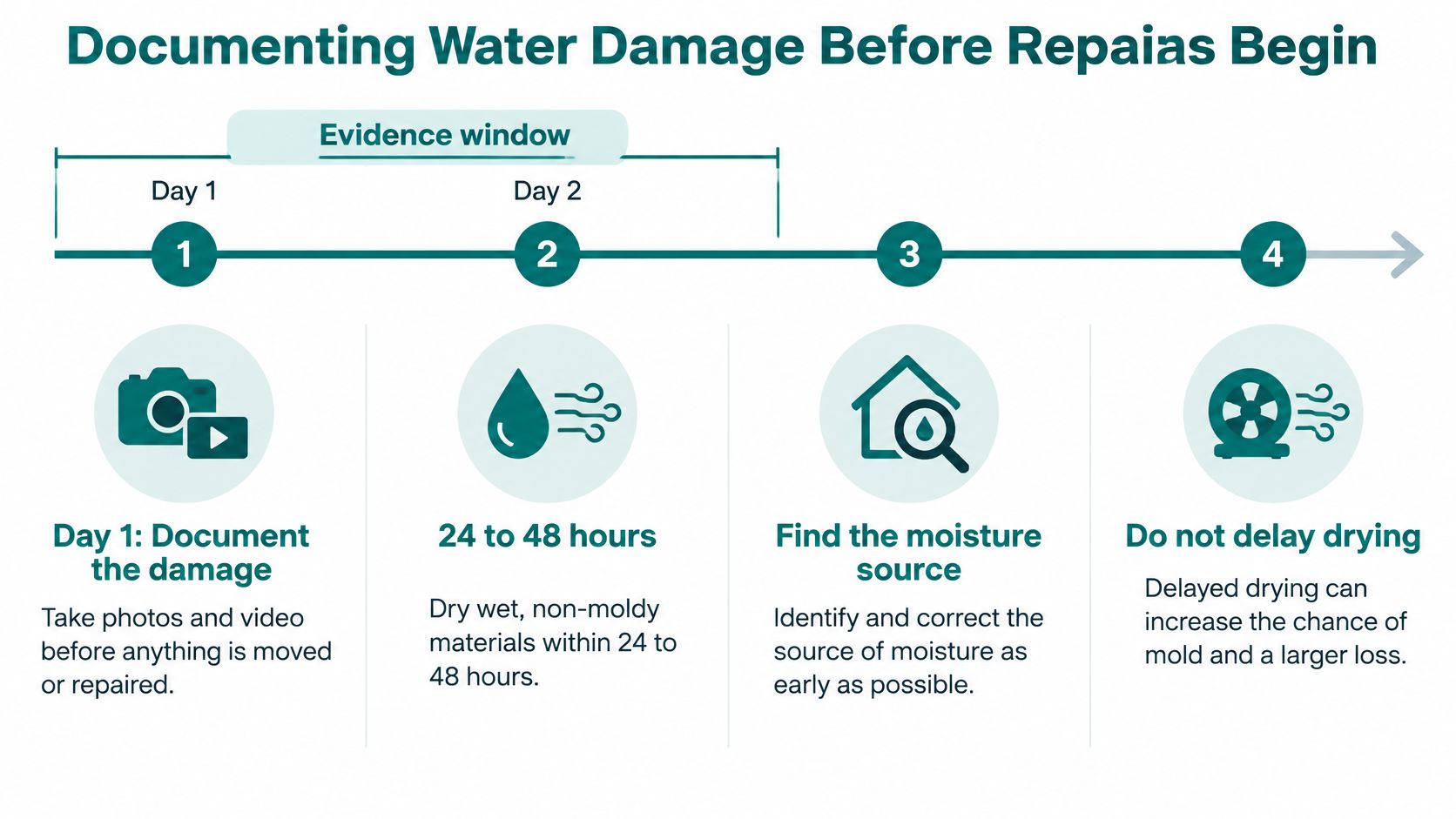
The steps, in order
1. Make the area safe before anything else. Leave if there's standing water or a structural, electrical or gas hazard, and call 911 or the relevant utility. Nobody should enter standing water or an unstable structure to take a photo.
2. Shoot dated photographs and video before demolition. Once the wet drywall is in a skip, the only proof of how high the water climbed is what was captured beforehand. Set the date stamp, and shoot wide before close.
3. Record the leak source and the water category. Clean supply-line water, grey water from an appliance and black water from a sewer are treated differently by both remediation standards and coverage analysis.
4. List affected materials room by room. Drywall, carpet and pad, insulation, cabinetry, trim and contents each carry a different replacement cost, and a room-by-room list is what makes the estimate auditable.
5. Keep the drying log. Equipment placement, operating hours, humidity and temperature readings, and the day the equipment came and went. That log is the difference between a documented mitigation and a guess.
6. Take moisture readings. A meter can measure wallboard, wood, brick and concrete and track drying progress. An infrared survey is worth requesting when there's a suspicion of concealed wet areas behind a finished wall.
7. Keep every receipt. Emergency extraction, a rented dehumidifier, a temporary repair to stop water entering. Small costs disappear from a claim when they're paid in cash and never logged.
Assembled, those records form one file: dated images, a source note, a material inventory, drying data, moisture readings and receipts. A water damage inspection produces much of the same evidence in a more formal package, and either version can be handed to any adjuster without further explanation.
Challenging an Estimate That Only Covers Surface Damage
Most estimates on water claims price the visible repair and stop: patched drywall, new flooring, paint. Hidden moisture, contaminated materials, occupant impacts and the full scope of remediation never make it onto the page.
EPA guidance on mold and moisture points to that wider scope: assess the size of the problem, identify the water source, document damaged material types, and use containment and protective equipment where conditions warrant, as described in the EPA's indoor air quality guidance on mold and moisture. Carpet pad and wet insulation that cannot be dried within the EPA drying window should be documented and replaced, and remediation is not finished until the source is corrected, visible mold and related odours are gone, and the space can be safely reoccupied.
Use the table as a checklist against the evidence collected earlier.
| Scope item | What to quantify | Common gap |
|---|---|---|
| Emergency services | Extraction, drying equipment and billed hours | Mitigation invoices arrive late and are left out |
| Demolition and disposal | Removed drywall, carpet, insulation and cabinets | Removal work is missing from the scope |
| Replacement materials | Matching flooring, drywall, paint and trim | Materials priced without matching the existing finish |
| Contents | Furniture, electronics and clothing on a dated inventory | Items missing from the inventory |
| Assessments | Moisture mapping, engineering or environmental reports | Reports not included in the estimate |
| Temporary relocation or income loss | Hotel, extra living costs or lost business income | Not addressed in the first estimate |
| Reconstruction | Labor, permits and code-required upgrades | Upgrades ignored or over-depreciated |
How to challenge an estimate in writing
Work through it line by line against the file, not from memory. Where a line item is missing, ask the insurer in writing which items were excluded and on what basis, and ask for the answer in writing as well. When the inspection record and the estimate disagree, request a reinspection rather than arguing the point by phone, and keep a copy of every response and every date.
Practical test: if a line item can't be tied to a photograph, a reading or a receipt in the file, expect the insurer to strike it. Evidence, not volume, moves an estimate.
The limit stated earlier still applies here: an omitted line is not automatically a covered line. A professional who treats every gap as money owed is setting up a disappointment, and a well-built file is what separates a real omission from a realistic estimate.
Handling Supplements and Costs After the First Payment
An initial payment does not always settle every insured part of the loss. Hidden damage frequently appears only once the walls and floors are open, and by then the paperwork has often been closed on the assumption that the visible damage was all of it.
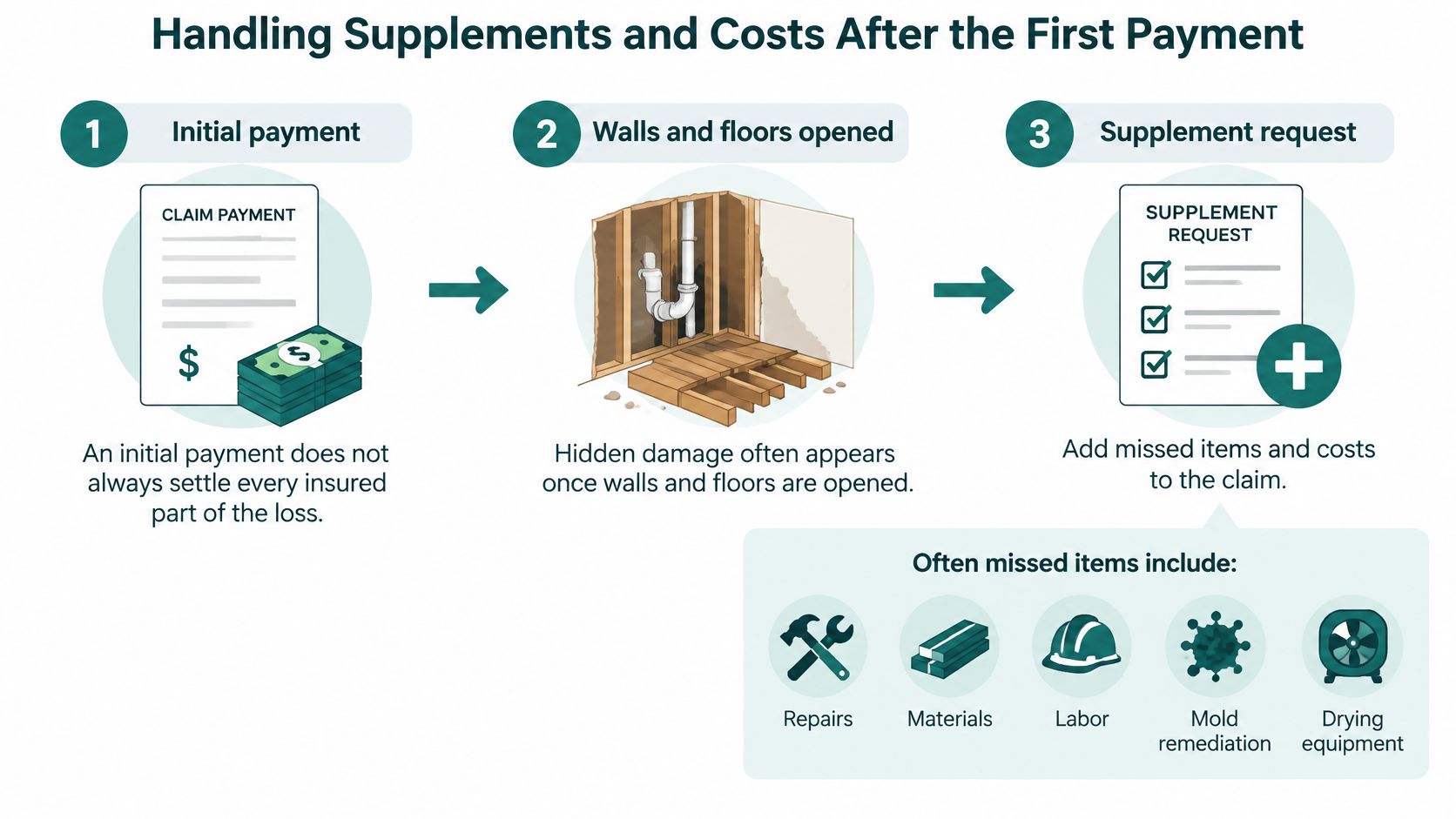
What gets missed after the first check
The usual omissions are consistent: newly found damage that needs a supplemental claim, recoverable depreciation held back until work is invoiced, code-required upgrades triggered by the repair, contents that were inventoried late, temporary relocation costs, and for a business, income lost while the premises are unusable. Each one has its own documentation requirement, and each one has a deadline set by the policy and local law.
Residential and commercial files diverge here. A homeowner's additional living expense claim turns on receipts and reasonableness. A business interruption calculation turns on payroll, continuing expenses, inventory, equipment and the restoration timeline, which is why commercial water claims often take longer to close than the physical repairs take to finish.
Disagreement over causation is where water supplements stall. The insurer may attribute newly exposed damage to long-term seepage or wear rather than the sudden event that triggered the claim, and each side's assessment has to be weighed against the moisture readings, photographs and reports already in the file.
A public adjuster can still take a claim after the first payment, but what remains recoverable depends on what has been signed. If a release reserves unpaid items, supplements can proceed on those items; a release that closes the claim entirely leaves far less room. Policy language, proof-of-loss requirements and local deadlines still apply, so read the release before cashing anything.
If a supplement is needed, the sequence matters. Document the newly found damage before the repair closes it up, submit the additional items with the support behind them, and then track the response: record each submission date, each follow-up and each reply from the insurer, so a stalled file shows up as dates on a log rather than a feeling that nothing is moving. The guide to filing a water damage insurance claim covers the paperwork order in more detail.
The decision framework is loss size, coverage uncertainty, documentation burden, operational interruption, and whether the insurer's estimate omits line items that can be supported. More professional involvement is not always better. When the remaining gap is a small number of well-documented line items, a policyholder who kept a clean file can often submit the supplement directly and keep the fee.
Check the License Fee and Contract Before You Sign
A signature should come after the water source has established which policy responds. Once that path is set, three contract details determine whether professional help will be worth its cost: licensure, compensation and scope.
Establish which peril is being claimed. Flood damage to U.S. homes and businesses exceeded $8 billion in 2024, including about $3.8 billion in communities not classified as high risk, according to FEMA's flood cost data. The peril named in the claim determines which policy responds, which adjuster handles it and what a representative can realistically do. If the cause remains disputed, settle that threshold before treating a fee quote as final.
Verify a state public adjuster license for the property's location. Licensing and authority are handled at the state level. Ask for the license number, check it through the state regulator's lookup tool, and confirm that the contract names the person or firm authorized to represent you.
Read the fee, scope and cancellation clause. Fee rules vary by jurisdiction and can differ during declared disasters, so the contract controls what will be charged. Check whether the percentage applies to the entire settlement or only to amounts recovered after signing, whether expenses are billed separately, what happens if the claim pays nothing and how the agreement can be cancelled.
Keep your own file. Dated photos, drying logs, receipts and every letter from the insurer should remain with the policyholder. Files get transferred, and the owner who kept copies is never dependent on someone else's records.
Before you sign: ask what happens if the claim pays nothing, whether expenses are billed separately from the percentage fee, which settlement amount the percentage applies to, and how the agreement can be cancelled.
On a residential water claim, PostDamage can connect a property owner with a licensed professional where available. PostDamage is an independent information and referral platform, not an insurance company, public adjusting firm, law firm or restoration contractor. It does not directly adjust, negotiate or settle claims, does not guarantee outcomes, and coverage depends on the policy and applicable law.
A denied, delayed or underpaid water claim is the kind of inquiry PostDamage is built to route. Submit your claim details through PostDamage, and a licensed professional can review the documentation, test the estimate against the evidence and tell you whether the file is worth pursuing before the next deadline passes.