
The drywall is back. The floors are down. The sign is lit. Six weeks after the restoration crew packed up, revenue is still running well below where it sat before the loss, because two corporate accounts never came back and the replacement equipment is still weeks from delivery.
That gap between reopening and recovering is where one of the least understood numbers in a commercial property policy decides how much of the loss gets paid. It's the period of indemnity, and it behaves like a clock that starts on the day of damage and keeps running long after the last contractor leaves.
What follows explains the clock in plain language: what starts it, what stops it, how it differs from the policy period, and why a short setting shows up months later as uninsured lost income.
What the Period of Indemnity Means for Your Business
Start with a countdown timer. It begins the moment fire, water, wind, or another covered event stops a business from running normally, and it runs whether or not anyone is watching it. The period of indemnity is the span during which the insured business's financial results remain adversely affected by covered physical damage. The Griffiths and Armour business interruption guidance frames it precisely: coverage generally begins on the date of the insured incident and ends when the business has recovered to the position it would likely have achieved without the loss, or when the policy's maximum indemnity period expires, whichever comes first.
Those two endpoints do all the work. One is economic, meaning results return to where they would have been. The other is contractual, meaning the calendar runs out. Whichever arrives first closes the claim window.
The rule to hold onto: a repaired building doesn't stop the clock, and neither does a reopened storefront. Only recovered financial results or an expired limit does.
The Period of Indemnity Is Not the Policy Period
These are two different measurements sharing one document. The policy period is the window in force, usually twelve months, and it says when coverage exists. The period of indemnity measures the loss itself, and the two rarely end on the same day.
Confusing them produces a specific mistake: assuming the claim has to close when the policy renews. It doesn't. What governs is the loss date, the length of the indemnity period, and how long results stay depressed.
A Three-Part Test to Run on Your Own Policy
- The maximum. Find the maximum indemnity period, or the definition that sets when the period ends. It may be a number of months, or a phrase like "time reasonably required to repair."
- The start trigger. Confirm the event that starts the clock. Most forms key it to physical damage, not to a business decision to close.
- The end condition. Identify whether the period stops at economic recovery, at the end of repairs, or at the calendar limit, and which comes first.
Policy wording and jurisdiction decide the final answer here. Definitions shift between forms, states, and countries, which is why the language deserves confirmation before a loss rather than after.
Typical Indemnity Periods by Coverage Type
The same loss can be measured by a repair-time definition or a stated calendar limit. That difference matters when repairs finish but revenue has not recovered, or when a fixed limit expires before work is complete. The figures below are illustrative policy examples, not statements of market norms. Actual terms depend on the wording of the policy and applicable jurisdiction.
| Coverage Type | Illustrative Period or Limit | How the Period Is Set | What to Check |
|---|---|---|---|
| U.S. business income form | No fixed calendar cap in this example | Time reasonably required to repair or replace damaged property | Whether lost income after repairs finish remains covered |
| Property business interruption with a declared maximum | 12, 18 or 24 months as illustrative examples | Stated maximum in the policy | Whether the limit allows for permitting, equipment lead times and rebuilding |
| Cyber business interruption | 90 to 180 days as illustrative examples | Often limited by the cyber coverage period | Whether outages at key software or cloud vendors are covered |
How to Read Each Row
In the first example, the period is tied to repair time rather than a stated calendar limit. That wording still needs careful reading. If the policy defines the end by completion of repairs, a business could finish construction while sales or production remain below normal. Check whether the policy addresses that gap. For a water loss, for example, a business might reopen after repairs but still face a gradual return of customers or operations. The water damage insurance claim guide explains how property damage and the related insurance claim fit together.
A declared maximum gives the business a calendar limit. Its usefulness depends on how well the limit accounts for the work required after a loss. Permitting, equipment lead times and rebuilding can all take time. If those tasks continue after the stated period ends, later lost income may fall outside the covered window, depending on the policy wording.
Cyber business interruption may use a shorter stated period, as the illustrative range in the table shows. The wording needs to clarify whether a disruption at a software or cloud vendor is covered, even when the business does not own that system. A waiting period may also affect when coverage begins, so check how it applies to each event.
Use the table to identify the structure to look for, not to predict what a policy will pay. Waiting periods, sublimits and extensions can alter how a particular coverage works. Read the declarations and the relevant definitions together, and confirm the applicable terms before relying on a period shown as an example.
How the Clock Runs From Loss to Payment
The cleanest way to see the clock is to watch one dated example run. The 2021 Munich Re claims guide on business interruption sets up a policy with a six-month indemnity limit and damage on October 1, 2018. The indemnity period then runs through March 31, 2019.
Note what that does to the mental model. The annual insurance period is a separate concept. It may have begun long before the damage and ended long before the last cheque, and neither fact changes the calculation.
The timeline below maps that window onto a live claim file.
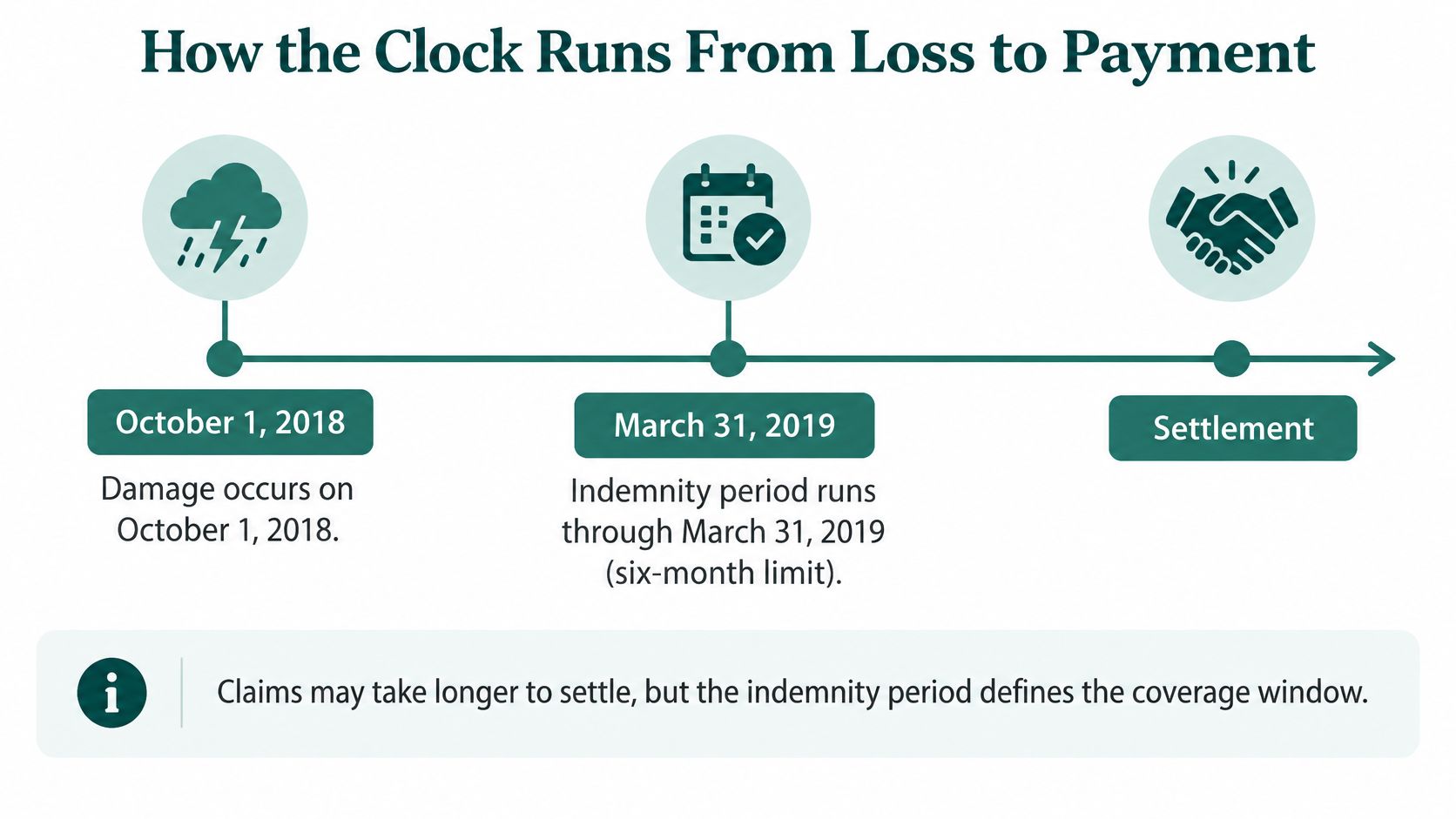
Inside that window, the stages arrive in a predictable order:
- The loss date. October 1, 2018. The clock starts, and every later date is measured from it.
- Clean-up, planning and permitting. All of it consumes the period. Demolition, drawings, inspections and approvals are loss time, not preparation time outside the coverage.
- Rebuilding and equipment replacement. Construction and machinery lead times run inside the same window. Order long-lead items early, because the period doesn't pause for a factory queue.
- Customers and revenue. Usually the slowest stage and the one most often left out of the recovery plan. Accounts that re-sourced during the shutdown don't automatically return when the doors reopen.
- The end. Either results reach the level they would have hit without the loss, or the six-month limit arrives on March 31, 2019, whichever comes first. In the second case, the remaining shortfall is the business's own.
Payments can keep flowing after the policy expires, which is exactly why a claim file has to track two dates at once: the policy expiration and the indemnity end date. Mixing them up is how a payable month gets closed early.
Loss date, maximum period, expected recovery date. Write all three on one line at the top of the claim file before the first adjuster call.
The dates above illustrate a method, not a schedule. A form that measures the period one way won't behave like a form that measures it another, so the wording controls.
Why Claims Stay Open Longer Than the Repairs
A building can be repaired while the business is still losing income. The indemnity period works like a clock that may keep running after construction ends, because customers, output, or staffing may take longer to return to normal. The policy wording determines how that period is measured.
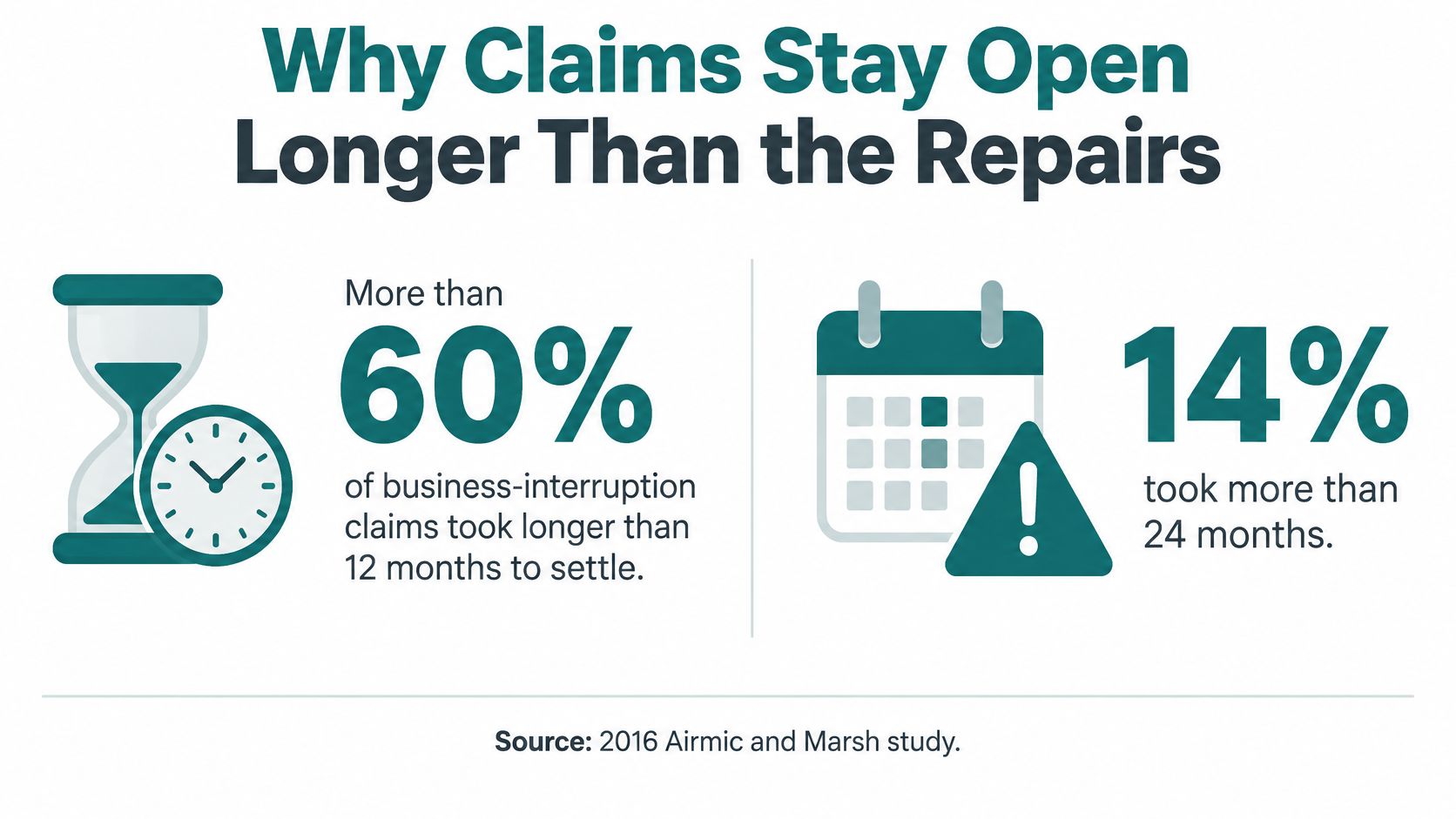
A 2016 study by Airmic and Marsh, cited in the National Association of Insurance Commissioners review of business interruption coverage, found that more than 60% of business interruption claims made by Airmic members took longer than 12 months to settle, and 14% took more than 24 months. The study linked long settlement times to the indemnity period running its course, rather than to slow claim handling. Some losses cannot be fully measured until the period ends.
Three Reasons a File Stays Open After the Building Is Fixed
- The loss is still being measured. If revenue or operating capacity remains below the level expected without the damage, the financial loss may continue after repairs. A final total needs an endpoint.
- The recovery has several stages. Drying, moisture testing, and rebuild sequencing can delay the return to normal operations. A timeline for water damage restoration shows how restoration work can occupy time before the business can assess its revenue recovery.
- The period has a defined end. The settlement calculation depends on the closing date set by the policy's indemnity period. Until that endpoint is clear, the full loss may remain unsettled.
A shorter maximum period does not make repairs or recovery faster. If the clock expires while revenue is still below normal, the remaining shortfall may fall outside the covered period and become an uninsured loss.
What to ask, in writing: Which stages remain before settlement, and what date does the insurer expect the indemnity period to end? Keep both answers with the claim file before the first payment arrives.
How Underinsurance Shrinks Your Recovery
A business can have a high insurance limit and still face an uninsured loss if the indemnity period ends before revenue returns to normal. The monetary limit sets one boundary; the period sets another. Once the clock runs out, lost income beyond that point may fall outside the recovery, even if the business is still rebuilding its customer base.
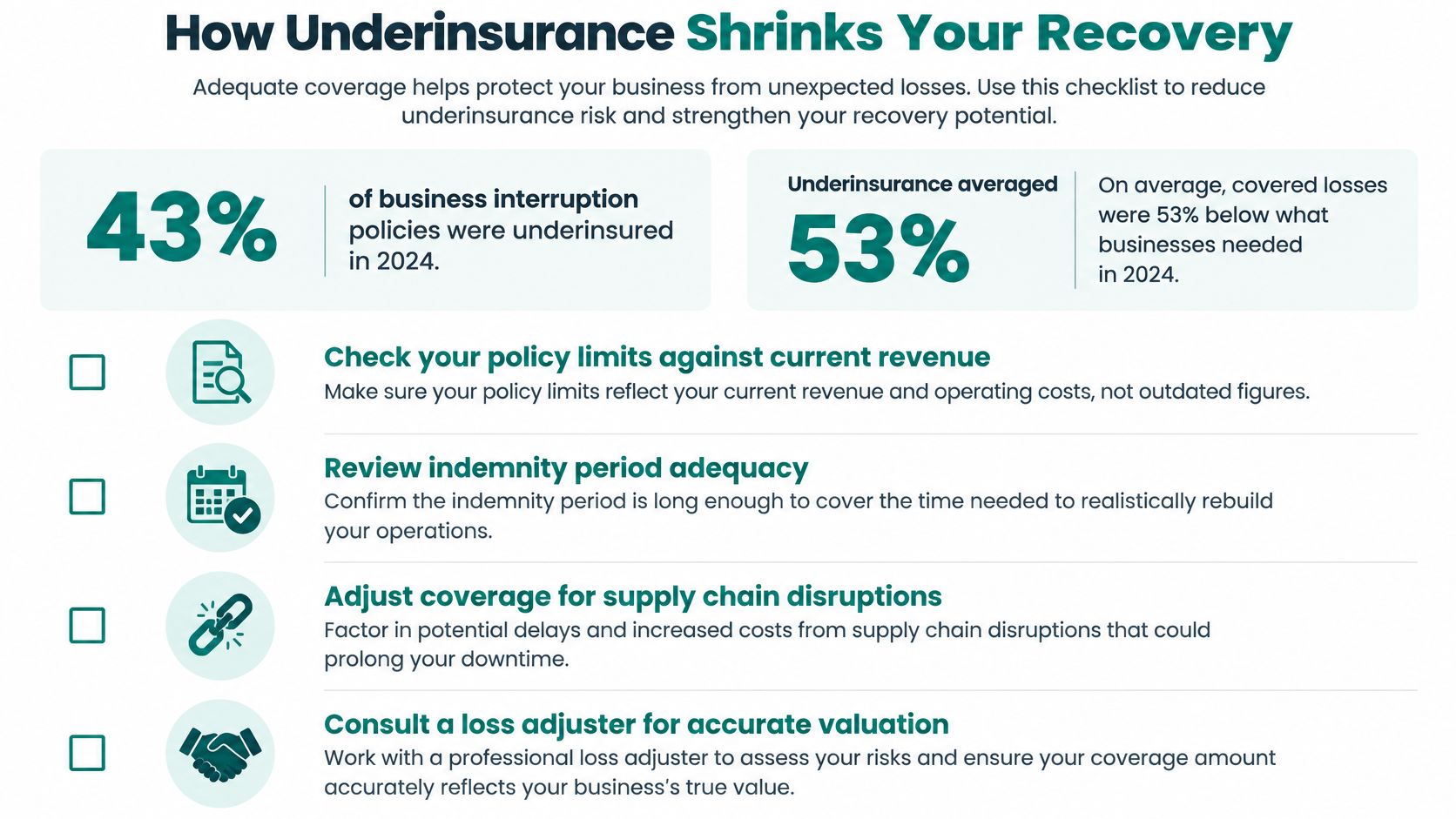
In 2024, 43% of business interruption insurance policies were underinsured, with underinsurance averaging 53%, according to the Chartered Institute of Loss Adjusters as reported by Zurich UK. These figures point to two separate checks: whether the insured amount is adequate and whether the period lasts long enough.
Seven Checks to Run on a Proposed Period
- Site clearance, planning and permits. A major rebuild involving demolition, complex approvals or specialist permits can spend substantial time on these steps before reconstruction begins. Include that time in the period.
- Machinery and specialist equipment. Imported or custom-built equipment may have long lead times. Check whether the period can cover the resulting interruption, not only the building work.
- Customer and market share recovery. Some accounts may not return. Consider how long it could take to rebuild the customer base that remains.
- Inventory and staffing ramp-up. Restocking and rehiring take time. Revenue may remain below normal while inventory and staffing recover.
- Seasonal revenue. If a business earns much of its margin in one or two quarters, check whether the period extends through those trading seasons. A twelve-month cap that ends in a quiet season may miss the recovery.
- Supplier restoration. A single-source supplier's own damage can prolong the interruption beyond the work at the insured site.
- Rebuild cost inflation. If rebuilding takes longer than expected, the original cost estimate may no longer reflect the cost of completing the work. Review the period alongside the projected rebuild schedule.
For practical guidance on steps for filing a water damage insurance claim, see the claim process explained by PostDamage.
The Endorsement Worth Asking About
An extended period of indemnity endorsement may provide cover for a specified time after operations resume, while revenue is still recovering. Ask how long the extension lasts and whether it is already included in the policy or must be added.
A simple test: if the maximum period ends before the business expects revenue to return to normal, the period may be too short. Policy wording and applicable law determine how coverage applies.
Modern Losses That Outlast a Standard Period
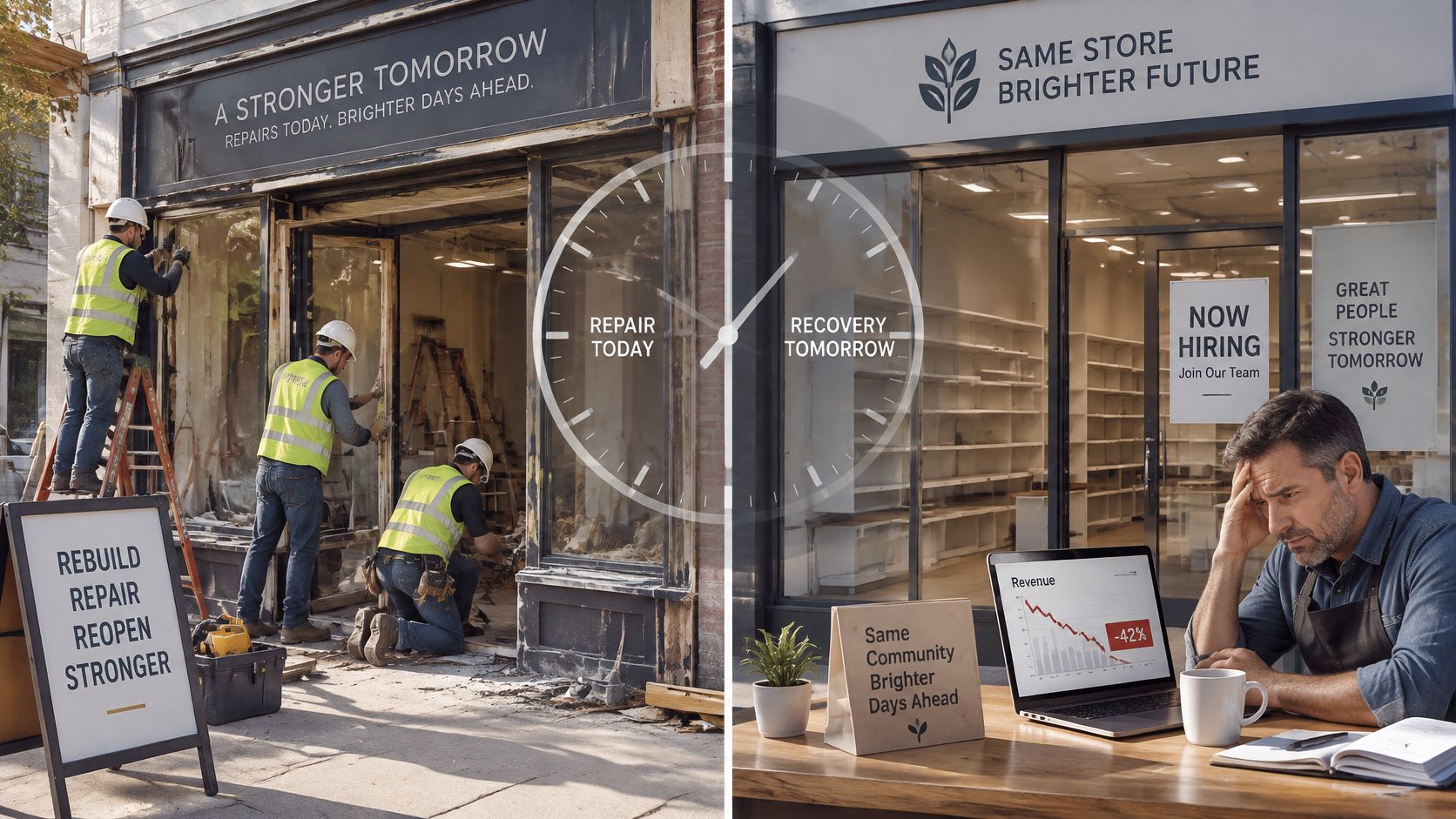
A shop may finish repairs and reopen, yet still earn well below its usual revenue months later. The indemnity clock can stop while the business is still recovering, leaving the shortfall uninsured if the policy's period has expired.
Allianz Commercial's analysis of business interruption claims covered 7,888 claims totaling approximately €6.74 billion from 2021 through 2025. Allianz reported average claim severity rising by more than 30% annually in the two most recent years. Its analysis also tracked more than 48,000 cloud and software outages in 2025 and put contingent cyber interruption at about 15% of large cyber claim value in the first half of 2025, up from 6% in 2024.
Those figures show why repair costs alone do not describe the full loss. Revenue can return gradually: a business might regain some sales after reopening, then remain below its normal level as orders and operating capacity recover. If the indemnity period ends during that climb, later lost income may fall outside the covered period.
Why Recovery Isn't a Straight Line
A building can be ready for business while operations remain disrupted. A supplier's damage, a logistics hub outage, or an unavailable software or cloud provider can slow revenue recovery even after repairs at the insured property are complete. The policy's wording determines whether those interruptions are covered.
Contingent business interruption concerns losses caused by damage to a supplier or another dependent business, rather than damage at the insured location. Coverage may depend on whether the policy identifies the relevant type of dependent property or business and whether the required damage trigger is met. Check the wording and any applicable endorsement rather than assuming that an interruption beyond your property is included.
Three Clauses That Shrink the Payment Inside the Period
- Waiting periods. A time deductible means the business absorbs the first hours or days of a covered loss. For a short cyber interruption, that wait can account for a meaningful part of the disruption.
- Sublimits. A policy may set a maximum indemnity period while a lower sublimit applies to a particular cause of loss. The time available can therefore outlast the amount payable for that cause.
- Demand loss. Customers may change habits or move to a competitor while operations are interrupted. Whether lost income from that shift is covered depends on the policy's terms.
More months do not automatically solve every gap. Check which supplier, platform, permit, or customer could keep revenue below normal, and whether the policy addresses the resulting interruption. Policy wording and applicable law determine the answer.
Confirm Your Indemnity Period Before You Settle
Three actions are worth completing before any settlement figure is accepted.
- Pull the declarations page and the business income form. Confirm the maximum period, the start trigger and the end condition, using the same three-part test outlined at the start.
- Compare the maximum with the expected recovery date. Run the seven checks against it. If the maximum ends before normal revenue returns, raise the gap with a broker and ask specifically about an extended period of indemnity endorsement.
- Document monthly revenue, expenses and lost gross profit. The file should show the loss across the full period, not only the month with the contractor invoice attached to it.
Coverage depends on policy terms and applicable law, and no outcome or settlement amount is guaranteed. PostDamage is an independent referral platform, not an insurance company, public adjusting firm or law firm. Its help is free with no obligation, and it provides information about licensed public adjusters, who can assist with documentation, estimates and negotiation within the scope permitted by state law.
A business interruption claim that was denied, delayed, or paid on a period that expired before revenue came back still has options worth reviewing. PostDamage works with commercial property owners in exactly that position, connecting them with licensed professionals who handle claim documentation, damage estimates and negotiation. Start a free, no-obligation request at PostDamage and get a second read on where the indemnity clock stopped.