
A proof of loss is a signed, sworn statement of the amount claimed under an insurance policy, not merely notice that damage happened. A common reference point is 60 days, but the controlling deadline comes from the policy, the jurisdiction, or an authorized written extension.
The kitchen floor may already be pulled up, drying equipment may still be running, and the contractor may not know what rebuilding will cost. Then the insurer requests a sworn form. The homeowner's task is to meet the applicable requirements without pretending unfinished estimates are final, usually by documenting known amounts, clearly identifying uncertainty, and securing any necessary extension in writing.
What a Proof of Loss Requires You to Swear
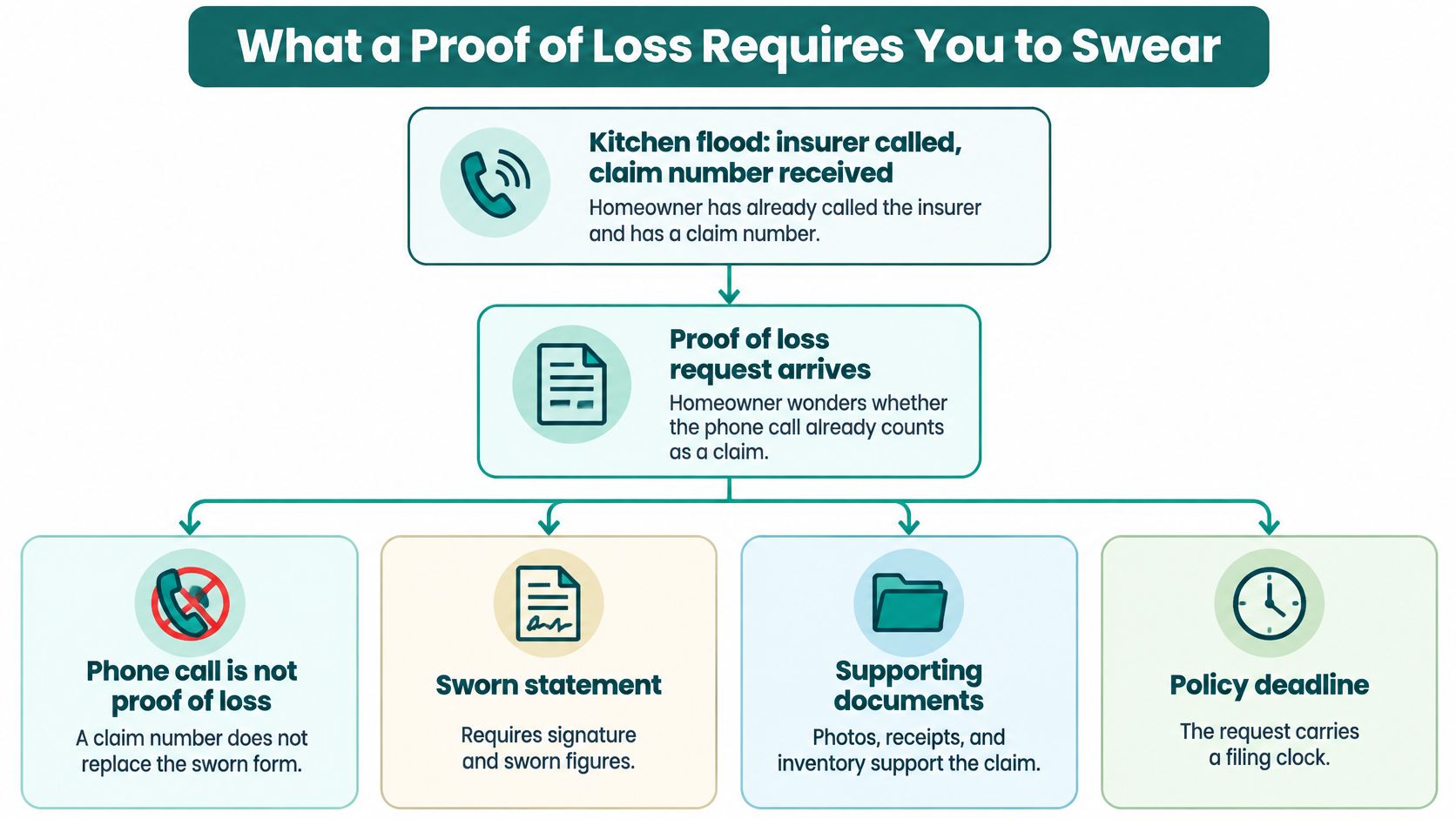
A supply line floods a kitchen. The homeowner calls the insurer, receives a claim number, and arranges emergency cleanup. When a proof-of-loss request arrives, the confusion is understandable: hasn't the homeowner already reported the claim?
Reporting damage and formally stating the amount claimed are different actions. A proof of loss usually identifies the event, the insured's interest in the property, the damaged building and contents, and the amount sought. Depending on the form, it may also require information about other insurance, mortgagees, occupancy, and ownership interests.
Think of it as a formal invoice the insurer can evaluate, with an important difference: the policyholder signs and swears to the information. It isn't a casual message saying a pipe burst.
The documents serve different purposes
- Notice of loss tells the insurer that an event occurred and starts the claim process.
- The adjuster's report records an evaluation of the damage, scope, and price.
- The proof of loss states what the insured formally claims, supported by the required evidence.
In the kitchen example, the homeowner should distinguish observed facts from conclusions. Photographs may establish wet flooring and swollen cabinets. A contractor's estimate may support replacement costs, while a plumber's report may help establish the source of the leak.
The guide to water damage insurance provides context for separating the reported event from questions about coverage. The sworn form still requires careful answers specific to the property and loss.
Why the form is more than paperwork
The New York Standard Fire Insurance Policy provides the historical reference for a signed, sworn proof within 60 days, unless extended in writing, and the 1943 shift in relevant limitation language from the date of the fire to the inception of the loss. Many states subsequently patterned standard fire policies on that approach.
That history explains why sworn documentation became a formal claim condition rather than an optional administrative courtesy. It doesn't establish the deadline for every modern property policy.
Practical rule: A claim number, inspection, or contractor invoice doesn't automatically replace a signed proof of loss when the policy requires one.
Before signing, the homeowner should read the declaration attached to the signature, verify the exhibits, and follow the form's execution requirements. An uncertain answer deserves clarification, not a convenient guess.
Deadlines That Control a Proof of Loss
The policy's actual wording comes first; this reference map separates filing deadlines from insurer-response and payment duties.
| Rule | Who it binds | Clock | What starts it |
|---|---|---|---|
| New York standard fire policy, historical reference | Insured | 60 days unless extended in writing | The loss, under the standard-policy wording |
| NFIP flood policy | Insured | Generally 60 days, unless an authorized extension applies, as described by FEMA's disaster-extension guidance | Date of loss |
| NAIC model after notice | Insurer | 15 days under the NAIC model provisions | Notice of claim, to send forms, instructions, and reasonable assistance |
| NAIC model after proof | Insurer | 15 days to start investigation; written explanation if unresolved at 30 days | Receipt of proof of loss |
| Uniform property and casualty model | Insured | Generally 90 days; late proof allowed when timely filing wasn't reasonably possible, with an outside limit of one year except legal incapacity | The loss |
| Louisiana bad-faith payment timing | Insurer | 30 days, or 60 or 90 days for catastrophic claims, according to Phelps Dunbar's summary of Louisiana's 2024 amendments | Receipt of satisfactory written proof of loss |
Similar clocks can govern different obligations
The standard fire-policy row is a historical reference, not a universal rule for homeowners insurance. A current policy may define its trigger through the loss itself, an insurer's request, or other wording that needs to be read alongside applicable state law.
The NFIP row concerns a specific flood-insurance program. Disaster-specific extensions have occurred, but a homeowner shouldn't assume a widely publicized extension applies to a different storm, location, or policy.
The NAIC rows describe model provisions, not automatically binding law in every state. They also use proof of loss broadly, including claim forms and other reasonable evidence ordinarily required from an insured. The related property and casualty model's late-filing allowance isn't permission to ignore an existing deadline.
Louisiana's row addresses a different question: when payment becomes due after satisfactory written proof. That payment trigger shouldn't be mistaken for the homeowner's deadline to return a requested sworn form, and current applicability requires checking the governing law and claim circumstances.
A filing deadline answers when the insured must act. An investigation deadline answers when the insurer must act. A payment deadline answers when satisfactory proof requires payment under the applicable rule.
Record the trigger, not just the due date
A useful deadline record identifies the policy provision, the triggering event, the resulting due date, and any written extension. It should also identify where and how the insurer requires submission.
That record prevents a common mistake: calculating from the request letter when the policy calculates from the loss. If the trigger or calculation is unclear, the homeowner should seek written clarification promptly rather than rely on a remembered industry rule.
How to File Before the Numbers Are Final
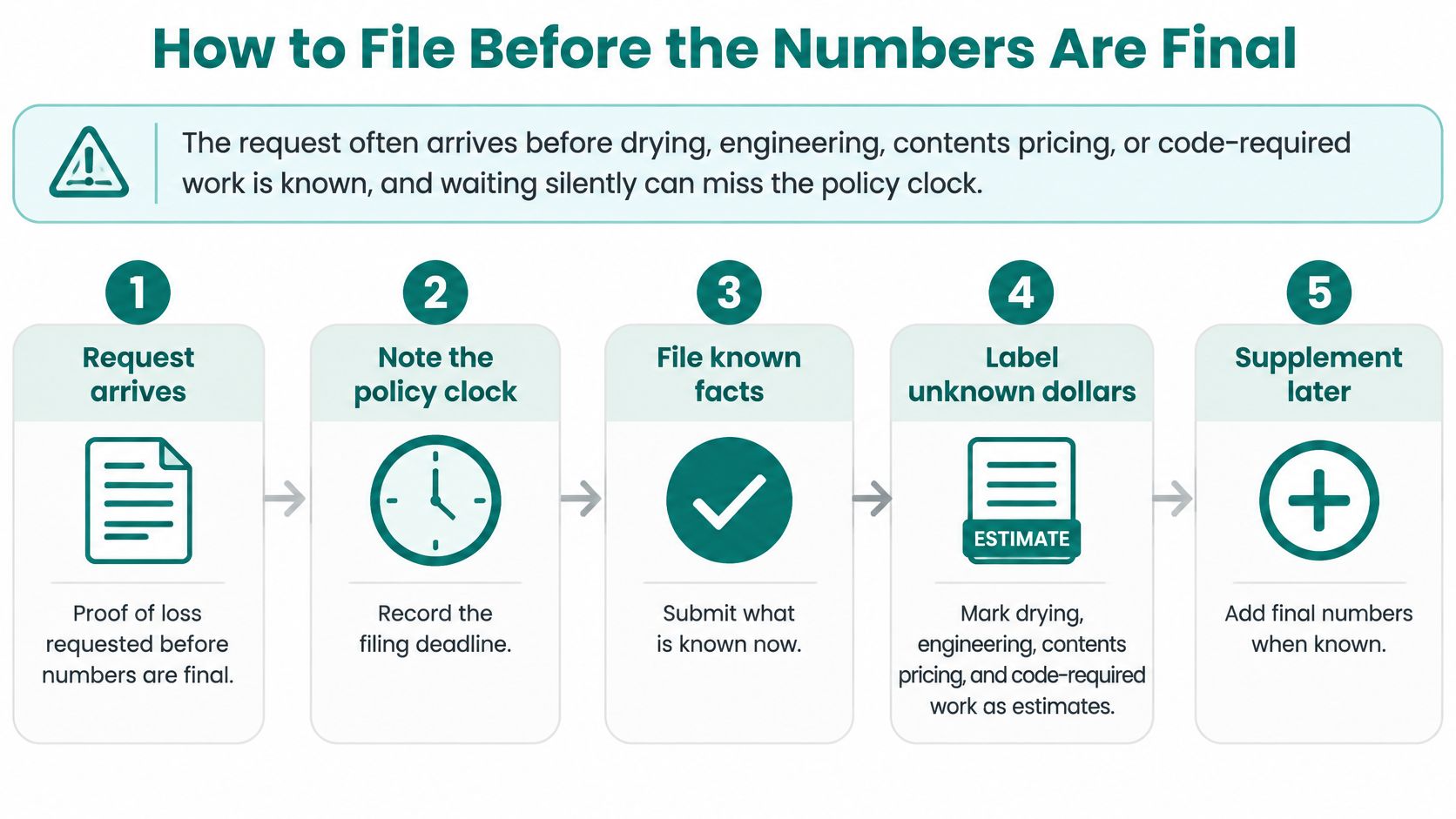
A request can arrive before drying, engineering, contents pricing, or code-required work is complete. Waiting for a perfect repair bill can leave the homeowner with a well-documented loss but a missed filing requirement.
Fewer claims don't make this problem less important. Verisk reported that U.S. homeowners' claims declined 19% year over year in 2025 to 5.27 million, while risks and losses became more concentrated and challenging. Complex damage still requires disciplined documentation when estimates remain unfinished.
A defensible filing sequence
Acknowledge the request in writing. Record the applicable deadline from the policy and request, together with the submission method. Save the acknowledgment with the claim correspondence.
Clarify what remains missing. Ask whether a partial or estimated sworn submission is acceptable and what supporting documents the insurer requires. A partial package shouldn't be assumed to satisfy the policy merely because it was delivered.
Stabilize the property while preserving evidence. Arrange necessary emergency protection and retain photographs taken before removal. Damaged items should remain available for inspection when safe and practical; safety-related disposal should be documented.
Build the amount from identifiable components. Use a room-by-room contents inventory and an itemized contractor estimate. For example, cabinet removal may be supported while concealed wall repairs remain subject to opening the assembly.
Submit an appropriately qualified package. Where permitted, include the signed form with clearly labeled exhibits such as estimated repairs, contents inventory, photo log, and mitigation invoices. Identify known costs and unresolved scope without inserting unsupported figures or signing an inaccurate declaration.
Request any extension in writing and retain the response. The request should identify the policy number, claim number, loss date, outstanding estimates or inventories, and the specific later date requested. An extension request isn't an extension, and a phone assurance isn't the written record needed to establish what was authorized.
Supplement or amend through the applicable process. Later-found damage, code requirements, and final invoices may change the claimed amount. Confirm how revisions must be submitted and review any language that could release unresolved portions of the claim.
Make the extension request specific
A useful request explains what prevents completion. For example, the contractor may be awaiting an engineer's findings before pricing structural work, while the contents inventory and mitigation charges are already available.
The correspondence can identify those completed exhibits, describe the pending report, and request a specific revised filing date. It should ask the insurer to confirm both the extension and whether the proposed interim submission meets its requirements.
The water damage claim filing guide can help organize the underlying claim record. The central safeguard remains accuracy: labeling an estimate explains uncertainty, but doesn't cure unsupported information or override policy requirements.
Documents for Water Fire Storm and Flood Losses
A strong package keeps the event, ownership, damaged property, and valuation separate. Different perils require different evidence, even when the insurer uses a similar sworn form.
Water from a supply line
Say a dishwasher connection leaks into the kitchen and adjoining room. The file should record when the leak was discovered, show the source and affected materials before tear-out, and identify the rooms involved.
Moisture readings and drying logs support the emergency work. The contractor's scope should distinguish extraction, equipment use, material removal, and rebuilding, with material quantities and labor assumptions visible. A separate contents list identifies damaged movable property rather than burying it in the construction total.
Fire and smoke
After a kitchen fire, room-labeled soot photographs help explain why cleaning extends beyond visibly burned cabinets. A fire report, when available, can support the event description without replacing the owner's inventory.
The contents record should distinguish items proposed for cleaning from items proposed for replacement or already discarded. Structural repairs, contents treatment, and smoke-odor work should remain identifiable so the reviewer can evaluate each category rather than interpret an unexplained cleanup total.
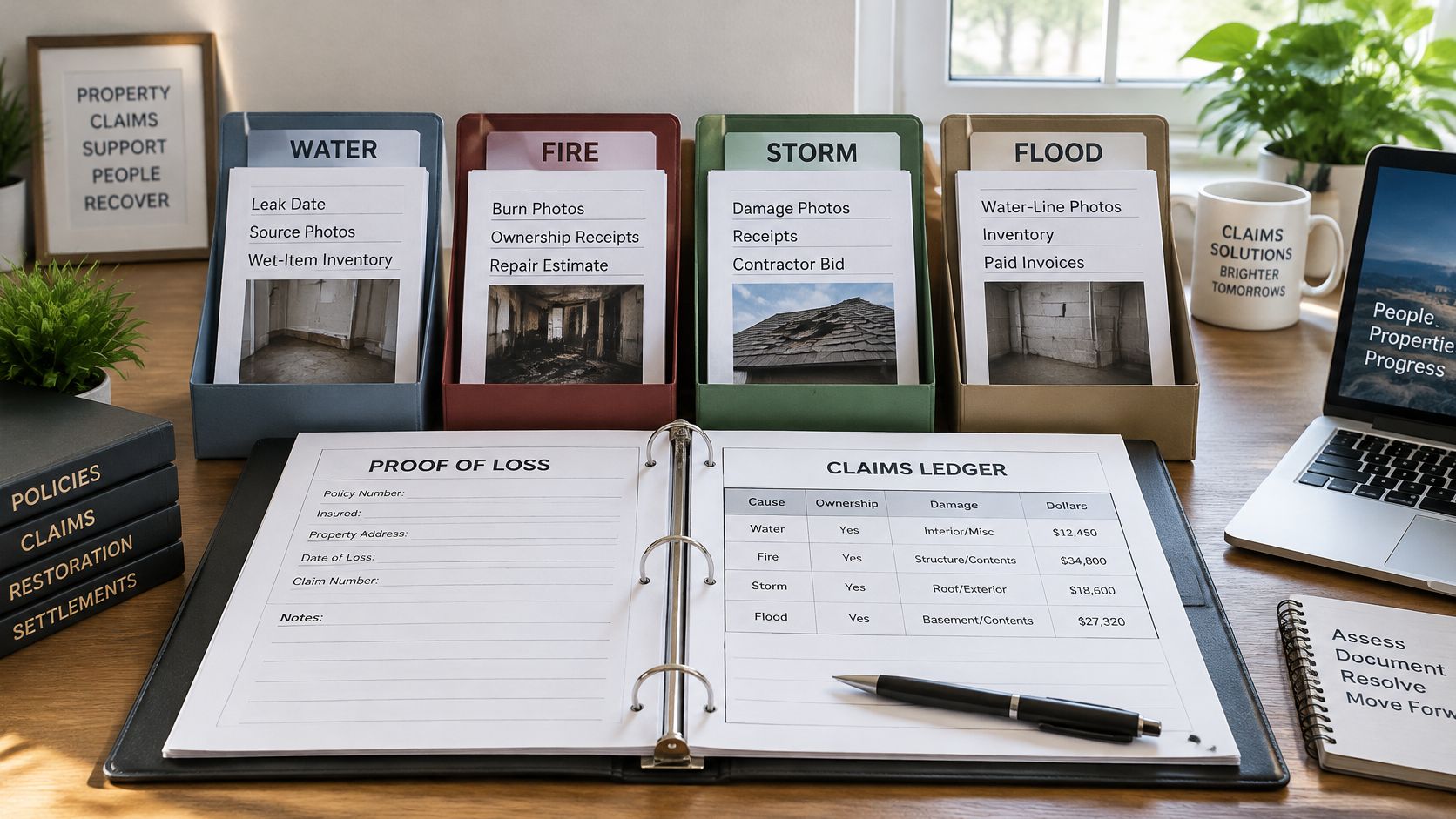
Wind, hail, and storm openings
For a wind-damaged roof, the package should connect the weather event to the affected roof areas and any resulting interior damage. Roof photographs, opening details, tarp invoices, and board-up receipts serve different evidentiary purposes.
The contractor should distinguish observed sudden damage from deterioration or prior repairs. A photograph of ceiling staining alone may not establish the exterior opening or explain the proposed roofing scope.
NFIP flood and shared properties
FEMA's flood proof-of-loss guidance describes a signed, sworn amount supported by building-repair estimates, a personal-property inventory, photographs, invoices, and receipts, with a standard deadline of 60 days after the loss unless an authorized extension applies. The statement also identifies the event, building and contents damage, other insurance, mortgagees or lienholders, and occupancy information.
For a flooded rental building, each exhibit should identify the unit or common area involved. Tenant-owned contents shouldn't be blended into the owner's building claim without establishing the relevant interest and coverage.
- Cause record: Event description, source photographs, and relevant reports.
- Ownership record: Insured interests, mortgagees, and property ownership details.
- Amount record: Itemized scope, inventory, estimates, and receipts.
The control test is straightforward: a reviewer should be able to evaluate coverage, cause, and amount from distinct, traceable parts of the package.
Signing Before Final Repairs and Other Costly Errors
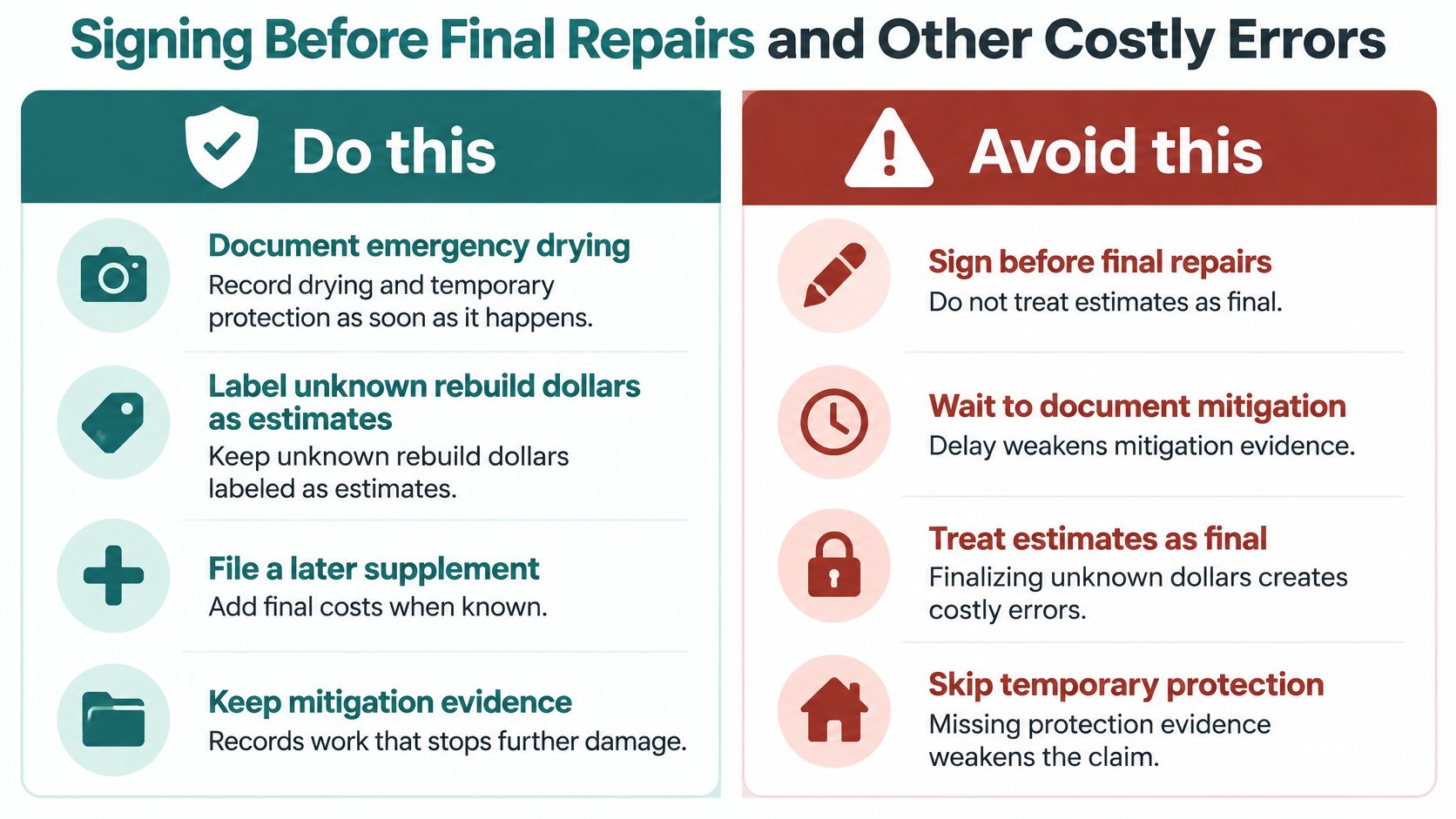
Final repairs don't always need to be complete before a proof of loss is signed. The harder question is whether the declaration accurately describes the amount claimed, whether estimated items are permitted and properly identified, and whether later revisions remain available under the policy process.
Waiting for completed construction can be impractical. Signing an unexplained round figure as though every component were settled creates a different problem. The safer approach distinguishes the evidence of emergency work from the valuation of unfinished repairs.
Three records in a property claim
| Record | Who creates it | What it proves | When it is used |
|---|---|---|---|
| Mitigation file | Owner or restoration contractor | Work performed to stop further damage and the supporting charges | As soon as emergency drying or temporary protection occurs |
| Adjuster estimate | Insurer or independent adjuster | Carrier evaluation of scope and price, not automatic agreement by the insured | After inspection |
| Proof of loss | Insured, signed and sworn | Amount formally claimed under the policy | By the applicable deadline, with uncertain lines labeled estimates where permitted |
| Supplement or amendment | Insured | Later-found damage, code items, or revised costs | When scope or price changes, through the required process and without unintended waiver language |
Emergency drying records answer what was done and why. A rebuild estimate answers what the contractor proposes to restore. Neither should be treated as interchangeable with a sworn statement or a settlement release.
The water damage restoration cost guide provides context for reviewing restoration charges. The actual claim still needs property-specific quantities, conditions, and supporting records.
Disagreement needs a reconciliation, not a guess
The LexisNexis home-insurance trends report reported that all-peril loss cost remained 50% higher in 2025 than in 2019, despite a 23.8% frequency decrease from 2024. That context reinforces why fewer claims shouldn't encourage casual documentation of a substantial loss.
When the contractor and adjuster disagree, the homeowner should identify the actual disputed lines. Perhaps the adjuster included visible flooring but omitted damaged underlayment. The useful response is a photograph, measurement, and separately priced scope, not a larger total.
Other differences may involve contents, concealed water damage, rooms identified later, or code-related work. Each should have its own explanation and evidence. An estimate can be uncertain; an unsupported allowance shouldn't be presented as established fact.
An accurate estimate describes its assumptions. A bargaining figure conceals them. A sworn statement should never be used as a negotiating bluff.
Errors that create avoidable disputes
- An unexplained lump sum: A total without room inventories or itemized repairs makes it difficult to verify what the homeowner included.
- Disposal without a usable record: When damaged materials must be removed, photographs, identifying details, and the reason for disposal help preserve evidence. Unsafe items shouldn't be retained merely for documentation.
- Mixed expense categories: Building repairs, contents, mitigation, and additional living expenses should remain separately traceable, even when a contractor bundles charges.
- Unconfirmed extension assumptions: News about disaster relief doesn't establish that a particular claim received a filing extension.
- Final-satisfaction language: A partial payment document may contain broader terms than the homeowner expects. The signature language needs review before acceptance.
- Unanswered ownership questions: Blank mortgagee, lienholder, or other-insurance fields can leave material information unresolved. The homeowner should clarify the required response rather than invent an answer.
- Intentional overstatement: Inflating quantities or values to leave negotiating room is incompatible with a sworn submission.
Professional help should match the problem
A public adjuster or lawyer is optional, not a requirement for every property claim. Professional review becomes more useful when the loss is substantial, causation is disputed, commercial interests overlap, or replacement-cost conditions create additional deadlines.
If a requested declaration can't be signed truthfully, the homeowner shouldn't sign first and hope to explain later. Prompt clarification, a documented extension request, and advice about the applicable requirements are safer than either silence or a knowingly inaccurate statement.
Decide Your Next Step on an Active Loss
An active claim calls for a clear decision, not another unsupported total. The homeowner should establish the form requirement, identify the controlling date, and determine whether the claimed amount represents completed work or supported estimates.
- Check the requirement: Locate the policy provision and the insurer's written request for a sworn proof.
- Check the deadline: Confirm the triggering event, submission instructions, and any authorized extension.
- Check the declaration: Compare the amount and attached exhibits with the language being signed.
If the insurer has requested the form, a same-day written acknowledgment helps establish an organized response. The immediate work is to assemble the photographs, inventory, and itemized estimates, then resolve omitted or disputed line items without unintentionally releasing unfinished parts of the claim.
For a small, agreed repair, the policy form and insurer's instructions may be sufficient. A large, delayed, denied, or underpaid claim may justify professional assistance before the homeowner signs a disputed declaration.
PostDamage is an independent property-damage information and referral platform serving homeowners, landlords, and commercial property owners. It prioritizes active claims, substantial losses, denied or underpaid claims, and a clear need for professional assistance.
PostDamage isn't an insurer, public adjusting firm, law firm, or restoration contractor, and it doesn't directly adjust, negotiate, or settle claims. Its content is general information, not legal, insurance, or claims advice, and it doesn't guarantee outcomes.
For an active loss with incomplete estimates or a disputed proof-of-loss amount, PostDamage offers a way to request professional assistance and connects qualified inquiries with relevant professionals where available. Property owners can submit the damage type, location, and preferred contact method with no obligation, helping identify an appropriate next step before signing unresolved claim documents.