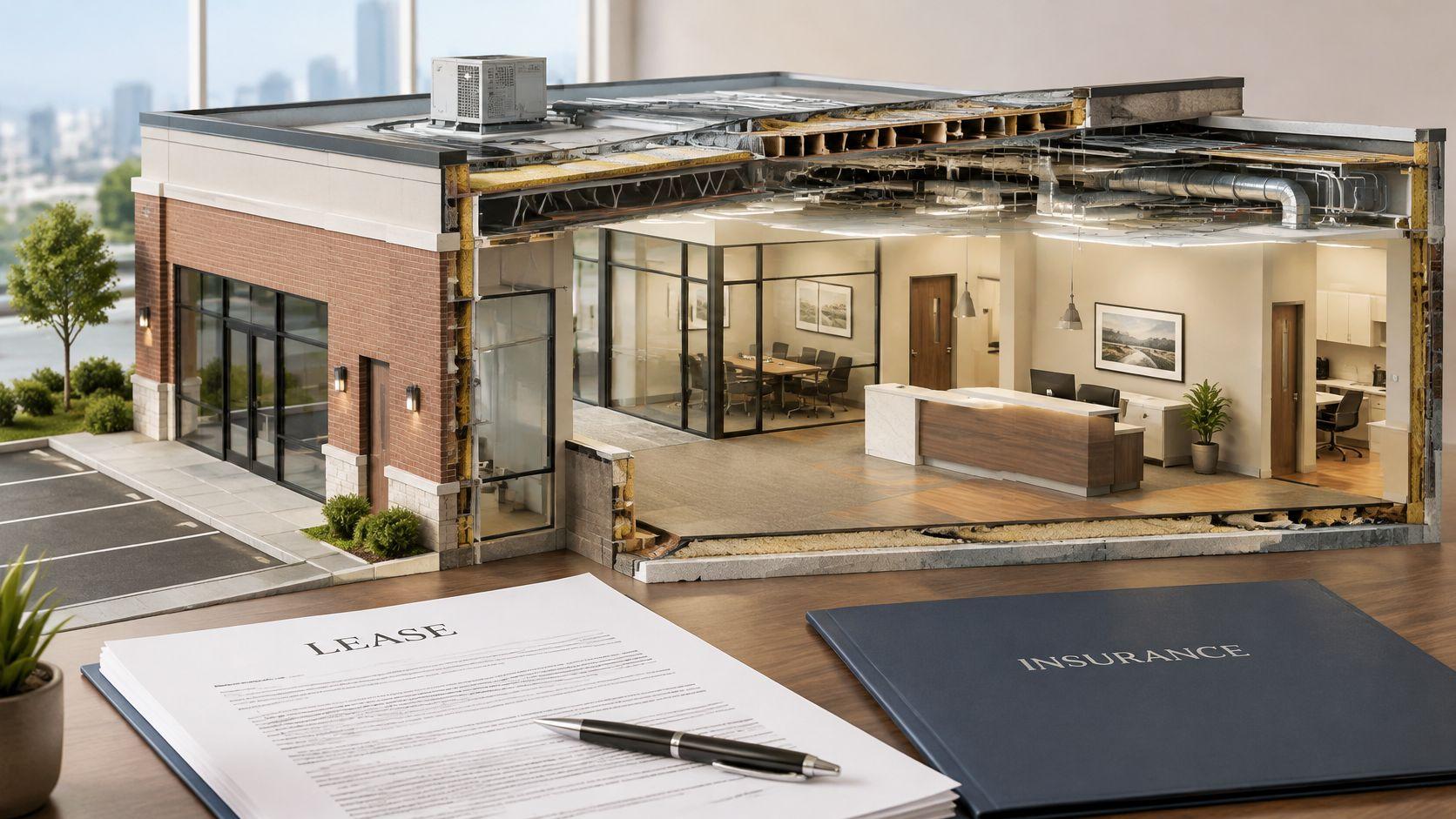
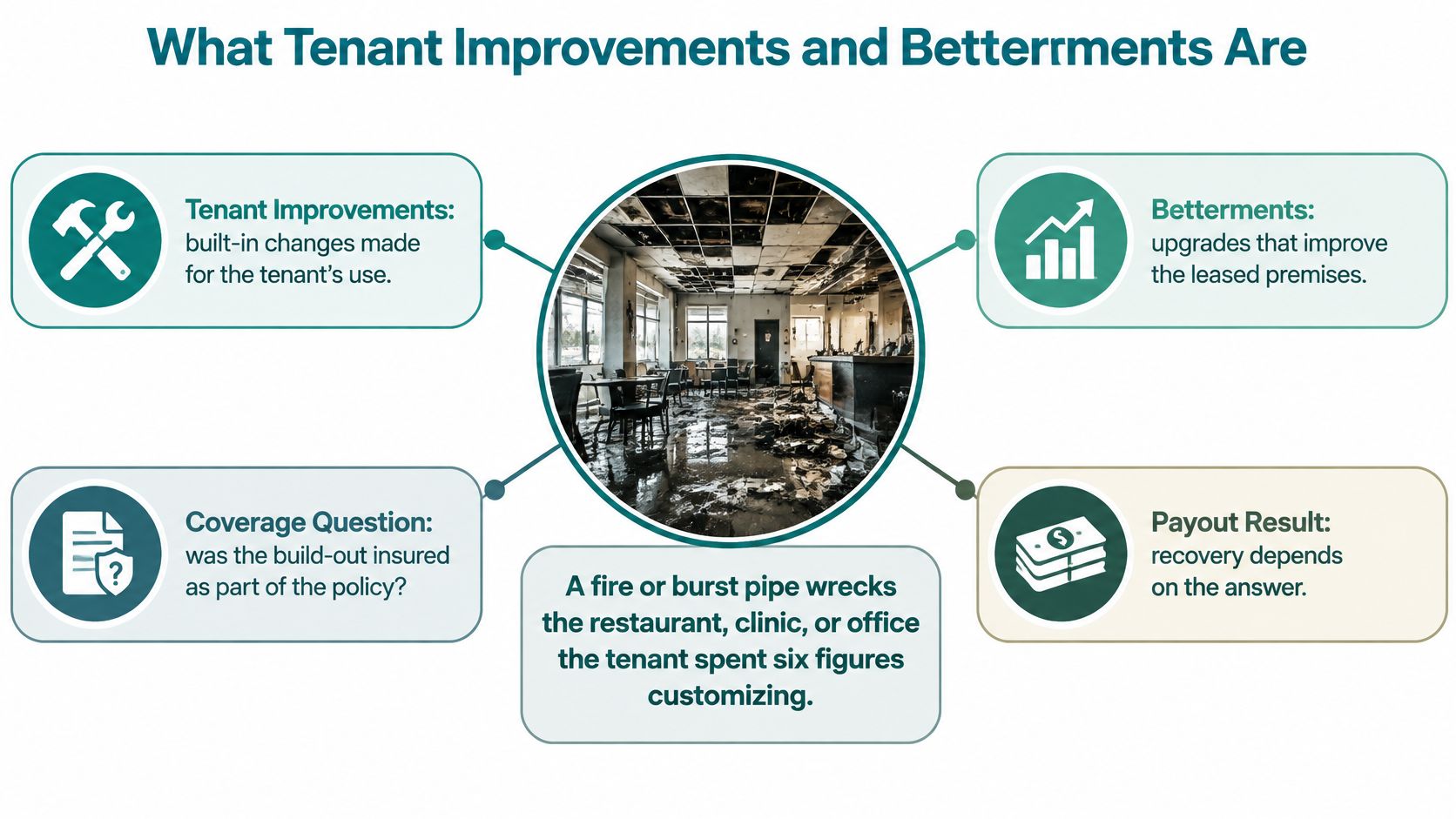
A fire or burst pipe wrecks the restaurant, clinic, or office the tenant spent heavily customizing. The landlord reports a building claim, the tenant reports damaged contents, and neither estimate clearly includes the partitions, specialized wiring, flooring, or built-in reception area. The business can't reopen without those improvements, but paying for their installation doesn't automatically establish who must insure or replace them.
Tenant improvements and betterments sit at the intersection of the lease, the property policy, and the rebuilding decision. An expensive build-out can produce a disappointing settlement when those documents assign different responsibilities, especially when the lease is nearly over or the landlord takes control of repairs.
What Tenant Improvements and Betterments Are
Tenant improvements and betterments, also called leasehold improvements or build-outs, are permanent alterations that make leased commercial space suitable for a tenant's operations. As Investopedia's explanation of leasehold improvements describes, these alterations include partitions, finishes, lighting, wiring, flooring, and certain plumbing or electrical work, with capitalized costs normally amortized over the shorter of useful life or the remaining lease term.
Consider a clinic opening in a largely unfinished suite. The landlord supplies the exterior enclosure and basic building systems. The tenant adds examination rooms, washable flooring, specialized electrical distribution, sinks, and built-in storage. Those additions make the suite usable as a clinic rather than rentable floor space.
Core distinction: Tenant-funded permanent improvements are generally capital assets, not ordinary rent or routine repairs. Their accounting treatment doesn't, by itself, establish insurance ownership or coverage.
The shorter accounting life can reduce book value near lease expiration. Insurance recovery may also narrow as the lease runs down, but that result comes from the policy's valuation language, not automatically from the accounting ledger.
The shell and the customized interior
A useful analogy separates a vessel's hull from everything fitted inside its cabin. The landlord commonly insures the building shell, while the tenant may insure the customized interior or the tenant's right to use it. That analogy helps identify the assets, but it isn't a substitute for reading the actual property definitions.
Typical build-out components include:
- Partitions and demising walls that establish rooms, treatment areas, or separate suites.
- Flooring, ceilings, and finishes installed for the tenant's layout and use.
- Lighting, wiring, and distribution serving workstations, equipment, or specialized operations.
- Plumbing and HVAC modifications needed for the tenant's particular occupancy.
- Built-in cabinetry and reception areas incorporated into the premises.
A restaurant's freestanding refrigerator and its permanently installed electrical distribution shouldn't disappear into the same construction total. They may fall under different property categories, carry different valuation conditions, and require different proof.
The central claim questions are therefore distinct: Who owns or has an insured interest in the improvement? What valuation applies after damage? What evidence supports recovery? A contractor's invoice helps answer the cost question, but it can't answer all of them.
Who Owns and Insures What in a Leased Space
The common dispute begins with matching assumptions: the tenant expects the landlord's building insurance to respond, while the landlord expects the tenant's property insurance to cover the interior. Neither assumption establishes coverage.
The table below is a starting allocation, not a coverage determination. The lease assigns contractual duties; the insurance contract determines whether a particular policy satisfies them.
Who owns and insures what in a leased commercial space
| Property | Typical examples | Typically owned by | Policy that usually responds | Claim valuation basis |
|---|---|---|---|---|
| Building shell | Structure, roof, exterior walls, base HVAC, common areas | Landlord | Landlord's commercial property policy | Replacement cost or actual cash value under the landlord's policy |
| Tenant improvements and betterments | Partitions, flooring, ceilings, lighting, wiring, plumbing, built-in cabinetry | Tenant or landlord under the lease | Tenant's TIB coverage, or landlord's policy when assigned and insured | ACV, replacement cost when applicable, or a lease-term-based proportion |
| Betterments | Higher-grade replacement finishes or upgrades beyond the damaged condition | Party commissioning or owning the upgrade under the lease | Tenant's or landlord's policy only to the extent applicable coverage responds | Covered restoration cost, with elective enhancements potentially deducted; code work requires separate review |
| Trade fixtures and equipment | Ovens, refrigeration, salon stations, attached trade machinery | Tenant, subject to lease terms | Tenant's business personal property coverage when included | ACV or replacement cost under the policy |
| Furniture and inventory | Desks, seating, freestanding fixtures, stock, supplies | Tenant | Tenant's business personal property coverage | Applicable valuation condition for the property category |
The betterments row needs care. An existing premium finish damaged by a covered event isn't automatically an uninsured upgrade merely because it's expensive. An elective improvement added during reconstruction is different from restoring what existed. Code-required work also shouldn't be treated automatically as a discretionary enhancement; its treatment requires review of applicable coverage and exclusions.
Attachment doesn't settle classification
An attached item can still be a trade fixture. A salon station, specialized machine, or kitchen component may be removable under the lease even though bolts, wiring, or piping connect it to the premises.
Conversely, paying for an installation doesn't necessarily mean the tenant retains legal ownership. A lease may transfer improvements to the landlord immediately, allow removal at surrender, or require the tenant to strip the premises back to shell condition. The tenant may retain an insured use interest even after ownership transfers.
Mark the table against the alterations, insurance, casualty, repair, and surrender clauses before a loss. Where an existing claim already involves conflicting allocations, commercial insurance claim help can provide a starting point for understanding documentation and professional-assistance options. The important task is identifying the disputed item and the exact lease and policy provisions, not deciding which party originally wrote the check.
How Insurers Value Tenant Improvements in a Claim
Original cost, book value, replacement cost, and insurance recovery aren't interchangeable. A fully amortized improvement may remain necessary and expensive to replace. A recently installed improvement may still face a restrictive settlement condition.
The IRS depreciation guidance distinguishes capital improvements and depreciation classifications, including 15-year treatment for certain qualifying leasehold improvements. Those tax classifications don't set the insurance settlement; the applicable property definition, valuation condition, endorsements, and limits do.
Valuation bases for tenant improvements in a claim
| Valuation basis | What it pays | Usual condition | Pitfall |
|---|---|---|---|
| Actual cash value | Replacement cost less applicable depreciation | Often applies without replacement-cost treatment | Payment can fall below the cost of rebuilding |
| Replacement cost | Covered cost to restore the improvements without depreciation, subject to policy terms | Applicable replacement-cost coverage and actual repair or replacement requirements | Incomplete or delayed work can affect recoverable payment |
| Remaining lease term proration | A time-based proportion of original cost under the policy formula | Can apply when improvements aren't promptly repaired or replaced | A short remaining term can substantially reduce recovery |
| Scheduled or agreed value | Payment under the relevant valuation provision, subject to the stated limit | Accurate declared values and any applicable agreed-value endorsement | A schedule isn't a guaranteed payment; coinsurance may remain unless modified |
Read the payment calculation, not just the limit
Under actual cash value, the insurer may apply depreciation for age, condition, and wear. For a damaged floor, the useful dispute may concern the depreciation assessment or repair scope rather than the original installation price. A demand for the entire renovation budget doesn't address either issue.
With replacement cost, eligible reconstruction may support payment beyond an initial depreciated amount. But replacement-cost coverage doesn't authorize unlimited spending or automatically cover a redesigned layout. The claim still needs a supported restoration scope, compliant timing, and evidence of completed work.
For lease-term proration, the denominator matters. A formula may use the period from installation to lease expiration rather than the asset's estimated physical life. Applying an informal useful-life fraction can therefore produce the wrong answer.
A scheduled limit is generally a ceiling, not a promise to pay that amount. An agreed-value endorsement is a separate contractual feature and may alter coinsurance obligations only while its conditions remain satisfied. Any coinsurance calculation should identify the required insurance amount, actual carried amount, applicable value, and deductible separately.
The policy doesn't refund a renovation budget. It pays an insured loss under a particular valuation method, and the remaining lease term may restrict that payment.
Maintain separate columns for historical cost, current replacement scope, depreciation or amortization, lease dates, ownership, and salvage. Combining them into a single asset value makes a disputed offer harder to evaluate.
Why Original Build-Out Cost Understates Today's Claim
Tenant-improvement allowances increased 112% since 2016 and reached a record level in 2025, according to CompStak's commercial-real-estate analysis. That movement warrants attention, but allowance growth isn't the same measure as construction-cost inflation.
An allowance reflects a leasing negotiation as well as the cost and scope of work. It can signal that an old insurance schedule needs review without establishing the replacement price of a particular restaurant, clinic, or office.
What commercial build-outs cost now
| Benchmark | Figure | Period |
|---|---|---|
| Tenant-improvement allowance growth since 2016 | +112%, record level | 2025 |
| TI allowances versus pre-pandemic levels in leading U.S. office markets | +68%, according to Newmark's second-quarter office reporting | Q2 2025 |
| Class A office TI cost per square foot | $92, according to CBRE's office outlook as reported by Alveole | 2024 |
| Class B and C office TI cost per square foot | $73, from the same CBRE office outlook | 2024 |
These office benchmarks aren't estimates for every commercial occupancy. A medical suite or restaurant needs its own measured scope, equipment specifications, and contractor pricing. Applying an office average to specialized premises can miss the systems that make the business functional.
Where an outdated schedule falls short
A limit copied from an old invoice may omit more than higher labor and material prices. The estimate should address:
- Outdated asset schedules. Later alterations may never have reached the insurance records.
- Contractor pricing and access. Reconstruction can require demolition, protection of undamaged areas, restricted working hours, and coordination with other occupants.
- Code-related work. Required changes need separate identification and a coverage review, not an assumption that every upgrade is insured.
- Long-lead components. Specialized controls, cabinetry, or equipment connections can affect the reconstruction schedule.
- Interrupted operations. A physically repaired shell may remain unusable while essential tenant systems are unavailable.
For water losses, water damage restoration cost considerations help distinguish immediate stabilization from the broader reconstruction scope. Drying and removing damaged materials don't establish the final cost of restoring the business premises.
Does a TIB limit cover today's rebuild cost or only historical spending? The answer follows the valuation provision, endorsements, lease allocation, and documented scope. Neither a higher landlord allowance nor a larger contractor proposal changes the policy automatically.
Construction timing also deserves written attention. Contractors should identify procurement constraints, and the insurer should receive notice of obstacles that may affect replacement requirements or claimed business-income losses. Re-price the schedule before renewal, while limits and endorsements can still be adjusted.
The Lease-Expiration Trap That Shrinks Recovery
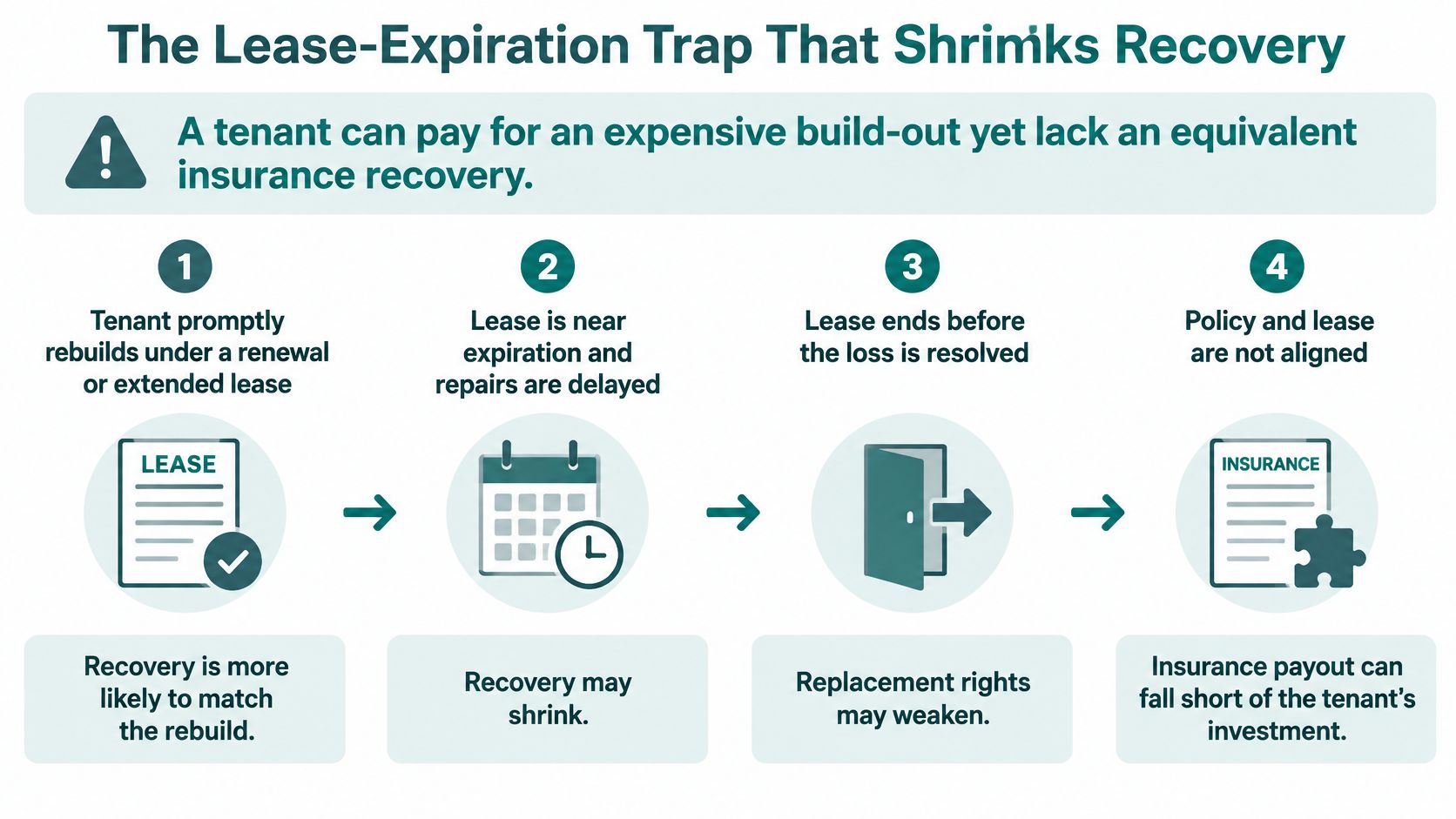
A tenant can finance an expensive build-out yet lack an equivalent insurance recovery. IRMI's analysis of tenants' improvements and betterments explains the central distinction: prompt repair can support actual-cash-value treatment, optional replacement-cost coverage introduces additional requirements, landlord-paid restoration may eliminate payment to the tenant, and failure to repair promptly can trigger a time-based original-cost calculation.
The decision to rebuild, relocate, or accept landlord restoration therefore belongs in the coverage discussion before the parties make irreversible commitments.
Different repair decisions produce different claims
The tenant promptly rebuilds. When applicable replacement-cost coverage is in place, completed covered work may support recovery of eligible reconstruction costs. Deductibles, exclusions, limits, and repair conditions still apply. Prompt rebuilding alone doesn't create replacement-cost coverage.
The landlord performs and pays for restoration. The tenant's TIB payment may be little or nothing under the applicable valuation condition. However, the landlord's contractor may restore only standard finishes, leaving specialized cabinetry, accessibility features, or tenant-funded systems unresolved.
The lease is nearly over and the tenant won't rebuild. A time-based settlement can leave the tenant with only a portion of original cost. Renewal options count only as the policy allows; an anticipated extension isn't automatically an enforceable extension of the valuation period.
The tenant renews and rebuilds. Continued occupancy may preserve the practical value of restoration, but the insurer still needs the executed lease documents, original-cost records, and applicable repair evidence. Renewal doesn't erase policy conditions.
Restoring the building isn't necessarily the same as restoring the tenant's functional business space.
Resolve the decision questions before committing
The tenant, landlord, and their representatives should establish:
- Ownership after installation. Did title transfer, and what insured use interest remains?
- Repair responsibility. Which party must restore each component under the casualty clause?
- Continuing interest. Will the tenant retain the right to occupy and use the improvements?
- Renewal treatment. Does the policy recognize an option, an exercised option, or only an executed extension?
- Original-cost evidence. Which invoices and completion records support the valuation formula?
Can a tenant still recover when the landlord repairs the premises? Sometimes, but the answer requires both contracts and an itemized landlord scope. A blanket assumption of either coverage or no coverage can overlook an important distinction between work paid by the landlord and work still owed by the tenant.
A practical claim sequence
Immediately after the loss, notify the tenant's insurer and landlord in writing, arrange necessary emergency protection, and preserve evidence where safe. Don't postpone urgent mitigation while seeking settlement clarification.
During the initial documentation, photograph damage room by room and separate building components, improvements, and movable property. Obtain the landlord's proposed scope and identify omitted tenant finishes or systems.
Before nonemergency reconstruction commitments, secure current estimates and request written clarification of valuation and repair conditions. Track procurement and access delays as they arise rather than trying to reconstruct the timeline after a payment dispute.
How to Document and File a Tenant Improvement Claim
A useful claim file connects each damaged improvement to its location, cost history, contractual responsibility, and proposed restoration. A single construction invoice rarely establishes all of those facts.
The IRS guidance on depreciable property and improvements treats qualifying betterments, restorations, and adaptations as capital improvements and recognizes that permanent improvements to rented business property can be depreciable by the tenant. That supports keeping a distinct asset record, although insurance coverage still follows the policy and applicable law.
Assemble a traceable submission
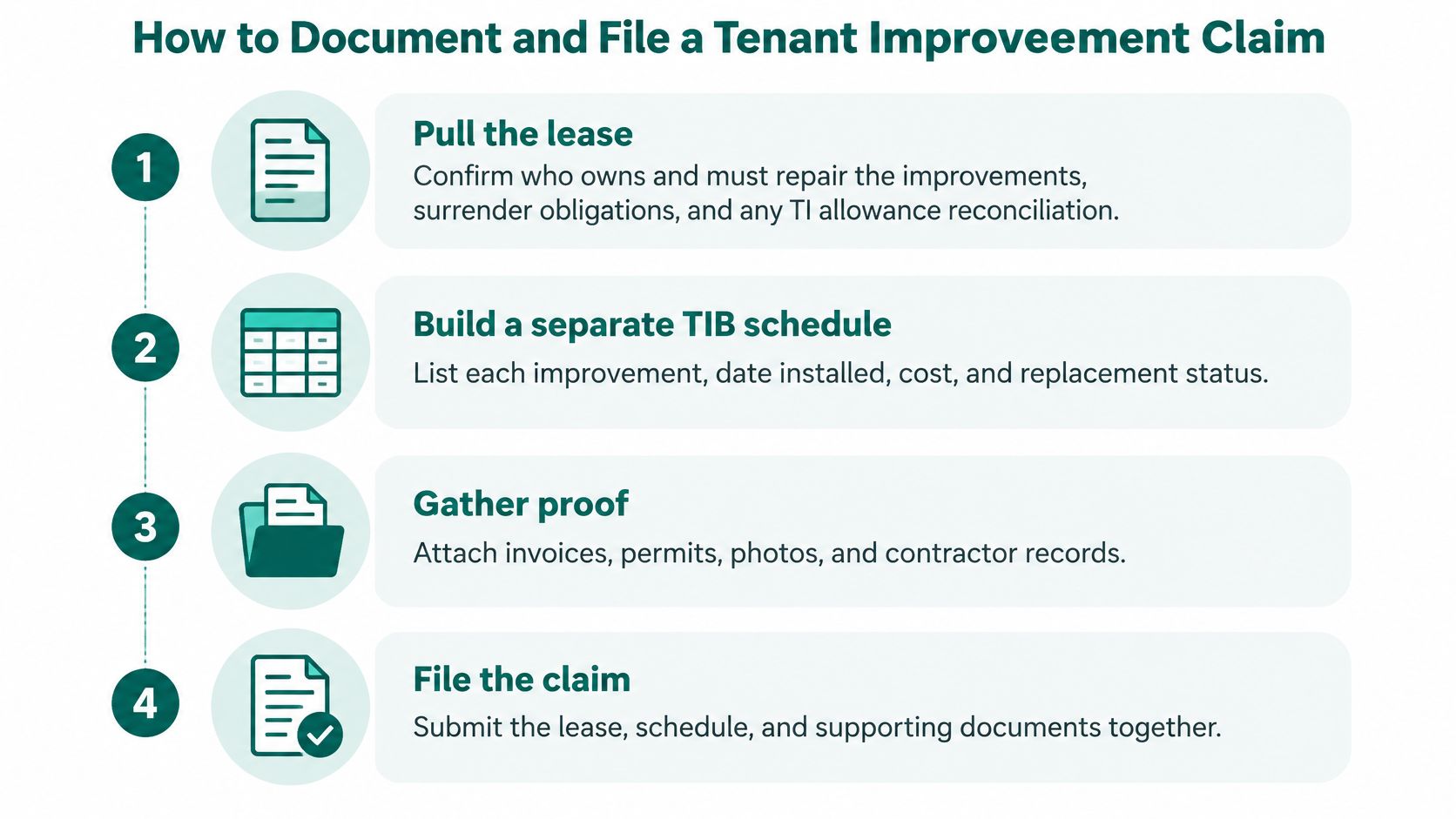
Pull the complete lease. Include amendments, extension agreements, work letters, and tenant-allowance reconciliations. Mark ownership, repair, insurance, casualty, and surrender obligations so the reviewer can identify the tenant's contractual exposure.
Build a separate TIB schedule. Export the fixed-asset ledger into a spreadsheet and add location, description, installation date, original cost, useful life, accumulated depreciation or amortization, and current replacement status. Reconcile broad ledger entries to individual components rather than submitting an unexplained renovation total.
Gather construction proof. Retain invoices, contracts, plans, permits, change orders, payment records, and completion documents. Keep records for partitions, cabinetry, electrical distribution, flooring, and HVAC modifications separately wherever possible. Costs shouldn't be reclassified merely to strengthen a claim; accounting treatment should remain accurate.
Document the physical damage. Use dated photographs and video, with wide views establishing location and close views showing material and condition. Label each item consistently across the photo log, asset schedule, and estimate. Preserve removed samples or components when safe and appropriate.
Obtain current replacement estimates. Qualified, appropriately licensed contractors should identify quantities, materials, demolition, installation, and necessary connections. Ask for separate pricing for covered restoration, elective redesign, and code-related work so disagreements don't obscure the entire estimate.
Coordinate with the landlord's claim. Compare scopes line by line and identify who will perform and pay for each component. Shared scope documents reduce duplicate submissions while exposing omissions, particularly where a landlord proposes standard finishes instead of specialized tenant work.
Check payment conditions and deadlines. Review repair requirements, proof-of-loss obligations, valuation endorsements, lease-term provisions, and coinsurance. Request written clarification where wording is disputed, while continuing to meet undisputed duties.
Supplement a deficient offer. Match each requested adjustment to an omitted item, incorrect quantity, unsupported depreciation assessment, or disputed contractual provision. A licensed public adjuster may help with documentation, estimates, and negotiations within the authority permitted by state law.
Make the file easy to review
Use a document index and consistent item identifiers. An estimate line labeled as reception cabinetry should lead directly to the corresponding photograph, invoice, and lease responsibility, without requiring the reviewer to search unrelated files.
For a burst-pipe loss, the water damage insurance claim filing guide provides additional procedural context. The same organized TIB schedule also supports renewal discussions by showing what remains installed, what changed, and which values need updating.
Protect Your Build-Out Before the Next Loss
Tenant improvements and betterments represent the customized interior that a business needs to operate, with ownership and insurance interests that can differ from those of the underlying building. The lease and policy together determine responsibility and recovery, not the renovation invoice alone.
A practical pre-loss review should produce written answers and usable records, rather than a general assurance that the premises are covered.
A workable review checklist
- Confirm ownership and repair duties. Reconcile the alterations, casualty, and surrender clauses with the intended insurance arrangement.
- Verify the insured limit and valuation basis. Compare coverage with a current, property-specific reconstruction estimate.
- Update the schedule regularly. Review it annually, at renewal, and after material alterations rather than automatically carrying forward old values.
- Preserve construction records. Store invoices, as-built plans, completion dates, and pre-loss photographs somewhere accessible outside the damaged premises.
- Align the occupancy documents. Provide executed extensions and relevant renewal information for review before assumptions about remaining use become a claim dispute.
A small, clearly documented disagreement may be manageable through a focused supplement. A substantial loss involving competing landlord and tenant scopes, disputed valuation, or stalled payments may justify professional assistance. Hiring a public adjuster is optional and may not suit every claim.
PostDamage is an independent information and referral platform, not an insurer, public adjusting firm, law firm, or restoration contractor. Its primary focus is connecting property owners needing claim assistance with licensed public adjusters. Professional availability, eligibility, services, and fees vary by location and provider, and neither a referral nor a particular claim outcome is guaranteed.
The strongest preparation happens before damage: clear responsibilities, current values, and accessible records. After a loss, the next-best protection is immediate, organized documentation that preserves the facts before demolition, reconstruction, or lease decisions change them.
PostDamage offers insurance claim help for property owners whose claims were denied, delayed, or paid less than expected, with a focus on connections to licensed public adjusters. For a commercial build-out claim involving disputed ownership, missing restoration work, or an unexpectedly low settlement, visit PostDamage to request a connection with an experienced, licensed professional.