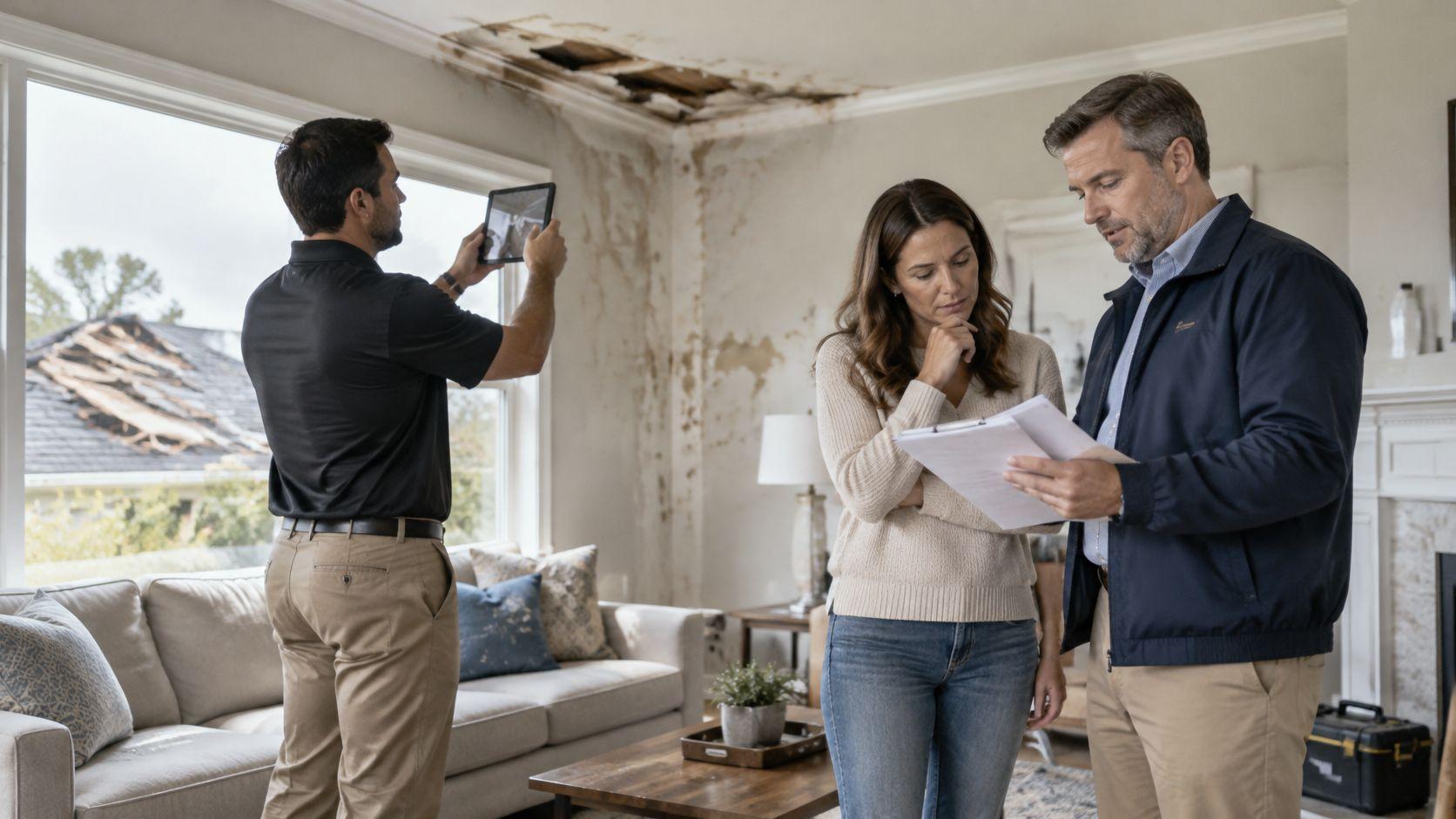
The storm has passed, ice is scattered across the yard, and the metal roof looks normal from the street. Then a dented downspout or a fresh ceiling stain raises the question: did the roof merely take a beating, or does it need repairs before the next rain?
Hail damage on a metal roof isn't measured by dents alone. The useful distinction is whether the storm changed appearance, compromised protection, or exposed weaknesses in an already weathered roof. A sound repair decision starts with the coating, seams, fasteners, and underlying support, not a count of visible dimples.
Signs of Hail Damage on a Metal Roof
After a hailstorm, dents in roof-level metal can help identify where impacts occurred. The National Oceanic and Atmospheric Administration's 2024 storm reports, cited by Roofing Contractor, recorded 5,373 hail events in the United States that year.
Foot-traffic depressions and manufacturing marks can look identical to fresh hail impacts. Compare marks across nearby panels and check earlier roof photographs before assigning them to a particular storm.
Hail damage signs and what they usually mean
| Sign | What it usually means | Next step |
|---|---|---|
| Dents or dimples on panel faces | Often cosmetic unless the coating is cracked or the panel is bent out of working shape | Schedule an inspection |
| Cracked, chipped or scratched paint coating | Bare metal may be exposed, allowing corrosion to start | Arrange a compatible touch-up or repair |
| Dents along seams, ridges or edges | Possible seam or fastener displacement | Schedule a professional inspection |
| Loose, backed-out or missing fasteners | A potential direct water-entry path | Arrange prompt repair |
| Damaged flashings, vent caps or skylight trim | Leak risk at penetrations | Arrange prompt repair |
| Dented gutters, downspouts or HVAC covers | Evidence of impacts around roof level | Have roof edges and curbs inspected |
| Water stains on ceilings or attic decking | Possible active leak | Arrange urgent inspection and temporary protection |
Active moisture, displaced flashing, and missing fasteners warrant prompt attention, especially if water is entering. Isolated panel dimples without other symptoms can usually wait for a scheduled assessment. Dents in gutters or downspouts help locate areas to check, but do not establish that roof panels have failed.
A safe post-storm check
Start from the ground. Use binoculars or a zoom camera to view roof edges and the ridge from a safe position, and note the storm date. Earlier roof photographs can help distinguish new marks from older ones.
Avoid walking on a wet metal roof to get a closer look. For guidance on scaled close-ups and recording damage locations, see the professional inspection section.
Cosmetic Dents Versus Functional Damage
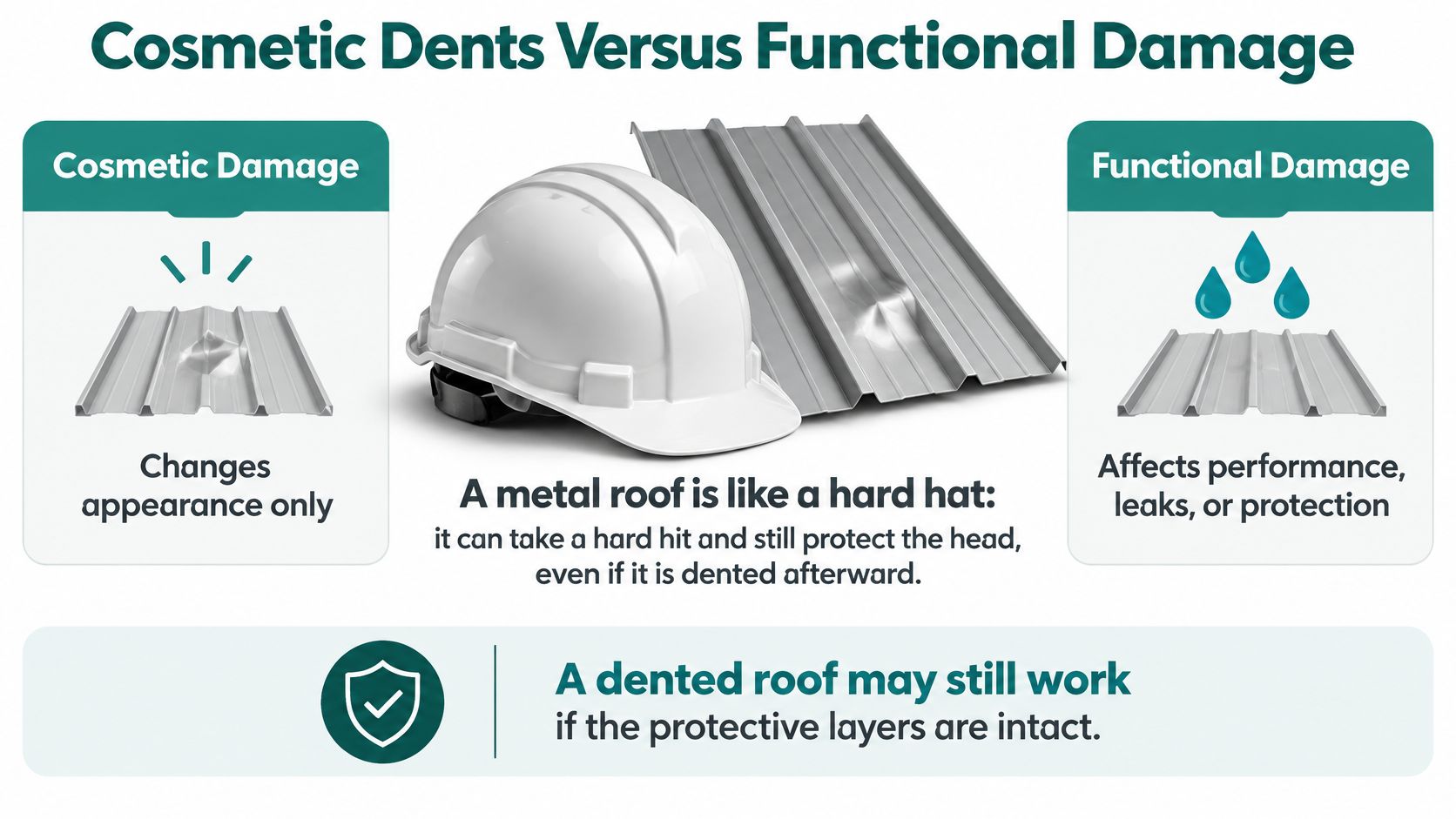
A metal roof is like a hard hat: it can absorb a hit and retain protection despite a visible dent. The comparison explains why appearance alone is a poor damage test, although a roofing assessment still needs to examine the entire assembly.
Cosmetic damage changes appearance without impairing weather protection. Functional damage compromises that protection through punctures, open joints, displaced components, or damage to protective layers that can shorten useful service.
The Institute for Business & Home Safety's commercial-roof guidance describes UL 2218 testing with a 2-inch steel sphere dropped from 20 feet, with Class 4 assessing functional integrity after two impacts at the same location. That guidance also warns that impact-resistant metal can sustain permanent aesthetic indentations.
A rating isn't a promise of a mark-free roof. Nor should classifications from different testing systems be treated as interchangeable. Steel-ball and ice-ball tests use different methods and evaluate products under controlled conditions, rather than reproducing every combination of wind-driven hail, roof support, and existing deterioration.
Cosmetic Versus Functional Damage
| Outcome | Cosmetic damage | Functional damage |
|---|---|---|
| Panel surface | Dented but still shedding water | Perforated, split or bent past function |
| Coating | Intact or lightly scratched without exposing metal | Cracked or chipped to bare metal |
| Seams and fasteners | Undisturbed | Displaced, backed out or missing |
| Typical action | Document and schedule an inspection | Repair promptly and keep the report |
The trade-off behind leaving dents alone
Leaving verified cosmetic dents avoids unnecessary panel removal and the disturbance of otherwise sound joints. The drawback is appearance, especially on a roof visible from living spaces or neighboring buildings.
A broad, shallow depression in a panel field may need no performance repair. A similar-looking depression at a folded seam needs closer examination because its location changes the consequences. Coating damage also deserves separate evaluation even when no water has entered.
Practical rule: A dent isn't proof of a leak, and the absence of a leak isn't a complete assessment of roof condition.
Where Hail Hits a Metal Roof Hardest
Impact energy increases with hailstone mass and the square of velocity, while thinner or unsupported metal deflects more readily, as explained in this technical comparison of roof hail-impact resistance. Consequently, similar-looking impacts can produce different deformation across a single roof.
Support and geometry matter as much as the broad panel surface. Caps, corners, joints, and projecting accessories deserve close attention because an impact there can affect how adjoining components fit together.
Vulnerable roof components and what to check
| Component | Why it is vulnerable | What to check |
|---|---|---|
| Ridge caps and eaves | Exposed edges with less support concentrate deformation | Bends, lifted edges, fastener lines |
| Valleys | Water and debris concentrate here | Seams, overlaps, debris buildup |
| Exposed fasteners | Washer seals can crack and screws can back out | Backed-out screws, cracked washers |
| Skylights and translucent panels | Thinner or less-supported sections can be vulnerable | Cracks, seal failure, frame damage |
| HVAC curbs and penetrations | Sharp geometry and sealant joints create transition points | Flashing, sealant, curb corners |
| Standing-seam joints and clips | Panel deformation can affect concealed connections | Seam displacement, suspected clip damage |
| Gutters and downspouts | Record impacts around the roof edge | Dents, loose brackets, fastener heads |
A 2025 experimental study of standing-seam metal roofs found that the first impact in successive hail strikes contributed more than 60% of total deformation. That finding helps explain why a pronounced dent doesn't necessarily represent repeated strikes, although a field inspection cannot reconstruct the storm from dent depth alone.
Recording useful evidence
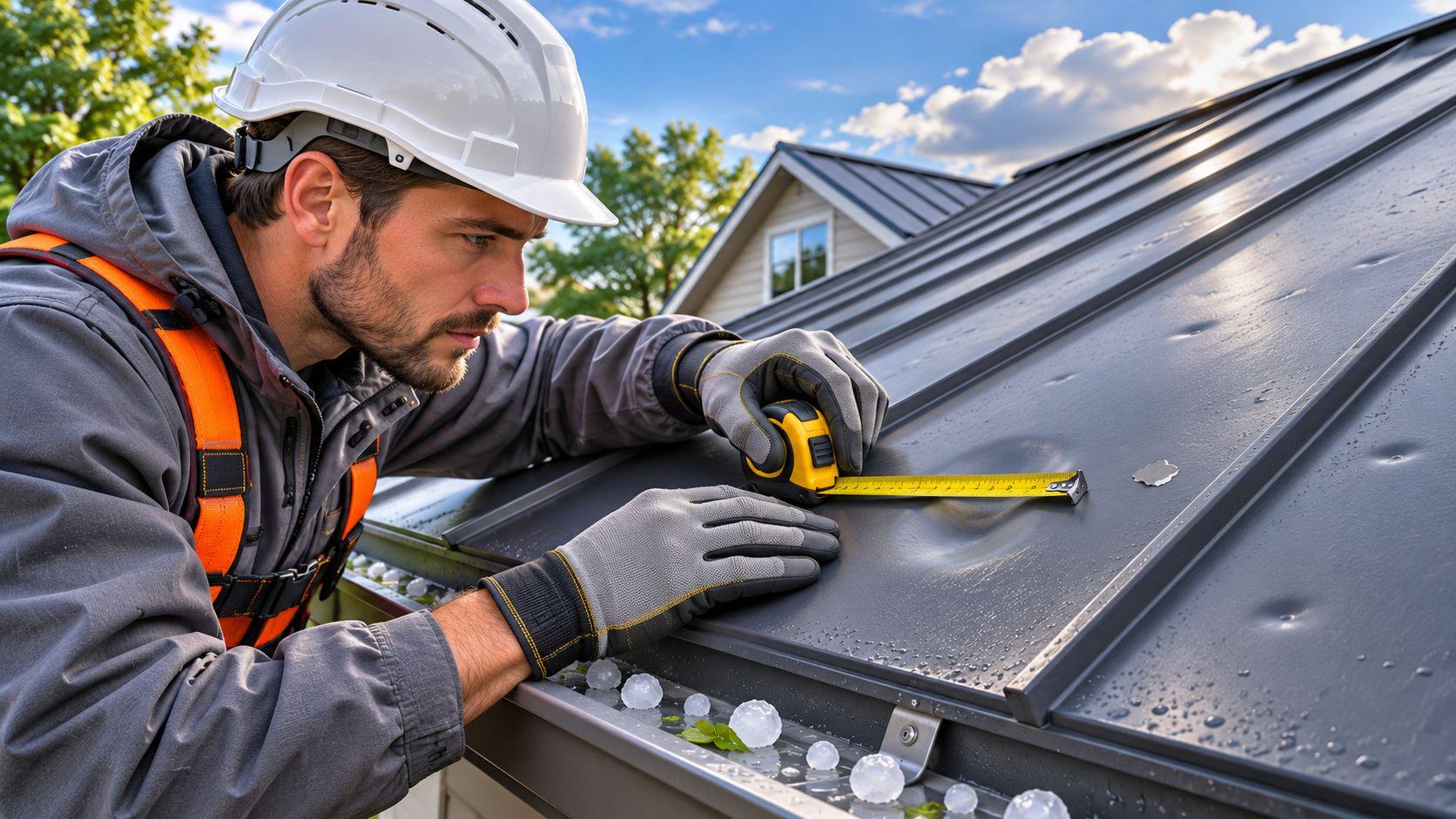
The inspector should pair an overview photograph with a scaled close-up, recording panel orientation, dimensions, and the mark's position relative to a joint or support. Raking light can reveal shallow depressions that disappear under direct overhead light.
Coating breaches and seam displacement should be recorded separately from dent dimensions. Suspected concealed-clip damage may require targeted investigation rather than a visual conclusion. Perforations, open seams, and displaced flashings justify prompt repair, not a notation that hail occurred.
How Roof Age and Condition Change the Risk
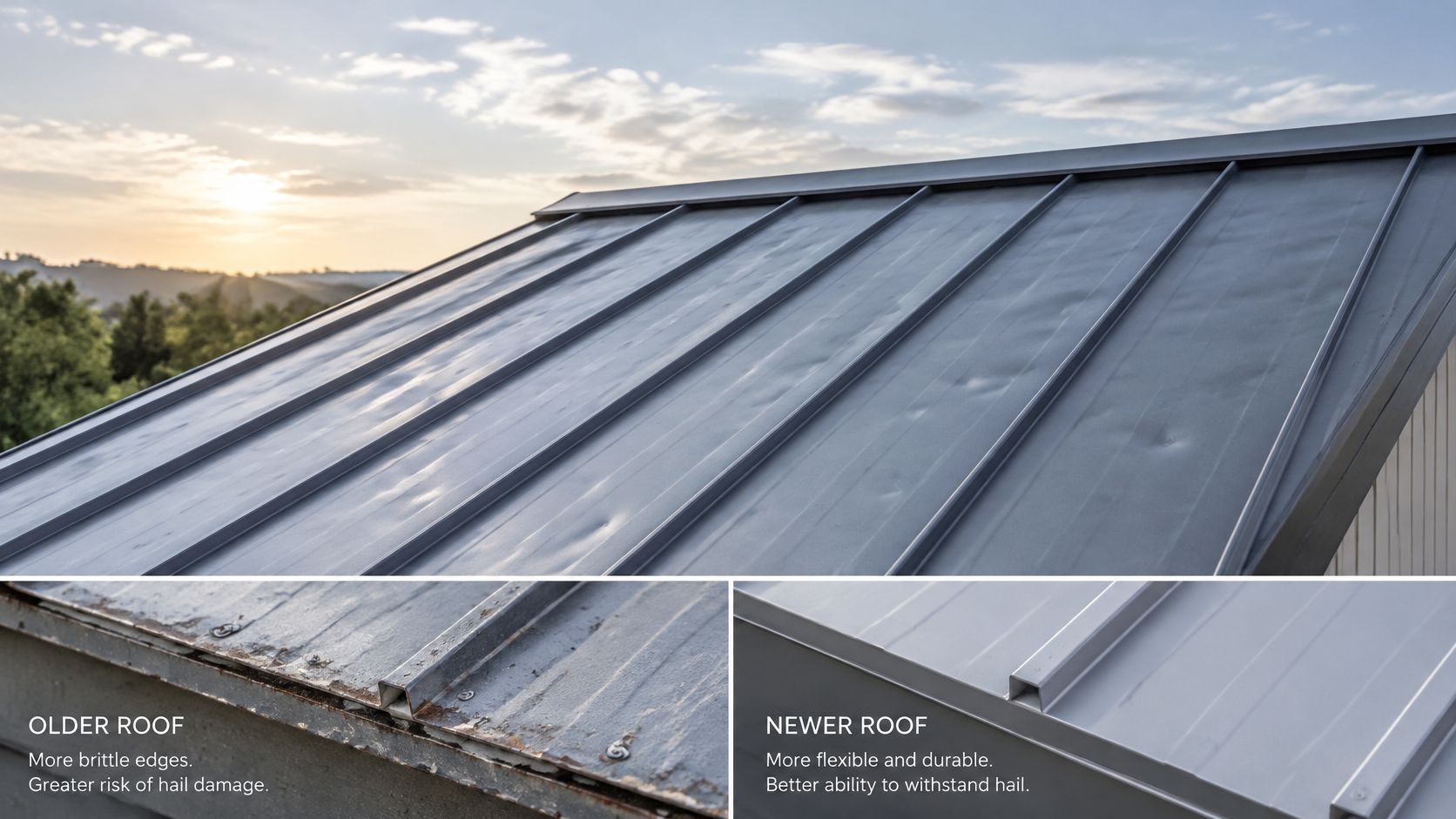
Consider an older standing-seam roof with failed clips beside a newer roof with intact coating and secure connections. Even under the same storm, the older assembly has weaknesses that the panel material alone can't overcome.
Cotality's severe-convective-storm report identifies aging roofs as more susceptible to hail failure and includes Verisk findings, reported by Claims Journal, that roofs in moderate-to-poor condition had roughly 60% higher loss costs than roofs in good-to-excellent condition. This is a roof-condition finding, not a metal-only performance guarantee.
Assess the assembly, not the birthday
Age should trigger questions, not an automatic replacement recommendation. The assessment should combine:
- Panel condition: Material, thickness, profile, corrosion, and coating adhesion.
- Installation quality: Support, attachment, seam formation, and allowance for thermal movement.
- Maintenance history: Previous patches, recurring leaks, failed washers, and neglected drainage.
- Storm exposure: Impact locations and damage around joints or accessories.
Replacing failed fasteners, repairing flashing transitions, and clearing obstructed drainage address specific weaknesses. Screws shouldn't be tightened indiscriminately; overtightening can crush washers or strip the attachment.
Repeated sealant patches aren't an economical substitute for restoring distorted joints. Where widespread deformation accompanies corrosion, unreliable attachments, or recurring leaks, replacement deserves a serious comparison with continued repairs.
A well-maintained older roof may be a better repair candidate than a younger roof with poor installation. Calendar age doesn't replace a condition report.
How to Arrange a Professional Roof Inspection
A useful inspection ends with a repairable scope. The inspector should understand the metal roofing system and separate storm-related changes from pre-existing deterioration.
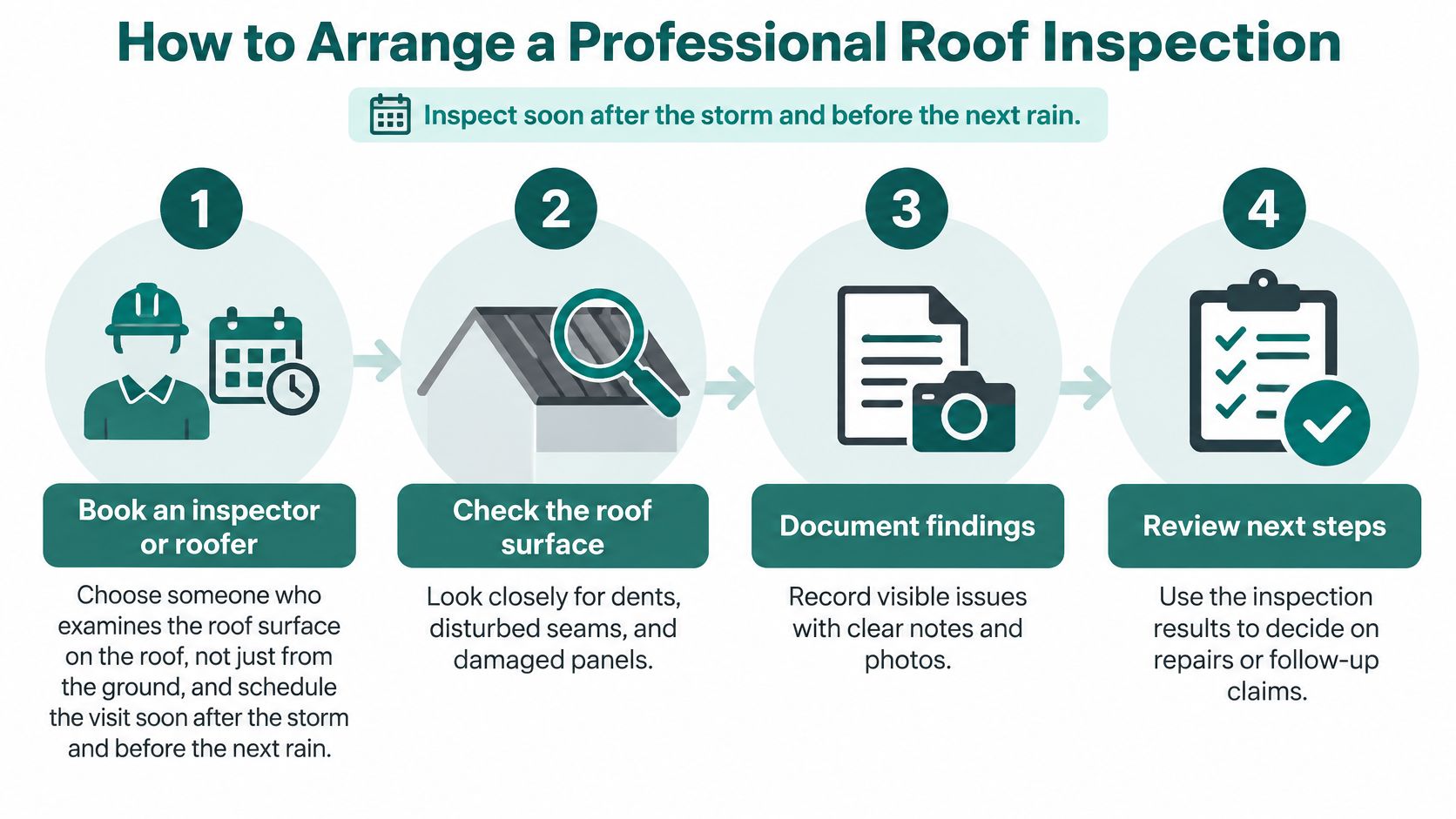
- Book a close-up assessment. The inspector or roofer should examine the roof directly where safe access permits. A conclusion based only on viewing the roof from the street may miss panel or connection issues.
- Confirm metal-roof experience and insurance. Standing-seam systems need different checks from exposed-fastener panels. Verify relevant experience, liability coverage, and licensing before granting roof access.
- Agree on the inspection scope. Ask for an assessment of seams, fastener heads, flashing, penetrations, gutters, and substrate support. Review the findings from a safe location rather than accompanying the inspector onto the roof.
- Ask for a clear written conclusion. Each finding should identify its location, severity, likely consequence, and recommended action. Cosmetic marks and functional concerns should be described separately.
- Investigate suspected failures carefully. The inspector should check finish damage and joint movement without scraping coatings or opening sound seams unnecessarily. Controlled water testing may help locate a suspected leak when it is safe and useful.
- Preserve the inspection file. Keep the report, photographs, estimates, and maintenance records together for insurance-claim preparation.
Questions before authorizing repairs
The IBHS hail-resistance document hosted by InspectApedia explains how age, corrosion, prior impacts, installation, and support can affect roof performance. An impact rating offers comparative information; it does not establish what happened during a particular storm.
Ask whether the damage affects panel serviceability and whether the proposed repair could affect the manufacturer's warranty. A weather-tightness warranty and a finish warranty cover different concerns. Review the terms rather than assuming either one covers hail dents.
Repair and Replacement Costs to Expect
Metal-roof estimates may price work by roofing square rather than by individual dent. The quotation should define its measurement basis and separate the affected area from the larger area that must be disturbed for access.
Forbes reported in 2024 that metal-roof hail repairs cost approximately $925 to $1,900 per roofing square, with an average minor repair project costing about $1,220.
Metal roof hail repair cost reference
| Item | Reference cost | Notes |
|---|---|---|
| Hail repair on metal roof, per roofing square | $925 to $1,900 | Reported 2024 range |
| Average minor repair project | About $1,220 | Reported 2024 average |
| Full metal roof replacement | Project-specific quote required | Roof area, panel system, and access determine scope |
| Impact-resistant metal replacement | Matched-scope quote required | Compare the same rating, assembly, and included work |
What changes the estimate
Panel profile and thickness affect material and handling requirements. Roof height, access, penetrations, and flashing work also change the labor involved; replacing a standing-seam panel can require disturbing adjacent connections rather than removing the damaged sheet.
Localized functional repairs on an otherwise sound roof usually favor repair. Widespread damage can reverse that calculation when repeated panel removals and flashing reconstruction approach the scope of replacement. Cosmetic denting alone doesn't establish that either expense is necessary.
Estimate check: A useful quotation names the panels, attachments, coatings, flashing work, disposal, and temporary protection included. A lump sum labeled hail repair is difficult to evaluate.
Each contractor should provide line-item pricing. Replacement alternatives should specify comparable impact ratings and assemblies, not merely describe the proposed roof as metal.
How to Handle the Insurance Claim
A hail claim turns on the policy's terms, the documented roof condition, and the insurer's coverage decision. A contractor's label for the damage does not determine coverage.
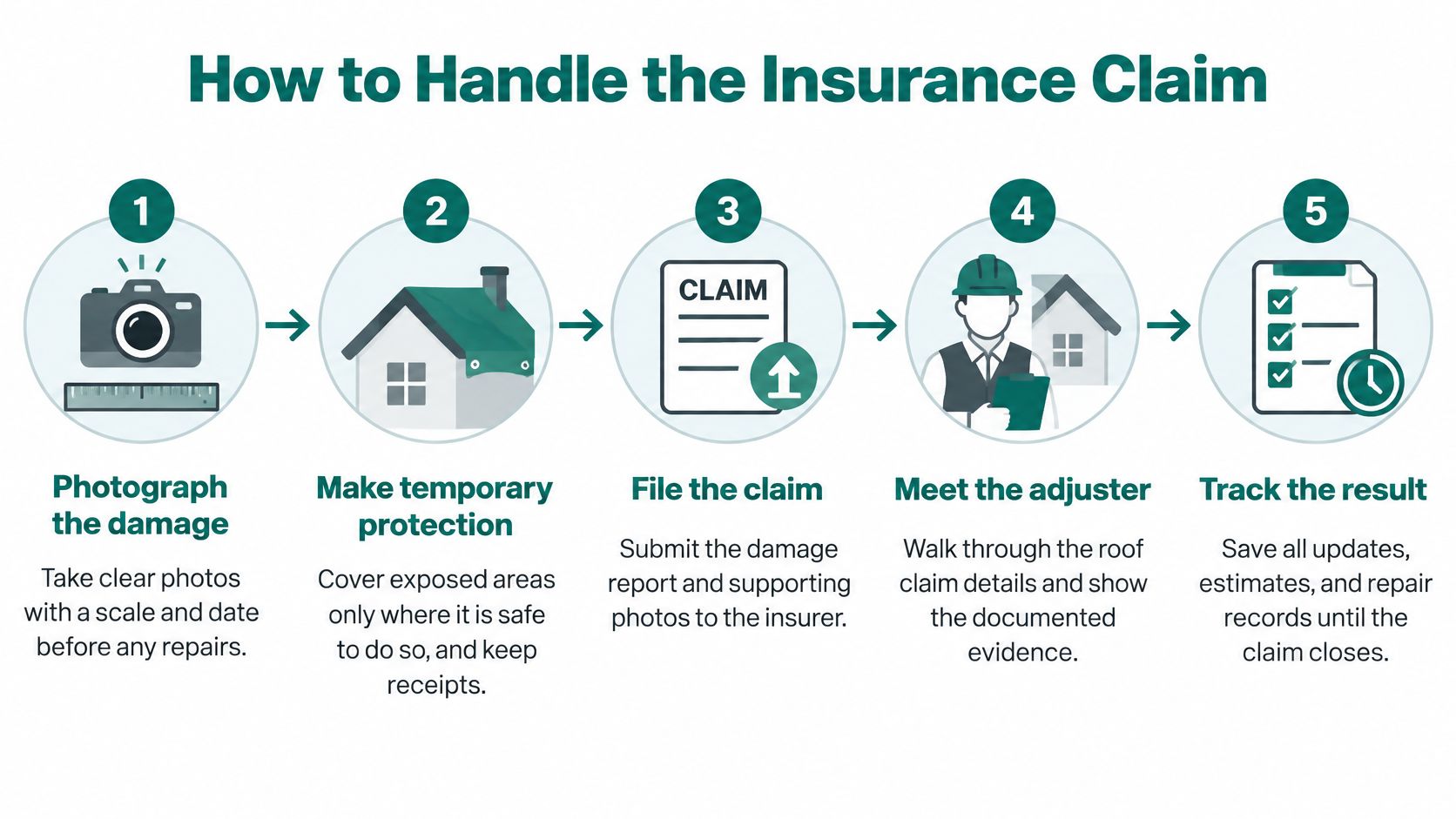
From storm documentation to claim review
- Preserve the inspection record. Use the professional report and documentation described in the inspection section. Keep copies where you can refer to them during the claim.
- Arrange safe temporary protection. A qualified professional should secure exposed areas when roof access is hazardous. Keep receipts and records of mitigation work.
- Notify the insurer promptly. Get a claim number and check the reporting deadline, including whether it runs from the storm date.
- Read the endorsements. Review cosmetic exclusions, covered components, and reporting duties before assuming which repairs the policy will pay for.
- Prepare for the adjuster. Have the professional report and any installation or maintenance records available during the inspection.
- Compare scope and payment terms. Check the contractor's estimate against the adjuster's quantities, deductible, depreciation, and actual-cash-value or replacement-cost provisions.
- Choose help based on the disagreement. Missing repair items may call for supporting documentation. A disputed coverage interpretation may warrant a different kind of assistance.
The owner should begin documentation and mitigation promptly. Inspection, estimate revisions, and settlement then follow the insurer's handling schedule, which can vary.
A public adjuster is optional, and claim size, fees, and the extent of disagreement can help determine whether one is appropriate. PostDamage offers free, no-obligation help with property insurance claims. For unresolved legal questions, review roof damage lawyer and attorney resources.
Choose Your Repair Path After the Inspection
Choose the work based on whether the roof still protects the building and on the condition of the surrounding assembly. Cosmetic dents may be acceptable if panels, seams, fasteners, and flashing remain sound. Policy terms and the owner's appearance preferences also affect whether to pursue repairs.
For localized functional damage, the scope should identify the affected connection, flashing, coating, or panel section. Completion photographs can document the repairs. If damage is widespread or the roof is in poor condition, replacement quotes should address the support and attachment system as well as the panels.
An analysis summarized by Professional Roofing associated impact-resistant metal roofs with losses approximately 60% to 80% lower than non-impact-resistant alternatives. That finding supports considering rated products during replacement, though it does not guarantee panels will avoid dents or that every installation will perform alike.
Before approving work, compare the written report, policy language, and itemized repair and replacement options. Check that the proposed scope addresses the defects identified in the inspection.
PostDamage helps property owners identify an appropriate next step after hail dents, disturbed roof components, or water entry. Visit PostDamage to share the damage type, ZIP code, and safely observed conditions, and request help or a connection with a relevant professional where available. For repair guidance on hail, wind, fallen-tree, and other storm damage, PostDamage offers a way to request professional assistance.