If an insurer has already paid a property claim, does a higher repair estimate mean someone made a mistake? Not necessarily. An insurance supplemental claim asks for additional payment on an existing loss when new evidence shows damage, repair work, or costs the original evaluation didn't fully address.
The useful question isn't who deserves blame. It's whether the property owner can connect each requested change to the covered event, the actual repair requirements, and supporting records.
What an Insurance Supplemental Claim Really Is
A supplemental property-insurance claim requests additional payment after an insurer has received, evaluated, or closed the original claim. It revises the evaluation of that loss rather than reporting an unrelated incident.
Think of the first estimate as a reviewed draft. A supplement is a documented amendment, identifying what should change and why. The National Association of Insurance Commissioners' homeowners claims instructions recognize supplemental payments as a distinct part of property-claim handling.
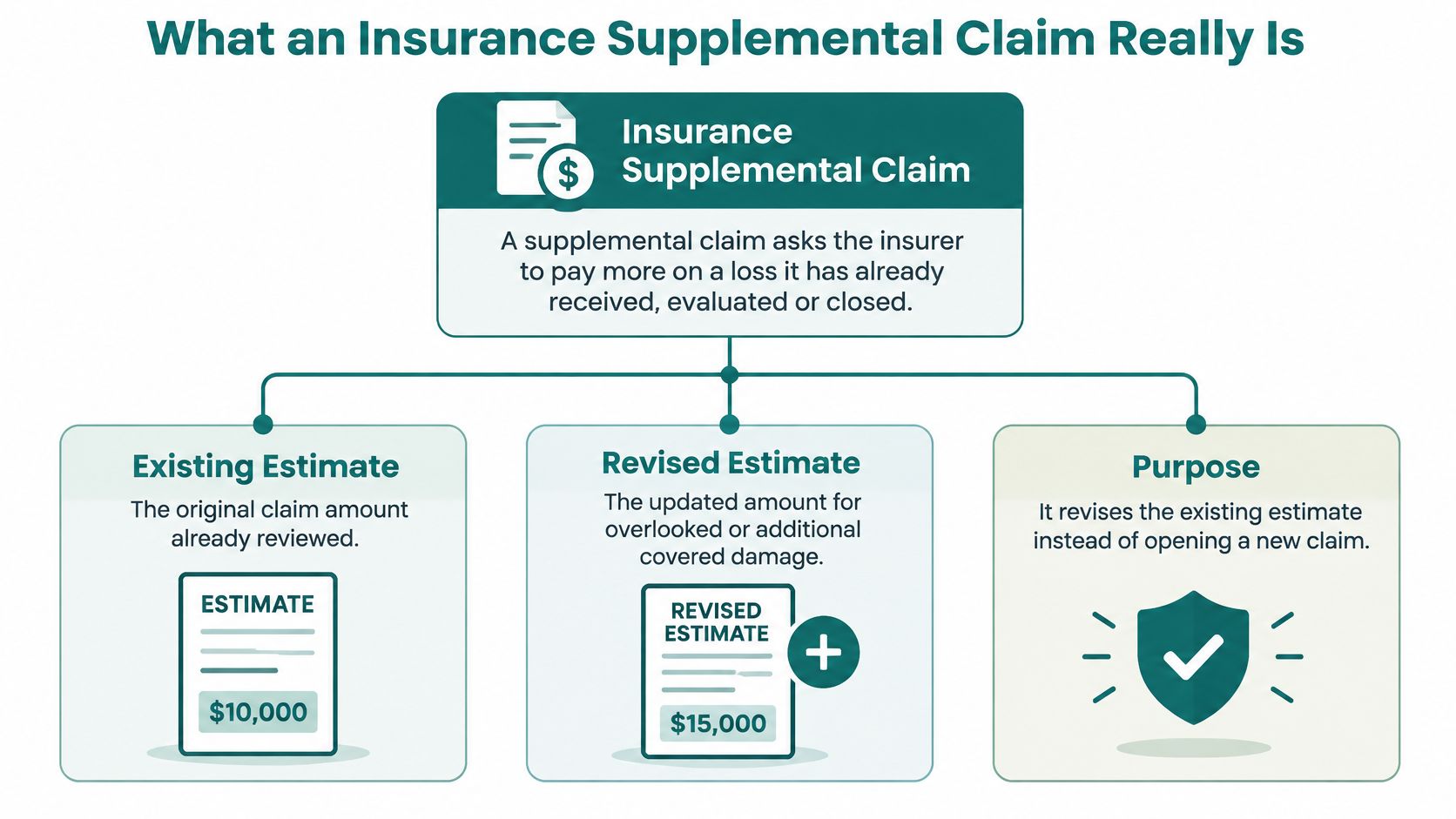
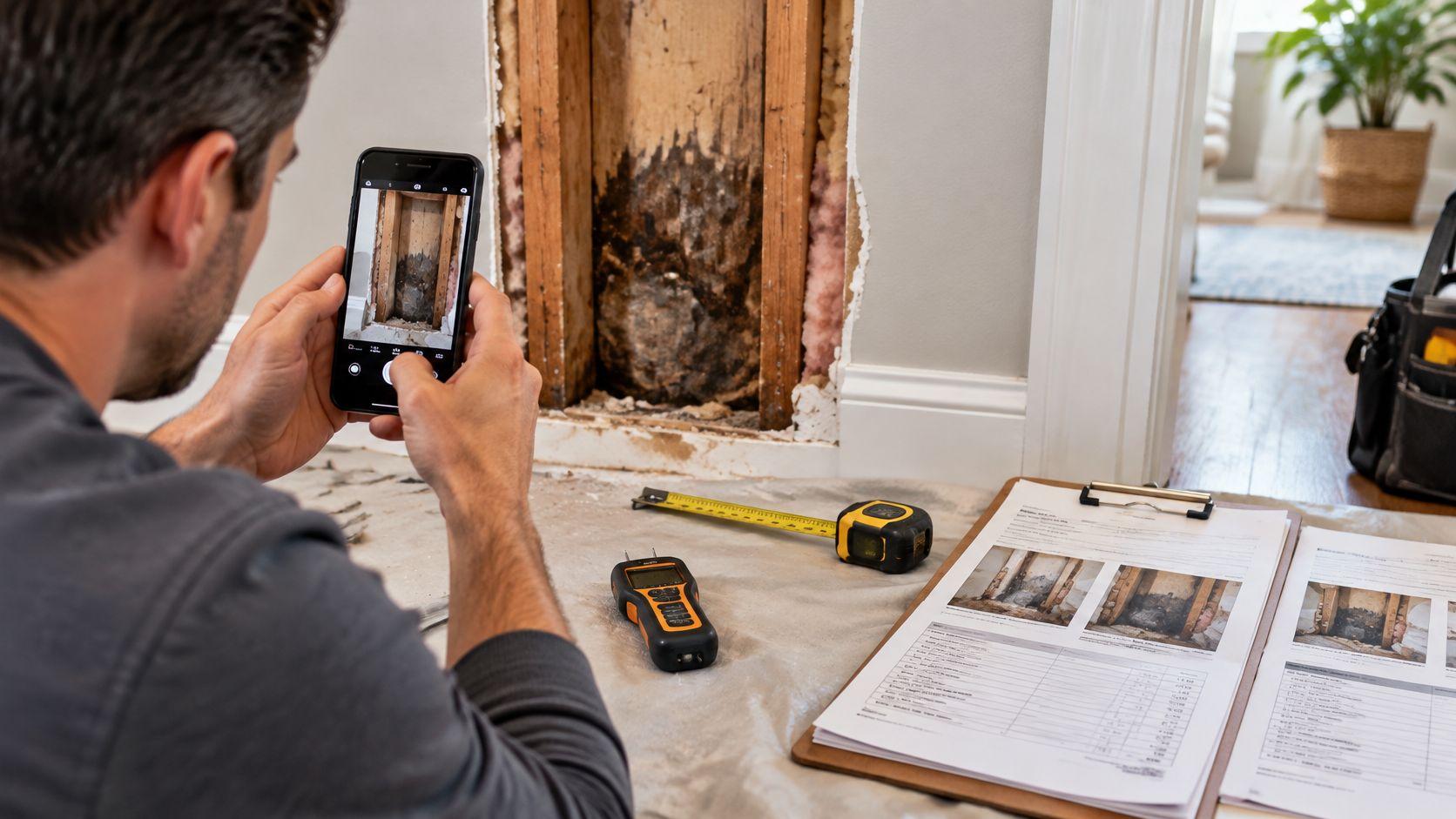
A supplement might begin when a contractor opens a damaged wall and finds affected insulation that wasn't visible during inspection. It can also address an incorrect quantity, unsupported pricing, or necessary repair work omitted from the estimate.
The starting point is the insurer's existing estimate and payment record, not just a contractor's higher total. Those documents establish which work the insurer already included and which items remain unresolved.
Original claim versus supplemental claim
| Criterion | Original claim | Supplemental claim |
|---|---|---|
| Trigger | Loss reported to the insurer | New damage, cost or pricing error found after an estimate or payment |
| Starting point | Initial inspection and first estimate | The insurer's existing estimate and payment record |
| Typical evidence | Photos, inventory, first contractor bid | Revised estimate, invoices, dated new photos and line-by-line comparison |
| Who reviews it | Insurer adjuster assigned to the loss | Insurer adjuster reviewing the updated file |
| Timing rules | Set by the policy and state law | Set by the policy and state law; check early |
The practical distinction
A useful request identifies the original claim, describes the proposed revision, and supplies evidence for the difference. For example, an added insulation line should identify its location, measured quantity, and relationship to the reported damage.
Practical rule: Additional damage or costs from the same loss may belong in a supplement. A separate incident generally requires a separate claim assessment.
Closure alone doesn't answer whether further payment is available. Policy conditions, coverage limits, exclusions, and applicable jurisdictional deadlines still govern the request.
When a Supplemental Claim Makes Sense
A contractor removes damaged flooring after a covered water event and discovers affected material underneath. That discovery may justify additional evaluation, but it doesn't establish coverage by itself. The insurer still needs to determine whether the newly exposed condition resulted from the reported event rather than an older leak or deterioration.
Situations where a supplement usually fits
| Situation | Supplement usually fits? | What decides it |
|---|---|---|
| Hidden damage found during demolition | Usually yes | Covered peril and damage documented before removal |
| Code-required work omitted from the estimate | Often, if the policy includes ordinance or law coverage | Policy endorsement and the local code requirement |
| Repair cost above the insurer's estimate | Possibly | Line-item pricing, quantities and invoices |
| Wear, maintenance or pre-existing damage | Usually no | Exclusions and prior inspection records |
| Upgrade beyond the prior condition | Usually no | Policy terms on repair to like kind and quality |
| Damage caused by faulty workmanship | Usually no | Exclusions and the cause-of-loss findings |
Necessary repairs versus optional improvements
Code-required work needs a specific explanation. A contractor should identify the applicable requirement and the work it makes necessary, while the policyholder checks whether the policy provides ordinance or law coverage. A general statement that a building needs updating isn't enough.
Likewise, a price difference needs more than competing totals. A contractor may include removal, disposal, preparation, and installation while the insurer's estimate includes only installation. That's a scope disagreement, not necessarily a dispute over the price of identical work.
Optional improvements should remain separate. Replacing damaged materials with a more expensive finish doesn't automatically make the added cost payable, even when completing the upgrade during repairs would be convenient.
Coverage disputes need a different response
A supplement addresses missing or revised loss information. If the insurer disputes whether the event is covered at all, the policyholder needs to address the denial's stated reasoning, not merely submit a larger estimate.
For water losses, a water damage insurance claim filing guide can help distinguish the event description from the repair documentation. Cause matters because similar-looking damage can arise from different circumstances.
Before proceeding, the owner should compare the proposed work with the declarations, coverage forms, endorsements, and exclusions. The same repair situation can produce different coverage answers under different policies and applicable state law.
Building a Supplement the Insurer Can Verify
A reviewable file lets an adjuster trace the requested payment from the observed damage to the proposed repair. Organization matters more than volume: a clearly labeled photograph and matching estimate line are more useful than an unexplained folder of images.
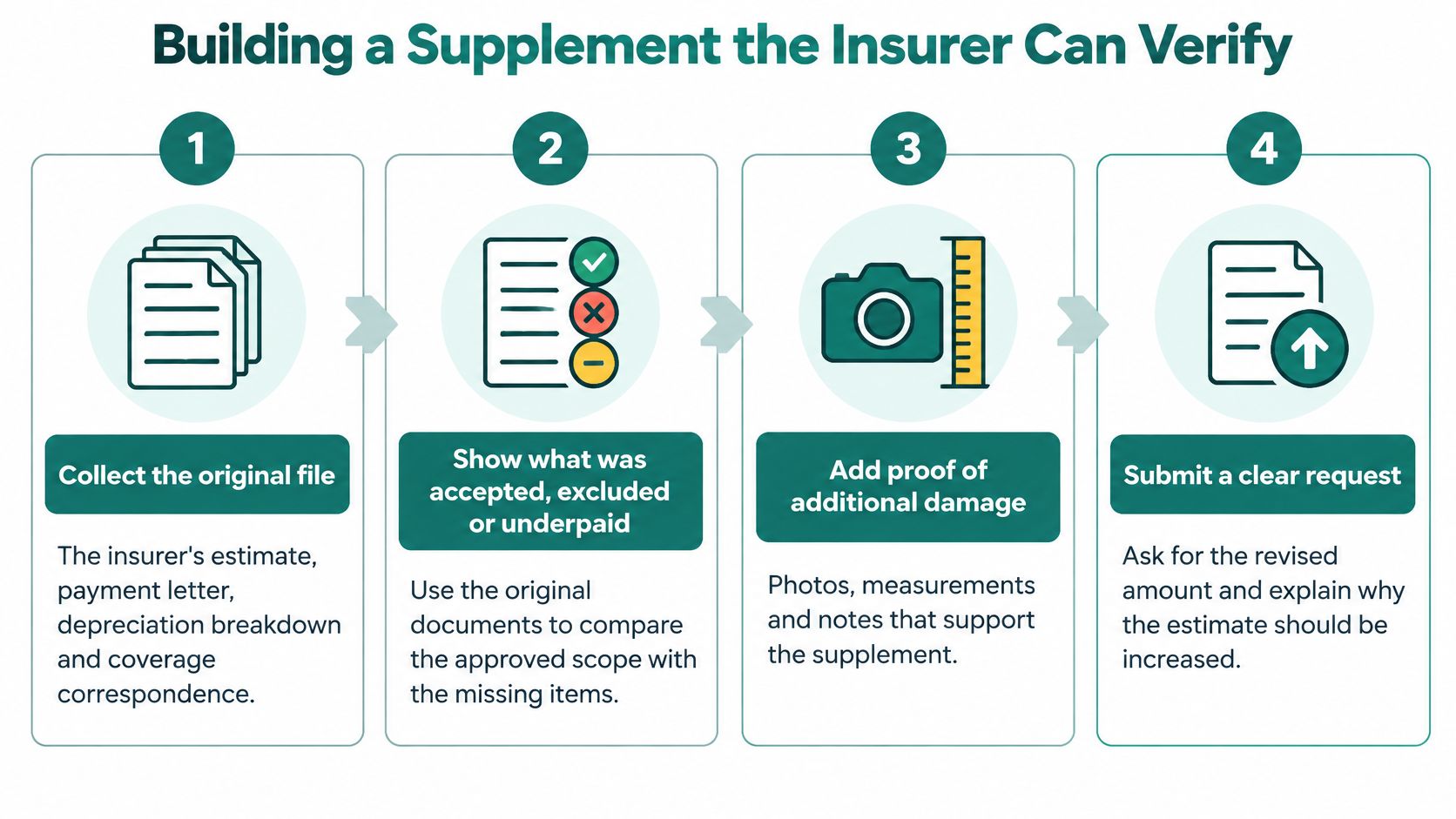
Assemble the evidence in review order
- Collect the original file. The insurer's estimate, payment letter, depreciation breakdown, and coverage correspondence establish what was accepted, excluded, or left open.
- Record newly exposed damage. Dated photographs and video labeled by room or building elevation preserve conditions before removal.
- Measure the affected areas. Location-specific dimensions and counts allow the adjuster to verify quantities.
- Obtain an itemized estimate. Separate tasks and unit prices make the requested revision testable.
- Retain cost records. Invoices, receipts, and material purchase records support charges and completed work.
- Use specialist findings where needed. An engineering or other qualified report can address disputed causation or structural conditions.
- Write a cover letter. Map each revision to its cause, location, quantity, and supporting attachment.
- Submit in writing. A saved submission and delivery confirmation establish what the insurer received.
Preserving settlement and coverage documents also matters outside the insurer's review. FEMA's insurance-document guidance explains that disaster-assistance applicants may need settlement records, denial letters, or evidence of unavailable coverage.
Fix preventable documentation gaps
- Removal before photographs: Record conditions first whenever safely possible, preserve samples when feasible, and don't delay urgent protective work.
- A higher total without detail: Attach a comparison showing the actual additions and revisions.
- Discarded earlier versions: Keep original estimates and payment explanations so changes remain traceable.
- Upgrades mixed with repairs: Separate optional improvements from the requested covered work.
- A bid treated as conclusive proof: Add available invoices, receipts, and explanations of pricing.
- Unanswered partial-payment notes: Respond to each item the insurer identifies as unresolved.
When contractors uncover water behind drywall, photographs should show both the affected material and enough surrounding detail to establish its location. Commercial owners should maintain separate supporting files for equipment, inventory, and business-income components.
Auditing the Insurer's Estimate Line by Line
The settlement total can conceal the reason for a disagreement. An owner comparing only the insurer's payment with a contractor's bid may miss differences in quantities, repair methods, depreciation, or work already allowed.
Scope reconciliation means comparing equivalent tasks before arguing about totals. The LexisNexis Risk Solutions home trends report provides industry context for examining claim severity and repair scope, while LexisNexis Risk Solutions' home-claims release reports that U.S. home-claim severity increased 33% between 2021 and year-end 2024.
Estimate components to audit and the gaps to look for
| Estimate component | What to verify | Sign of a gap |
|---|---|---|
| Room or elevation list | Every damaged area appears | Missing rooms, outbuildings or building sides |
| Quantities | Square footage, linear feet and counts match recorded measurements | Total quantities below the measured area |
| Unit pricing | Labor and material rates compared with local written quotes | Prices well below local quotes with no explanation |
| Depreciation | Each depreciation percentage or amount is itemized | One lump-sum depreciation figure with no breakdown |
| Ordinance or law items | Code-required work is listed separately | Code-required work absent from the estimate |
| Debris removal and temporary protection | Shown as separate lines | Bundled into a single unexplained figure |
| Deductible | Applied once for the loss under review and matched to the declarations and applicable endorsements | Deductible amount does not match the policy |
Turn each discrepancy into a reviewable question
For every suspected gap, the owner should create a spreadsheet entry containing the estimate line reference, requested correction, supporting document, and amount in question. A missing task can reference the nearest related line and be marked as an addition.
Suppose the insurer included wallboard replacement but omitted affected insulation. The entry should identify the room, attach photographs and measurements, and explain the insulation task separately from wallboard work.
For pricing disputes, written quotes should describe comparable work. A water damage restoration cost explanation can help owners recognize cost categories, but the submission needs property-specific support rather than a broad cost range.
A discrepancy identifies a question to resolve. It doesn't, by itself, prove insurer misconduct or contractor inflation.
Depreciation also deserves separate treatment from missing scope. Some replacement-cost payments may require completed repairs and supporting receipts under the policy, so an amount withheld pending documentation shouldn't automatically be classified as omitted damage.
When Deadlines and Response Times Apply
A deadline for the policyholder to submit documents isn't the same as a deadline for the insurer to respond. Confusing the two can leave an owner waiting for a decision while a separate filing requirement approaches.
The examples below illustrate different obligations. Neither creates a universal deadline for every property claim.
Example filing and response windows
| Context | Rule in the research | Where to check |
|---|---|---|
| Florida homeowners property claim | Under Florida Statute 627.70131(7)(a), insurers generally must pay or deny a supplemental claim, or part of it, within 60 days after notice, unless circumstances beyond their control prevent compliance, as described in the Florida insurance regulation report. | Current statute and policy |
| NFIP flood claim | A supplemental Proof of Loss generally must be submitted within the applicable 60-day Proof-of-Loss period, unless FEMA grants an extension, according to FEMA's supplemental flood-claim guidance. | Policy proof-of-loss terms and applicable FEMA guidance |
| Other states and private policies | State law and policy wording establish the applicable requirements. | Declarations, policy conditions and state insurance department |
For Florida claims, the insurer must also explain when a payment isn't full and final, indicate that evaluation continues, and explain that additional payments may follow. Owners should verify the current statutory text and any applicable exceptions before relying on a response window.
Check the actual obligations
- Locate the policy clauses. Identify notice, proof-of-loss, and suit provisions, including any deadlines tied to the loss date.
- Record correspondence dates. Save the latest payment explanation or denial, along with delivery and submission records.
- Confirm jurisdictional requirements. Consult the state insurance department when the applicable dates or rules remain unclear.
Deadline safeguard: An open conversation with an adjuster shouldn't be treated as an extension unless the applicable requirements support that conclusion.
If the insurer remains silent beyond an applicable period, the owner should send a written follow-up identifying the submission date, relevant policy provision, and state requirement. Preserving that correspondence supports a later inquiry or complaint; it doesn't replace compliance with the owner's own deadlines.
Decide Whether to File or Get Professional Help
Before submitting, a property owner should answer these questions:
- Is the added cost connected to a documented covered event? A request needs a defensible cause, not merely a repair expense.
- Is the supporting file usable? The original estimate, payment explanation, dated photographs, and proposed revisions should be ready for review.
- Is the loss difficult to separate or value? Multiple causes, commercial operations, extensive damage, or disputed findings may justify professional assistance.
A manageable file may not need representation
An owner who can explain the changes and support them clearly may submit the supplement directly. The cover letter should state the requested revision, identify attachments, and ask the insurer to explain any disputed items in writing.
The owner should also decide who will answer technical questions. A contractor may need to explain quantities or repair methods, while a specialist may need to clarify findings about causation. Keeping those responsibilities clear avoids asking a single document to prove everything.
Complexity can justify professional review
A licensed public adjuster may help organize evidence, prepare estimates, and present claim issues within the scope permitted by state law. Hiring one is optional and may not be appropriate for every claim.
Commercial owners may need assistance separating building repairs from tenant improvements, equipment, inventory, extra expense, and business interruption. Those categories require different records, even when they arise from the same event.
Before hiring, an owner should verify the professional's license and review the agreement's fees, responsibilities, and cancellation provisions. A contractual coverage dispute or approaching suit deadline may also warrant advice from a qualified attorney rather than estimate assistance alone.
PostDamage is an independent information and referral platform, not an insurer, public adjusting firm, law firm, or restoration contractor. It doesn't directly adjust, negotiate, or settle claims.
The decision to file remains with the policyholder. No professional review guarantees coverage, an increased settlement, or payment.
For property owners whose claims were denied, delayed, or paid less than expected, PostDamage offers a free, no-obligation insurance claim help review request and may connect qualified inquiries with licensed professionals where available. Property owners considering a supplemental claim can visit PostDamage to request assistance with evaluating their next steps; no insurance outcome, settlement, or payout is guaranteed.