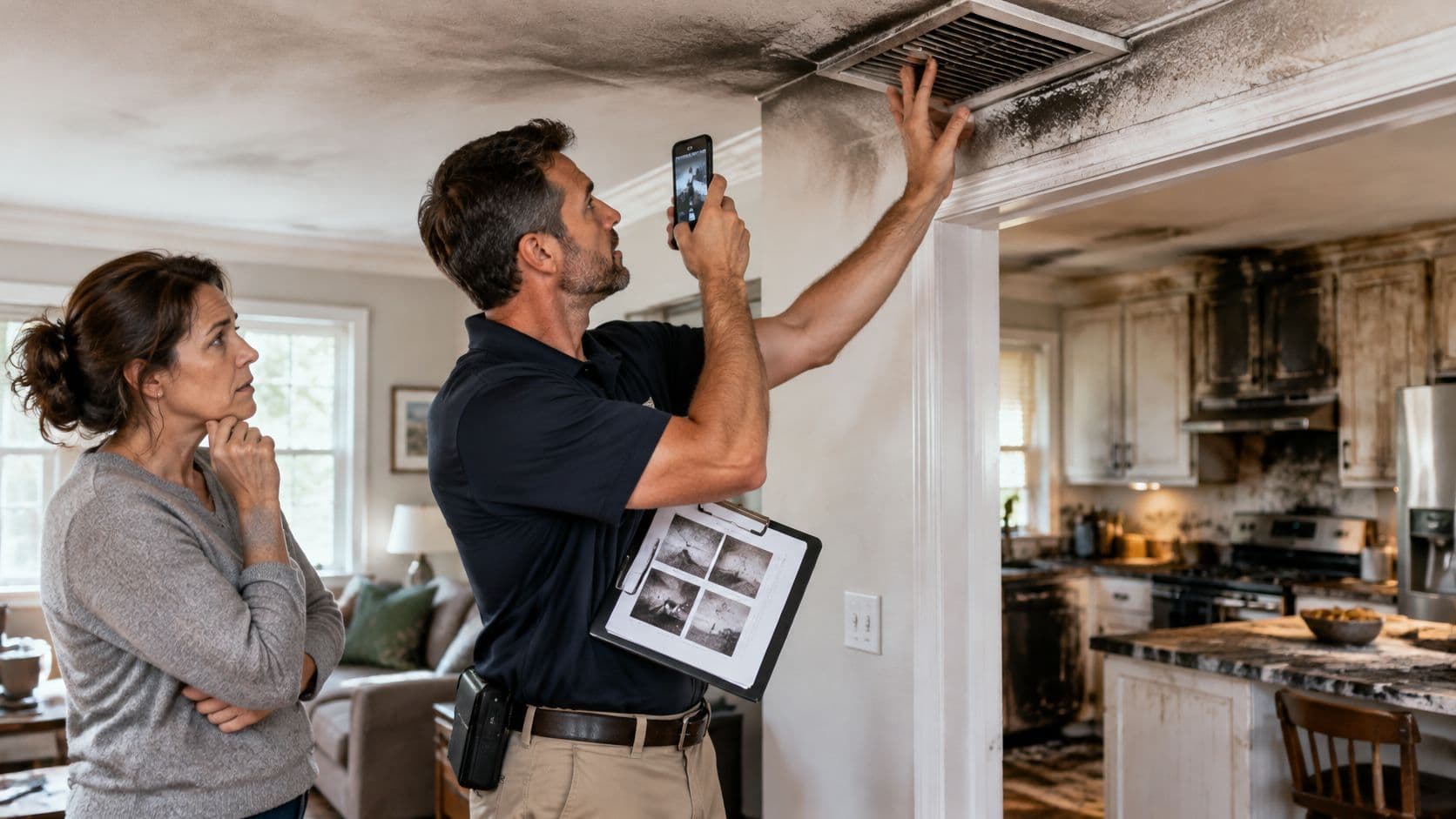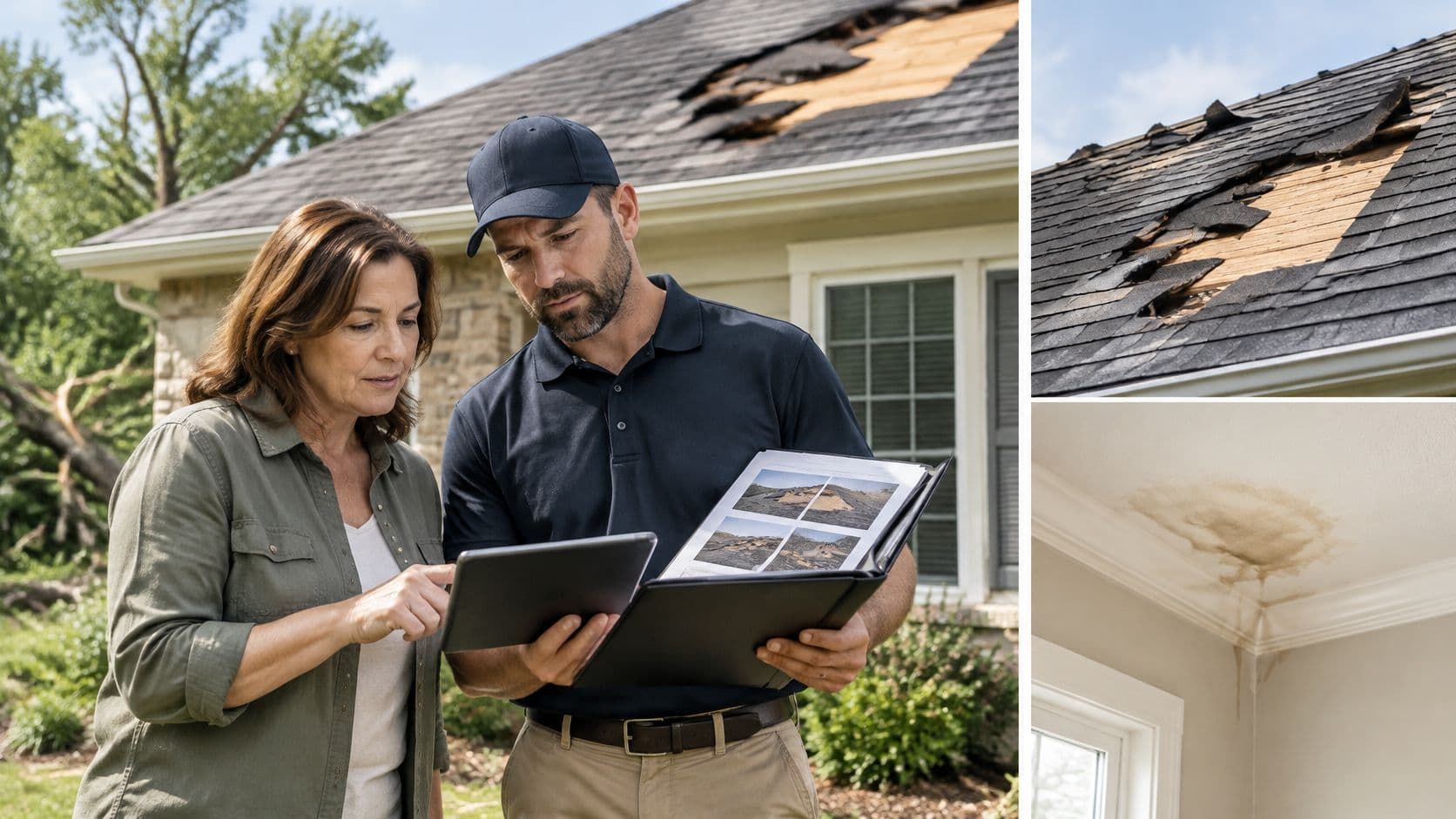
Standard homeowners insurance often covers sudden, accidental water damage from inside the home, such as a burst pipe, but usually excludes flood, groundwater, and gradual leaks. The cause, not the presence of water, decides which coverage may apply.
The familiar advice that sudden damage is covered and slow damage isn't leaves important questions unanswered. A failed pipe and the floor it soaked may receive different treatment, and an insurer's acceptance of coverage doesn't establish that its repair estimate is complete.
For anyone asking “is water damage covered by insurance,” the useful starting point is a description of the event: where the water entered, how quickly it appeared, and what it damaged.
Which Water Losses Home Insurance Usually Pays
| Water source | Usual standard-policy treatment | What else may be needed |
|---|---|---|
| Burst pipe, supply line, or washer hose | Often covered if sudden and accidental | No separate flood policy |
| Sudden appliance overflow | Often covered as accidental discharge | Check personal-property limits for contents |
| Wind-opened roof with rain inside | Resulting interior damage often covered | Roof repair itself may be limited if wear is the cause |
| Slow leak, seepage, or known unrepaired leak | Usually excluded as gradual or maintenance | Not fixed by flood insurance |
| Groundwater, rain runoff, or snowmelt | Generally excluded | Review flood options if water entered from outside |
| Rising floodwater from outside or the ground | Excluded from a standard homeowners policy | NFIP or private flood policy |
| Sewer, drain backup, or sump-pump failure | Often excluded | Water-backup or sump endorsement if purchased |
The National Association of Insurance Commissioners homeowners insurance guide identifies damage from plumbing or a roof leak as typically covered, while groundwater, rain runoff, and snowmelt are generally excluded. The policy's wording, deductible, exclusions, and cause of loss still control the actual decision.
A supply line that breaks while the household sleeps fits the usual accidental-loss pattern. Water escapes from a functioning indoor system and damages surrounding property before anyone can respond.
A dishwasher that suddenly overflows may fit the same pattern. Coverage for the kitchen floor doesn't automatically establish the value of damaged belongings, however. Building repairs and personal property are separate claim components.
Rain inside isn't automatically flood
Wind can lift part of a roof and allow rain into a bedroom. That may be a storm-related interior loss, even though the water began outdoors.
A worn roof presents a different question. The insurer may distinguish damage to the ceiling from the cost of replacing deteriorated roofing, and policy exclusions can affect either part. A roofer's description of the opening matters more than the homeowner's general description of a wet ceiling.
The remaining rows involve exclusions or additional coverage. Repeated seepage is generally treated as maintenance rather than an accident; water collecting against a foundation isn't treated like a broken supply line.
Sewer backup and sump-pump failure require their own check. An endorsement, which changes the standard policy, may provide protection that the basic contract doesn't.
Practical rule: A useful loss report names the entry point and describes whether the water appeared suddenly. It doesn't begin by choosing an insurance label.
Before contacting the insurer, the homeowner should record observable facts without delaying the report. A statement that water emerged beneath the washing machine during a cycle is more useful than an unsupported conclusion that the house flooded.
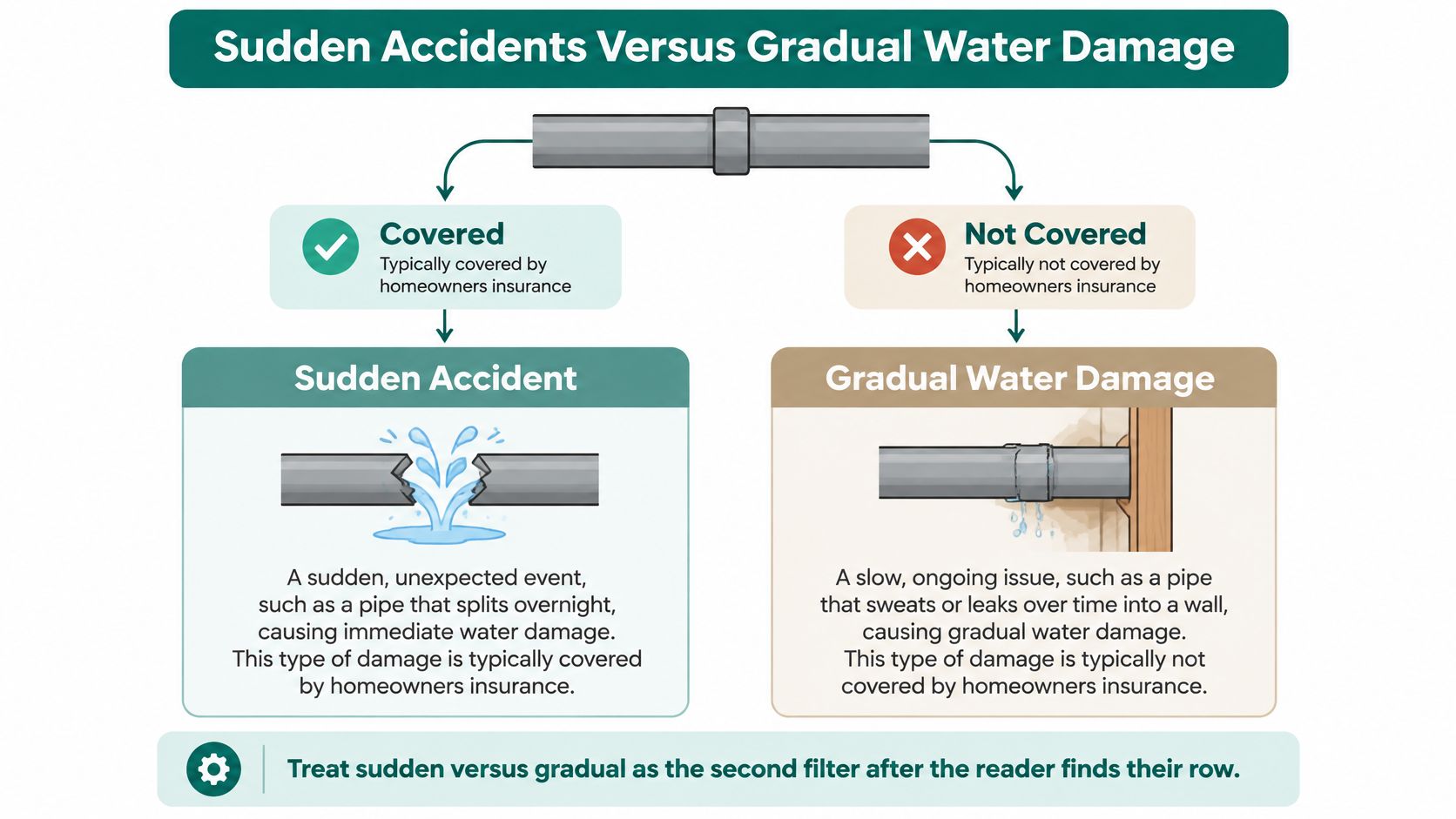
Sudden Accidents Versus Gradual Water Damage
A pipe that splits overnight and a pipe that has been sweating into a wall can leave similar stains. Insurers may treat them very differently because the damage developed in different ways.
Sudden versus gradual is the next filter after identifying the water source. The relevant question isn't just when the homeowner discovered the stain, but when and how the damaging release occurred.
Discovery doesn't establish the start date
Say a household returns from an outing to find water pouring through a ceiling. A plumber identifies a fresh split in the supply pipe, and photographs show the active discharge. Those facts support a discrete event.
By contrast, a soft cabinet base, repeated staining, and a previously reported drip may support an ongoing leak. Discovering extensive rot suddenly doesn't turn the process that caused it into a sudden accident.
Useful evidence includes:
- Failure details: The plumber's report should describe the damaged component and the observed failure, rather than just state that a leak existed.
- Earlier conditions: Prior repair records and photographs can establish whether warning signs were present.
- Damage pattern: Moisture readings and opening photographs can help connect affected materials to the release.
The burst-pipe water damage guide provides additional context for organizing a pipe-loss claim. The homeowner should distinguish confirmed observations from assumptions about how long water was escaping.
The failed part isn't the resulting damage
A worn valve can fail and ruin nearby drywall. The valve replacement and the drywall repair shouldn't be combined into an unexplained plumbing total.
Many policies treat the failed component differently from the property damaged by its discharge. An insurer might exclude replacement of the worn part while accepting covered drying and rebuilding costs, subject to the contract.
Hidden damage also needs its own support. Wet insulation, swollen subflooring, and damaged cabinet backing may belong to the same sudden event even when they weren't visible during the initial inspection.
Mold requires a separate review. Policies may exclude it, limit it through a sublimit, or impose conditions on coverage, so mold-related work shouldn't be assumed to follow every accepted water claim.
A useful written account identifies where water escaped, when it was first observed, and whether anyone knew of a leak beforehand. If the start time is unknown, the account should say so rather than manufacture certainty.
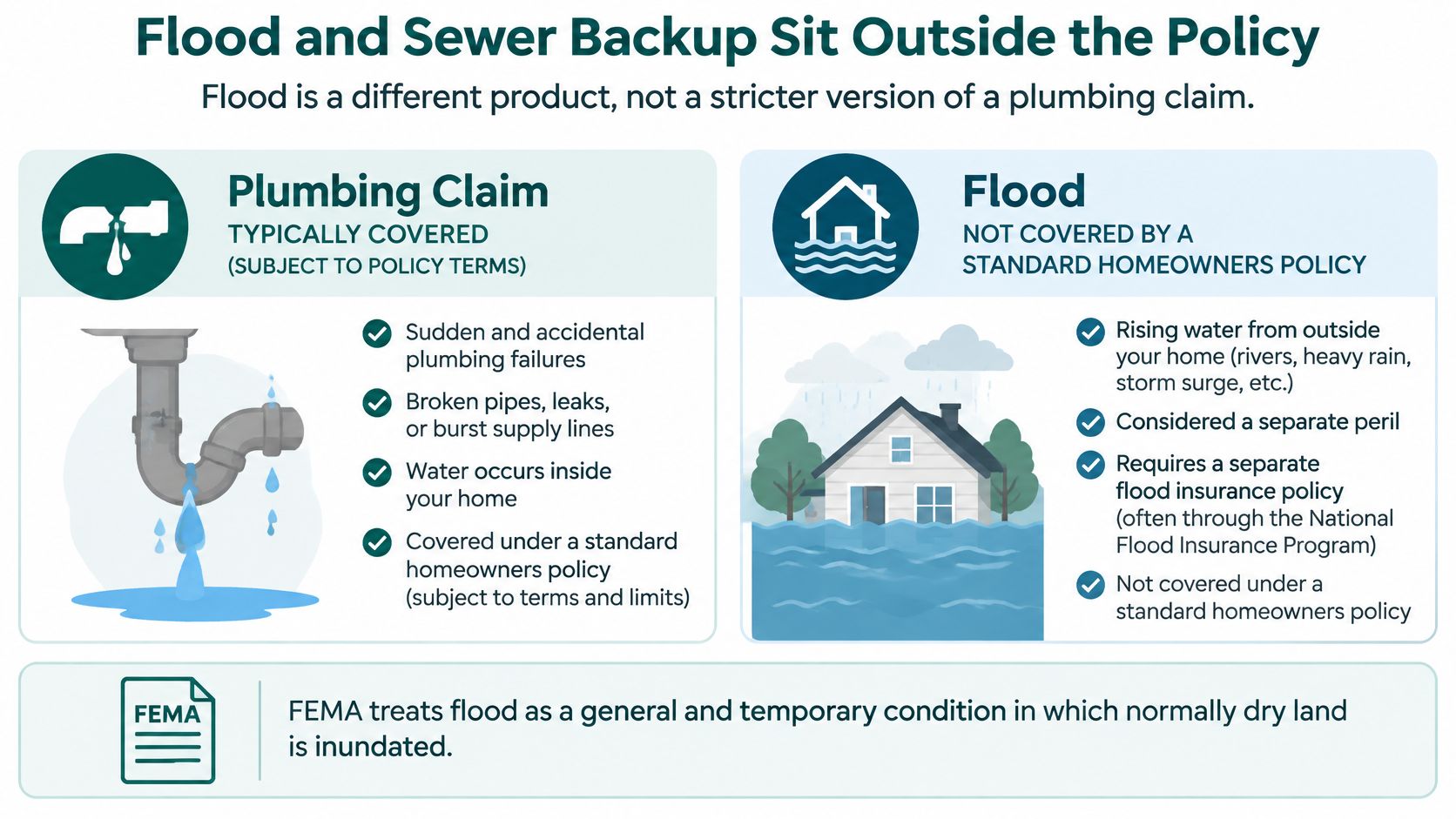
Flood and Sewer Backup Sit Outside the Policy
Flood insurance is a different product, not a stricter version of a plumbing claim. A homeowners policy, a flood policy, and a water-backup endorsement address different events, even when each event leaves a basement wet.
The National Association of Insurance Commissioners flood insurance guide confirms that standard homeowners insurance excludes flood damage and generally requires separate NFIP or private coverage. Buying homeowners insurance alone therefore doesn't establish protection against rising outdoor water.
Flood has a specific definition
The FEMA flood insurance guidance describes covered flooding as a general and temporary inundation of normally dry land, generally affecting two or more properties or at least two acres, and identifies NFIP limits of up to $250,000 for a residential building and $100,000 for residential contents, with commercial limits up to $500,000 each for buildings and contents.
Those are coverage ceilings, not promised payments. Purchased limits, deductibles, exclusions, and valuation provisions still determine what a particular policy can pay.
| Protection | Main purpose | Important limit check |
|---|---|---|
| Homeowners water coverage | Covered accidental property damage, including qualifying internal releases | Dwelling, contents, deductible, and any water limitations |
| Separate flood insurance | Direct physical damage from a qualifying flood | Purchased building and contents limits |
| Water-backup endorsement | Qualifying sewer, drain, or sump-related losses described in the endorsement | Backup sublimit, deductible, and covered equipment or events |
A flood policy shouldn't be assumed to cover every damp basement. Water seeping through a foundation can raise groundwater exclusions and flood-definition questions that require examination of the actual event.
Likewise, a home outside a designated high-risk area isn't automatically safe from flood loss. A map category isn't a substitute for understanding drainage, nearby waterways, or the insurance contract.
Backup isn't another word for flood
Consider sewage emerging through a basement floor drain while the street remains dry. The relevant inquiry is whether a sewer or drain backed up and whether the policy contains the applicable endorsement.
A sump pump that stops working raises another distinct question. The endorsement must be checked for the failure or overflow involved, rather than assumed to cover every pump problem.
A wet basement describes the damage location. It doesn't identify the insured event.
The declarations page should list any water-backup coverage, but the endorsement supplies the operative terms. The property owner should obtain both.
When water enters through a drain and a wall during the same storm, separate notes should identify each route. Combining everything under a flood label can obscure evidence needed to evaluate each cause.
How Real Water Losses Get Sorted
Real claims rarely arrive as tidy textbook examples. The following scenarios show how the same room can contain damage that requires different coverage decisions.
Household losses with different causes
A kitchen supply line breaks overnight. Water ruins cabinet panels, and mold appears during the aftermath. The sudden discharge belongs in the homeowners review; the failed hose and mold-related work require separate treatment under the policy.
Wind lifts shingles and rain stains bedrooms. Photographs of displaced roofing and the interior water path can support a storm claim. The insurer may still dispute deterioration in older roofing or apply depreciation when valuing covered roof work.
Groundwater enters through a basement wall after prolonged rain. No plumbing failure is found. The relevant review concerns groundwater exclusions and any applicable flood coverage, not a claim framed as an indoor pipe accident.
A municipal sewer surcharges into a floor drain. A nearby river remains within its banks, but wastewater enters the building. The correct coverage inquiry concerns sewer backup and the purchased endorsement, not whether a storm occurred.
The Michigan Department of Insurance and Financial Services severe-weather guidance distinguishes the specialized insurance meaning of flood from storm rain intrusion, sewer backup, and sump-pump problems, and advises reporting water damage while coverage is being determined. Waiting for a homeowner to solve the classification question can delay notice unnecessarily.
Mixed losses need separate decisions
Suppose a shop suffers a pipe break, followed by a power outage that spoils inventory. Repairs to the building, damaged stock, and lost trading income may involve different coverage provisions and exclusions.
A denial concerning spoiled inventory doesn't establish whether the pipe-damaged walls are covered. Equally, acceptance of the wall repairs doesn't establish coverage for the inventory or lost income.
A useful claim file separates:
- Cause evidence: Photographs, failure reports, and the sequence of events.
- Property categories: Building components, equipment, stock, and tenant improvements.
- Financial consequences: Relocation costs or business-income losses supported by records.
A denial of a failed-part repair doesn't automatically exclude resulting damage. But an excluded cause may also exclude resulting damage, depending on the wording and any applicable exceptions or concurrent-cause provisions.
The owner should request the specific policy language and factual explanation behind each disputed decision. Materials should be preserved where safe until the cause is documented, without allowing evidence preservation to delay necessary mitigation.
How to Document Damage and File the Claim
A claim file should allow someone who wasn't present to understand what happened and what repairs are necessary. In the ISO data set, water damage and freezing accounted for 22.6% of homeowners' property-damage claims in 2023, according to 24 Hr FloodMasters' statistics summary.
That frequency doesn't make an individual claim self-proving. The owner's records still need to establish cause, timing, and the extent of damage.
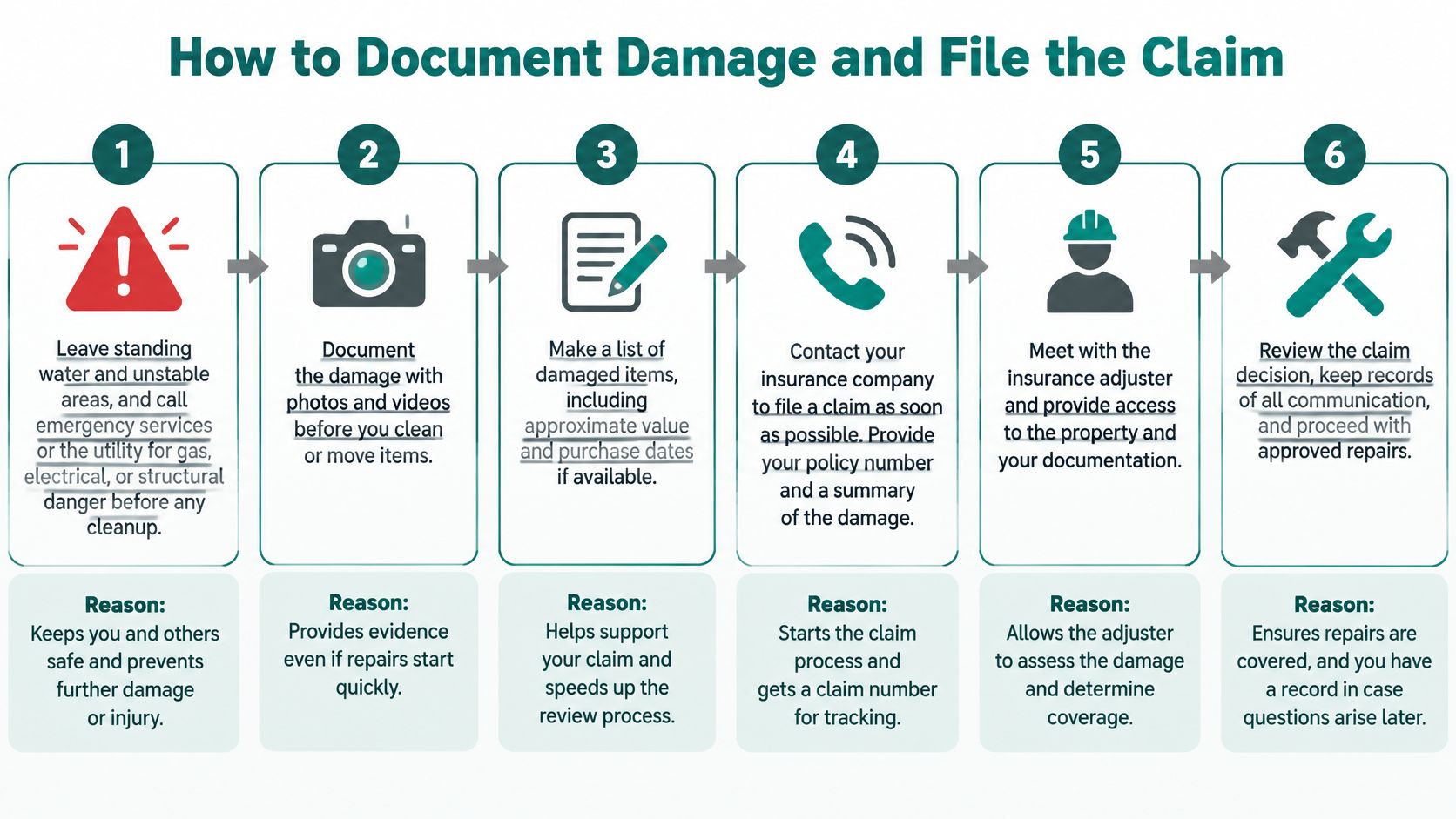
A practical filing sequence
Leave hazardous areas first. Nobody should enter standing water or an unstable structure to collect evidence. Emergency services or the appropriate utility should handle electrical, gas, structural, or other immediate dangers.
Limit further damage when safe. A safely accessible water shutoff may stop an active supply leak; qualified help may be needed for extraction and drying. The water damage mitigation guide explains the distinction between limiting additional damage and completing permanent repairs. Every mitigation invoice should be retained.
Photograph before removal. Wide views establish each room's condition; close-ups show the entry point, waterline, and damaged materials. Failed fittings and representative materials should be preserved when safe, with insurer instructions requested before disposal. Hazardous materials shouldn't remain merely for an inspection.
Write a factual timeline. The record should distinguish when water was discovered from when it may have started. Known prior leaks, emergency calls, shutoff actions, and contractor visits belong in the same chronology.
Collect the policy and report promptly. The declarations page, deductible provisions, endorsements, and any flood policy should be gathered. Prompt-notice and proof-of-loss requirements need attention, but assembling a perfect packet shouldn't delay notice. The owner should record the reporting date and retain every written submission.
Separate the claimed losses. Building repairs, damaged belongings, and additional living expenses need distinct records. A business should also separate equipment, inventory, and income effects. These categories are payable only when the relevant coverage and conditions apply.
Compare the estimate with the evidence. Room names, materials, quantities, and drying work should align with photographs, moisture readings, and invoices. Missing items warrant a written question and supporting documentation rather than an unsupported demand for a larger total.
Keep communications traceable
A simple folder system can separate policy documents, photographs, invoices, estimates, and correspondence. Telephone discussions should be followed by a brief written confirmation of important instructions or unresolved questions.
File-readiness check: Cause, timing, photographs, and invoices should be understandable together, without requiring the owner to reconstruct the story from memory.
Why a Covered Water Claim Can Still Pay Too Little
Coverage acceptance and a complete repair estimate are different achievements. LexisNexis figures reported by Reinsurance News show non-weather water-loss severity increased 2.5% from 2024 to 2025, while water-claim frequency fell 7.8% in 2025.
Fewer claims don't mean a smaller repair bill for a household that suffers damage. The practical issue is whether the insurer's scope of loss, the list of damaged items and proposed repairs, reflects the supported work.
Lines a water estimate often misses
| Line item | Often treated as | What to compare |
|---|---|---|
| Resulting building repairs | Covered when the cause and damage satisfy policy terms | Moisture map and contractor scope |
| Repair of the failed pipe or appliance | Often excluded or limited as the source | Invoice split from rebuild costs |
| Hidden wet cavities | Part of the same sudden loss if documented | Opening photos and moisture readings |
| Matching and code upgrades | Matching may be disputed; code upgrades require applicable ordinance-or-law coverage | Policy endorsement and local code notes |
| Contents | Subject to limits and depreciation method | Replacement-cost versus actual-cash-value wording |
| Emergency mitigation | Often covered when reasonable, necessary, and tied to a covered loss | Dry-out invoices and equipment logs |
| Additional living expense or business income | Only under applicable coverage and qualifying conditions | Receipts, income records, and the supported loss period |
A visual inspection can miss wet insulation behind a finished wall. A moisture map, which records affected locations and readings, can support further investigation; opening photographs can then document what was found.
Matching disputes need a different explanation. A contractor proposing replacement across an adjoining area should identify why the proposed repair can't reasonably be limited to the visibly damaged patch, while the owner checks applicable policy wording and law.
Code upgrades require specificity as well. A contractor should identify the actual requirement and affected work, not add a general code allowance without support.
A lower check isn't always an omitted repair
Depreciation, deductibles, sublimits, and valuation provisions can reduce payment even when the estimate lists the necessary work. Actual cash value generally reflects depreciation, while replacement-cost coverage may permit additional recovery after applicable conditions are met.
A contents list should therefore record the item, its age and condition, and replacement support. A household shouldn't assume that a damaged sofa will be valued using the same method as a structural repair.
For rental and commercial properties, ownership also matters. The file should establish whether equipment, inventory, and tenant improvements belong to the insured and fall within the applicable coverage.
A supplement should identify newly documented damage or costs and explain each requested change. Current contractor prices, drying logs, and invoices are stronger support than a statement that the original offer feels low.
A licensed public adjuster may help quantify a large or disputed scope. That assistance can't create coverage for an excluded loss or guarantee additional payment.
Decide Whether to File Alone or Get Help
A straightforward claim may be manageable without representation. The owner can assess whether the cause is clearly documented, the policy addresses that source, and the written estimate agrees with the visible and measured damage.
When those conditions are satisfied, the practical task is organization: timely notice, accurate records, cooperation with inspection requests, and careful review of the insurer's response.
Signs that a second look may help
- A disputed cause: A denial cites flood, gradual damage, or backup, but a contractor's findings and the timeline support a different event.
- An incomplete estimate: Documented drying, wet cavities, damaged contents, or qualifying relocation costs have no corresponding line.
- Several affected interests: A rental or commercial loss involves tenant improvements, equipment, stock, or interrupted operations.
The reason for assistance should be specific. A written exclusion dispute calls for a coverage-focused review; missing quantities call for an estimating review. A legal dispute may require an attorney rather than an adjuster.
Hiring a public adjuster is optional and may not be appropriate for every claim. Within the scope permitted by applicable state law, a licensed public adjuster can represent the policyholder, document damage, prepare estimates, and negotiate, without guaranteeing approval or a higher settlement.
PostDamage's insurance claim help service provides information and connects property owners whose claims were denied, delayed, or paid less than expected with licensed public adjusters. PostDamage isn't an insurance company, public adjusting firm, law firm, or restoration contractor, and doesn't directly adjust, negotiate, or settle claims.
The decision should turn on the unresolved problem, not the size of the first check. A homeowner who can identify the disputed cause or missing repair is better positioned to decide what kind of help is useful.
PostDamage offers claim-help information and connections to licensed public adjusters for property owners facing denied, delayed, or underpaid water-damage claims. Owners seeking help with a coverage dispute or an incomplete repair estimate can visit PostDamage to explore available assistance without any promise of a payout.