
A pipe bursts overnight, a contractor gives one repair figure, and a few days later the insurer sends a longer document with a much lower total. That's usually the first close look a property owner gets at an insurance claim estimate, and confusion is understandable because the pages mix measurements, unit prices, depreciation, and deductibles. The total at the bottom isn't the whole story. A careful review starts with the inputs: what work was included, what prices were used, which valuation method applies, and what the policy promises to pay. Those details explain most gaps before there's any need for a dispute.
What an Insurance Claim Estimate Includes
An insurance claim estimate is the insurer's itemized scope and price for repairing or replacing damaged property. Think of it as a bill built from a menu of work items rather than one lump sum. Each line should name a task, a quantity, and a price, so a reader can trace how the total was built instead of guessing at it.
That document informs the claim, but it doesn't decide coverage by itself. Policy wording, cause of loss, limits, exclusions, endorsements, and applicable law still control payment. A line item can be priced correctly and still fall outside the policy, while covered damage can be underpaid because a room, material, or trade was left out of the scope.
The Parts That Build the Total
FEMA guidance on claim estimates identifies the core technical controls as accurate material unit costs, labor and sales tax, applicable depreciation for both building components and contents, and overhead and profit when a general contractor is involved. Estimates should also be itemized by room and include quantities or square-foot measurements. Those fields matter because omitted rooms, incorrect quantities, outdated local pricing, or missing contractor overhead can produce an artificially low estimate even when coverage exists.
| Component | What It Covers | Common Gap |
|---|---|---|
| Materials | Unit cost of each replacement material | Outdated local pricing |
| Labor | Installation hours for each trade | Trades or hours left out |
| Quantities and measurements | Square footage or count per room | Omitted rooms or wrong quantities |
| Sales tax | Tax on materials and labor where applicable | Left out entirely |
| Overhead and profit | General contractor overhead and profit on multi-trade work | Omitted when a general contractor is needed |
| Permits and code work | Permit fees and code-required upgrades | Not in the first estimate |
| Debris removal | Hauling and disposal of damaged materials | Assumed or excluded |
| Depreciation | Age-based reduction for building components and contents | Applied inconsistently between categories |
| Deductible, limits and exclusions | Your share, policy maximums and excluded items | Confused with the settlement total |
Why Room by Room Detail Matters
Room-by-room organization makes omissions visible. A kitchen loss, for example, might need demolition, drying, cabinetry, flooring, plumbing, electrical work, painting, and appliance reconnection. If the estimate lists flooring but skips the cabinets that must be removed to install it, the scope isn't complete even if the flooring price looks fair.
Photographs support that check. Pictures of damaged and undamaged elements help validate both the existence of an item and how far the damage extends. A photo of an intact matching cabinet run, for instance, can matter when the estimate prices only one damaged section.
Simple completeness test: if a damaged room, fixture, or contents item has no matching line, the estimate is incomplete until the insurer explains why it was left out.
That test doesn't assume bad faith. It separates three different problems that readers often blur together: damage that wasn't scoped, work that was scoped but priced low, and work the policy doesn't cover. Each problem needs a different response, and the estimate's own lines show which one applies.
Replacement Cost vs Actual Cash Value in Your Estimate
Every valuation-based estimate contains figures that are easy to confuse, especially when only one check amount is expected. The three numbers to separate are gross replacement cost, depreciation withheld, and the deductible. Until those are written on one page, a contractor bid and an insurer estimate can look further apart, or closer, than they really are.
Replacement cost value (RCV) is the cost to repair or replace with comparable materials, subject to policy terms and limits. Actual cash value (ACV) generally reflects replacement cost minus depreciation. That difference affects both the amount paid and the timing, because an ACV payment may arrive first while any recoverable amount waits for proof that repairs were completed.
A Worked Example With a Laptop
The National Association of Insurance Commissioners disaster claims guide illustrates depreciation using a two-year-old laptop with a four-year useful life, where a comparable replacement costing $750 is assigned 50% depreciation, producing a $375 ACV payment. The laptop example is small, but the logic applies directly to roofing, flooring, appliances, and other building components with an expected service life.
| Figure | How It Is Calculated | Worked Example |
|---|---|---|
| Replacement cost value (RCV) | Cost to repair or replace with comparable materials, before depreciation | Comparable laptop at $750 gross |
| Depreciation | Age-based reduction applied to the item | 50% of $750 = $375 withheld under ACV |
| Actual cash value (ACV) | RCV minus depreciation | $750 minus $375 = $375 paid first |
| Recoverable depreciation | Withheld amount released after documented repair or replacement, where the policy allows | $375 released after receipts are provided |
| Deductible | Your share, subtracted from the covered amount | Amount set on your declarations page |
How the Same Math Reaches a Home Repair
Say damaged flooring is halfway through its useful life and the replacement scope is otherwise agreed. The insurer might price the full replacement, withhold part of it as depreciation, subtract the deductible, and issue the ACV portion first. Where the policy permits recoverable depreciation, the withheld amount may be released after the insured documents repair or replacement.
That sequence explains a common misunderstanding. A first payment lower than a contractor bid doesn't always mean the scope was priced too low. It may mean depreciation was withheld, the deductible was applied, or both. The declarations page should be checked for the valuation basis before any numbers are compared.
Receipts, invoices, inventories, photographs, and age records should be kept together from the start. Those records substantiate both the repair scope and the amount eligible for reimbursement, and they're far easier to gather during repairs than months later.
How to Review an Estimate Line by Line
A line-by-line review is most effective as a side-by-side comparison. The goal is to find exactly where the insurer's scope, measurements, or pricing differ from the damaged property and from a contractor's documented bid. Specific differences are easier for an adjuster to answer than a general claim that the total feels low.
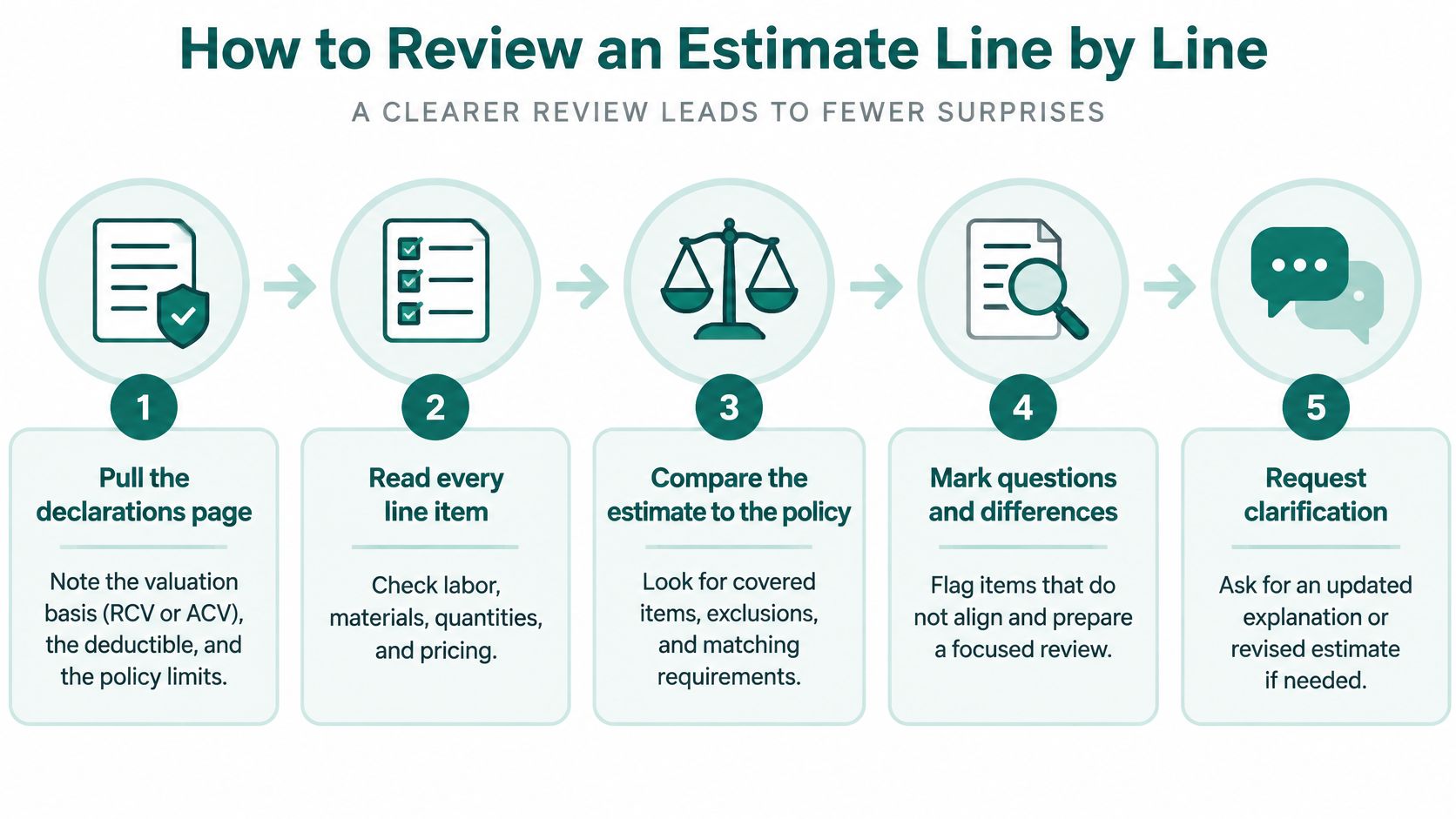
The Nine Checks in Order
- Pull the declarations page first: Note whether the policy uses RCV or ACV, plus the deductible and limits. Every later number depends on those terms, so guessing at them wastes the rest of the review.
- Place both documents side by side: Put the insurer estimate beside the contractor bid, room by room. Differences show up fastest when both documents follow the same order through the property.
- Match each damaged item to one line: List any damaged item with no matching line as a gap. That list becomes the core of any later supplement request.
- Check quantities against measurements and photos: Compare square footage, linear feet, and item counts with on-site measurements. Photographs of damaged and undamaged elements confirm both existence and extent.
- Compare unit prices with current local pricing: Note the source and date for any price used to question a line. Regional pricing databases can lag behind what local trades charge after a widespread loss.
- Check for consistent treatment of age and condition: Building components and contents should be assessed by the same method throughout the estimate. Two similar items handled differently is a specific, correctable error an adjuster can answer directly.
- Verify the add-on costs: Confirm that taxes, permits, debris removal, and overhead and profit are either included or explained. Multi-trade work coordinated by a general contractor is where overhead most often goes missing.
- Separate the three figures: Keep gross replacement cost, withheld depreciation, and the deductible as distinct numbers when comparing totals. The split shows whether a shortfall comes from scope, pricing, or payment timing.
- Send disagreements in writing: For each disputed line, give the line item, the supporting evidence, and the amount believed to be correct. A short list backed by photos, measurements, and invoices is harder to set aside than a long unsupported one.
Water losses show why step three matters so much. Drying and extraction work often happens before repairs begin, and a reader comparing mitigation invoices against restoration lines can review typical water extraction cost considerations to understand which charges belong in which part of the file. Emergency work billed separately should never be mistaken for duplicate repair scope.
Keep the disagreement list to items that evidence can support. Each supported line stays specific, answerable, and tied to the property instead of to frustration with the process.
Why a Low Estimate Is Not Always an Unfair One
A low estimate is often a question of assumptions, not arithmetic. An adjuster can add every line correctly and still produce a total that won't rebuild the property, because the result depends on the square-foot cost, scope assumptions, and pricing database used to build those lines. Readers who only challenge the addition miss the part of the estimate that drives the number.

The Colorado Division of Insurance analysis of Marshall Fire underinsurance examined 951 Marshall Fire total-loss homes and estimated aggregate underinsurance between $34 million and $155 million, depending on whether rebuilding costs were modeled at $250, $300, or $350 per square foot. Nothing about the homes changed across those scenarios. Only the cost assumption changed, and the shortfall moved by more than a hundred million dollars.
Which square-foot cost and scope assumptions produced the estimate, and what evidence would justify revising them?
Cost Drivers Standard Pricing Can Miss
Several real rebuilding costs don't sit comfortably inside a standardized database:
- Labor shortages: Local trades may charge more when many properties compete for the same crews after a large loss.
- Code-upgrade requirements: Work required by current code may not appear in a like-for-like replacement scope.
- Debris removal and permitting: Hauling, disposal, and permit fees are real costs that early estimates sometimes assume away.
- Access constraints: Tight lots, upper floors, and occupied buildings can slow work and raise prices.
- Inflation: Material prices can move between the loss date, the estimate date, and the actual repair date.
Replacement cost coverage also doesn't make every rebuilding expense payable. Policy wording, ordinance or law coverage, deductibles, depreciation rules, and applicable law still control which of those costs the insurer must pay. A reader reviewing how water damage insurance treats covered causes and exclusions will see why a correct repair price and a payable claim amount aren't always the same number.
A low figure may therefore reflect an underinsured policy or an incomplete scope rather than an unfair adjuster. Those causes lead to different next steps: a limit problem can't be fixed by repricing lines, while a scope problem can be documented and submitted as a supplement. A licensed public adjuster or other qualified professional may help document that supplement, without any promise of a higher settlement.
Delayed Payments and Supplemental Estimates
An accepted estimate and available cash are different milestones. Payment can be staged, held for missing documents, routed through a mortgage company, or split between an initial actual cash value amount and recoverable depreciation released later. A repair plan built on the estimate total alone can run out of money while the claim is technically moving forward.
That gap is common enough to budget for. Consumer Reports coverage of homeowners insurance claim payment timing reports that the National Association of Insurance Commissioners identifies claim-processing delays as its most common complaint type, and cites a nationally representative 2025 survey in which one-quarter of homeowners who had made a claim in the previous five years waited more than 30 days for payment, while 6% waited more than 90 days.
Five Questions to Answer in Writing
- What amount is undisputed? Ask what can be paid now, before disagreements over other lines are resolved.
- Which documents are still missing? Get the specific list rather than a general statement that the file is incomplete.
- Is the first check actual cash value? The depreciation split covered earlier decides whether more money follows; ask exactly what proof of completed repairs triggers that release.
- Who controls the funds if there's a mortgage? A mortgagee may need to endorse checks or release money in stages as work progresses.
- How should new damage be submitted? Confirm the format for sending higher contractor bids or newly discovered damage as a supplement.
A legitimate staged process explains itself: each stage has an amount, a reason, and a next step. Silence has none of those. Written status requests should cite the claim number, the outstanding item, and the date of the last response, so each follow-up builds on the one before it.
Supplements, Deadlines, and Cash Flow
Say a wall comes open during repairs and water damage shows behind it. That discovery goes back to the insurer as a supplement under the same claim number, with photographs taken before the wall is closed again and the revised contractor bid attached. Filing it as a separate, unconnected request creates confusion about which loss the damage belongs to, which is exactly the kind of snag that stalls payment.
Two policy items deserve early attention while that happens. The proof of loss deadline in the policy should be confirmed rather than assumed, and additional living expense should be checked to see whether it's being paid separately from the building estimate. An unanswered proof of loss or unclaimed living costs can stall or shrink a settlement even when the repair scope is agreed.
Repairs, temporary housing, and payroll still need funding while all of this is pending. One log listing each supplement submitted, each payment received, and each document outstanding shows at a glance what the claim still owes and how far the cash on hand stretches.
Commercial and Multi-Category Claims to Plan Around
A restaurant fire can produce one estimate total that touches five coverages at once. A commercial estimate works like several smaller estimates sharing one claim number: building repair, contents and equipment, business income, temporary relocation, emergency mitigation, and flood coverage can each carry different limits, deductibles, and documentation rules. One combined figure hides which limit pays for which loss.
FEMA reporting on National Flood Insurance Program claims supports keeping those categories distinct, because building, contents, business interruption where covered, emergency mitigation, and flood-policy limits may be adjusted under different terms. Observed damage still has to be matched to the insured peril, policy definitions, limits, and exclusions before any category total means much.
The Record Each Category Needs
- Building repair: A room-by-room scope with quantities and unit pricing, structured like a residential estimate.
- Contents and equipment: An inventory with age and purchase invoices, separating damaged equipment from inventory losses.
- Business income: Sales records, prior-year financials, and payroll records covering the interruption period.
- Temporary relocation: Lease terms, rental invoices, and moving receipts showing the cost of operating elsewhere.
- Emergency mitigation: Dated vendor invoices for drying, board-up, or similar work completed before repairs began.
Commercial jobs also tend to involve several trades under a general contractor, so overhead and profit, specialty trades, and code-upgrade work should appear as separate lines rather than being absorbed into a general repair figure. The common trap is a flood sublimit: building and contents may look fully documented, yet both can be constrained by one flood cap while other categories sit under different terms.
Decide Whether to Challenge the Estimate or Get Help
The right response depends on what the review found. If the estimate lists every damaged item, the valuation is clear, and the remaining gaps are small, a written line-item response with a supplement log may be enough. Readers still learning the filing sequence can compare their documents against the steps for how to file a water damage insurance claim before sending that response.
Help becomes more reasonable when scope is missing, the valuation basis is unclear, a commercial loss spans several categories, or a policy deadline is close. A licensed public adjuster generally works within the scope permitted by state law to document damage, review estimates, and negotiate on the policyholder's behalf. Hiring one is optional and may not be appropriate for every claim, and professional availability, services, and fees vary by location and provider.
Need help with a homeowners insurance claim? PostDamage can help connect you with a licensed professional. Need help with a commercial property insurance claim? PostDamage can help connect your business with an experienced, licensed professional. The free, no-obligation insurance claim help review takes about one minute to request.
PostDamage is an information and referral platform, not an insurer, adjusting firm, or law firm, and it doesn't guarantee outcomes. The practical next step is to gather the declarations page, the estimate, the contractor bid, and photographs before requesting that review, so the conversation starts with documents rather than recollection.
If an estimate total doesn't match the damage, the contractor's scope, or the policy's valuation basis, a documented review is the place to start before repairs and deadlines get ahead of the claim. The size and shape of the gap usually decides the path: a few missing line items call for a written supplement, while a missing room, an unexplained price change, or an approaching deadline favors professional help. PostDamage helps property owners request a free, no-obligation insurance claim help review and connect with a licensed professional where available.