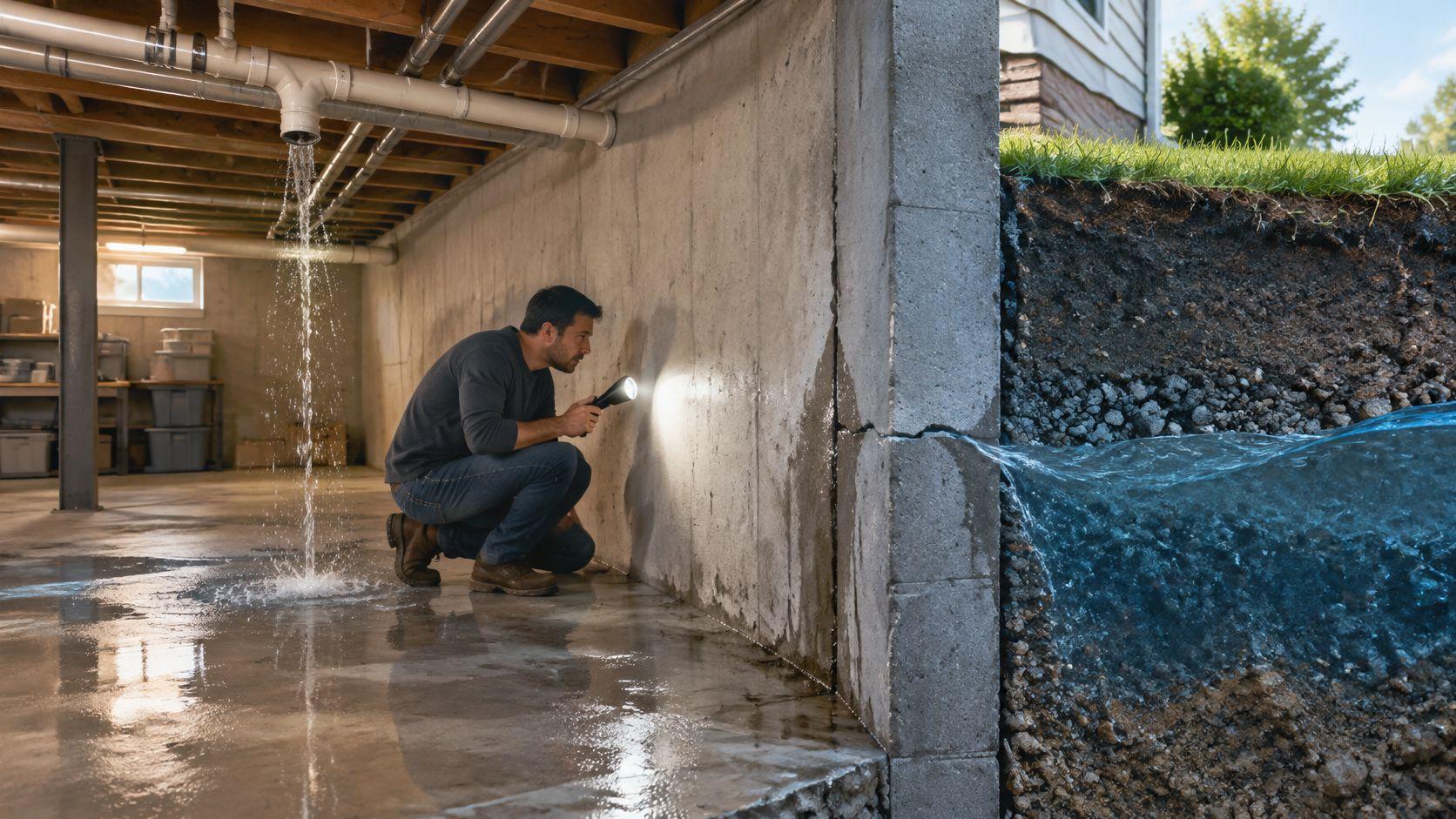
Foundation water damage coverage is the protection a policy provides for water damage to a foundation and the building, and it depends mainly on where the water came from and whether the event was sudden and covered.
If the same basement wall gets wet from a broken pipe or rain-soaked soil, why might an insurer pay for one loss but deny the other? The visible damage can look identical, but the insurer must determine which event started the damage and how the water reached the building.
Why Foundation Water Damage Coverage Confuses Owners
A homeowner discovers a damp basement wall the morning after heavy rain. The storm seems like the obvious explanation, but the stain alone doesn't establish whether rain entered through the foundation, a pipe failed nearby, or an older moisture problem became noticeable.
That uncertainty explains why asking what is foundation water damage coverage doesn't produce a simple yes-or-no answer. The phrase describes a coverage question, not necessarily a separate benefit listed under that name. An adjuster examines the cause, the damaged property, and the contract provisions that apply.
Water claims aren't all foundation claims
Water losses are common. The Insurance Information Institute's homeowners insurance statistics report that water damage and freezing affected 1.6% of insured homes, approximately 1 in 60, for the period from 2018 through 2022, and represented 22.6% of homeowners claims in 2023.
Those figures combine different water and freezing losses. They aren't a measure of insured foundation damage, and they don't establish that every wet basement qualifies for payment.
Consider the different questions behind similar damage:
- A plumbing failure: Did an accidental discharge damage otherwise sound building materials?
- Water outside the home: Did runoff, rising water, or saturated soil supply the moisture?
- An existing condition: Did deterioration, drainage problems, or repeated leakage contribute?
A wet wall identifies the location of damage. It doesn't identify the insured cause.
Groundwater, floodwater, and neglected maintenance can receive different treatment even when the repair estimate looks similar. Repair bills establish the financial loss, while source reports, photographs, and policy wording help establish whether coverage applies.
A useful mental model is an incident reconstruction rather than a checklist of damaged objects. The central question isn't whether the policy mentions foundations. It's how the water reached the house.
Which Water Sources Policies Cover and Which They Exclude
The working rule is that standard homeowners insurance generally covers sudden, accidental internal water losses and may cover certain rain-related losses. Water that rises, seeps, or runs into the building from outside generally faces exclusions.
The Insurance Information Institute's water-damage guide distinguishes top-down water, such as rain or burst sprinklers, from bottom-up water, such as river overflow. That distinction is a useful memory aid, not a substitute for the policy.
Typical coverage by water source under a standard homeowners policy
| Water source | Typical standard treatment | What decides the outcome | Usual next step |
|---|---|---|---|
| Burst supply pipe inside the home | Usually covered | Sudden, accidental internal failure | Keep the failed pipe and get a plumber report |
| Roof leak or wind-driven rain | Often covered | Whether a covered storm created the opening and what the rain provisions require | Photograph roof damage and interior water paths |
| Ice dam water entering the home | May be covered | Cause and policy wording | Document ice buildup and water paths |
| Groundwater seepage through foundation walls | Usually excluded | Gradual entry from soil or cracks | Check the declarations page for a seepage endorsement |
| Hydrostatic pressure or snowmelt | Usually excluded | Water pressing in from outside | Ask the insurer for the exclusion in writing |
| Surface-water runoff or river overflow | Excluded from standard policy | Flood definition and a separate flood policy | Confirm whether a flood policy is in force |
| Sewer or drain backup | Generally excluded unless endorsed | Backup endorsement on the policy | Check the declarations page for a backup endorsement |
| Sump-pump failure | Often requires an endorsement | Endorsement wording and the circumstances of failure | Review the sump-pump endorsement text |
A burst supply pipe presents the clearest internal-loss example. Preserving the failed section helps distinguish an abrupt break from an ongoing leak.
Roof leaks and wind-driven rain require closer attention to the opening through which rain entered. Ice-dam claims likewise need evidence showing the route from the roof into the building, rather than an assumption that all storm-related moisture receives identical treatment.
Groundwater seepage shifts the inquiry to soil, cracks, and drainage. Hydrostatic pressure and snowmelt raise similar questions about external water, while runoff and river overflow require checking separate flood protection.
Sewer backup and sump-pump failure require reading the relevant endorsement, if attached. An endorsement's title alone doesn't establish its triggers or exclusions.
Where the controlling language appears
The declarations page identifies policy limits, deductibles, and attached forms. The actual coverage grants, definitions, exclusions, and endorsements explain what those entries mean.
Typical provisions address sudden and accidental loss alongside exclusions for wear, deterioration, settling, cracking, and continuous or repeated leakage. Exact language differs by insurer and state, so a homeowner shouldn't substitute a general description for the contract.
The broader explanation of whether homeowners insurance covers water damage can help organize that review. Every table entry remains a starting point, subject to the policy, evidence, endorsements, and applicable law.
Why Seepage and Maintenance Problems Get Excluded
A burst hose and a faucet dripping behind a wall can both soak building materials. Insurers commonly distinguish them because the burst is an identifiable accident, while an ongoing drip may involve repeated exposure and a condition that requires maintenance.
The National Association of Insurance Commissioners' homeowners insurance guidance provides the broader framework for reviewing covered losses and exclusions. Foundation claims require particular attention to groundwater, seepage, and maintenance provisions rather than the seriousness of the damage alone.
How ordinary building conditions become coverage problems
Consider these scenarios:
- A widening wall crack: A hairline crack in a poured foundation repeatedly admits moisture each spring. The issue is recurring entry through an existing condition, not the date the owner noticed a stain.
- A cracked floor slab: Soil moisture passes through the slab and damages the finished floor. The moisture source and deterioration provisions matter even if replacing the floor is expensive.
- Settled exterior soil: The ground slopes toward the house after settling, directing rain against the basement wall. An insurer may treat the drainage condition as maintenance rather than an insured accident.
Hydrostatic pressure means water in saturated soil pushes against a foundation. When that pressure forces moisture through joints or cracks, the insurer generally examines external-water exclusions rather than treating the entry as an internal plumbing discharge.
What an endorsement can change
A seepage, sewer-backup, or sump-overflow endorsement can add protection for specified situations. It doesn't automatically insure defective construction, an unstable wall, or every structural foundation problem.
Practical distinction: Coverage for water entering through a crack isn't necessarily coverage to correct the underlying crack.
A visible crack therefore shouldn't end the analysis. The insurer still needs to identify what caused the claimed damage and whether a covered event started the water's path. The repair needed to prevent recurrence may receive different treatment from the resulting damage.
Borderline Cases Where the Cause Decides the Claim
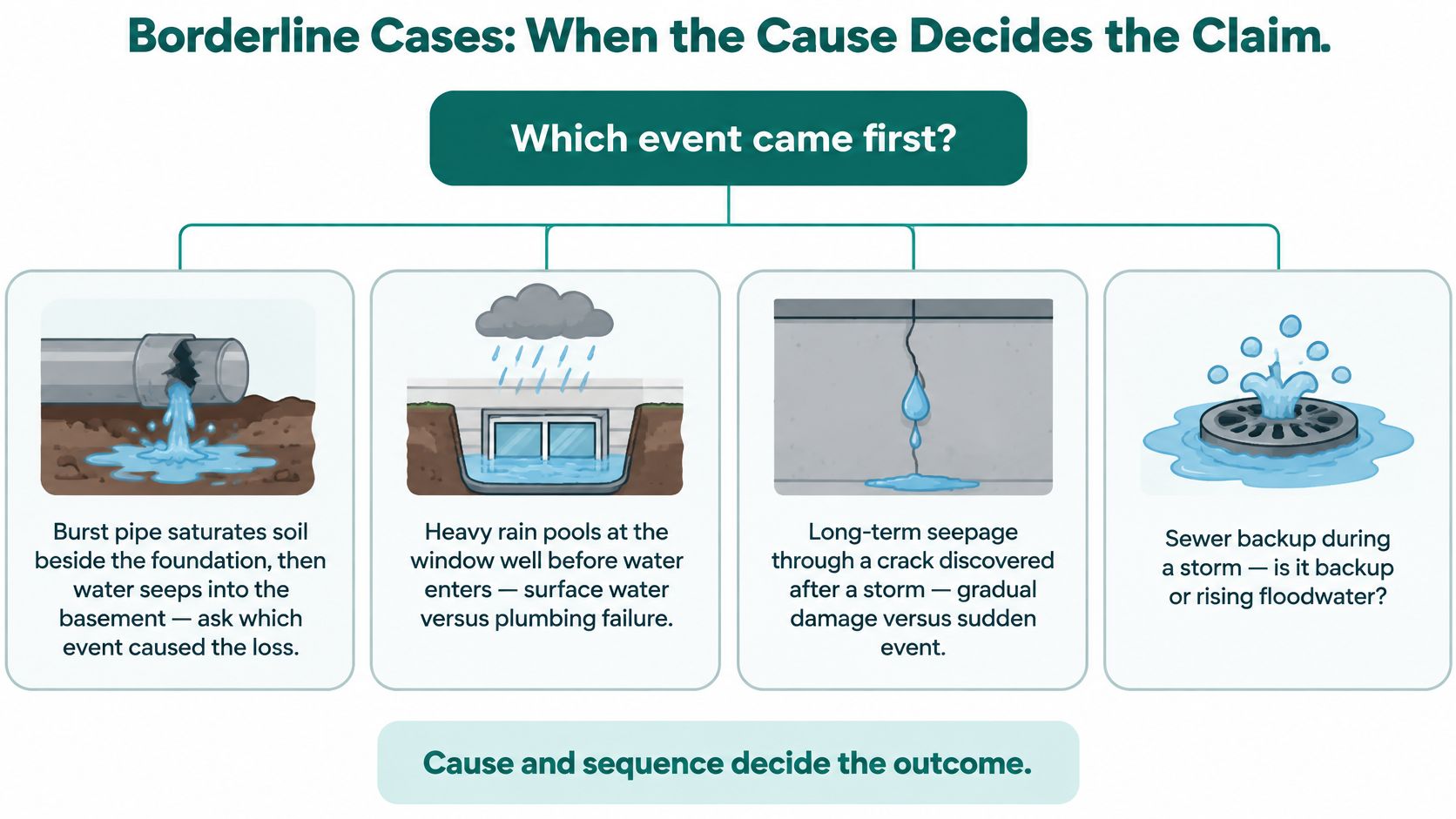
The difficult claims involve more than identifying whether water appeared suddenly. A sudden discovery can reveal an old problem, while an accidental event can send water through soil before it reaches the basement.
Washington's insurance regulator explains water-damage coverage by distinguishing accidental plumbing losses from generally excluded gradual damage involving groundwater, foundation leaks, cracks, and gaps. Applying that distinction requires reconstructing the sequence.
When an accident and an outside pathway overlap
Did a burst pipe start the loss before water entered the soil? Say a supply pipe beside the house breaks, saturates the soil, and water later enters the basement. A plumber's findings can establish the break, while an engineer's assessment and moisture mapping can help distinguish damage caused by that discharge from pre-existing seepage.
The important evidence includes the pipe's location, estimated discharge timing, photographs before excavation, and records of earlier dampness. Interior water damage and foundation movement may require separate causation findings.
Did a storm create a new opening or expose an old defect? Rain entering through an existing crack isn't automatically covered because a storm occurred. Pre-loss photographs, weather records, inspection findings, and earlier repair invoices help establish whether the event changed the building or merely supplied water to an existing route.
When equipment or neighboring land is involved
Did the sump pump fail in a way the endorsement covers? A basement can fill after mechanical failure, power interruption, excessive inflow, or a combination. The pump should be preserved, with a technician's report identifying its condition and the reason it stopped working.
The adjuster then compares those facts with the endorsement's actual trigger. Evidence of a storm doesn't, by itself, establish either sump coverage or flood coverage.
Where did water from the neighboring property originate? A broken supply line next door raises different questions from overland storm runoff. Photographs of the route, neighboring-property observations, drainage features, and professional findings help identify the source without assuming that crossing a property boundary settles coverage.
Why mixed causes need a written explanation
Some policies contain anti-concurrent-causation language, which may affect losses involving both covered and excluded causes. Its effect depends on the wording and applicable state law.
The adjuster's written position should identify the relevant causes and provisions, not merely label the claim foundation damage. The clearest order of analysis is the event, the water path, the damaged component, and the applicable endorsement.
Flood, Sewer Backup and Seepage Policies Compared
A finished basement after heavy rain can look the same in three different losses. Insurers sort them by the first damaging event and the path the water followed. Standard homeowners insurance generally excludes flood, so flood protection is typically bought as its own policy. Calling the basement "flooded" only describes the scene. The flood policy applies when the event matches that policy's definition.
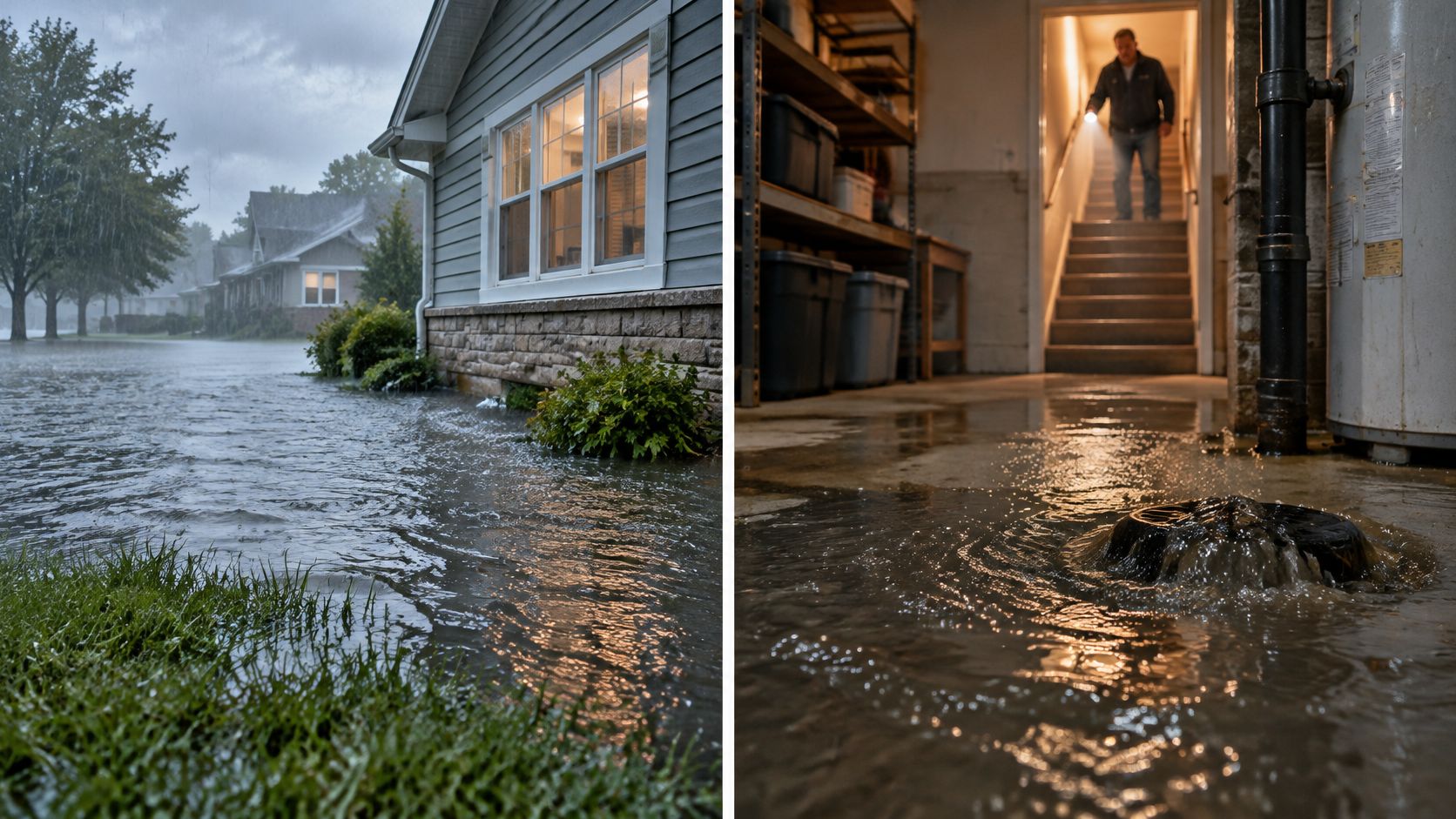
Flood requires a qualifying event
Under FEMA's flood terminology, flooding is a general and temporary inundation of normally dry land affecting at least two properties or two acres. Qualifying causes include overflow, unusual and rapid surface-water accumulation or runoff, mudflow, or specified shoreline erosion.
That definition is the coverage test. Water that rose over exterior grade and spread across neighboring land can meet it. Water that entered one foundation through an old crack, with no broader inundation, often does not. NFIP building coverage can include foundations, foundation walls, anchorage systems, and related components, up to the residential building limit in the policy. Contents coverage is written separately.
The gap is easy to miss. Isolated basement seepage can miss the flood definition and still fall under a homeowners exclusion.
Backup protection addresses a different mechanism
Sewer or drain backup is usually a separate endorsement. On the declarations page, the question is whether water reversed through a drain, sewer, or sump under the circumstances that endorsement names.
The water-damage coverage explanation from Nationwide separates outside water from backup protection. It also notes that continuous exposure can damage a foundation without standard-policy coverage.
These protections work like sorting mail by the return address. The wet basement is the envelope. The source decides which policy, if any, opens.
| Protection | Pathway it tests | What to match on the declarations page |
|---|---|---|
| Flood policy | A qualifying external inundation, then eligible building property | Whether a flood policy is in force, and which foundation components it lists |
| Backup endorsement | Water that backed up through a specified sewer, drain, or sump | Whether that mechanism is endorsed, plus the deductible and any waiting period |
| Seepage endorsement | Only the seepage the endorsement actually grants | Whether any seepage grant appears, and the limits written beside it |
Each row still has its own property limits. Basement belongings, landscaping, temporary living costs, mold, and a later drainage project are separate questions. Read the definitions, deductibles, waiting periods, exclusions, and property limitations in that policy. Wording and state law decide the result, and no form pays every wet-basement loss.
Commercial owners face the same source test, then a second one. Damaged equipment and lost business income respond only if those coverages are on the policy that matches the water's path.
How to Document Damage and Protect Your Claim
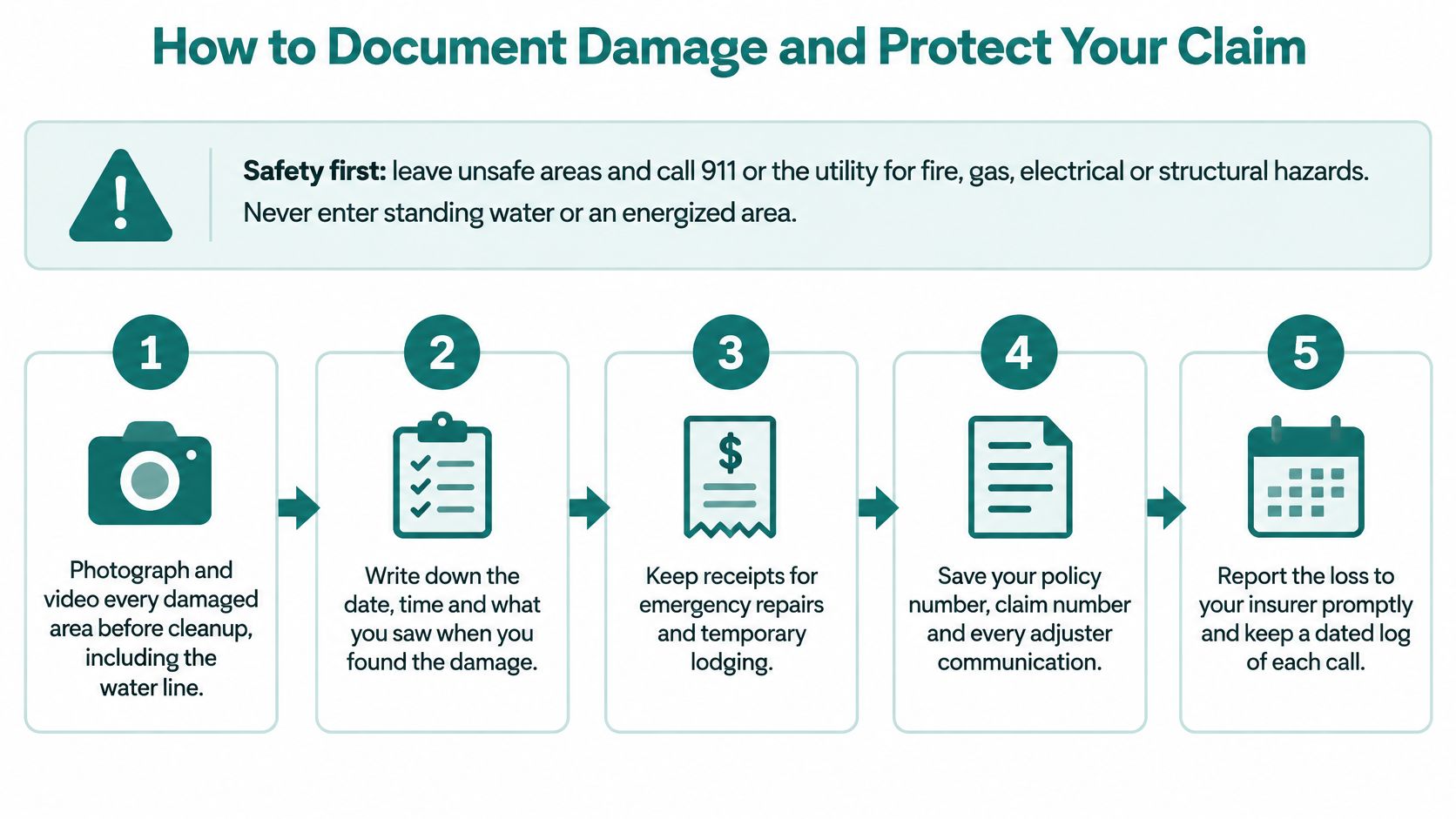
Safety comes before evidence. PostDamage advises property owners to leave unsafe areas before documenting damage, call emergency services or the appropriate utility for immediate hazards, and never enter standing water or an unstable structure.
The strongest claim file separates observations from conclusions. Photographs can show where water traveled; a qualified professional's report can explain why.
Preserve the scene without taking risks
Leave unsafe areas immediately. Fire, gas, electrical, structural, and other immediate hazards require emergency services or the appropriate utility. Documentation never justifies entering standing water, an energized area, or an unstable structure.
Photograph and video accessible damage before cleanup. Capture wide views and close-ups of water lines, cracks, stains, exterior grade, and visible pathways, because close-ups alone may not show how the affected areas connect.
Record discovery separately from suspected onset. The log should state when the owner first noticed damage, what was visible, and any recent weather or plumbing events. An accurate account such as damage discovered after rain is more useful than an unsupported conclusion that rain caused everything.
Preserve the failed pipe section, pump, hose, or other component when safe and practical. A contractor should label and retain removed parts rather than discard them, since physical evidence may help resolve an argument about failure versus deterioration.
Build a record that supports a coverage decision
Limit further damage safely. Arrange reasonable emergency measures to stop the source and dry affected areas, keeping receipts and itemized work records. Emergency work should be distinguished from upgrades or permanent corrective construction.
Ask the plumber, engineer, or drying company for a written report. The report should describe observed conditions, testing, likely source, moisture pattern, and any uncertainty, rather than state that insurance should pay.
Map the affected area. Moisture readings and photographed water-line locations can show the spread across walls and floors. A technician should identify measurement locations and materials so later readings can be compared meaningfully.
Request the insurer's written cause-of-loss explanation and the exact provisions supporting its position. This makes it possible to respond to a specific factual finding or exclusion instead of disputing a vague label.
The water-damage insurance claim filing guide offers additional process guidance. Prompt reporting, a dated communication log, and saved copies of submissions help keep the record organized.
A complete working file contains dated photographs, source findings, mitigation receipts, contractor scopes, and insurer correspondence. If a professional report or written coverage position isn't available yet, the file should identify the outstanding request rather than substitute a guess.
Documentation priority: Preserve evidence of the source before demolition removes it, without delaying necessary safety measures or reasonable damage control.
What Repair and Mitigation Costs Are Covered
Once a cause is covered, payment still turns on three checks: the work repairs insured damage, the price is reasonable, and the amount fits the policy limit and settlement rule. A sump upgrade that never touches the wet rooms fails the first check, even after a sudden pipe break.
Keep emergency drying and permanent reconstruction on separate estimate lines. The documentation steps above already separate emergency work from upgrades and permanent corrective construction. Use that split here, then test each line against the covered cause.
Emergency work and resulting damage
Policies commonly require reasonable steps to protect the property from further damage after a covered loss. Pumping, drying, and temporary protection are reimbursed when they limit additional harm from that covered event and the invoice lists the equipment, labor, rooms, and why each task was necessary. Hiring a contractor does not decide coverage by itself.
The explanation of water mitigation costs groups those charges the way an insurer reviews them.
Permanent lines should follow the water's path from the first damaging event:
- Resulting interior damage: Drywall, flooring, cabinets, and belongings the covered discharge reached.
- Structural correction: Foundation stabilization, wall straightening, or crack repair, each needing its own look at the policy.
- Preventive improvements: Exterior waterproofing, regrading, or drainage changes meant to stop a later event, not to restore this one.
What shapes the payment
Settlement wording changes the amount and the timing. Actual cash value generally subtracts depreciation. Replacement-cost wording often releases the rest only after the repair or replacement is finished.
Check any water or mold sublimit, the deductible, and whether the estimate prices materials like the ones damaged rather than an upgrade. A foundation rebuild is paid with the interior loss only when the same sudden discharge is the first damaging event. Long-term seepage leaves that structural line outside the interior payment.
Get a written scope and price, request an inspection, and ask the insurer to name open items before large permanent work starts. Begin necessary emergency protection right away. Hold optional tear-out until someone can still see the wet materials.
Confirm Your Coverage Position Before You Accept a Denial
A denial or low estimate deserves a specific explanation. The owner should request the insurer's written exclusion, endorsement interpretation, or causation finding and compare it with the complete policy, not just the declarations summary.
Identify the actual disagreement
The next action depends on what remains disputed:
- Cause: Does the insurer's account match the plumbing or engineering evidence?
- Coverage: Does an attached endorsement change the exclusion cited?
- Scope: Did the estimate omit damaged materials or necessary covered work?
- Procedure: What notice, proof-of-loss, review, or dispute deadlines apply under the policy and state rules?
An independent review or licensed public adjuster may be appropriate for mixed water sources, substantial foundation or interior damage, or an estimate that appears incomplete. A public adjuster represents the policyholder within the scope permitted by state law, but a review doesn't guarantee approval or a different settlement.
PostDamage helps visitors understand when hiring a public adjuster may be appropriate. It's an independent information and referral platform, not an insurance company, public adjusting firm, law firm, or restoration contractor, and it doesn't directly adjust, negotiate, or settle claims.
The most useful challenge to a denial identifies a factual error, overlooked provision, or unsupported repair scope. General dissatisfaction alone doesn't resolve those questions.
PostDamage offers insurance claim help for property owners facing denied, delayed, or lower-than-expected payments, including disputed foundation water damage. Homeowners seeking help can visit PostDamage to request a connection with an appropriate licensed professional and better understand the options for their claim.