
The kitchen fire is out. The homeowner is staying elsewhere, smoke-damaged rooms have been gutted, and the insurer's letter cites a policy condition that never seemed important before. Meanwhile, the restoration invoice is due, the house still smells of smoke, and the letter doesn't clearly explain which repairs the insurer refuses to pay for.
The first task is to identify what the insurer decided. A refusal to cover the entire loss is different from rejecting damaged contents, excluding defective wiring, withholding depreciation, or closing a file because documents are missing. Calling every disappointing payment a denial can send a homeowner toward the wrong response.
The recurring reasons insurance companies deny fire claims involve notice, property protection, occupancy, accuracy, cause, exclusions, cooperation, and valuation. Understanding the condition cited in the letter makes it easier to collect relevant evidence instead of submitting another pile of unrelated photographs.
Before responding, the homeowner should separate the dispute into:
- Coverage: Whether the policy covers the property, event, and circumstances.
- Compliance: Whether the homeowner met the policy's reporting and documentation requirements.
- Amount: Whether the insurer included the correct repairs, quantities, prices, and benefits.
Each issue needs a different response. The following denial reasons pair the policy problem with evidence to preserve and a specific sentence the homeowner can send in writing. Those requests aren't admissions or guarantees of coverage. They're a practical way to make the insurer explain its position precisely.
1. Late Notice of Loss
Late notice becomes a coverage dispute when the insurer says the delay interfered with its investigation. The relevant question isn't just when the fire happened. It's when the homeowner discovered damage, when the insurer received notice, and what changed before inspection.
The Financial Conduct Authority's consumer research identifies failure to notify within the policy deadline among potential problems in fire and smoke claims. The applicable policy and local law determine the consequences, so a universal reporting deadline shouldn't replace the actual contract.

Consider a small kitchen fire followed by the later discovery of soot inside a wall cavity. The homeowner should distinguish the original incident from the discovery of concealed damage, without suggesting that later discovery automatically restarts a deadline.
Evidence that establishes the timeline
- Reporting records: Claim acknowledgments, emails, portal confirmations, and telephone logs showing when notice reached the insurer.
- Discovery records: Dated photographs, contractor findings, and a short explanation of when concealed damage became apparent.
- Inspection history: Adjuster appointments, access arrangements, and records showing which materials remained available.
- Reasons for delay: Evacuation instructions, hospitalization records where relevant, or restrictions preventing safe access.
Sentence to request in writing: Please identify the notice provision being applied, the date notice was required, and the specific investigative opportunity or evidence allegedly lost because of the delay.
That request separates a missed date from the insurer's explanation of why it matters. Local rules may affect whether the insurer must demonstrate actual harm, so a homeowner shouldn't assume that either late reporting or an available inspection automatically decides coverage.
2. Failure to Protect Property From Further Damage (Duty to Mitigate)
A broken window remains open after a fire, rain enters, and the insurer disputes the later water damage. That's a different issue from whether the original fire was covered. A mitigation dispute should identify the additional damage allegedly preventable, rather than treat every damaged surface as the homeowner's responsibility.
Reasonable protection can include professional board-up, roof covering, water extraction, and controlled drying. Coverage for those expenses depends on the policy and circumstances, so an emergency work authorization shouldn't be mistaken for insurer approval.
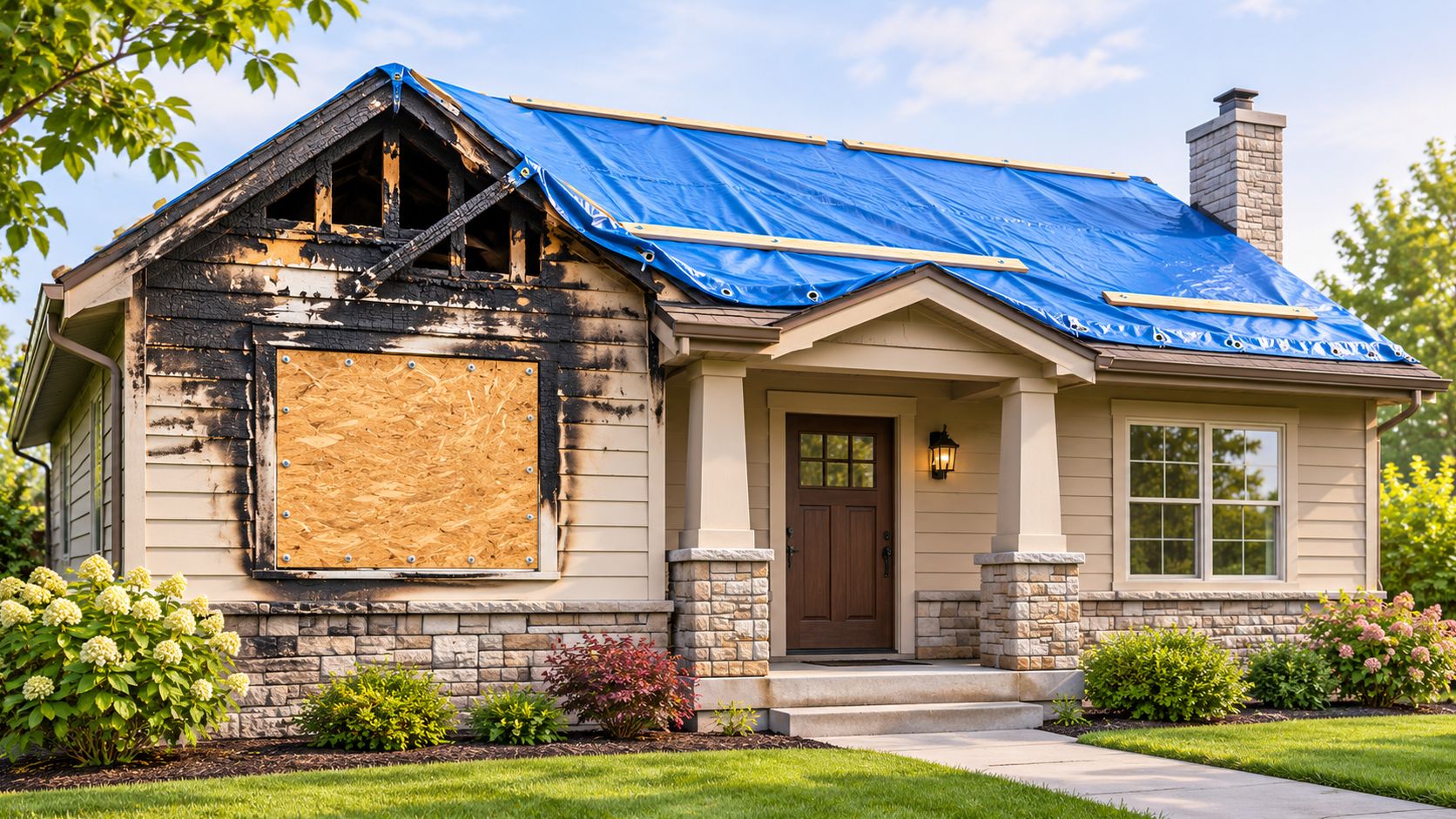
Safety first: Property protection doesn't require a homeowner to enter an unstable building, handle damaged electrical equipment, or disturb a suspected fire origin.
The practical trade-off is speed versus preservation. Leaving wet materials untouched can worsen conditions, but unnecessary demolition can remove evidence. The FireRisk.ai fire-claim denial guide recommends separating safety work from nonessential demolition, documenting conditions before disturbance, and asking the carrier what evidence it needs.
Record what happened before and after protection
The useful file contains before-and-after photographs, itemized emergency invoices, access restrictions, weather exposure, and contractor drying or cleaning logs. Photographs should show both the opening that needed protection and the surrounding materials, not just the finished board-up.
For smoke-related work, smoke damage restoration guidance can help homeowners distinguish soot cleanup, odor treatment, and reconstruction scope. A contractor should document why each operation was necessary rather than describe everything as general cleanup.
Sentence to request in writing: Please identify each item of additional damage attributed to inadequate mitigation, the protective action allegedly required, and the policy provision supporting that reduction.
3. Vacancy or Unoccupancy Provisions
An empty building isn't automatically an excluded building. The insurer must apply the actual policy wording to the property's use and condition. Vacancy and unoccupancy can mean different things, and their consequences vary across policy forms.
This issue often arises during a tenant transition, renovation, extended absence, or move. A landlord might retain utilities and furniture while a rental awaits a new tenant, yet the insurer may argue that the building met its definition of vacancy.

Prove use, not just ownership
Useful evidence shows how the property was used during the disputed period:
- Occupancy documents: Leases, move-in and move-out records, resident correspondence, and temporary relocation arrangements.
- Property activity: Utility consumption, alarm records, inspection logs, and dated photographs of furnishings.
- Renovation records: Permits, contractor schedules, work orders, and evidence of whether residents remained.
- Insurance communications: Messages to the agent or insurer about a change in occupancy and any resulting endorsement.
Active utilities alone don't prove residence. Likewise, an occasional inspection doesn't necessarily satisfy a policy's occupancy requirement. The strongest response combines contemporaneous records with the policy's definition rather than relying on the owner's understanding of the word vacant.
Sentence to request in writing: Please provide the vacancy or unoccupancy wording relied upon, the dates used to calculate the restricted period, and the evidence establishing that the policy definition was met.
Before a future extended absence, the owner should obtain written clarification about any endorsement needed. After a denial, the priority is reconstructing the actual timeline, not purchasing new coverage and assuming it applies backward.
4. Misrepresentation, Concealment, or Fraud
An inventory error can become more serious when the insurer believes it was deliberate. Inflated quantities, altered receipts, inaccurate occupancy statements, and omitted application information can move a claim from a pricing disagreement into a challenge to coverage.
Verification problems also occur outside private insurance. KPBS reporting on wildfire disaster assistance describes identity, residence, duplicate-benefit, and suspected-fraud concerns in FEMA applications. Those are assistance-program findings, not a private-insurance denial rate, but they illustrate why ownership and occupancy records matter alongside damage photographs.
Separate a correction from an unsupported accusation
Suppose a homeowner lists a replacement television model instead of the older model destroyed in the fire. The homeowner should correct the description promptly, identify the original source of the error, and preserve both versions of the inventory. Replacing the earlier document without notice can make the record harder to explain.
The evidence should include:
- Original submissions: The signed application, contents inventory, receipts, and every revision.
- Ownership support: Purchase emails, account statements, delivery records, and photographs taken before the loss.
- Correction history: A dated explanation identifying exactly what changed and why.
- Agent communications: Records showing who supplied and entered disputed application information.
Sentence to request in writing: Please identify each statement alleged to be false, the evidence contradicting it, whether intentional deception is alleged, and the policy provision supporting the coverage decision.
An honest mistake and a deliberate falsehood aren't interchangeable, but an application error can still have consequences depending on applicable law. When the insurer alleges fraud or seeks to undo coverage, qualified legal review is more appropriate than improvising an extensive sworn explanation.
5. Arson, Incendiary Fire, or Insured-Caused Fire
Evidence that someone intentionally started a fire doesn't, by itself, explain why a particular homeowner's coverage is excluded. The insurer's position also depends on the policy language, who allegedly acted, and that person's relationship to the insured.
A fire set by an unknown intruder presents a different coverage question from an allegation that the policyholder directed the act. A tenant's conduct or a household member's involvement requires careful attention to who qualifies as an insured and which intentional-loss wording applies.
An origin-and-cause finding and a coverage decision answer different questions. The insurer should explain the connection between them.
For example, an investigator may identify several areas of origin, while the homeowner disputes the conclusion that an insured caused the fire. A reconstruction estimate won't resolve that disagreement. The evidence needs to address origin, access, timing, and attribution.
Preserve the scene without risking safety
The homeowner should retain fire-department incident records, available origin-and-cause reports, scene photographs, alarm information, witness contact details, and access records. Damaged appliances, wiring, or components should remain available when professionals determine they can be safely preserved.
Necessary emergency work should be documented before materials are moved. A request for inspection instructions is useful, but the homeowner shouldn't delay essential life-safety measures while waiting for a reply.
Sentence to request in writing: Please identify the intentional-loss provision relied upon, the person whose conduct allegedly triggers it, and the factual and expert evidence supporting that conclusion.
Cooperation matters, but guessing doesn't help. When a homeowner doesn't know an answer, the response should say so rather than supply a theory. An arson accusation, sworn examination request, or demand involving possible criminal exposure warrants prompt advice from qualified counsel.
6. Wear and Tear, Maintenance, Electrical, or Workmanship Exclusions
A dryer fails, flames damage the laundry room, and the insurer excludes the appliance. That decision doesn't necessarily settle coverage for the walls, cabinets, smoke contamination, or firefighting water. The defective component and the resulting fire damage require separate analysis.
Some policies distinguish excluded deterioration or faulty work from resulting damage caused by an otherwise covered peril. The wording controls, including any exception that restores coverage for ensuing loss. Neither the age of the appliance nor the existence of faulty wiring automatically answers the whole claim.
Divide the estimate by cause and repair purpose
A useful contractor scope separates:
- Pre-existing conditions: Deterioration, old staining, damaged insulation, or repairs needed before the fire.
- Failed components: The appliance, connection, circuit, or workmanship identified as defective.
- Resulting damage: Burned finishes, smoke-affected materials, and damage from firefighting.
- Required upgrades: Work the contractor attributes to applicable building requirements, with supporting documentation.
The homeowner should collect maintenance invoices, earlier inspection findings, recall correspondence if relevant, and photographs of the affected equipment. A qualified electrician can document observed wiring conditions, but a routine repair estimate shouldn't be presented as a forensic determination of fire cause.
Sentence to request in writing: Please identify the excluded defect or maintenance condition, separate its repair cost from the resulting fire damage, and explain how any ensuing-loss wording was applied.
The trade-off is precision versus overstatement. Denying every pre-existing problem can undermine credibility, while accepting a broad maintenance label can leave unrelated fire repairs unpaid. A line-item response makes room to acknowledge an excluded component without conceding the entire room.
For a condo loss, the file should also distinguish unit finishes, personal property, and building components addressed by the association's policy. The homeowner's policy may not insure every part of the damaged structure.
7. Failure to Cooperate, Incomplete Documentation, or Late Proof of Loss
A contractor's estimate arrives, but the requested contents inventory doesn't. The claim stalls, and the homeowner receives a closure letter. An incomplete file can produce no payment without resolving whether the underlying fire damage is covered.
A U.S. House committee briefing document discusses administrative and coverage-related reasons claims may close without payment, including incomplete information, missing documentation, and unfinished inspections. That distinction matters when deciding whether to submit missing evidence or challenge a coverage interpretation.

Build a request-and-response record
The homeowner should keep a running log containing the insurer's request, the stated deadline, the response date, and delivery confirmation. A sworn proof of loss is a formal claim submission, not merely another contractor estimate, so the correct form and requirements deserve attention.
- Completed requests: Preserve the submitted documents and proof that the insurer received them.
- Unavailable records: Explain what's missing, why it's unavailable, and which substitute records exist.
- Extensions: Request additional time before the stated deadline and obtain written confirmation.
- Inspection access: Offer practical appointment options and record any access restrictions.
Sentence to request in writing: Please identify every outstanding request, its policy basis and deadline, and whether the file is administratively closed or coverage has been formally denied.
Repeatedly sending the same attachments without an index rarely clarifies the dispute. A short cover letter matching each request to its corresponding document works better.
PostDamage's insurance claim help information explains options for denied or underpaid claims and potential professional referral. A request for help doesn't replace responding to the insurer or preserving applicable deadlines.
8. Coinsurance Penalties, Underinsurance, and Valuation Disputes
A covered fire can still leave a large unpaid balance. Deductibles, limits, sublimits, depreciation, and any applicable coinsurance condition affect payment differently. None should be treated as interchangeable with an exclusion of the fire itself.
The National Association of Insurance Commissioners' underinsurance analysis reports that United Policyholders' surveys found 42% of responding homeowners affected by the 2020 California wildfires were underinsured for rebuilding costs. That finding concerns those survey respondents, but it demonstrates the practical difference between having fire coverage and having enough rebuilding coverage.
Payment distinction: A low estimate calls for scope and pricing evidence. An exhausted policy limit calls for checking available coverage and endorsements.
Consider a room paid initially at depreciated value. Depending on the policy, additional replacement-cost benefits may become available after qualifying repairs and documentation. That differs from a room omitted from the estimate or a separate category capped by a sublimit.
Request the calculation, not just the total
Collect the declarations page, endorsements, itemized insurer estimate, contractor scope, depreciation schedule, and receipts for completed work. Compare material descriptions, quantities, repair methods, and omitted operations before focusing only on the bottom line.
Sentence to request in writing: Please provide the itemized valuation, depreciation calculation, deductible, applicable limits and endorsements, any coinsurance calculation, and the requirements for recovering withheld replacement-cost benefits.
Coinsurance shouldn't be assumed merely because coverage is insufficient. The insurer should identify the actual condition and explain its arithmetic.
A valuation disagreement may justify estimating assistance, while a disagreement over what the contract covers may call for legal review. PostDamage's fire damage lawyer information describes a possible professional-review route, not a requirement to hire counsel or a promise of recovery.
How Each Fire Claim Denial Reason Typically Affects Coverage
| Item | Typical Trigger | Denial Scope | Key Evidence to Keep |
|---|---|---|---|
| Late Notice of Loss | Fire reported days or weeks after discovery | Claim may be reduced or denied if delay harmed investigation or settlement | Notice dates, call and email records, photos, and timeline of when damage was discovered |
| Failure to Protect Property From Further Damage (Duty to Mitigate) | Owner delays reasonable emergency protection or cleanup after a fire | Additional damage that could reasonably have been prevented may be excluded | Before-and-after photos, receipts, mitigation logs, and written insurer approvals or requests |
| Vacancy or Unoccupancy Provisions | Property meets the policy's vacancy or unoccupancy definition | Fire coverage may be limited or excluded under the policy terms | Utility bills, inspection logs, occupancy records, and vacancy endorsements |
| Misrepresentation, Concealment, or Fraud | Material facts are hidden or false information is submitted | Disputed items, the entire claim, or the policy may be affected | Accurate inventories, receipts, photos, account records, and written corrections |
| Arson, Incendiary Fire, or Insured-Caused Fire | Insurer suspects the fire was intentionally set by an insured or someone acting at their direction | Loss caused by an intentional act may be excluded | Cause-and-origin reports, investigation records, preserved damaged materials, and relevant correspondence |
| Wear and Tear, Maintenance, Electrical, or Workmanship Exclusions | Fire is linked to deterioration, faulty equipment, wiring, or workmanship | Defective parts or maintenance costs may be excluded; resulting fire damage may remain covered | Maintenance records, inspection reports, warranties, and electrician or fire investigator findings |
| Failure to Cooperate, Incomplete Documentation, or Late Proof of Loss | Missed deadlines, incomplete records, or failure to attend required examinations | Payment may be delayed or denied under policy conditions | Deadline notices, extension requests, proof of loss, photos, receipts, estimates, and correspondence |
| Coinsurance Penalties, Underinsurance, and Valuation Disputes | Coverage is below policy requirements or parties dispute the value of the loss | Payout may be reduced or limited by valuation, depreciation, deductibles, or sublimits | Policy and coverage records, replacement cost estimates, repair documentation, and itemized valuations |
From Denial Letter to Dispute Your Next Moves
The strongest response to a fire-claim denial isn't necessarily the longest. It identifies the insurer's stated reason, supplies evidence addressing that reason, and requests a clear decision on the disputed benefit. A photograph of burned cabinets won't answer an occupancy allegation, just as a utility bill won't establish the cost of smoke remediation.
Start with the complete written position. If the insurer communicated only by telephone, request written confirmation identifying what was denied, what remains under review, and which policy provisions apply. Obtain the full policy, including endorsements, rather than relying only on the declarations page.
Assemble a focused response
- Match each issue to evidence: Pair late notice with the reporting timeline, vacancy with occupancy records, and valuation with an itemized competing scope.
- Explain attachments: Give each document a clear filename and describe which disputed fact it addresses.
- Separate corrections from disagreements: Correct factual mistakes plainly, then explain where the homeowner disputes the insurer's interpretation.
- Request a specific action: Ask for reconsideration, inspection, an amended estimate, or clarification of a particular unpaid category.
- Preserve deadlines: Record policy and correspondence deadlines, and obtain claim-specific guidance where the applicable date is uncertain.
A pending reconsideration request shouldn't be assumed to extend other deadlines. Likewise, the homeowner shouldn't assume that the insurer's willingness to review additional photographs means its prior coverage position has changed.
Professional review should fit the problem. A restoration contractor documents damage and repair scope; a public adjuster may assist with policyholder claim matters within the scope permitted by state law; an attorney addresses legal coverage disputes. Hiring a public adjuster is optional and may not suit every claim, particularly where the expected benefit doesn't justify the cost.
Before signing an agreement, the property owner should understand the professional's role, fees, expenses, cancellation terms, and treatment of previously paid benefits. The decision to hire any professional rests with the property owner.
This is general information, not legal, insurance, or claims advice. Coverage depends on the policy, facts, and applicable law, and neither a detailed evidence package nor professional involvement guarantees payment. The immediate objective is narrower and useful: obtain an understandable coverage position and create a record that supports an informed response.
PostDamage provides property-damage information and reviews claim details for possible referral, including denied or underpaid fire claims. Property owners can visit PostDamage to describe the damage and claim problem and request information about potential help. PostDamage doesn't adjust, negotiate, or settle claims, and the property owner decides whether to hire any professional.