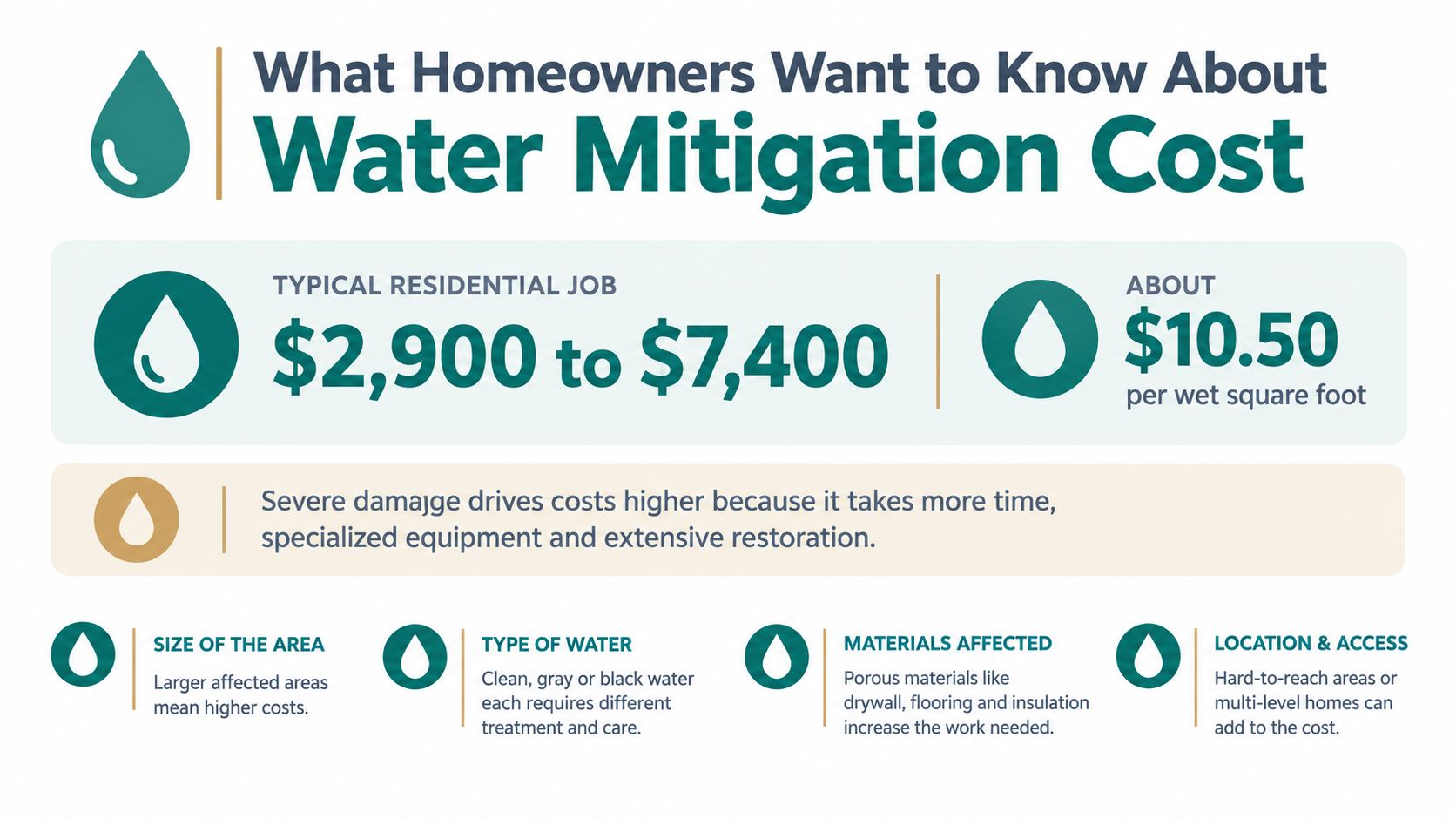
A typical residential water mitigation job often costs $2,900 to $7,400, or roughly $10.50 per wet square foot. Severe or contaminated losses can push the bill into the tens of thousands.
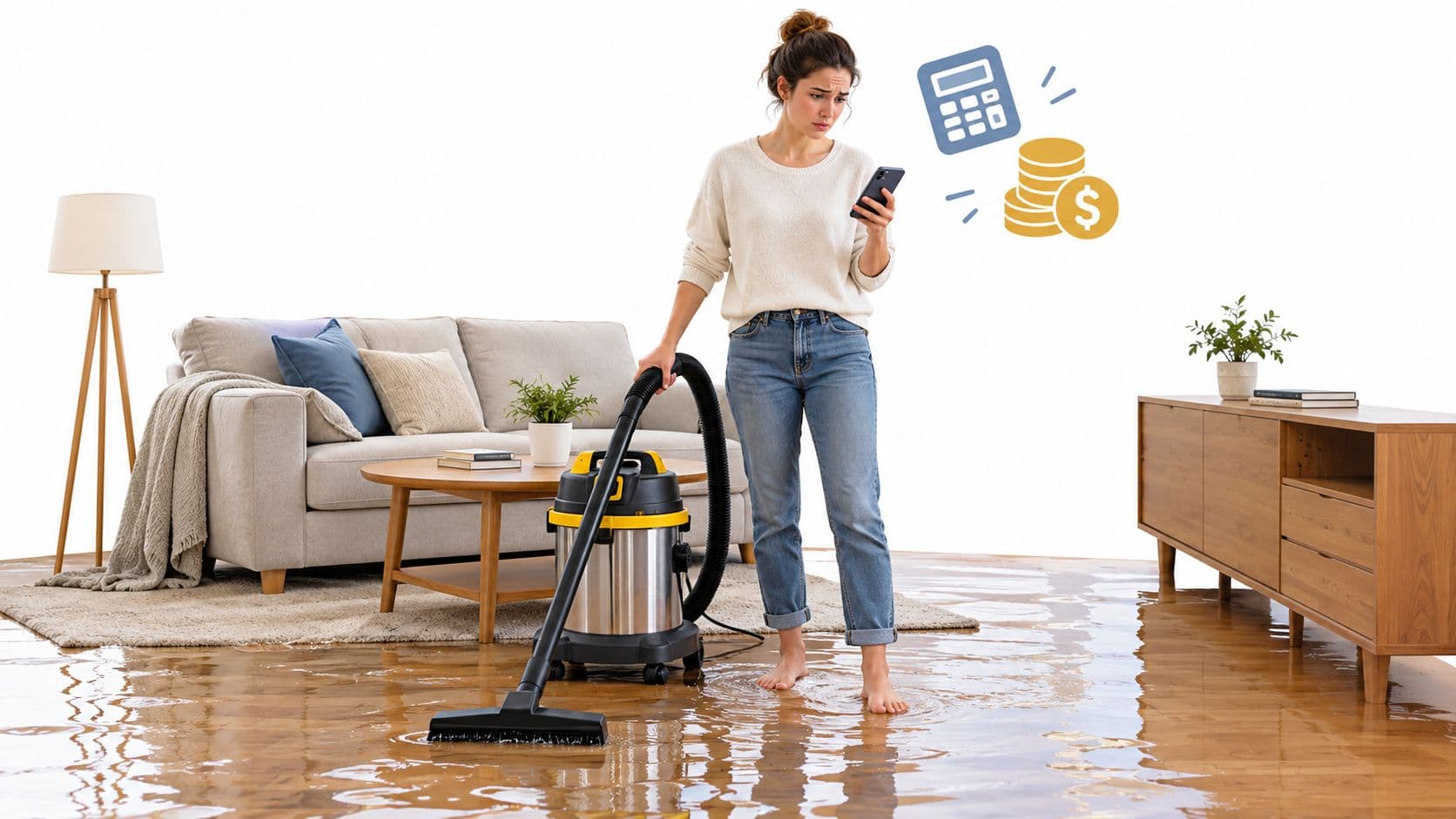
A homeowner standing in a wet room usually has a phone in one hand and a Shop-Vac in the other. The immediate questions are practical: what counts as mitigation, what should it cost, how long will drying take, will insurance help, and can the damage be handled without professional assistance?
The answer depends less on the amount of visible water than on what the water has reached, how long it has been present, whether it is contaminated, and whether the structure is still holding moisture. A small clean-water loss may stay within a manageable mitigation range. Water inside walls, under flooring, beneath cabinets, or throughout several rooms can require equipment, monitoring, demolition, and reconstruction.
This guide separates mitigation, repair, and full restoration before discussing price. It also explains what belongs on a quote, which conditions justify professional help, and how documentation affects the out-of-pocket bill.
What Homeowners Want to Know About Water Mitigation Cost
If water is spreading across a floor, the first cost question is not the final rebuilding bill. It is whether you need mitigation now, repair later, or full restoration to return the home to its pre-loss condition. Mitigation stops additional damage, extracts water, dries the structure, and removes materials that cannot be saved. Repair replaces damaged components. Full restoration combines those steps with broader rebuilding and finish work.
For a typical residential mitigation job, published industry and insurance figures place the cost around $2,900 to $7,400, with an estimate of about $10.50 per wet square foot. Drying equipment, setup, monitoring, demolition, and teardown can account for much of the bill, not just visible water extraction. Read the residential water mitigation cost breakdown for the underlying figures.
That range does not fit every loss. A large affected area, contaminated water, saturated materials, or a delayed response can push the cost into the tens of thousands. Published claim examples include severe losses involving contaminated basements and upper-floor damage reaching $60,000 or $100,000. See the severity-based water damage claim examples for the cited cost distinctions.
The first decision is not the final price
Call a professional when water has entered porous materials, hidden spaces, multiple rooms, or areas near electrical systems. File an insurance claim when the loss may exceed your deductible or involve covered damage, and document the condition before cleanup changes the evidence. Waiting is reasonable only when the source is stopped, the affected material is limited, and no moisture has reached the structure.
A wet tile surface is easier to evaluate than a soaked subfloor. A clean supply-line leak requires a different response from sewage or other grossly contaminated water. Water under flooring or inside walls also demands more investigation than a small spill found quickly.
A useful quote should answer four questions:
- What area is affected? It should identify rooms, wall cavities, ceilings, cabinets, crawlspaces, and flooring.
- What kind of water is involved? The source determines safety procedures, treatment, and disposal.
- What must be dried or removed? Drywall, insulation, carpet padding, subfloors, and other porous materials may need different handling.
- How will completion be verified? Moisture readings and equipment logs show whether drying has finished.
The goal is to match the response to the loss. Do not treat a hidden structural problem as a surface cleanup job.
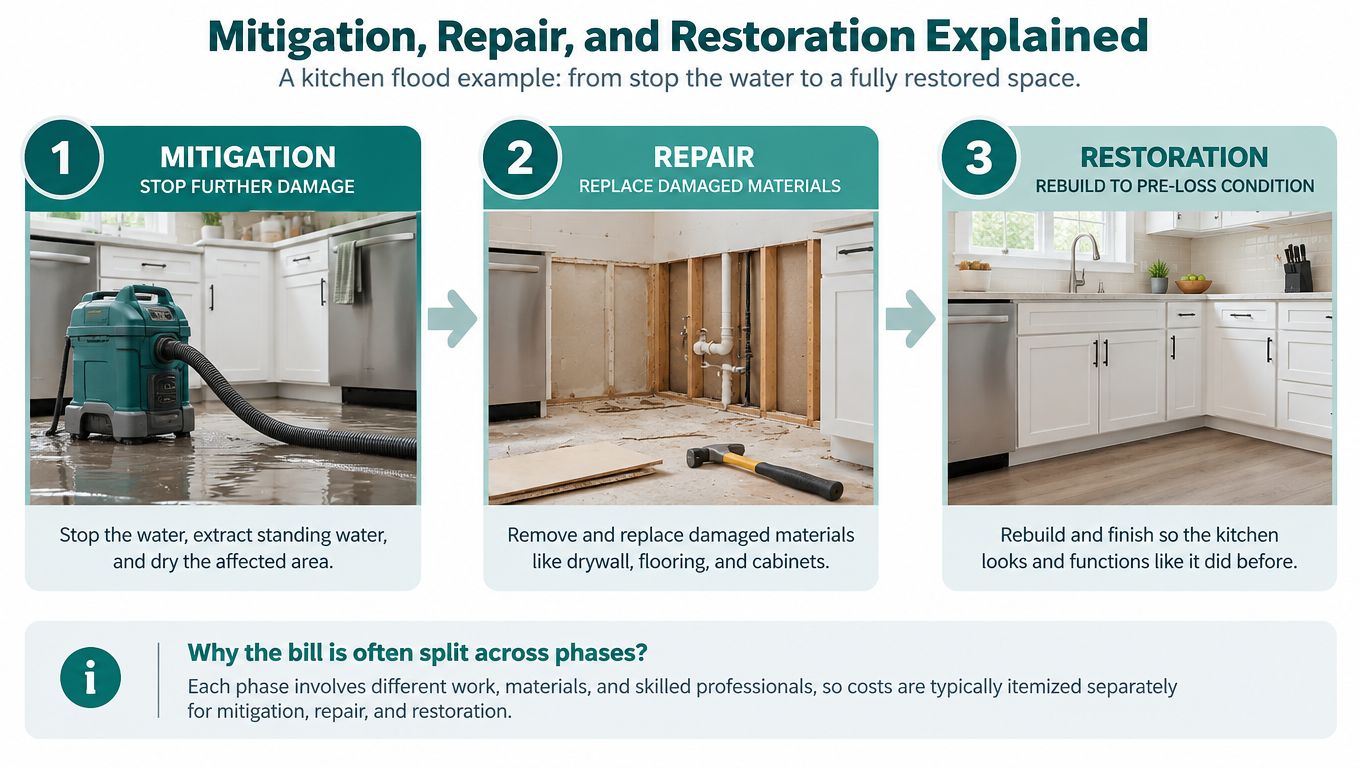
Mitigation, Repair, and Restoration Explained
A water-loss invoice becomes easier to understand once the work is divided into three phases. Mitigation makes the property stable and dry. Repair replaces damaged components. Restoration describes the broader process of returning the property to its pre-loss condition.
Consider a supply line under a kitchen sink that bursts overnight. Water spreads across the kitchen floor, soaks the lower cabinets, and reaches the adjoining dining room.
Mitigation handles the immediate loss
The mitigation crew identifies and stops the source, extracts standing water, checks moisture in floors and walls, places drying equipment, and monitors conditions. If materials are too damaged or contaminated to save, controlled demolition and disposal may also belong to this phase.
The first 24 to 72 hours often receive close attention because moisture can move through porous building materials during that period. The precise response still depends on the source, the materials, and the extent of the loss. A more detailed explanation of the emergency process appears in what water mitigation involves.
Repair replaces what the water damaged
Repair begins after the affected structure has been evaluated and dried as far as practical. In the kitchen example, repair could include replacing lower cabinets, damaged drywall, flooring, trim, or sections of subfloor.
Repair estimates can be separate from mitigation estimates because the work requires different labor, materials, and decisions. A mitigation company may remove wet drywall, while a later contractor rebuilds the wall. The insurance adjuster may also review those scopes separately.
Restoration describes the complete outcome
Restoration is the larger objective. It can include emergency mitigation, drying, demolition, cleaning, repair, reconstruction, and finishing work. Some companies use the term broadly, while others use it for the rebuilding phase after mitigation.
Practical rule: A quote should state clearly whether it covers emergency mitigation only, repairs only, or the full restoration process.
This distinction matters when comparing prices. A low quote may cover extraction and equipment placement but exclude monitoring, demolition, cabinet work, flooring, or reconstruction. A higher quote may include a wider scope rather than a higher rate for the same work.
What Actually Drives the Price of Mitigation
A puddle in one room can hide moisture under flooring, inside walls, or below cabinets. The visible water gives you a starting point, not a final price. Water category, moisture class, affected area, materials, access, labor, and equipment duration determine what mitigation requires. Those factors also guide your next decision: call a professional, document the loss for an insurance claim, or wait when the risk is low and the source is fully controlled.
Water category changes the work
IICRC-based guidance separates water losses into three categories. Category 1 is clean water, such as water from a supply line. Category 2 is significantly contaminated gray water, which may come from an overflow involving household waste or cleaning chemicals. Category 3 is grossly contaminated black water, including sewage or certain flood conditions. Review the three water damage categories before deciding whether household equipment is appropriate.
Category affects containment, personal protection, cleaning, disposal, and whether porous materials can remain. If contaminated water is involved, call a professional rather than treating the loss as a larger clean-water spill. Record the source and affected areas before cleanup if filing a claim.
Moisture class shows how far water traveled
Moisture class describes how much material absorbed water and how difficult that material is to dry. Class 1 involves less than 5% of the combined floor, wall, and ceiling area. Class 2 involves 5% to 40%, while Class 3 involves more than 40%. Class 4 covers dense materials such as hardwood, concrete, or plaster that hold tightly bound moisture and may take weeks to release. See the moisture class definitions.
The classification helps set the equipment and drying strategy. It also explains why two rooms with the same visible puddle can receive different estimates. A larger or deeper moisture pattern supports calling a professional and strengthens the documentation needed for a claim.
Area, materials, and access add practical costs
Materials respond differently to water. Carpet and padding can retain moisture, laminate can swell, hardwood can cup or buckle, and tile can conceal water beneath the surface. Drywall may wick upward from the floor, while insulation and subflooring can stay wet after the room appears dry.
Access changes labor. A crawlspace, upper floor, tight wall cavity, or heavy contents load may require more time. Moving furniture, protecting unaffected areas, opening walls, and carrying equipment on stairs all affect the work plan. Waiting can be reasonable only when the source is stopped, the affected materials are limited, and hidden moisture is unlikely.
Equipment duration is another major variable. Structural drying equipment commonly adds about $500 to $8,000 to a mitigation job. Smaller single-room losses often fall around $500 to $1,500, while multi-room drying commonly reaches $1,500 to $4,000 when equipment runs for several days. Review structural drying cost factors. Ask for readings and equipment duration in the claim record.
| Cost Driver | Effect on Price |
|---|---|
| Water category | Contaminated water requires more protection, cleaning, containment, and disposal. |
| Moisture class | Greater absorption means more equipment, monitoring, and possible demolition. |
| Affected square footage | Larger areas require more labor, equipment, and drying capacity. |
| Flooring and subfloor | Porous or layered materials can hide moisture and require removal. |
| Wall and ceiling materials | Wicking drywall, insulation, and dense materials change the drying plan. |
| Equipment days | Longer drying increases rental, monitoring, and labor charges. |
| Access | Crawlspaces, upper floors, tight cavities, and contents handling add work time. |
Air movers commonly cost about $25 to $75 per unit per day, while dehumidifiers commonly cost about $75 to $200 per unit per day. Multiple units running through a 3- to 7-day cycle can create several thousand dollars in equipment charges before demolition or repair is added. See the equipment pricing explanation. Compare the scope, not just the total. A lower figure may reflect fewer drying days or a smaller affected area.
What a Mitigation Quote Really Includes
A mitigation quote should explain what happened, what the crew will do, and what remains outside the job. A single total cannot show whether the estimate covers inspection, extraction, drying, demolition, treatment, or contents handling. Before you approve the work, check that the quote identifies affected rooms, water category, moisture class, materials at risk, equipment, monitoring, and exclusions.
Inspection comes before extraction
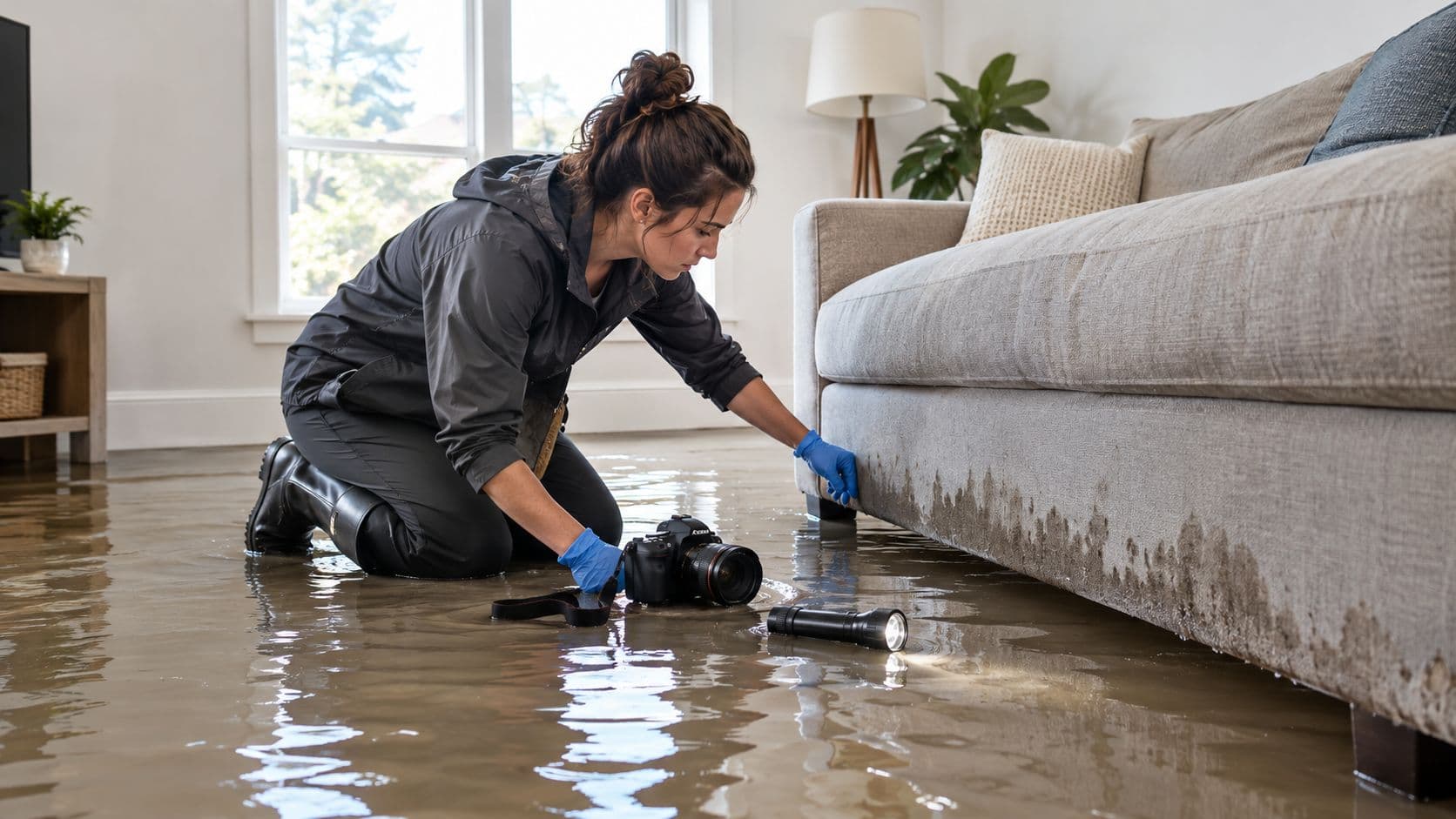
The first visit should locate both visible and hidden moisture. The technician may map conditions around baseboards, flooring edges, cabinets, ceilings, wall cavities, and nearby rooms. The estimate should state what was tested and document conditions before materials are removed. Those records support a claim and help you decide whether waiting is likely to increase the scope.
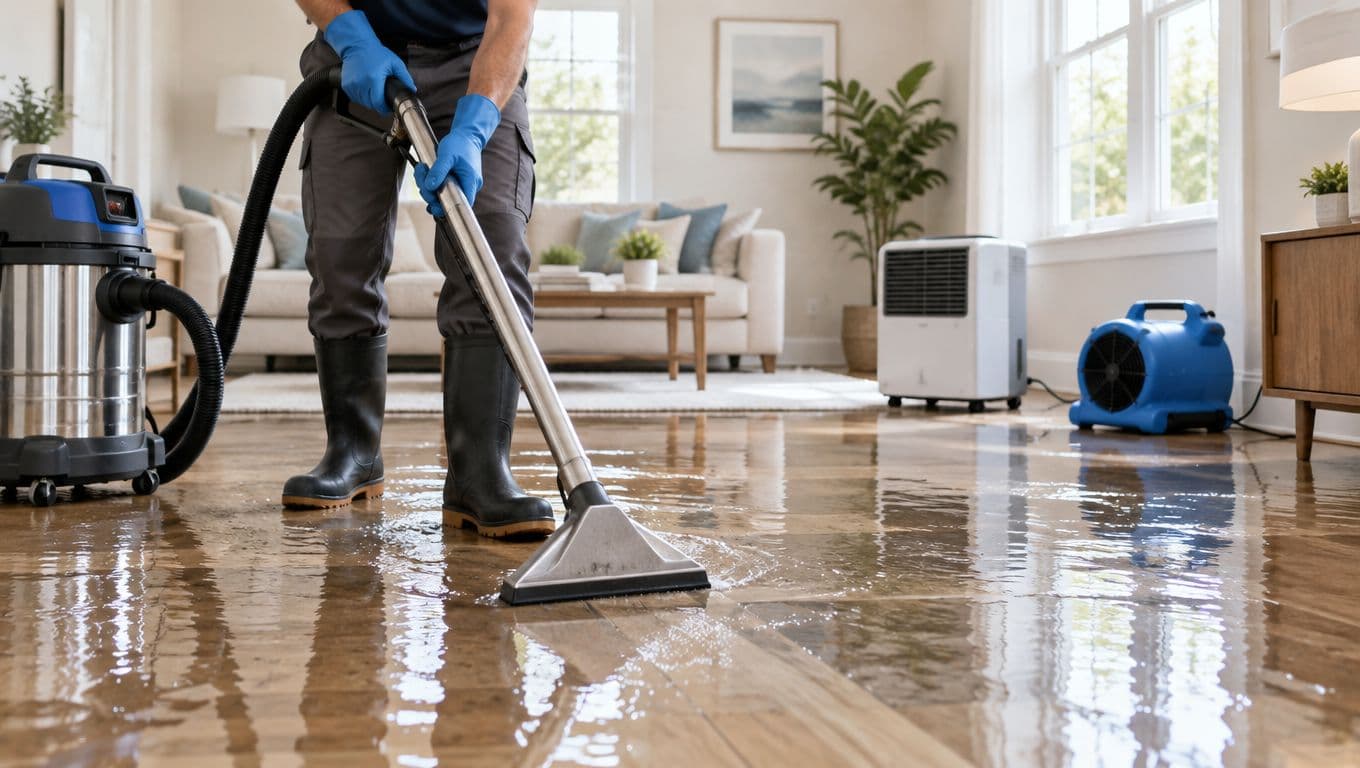
Extraction removes standing and trapped surface water. The crew may use portable or larger extraction equipment based on access and the affected area. Extraction does not prove that the structure is dry. Ask how the technician will verify moisture after the water is removed.
Drying is an active service
Air movers increase evaporation from wet materials. Dehumidifiers remove moisture from the air so evaporation can continue. Equipment placement should follow the moisture pattern, then change as readings change.
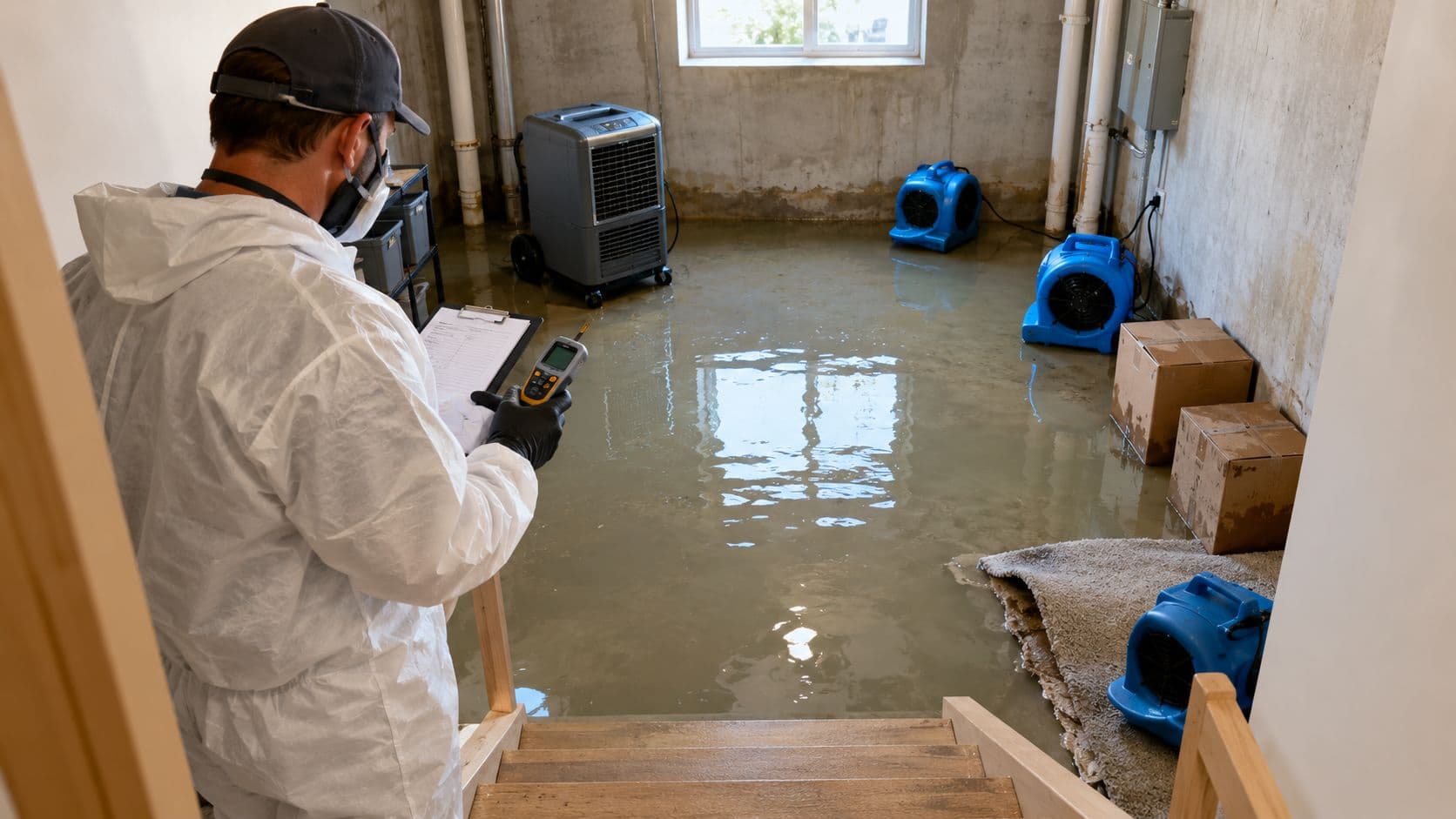
Monitoring visits show whether the plan is working. The record should list reading dates, areas checked, equipment operating, changes made, and the reason drying ended. If a quote includes equipment but no monitoring, ask for that work to be listed before comparing prices.
Demolition and treatment need clear descriptions
Materials that cannot be dried or safely retained may include drywall, insulation, carpet padding, trim, and other porous components. The quote should name each material, quantity, reason for removal, and disposal method. Contaminated water also requires a stated treatment and cleaning process, not a vague cleaning charge.
Contents work needs the same clarity. Furniture and belongings may block access or face moisture damage. The estimate should distinguish moving items within the property from packing, storage, cleaning, or replacement.
| Quote Line Item | Typical Share of Total | What It Covers |
|---|---|---|
| Drying equipment | 34% | Air movers, dehumidifiers, and related equipment use. |
| Demolition and debris removal | 20% | Removal, handling, and disposal of unsalvageable materials. |
| Setup, monitoring, and teardown | 19% | Equipment placement, moisture checks, adjustments, and removal. |
| Water extraction | About 4 cents of every dollar | Removal of standing or readily accessible water. |
These shares come from a residential mitigation cost dataset, as summarized in the water damage cost reference. They do not predict every invoice. Category, class, layout, materials, and scope can change the balance.
A low bid may omit monitoring, dehumidification days, or demolition. Compare line items before totals, and confirm whether repair and reconstruction are excluded or included. That distinction determines whether you are approving mitigation now or committing to a larger project.
Realistic Cost Scenarios by Type of Loss
A water mitigation quote starts with the loss itself. A clean leak contained to one area calls for a different response than contaminated water spreading through several rooms. The distinction affects whether you should call a professional, document the damage for an insurance claim, or wait while checking a minor spill yourself.
The scenarios below show how scope changes the cost. A generic estimate cannot replace an inspection, moisture readings, or a clear description of materials affected.
A contained clean-water leak
A supply line breaks near a bathroom or utility area, and the water is shut off quickly. The work may involve extracting water from flooring, removing nearby baseboards, and placing drying equipment in the affected room and adjacent spaces.
Costs often stay toward the lower end of the local residential range when water has not entered wall cavities, cabinets, insulation, or a large subfloor area. Even a limited loss needs a quote that identifies equipment, monitoring, moisture testing, and material removal. If you plan to file a claim, photograph the source and affected surfaces before work begins.
A multi-room appliance overflow
A dishwasher or washing-machine overflow moves from a kitchen or laundry area into adjoining flooring. Water can travel beneath cabinets, under floating floors, and through room transitions before the surface looks visibly wet.
This loss usually needs a wider moisture map and more drying capacity than a contained spill. Costs increase when baseboards, flooring edges, cabinet toe-kicks, or sections of subfloor must be opened to confirm the extent of moisture. Calling promptly can limit the area that requires removal and make the claim record easier to support.
A contaminated or delayed loss
A sewer backup or long-standing flood requires a different work plan. Category 3 procedures may include containment, protective equipment, controlled demolition, disposal of porous materials, and more extensive cleaning.
A contaminated loss can exceed the ordinary residential mitigation range by a wide margin. Published claim examples show severe water events can reach $11,000 for a single floor with an inch of water in a small home and $29,000 for a foot of water in a single-family home. Contaminated basement or upper-floor damage can cost substantially more. Review the published water-loss severity table.
| Scenario | Affected Area | Water Category | Estimated Mitigation Cost | Typical Timeline |
|---|---|---|---|---|
| Contained supply-line leak | One room or a small connected area | Usually Category 1 | Lower end of the applicable local range when materials remain salvageable | Often a short drying phase, subject to readings |
| Appliance overflow | Kitchen, laundry area, and adjoining flooring | Often Category 1 or Category 2, depending on the source and timing | Mid-range when several rooms or layered materials are involved | Several days may be needed for equipment and monitoring |
| Sewer backup or delayed flood | Multiple rooms, porous materials, and contents | Category 3 | Upper end of the range or tens of thousands in severe cases | Longer when demolition, disposal, and dense materials are involved |
Most residential mitigation work takes about 3 to 5 days when professional air movers and dehumidifiers run continuously. See the residential restoration timing guidance. That timeline covers mitigation, not full repair. Cabinet replacement, flooring installation, painting, and reconstruction may continue after drying ends. Before approving work, confirm which of those later tasks are excluded from the mitigation estimate.
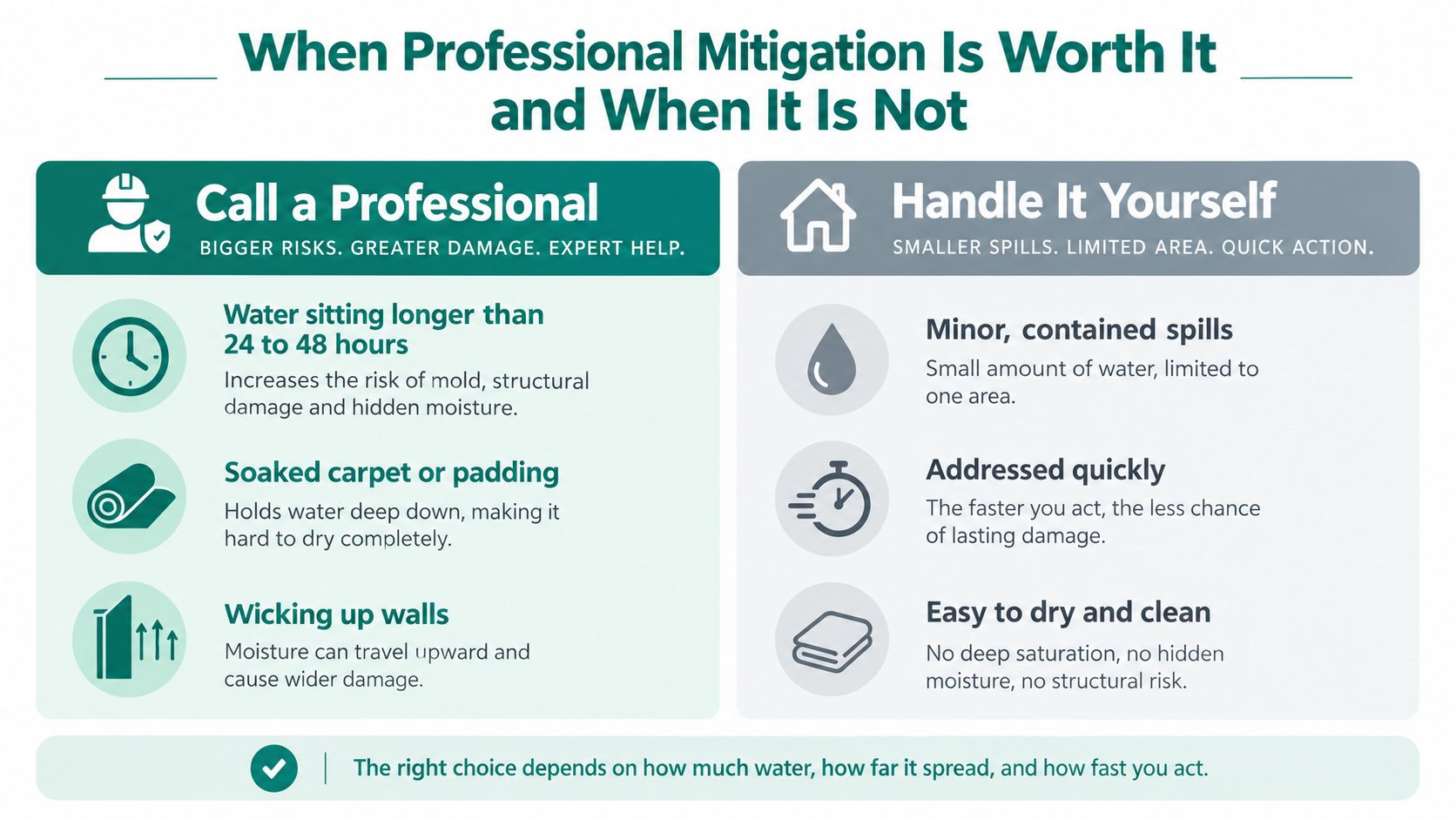
When Professional Mitigation Is Worth It and When It Is Not
A careful homeowner can handle a narrow class of incidents. A small clean-water spill on tile or vinyl, discovered quickly and fully dried with safe airflow, may not require a restoration crew. The surface should still be checked around edges, transitions, cabinets, and nearby walls because water can travel farther than it appears.
Professional mitigation becomes the sensible choice when the loss has hidden-space potential or a contaminated source. Delaying an assessment can make it harder to distinguish original damage from later deterioration and can weaken the documentation needed for an insurance claim.
Call for an assessment when any of these conditions apply
- Water has remained in place: Water sitting beyond the initial response period deserves professional moisture testing, especially when flooring or walls are involved.
- Carpet or padding is soaked: Padding can retain moisture beneath a surface that looks manageable.
- Drywall has wicked water: A damp wall can extend beyond the visible stain and may require readings at several heights.
- The source is contaminated: Sewage, toilet backups, and other grossly contaminated water require procedures beyond ordinary household cleaning.
- Structural materials are involved: Subfloors, framing, hardwood, plaster, and concrete can retain moisture after surface drying.
- HVAC areas are affected: Water near ductwork or air-handling components needs careful evaluation before the system operates normally.
- An insurance claim may follow: A professional scope, moisture map, equipment log, and itemized invoice can support the claim record.
The 24 to 48-hour decision point is useful because water that remains in porous materials becomes harder to evaluate and dry efficiently. It isn't a guarantee that a loss is safe or unsafe based on the clock alone. Source, category, temperature, ventilation, material type, and hidden moisture all matter.
A homeowner shouldn't choose DIY cleanup simply because the visible water is gone. The real question is whether the building materials are dry and whether the loss has been documented.
For a minor event, the safe sequence is straightforward: stop the source if possible, remove surface water, move unaffected contents away, ventilate appropriately, and watch for swelling, staining, odor, or changes in flooring and walls. If any uncertainty remains, an assessment costs less than guessing about hidden moisture while repairs proceed.
Insurance, Documentation, and the Real Out-of-Pocket Bill
Insurance usually turns on the cause of the water loss, not the presence of water. A sudden internal event, such as a burst pipe or appliance failure, may be treated differently from a gradual leak, deferred maintenance, or external flooding. Policy language controls, so property owners should notify the carrier promptly and ask what documentation and emergency work the policy requires.
Understand which coverage may apply
Dwelling coverage generally concerns the building, including eligible walls, floors, ceilings, and built-in components. Contents coverage concerns personal property. Additional living expenses may address eligible temporary housing or related costs when a covered loss makes the home unsuitable, subject to policy terms and limits.
A “covered peril” is a cause the policy agrees to insure. A “gradual leak exclusion” generally means the policy may not cover damage that developed over time because the owner didn't address an ongoing condition. Flood-related losses may require separate coverage, and a standard homeowners policy may not respond the same way to water entering from outside.
The most useful insurance question is not whether the claim is covered. It is how much of the mitigation bill remains after the deductible, exclusions, limits, and any applicable sublimits.
The deductible changes the actual bill
A $5,000 mitigation invoice paired with a $2,500 deductible leaves the policyholder responsible for the deductible before eligible reimbursement is considered. The insurer may also separate emergency mitigation from reconstruction, contents, or excluded causes.
That example doesn't establish coverage. It shows why the estimate, policy, and deductible must be read together. A homeowner should avoid authorizing a broad reconstruction scope before understanding whether the carrier has accepted the cause of loss.
Build the claim file before cleanup
The strongest documentation follows the sequence of events:
- Record the condition first. Timestamped photos and video should show the source if visible, standing water, affected rooms, contents, stains, swelling, and any safety concerns.
- Write a short timeline. Note when the loss was discovered, when the source was stopped, what areas were affected, and what emergency steps followed.
- Request moisture records. The mitigation company should provide readings, equipment logs, monitoring notes, and a description of completed work.
- Keep itemized invoices. Extraction, equipment, monitoring, demolition, disposal, treatment, contents handling, and other services should be separated.
- Preserve damaged materials when practical. The adjuster may need to inspect them, though safety and contamination decisions come first.
For a ceiling leak, guidance on water leaking through a ceiling can help property owners identify immediate documentation and safety priorities.
Claims are commonly weakened when the cause is unclear, the damage was documented only after cleanup, invoices are vague, or gradual deterioration is presented as a sudden event. A clean paper trail doesn't guarantee payment, but it gives the adjuster a factual record to evaluate.
Your Next Steps and How PostDamage Can Help
The first 24 to 72 hours should focus on controlled action rather than rushed reconstruction:
- Stop the source safely. Shut off water only if the valve is accessible and there is no electrical or structural danger.
- Document before disturbing the scene. Photograph rooms, materials, contents, water lines, and the apparent source.
- Protect people and property. Keep occupants away from electrical hazards and contaminated water, and move unaffected belongings when safe.
- Request a written assessment. A qualified mitigation company should identify the category, affected areas, equipment plan, monitoring approach, and exclusions.
- Notify the insurer. Open a claim when coverage may apply and ask about emergency work, documentation, and deductible treatment.
PostDamage provides consumer water-damage guidance and can help homeowners, landlords, and small businesses move from an unclear incident to a more organized next step. Its water damage restoration resource connects the decisions around mitigation, documentation, and follow-up repair without treating every wet room as the same job.
The right objective isn't to accept the first price or delay until the damage grows. It's to identify the source, measure the affected structure, separate mitigation from repair, and choose help that matches the actual loss.
PostDamage helps property owners understand water mitigation cost, prepare useful documentation, and identify the appropriate type of professional support for a water-damage incident. Homeowners, landlords, and small business owners can describe what happened and visit PostDamage to find a clearer path forward without being pushed into unnecessary work.