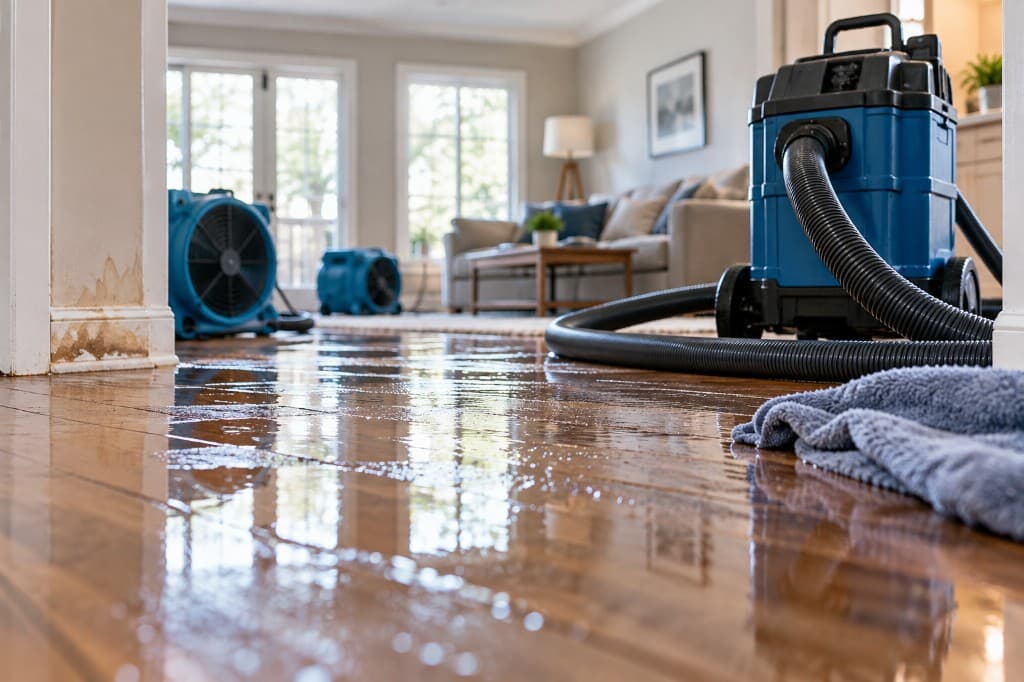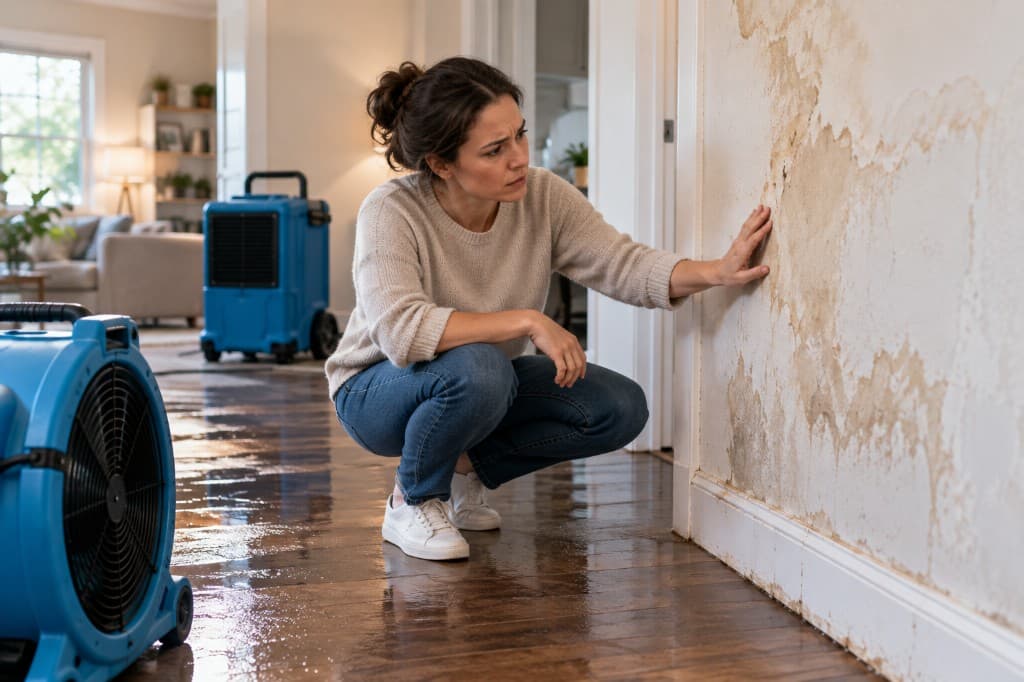
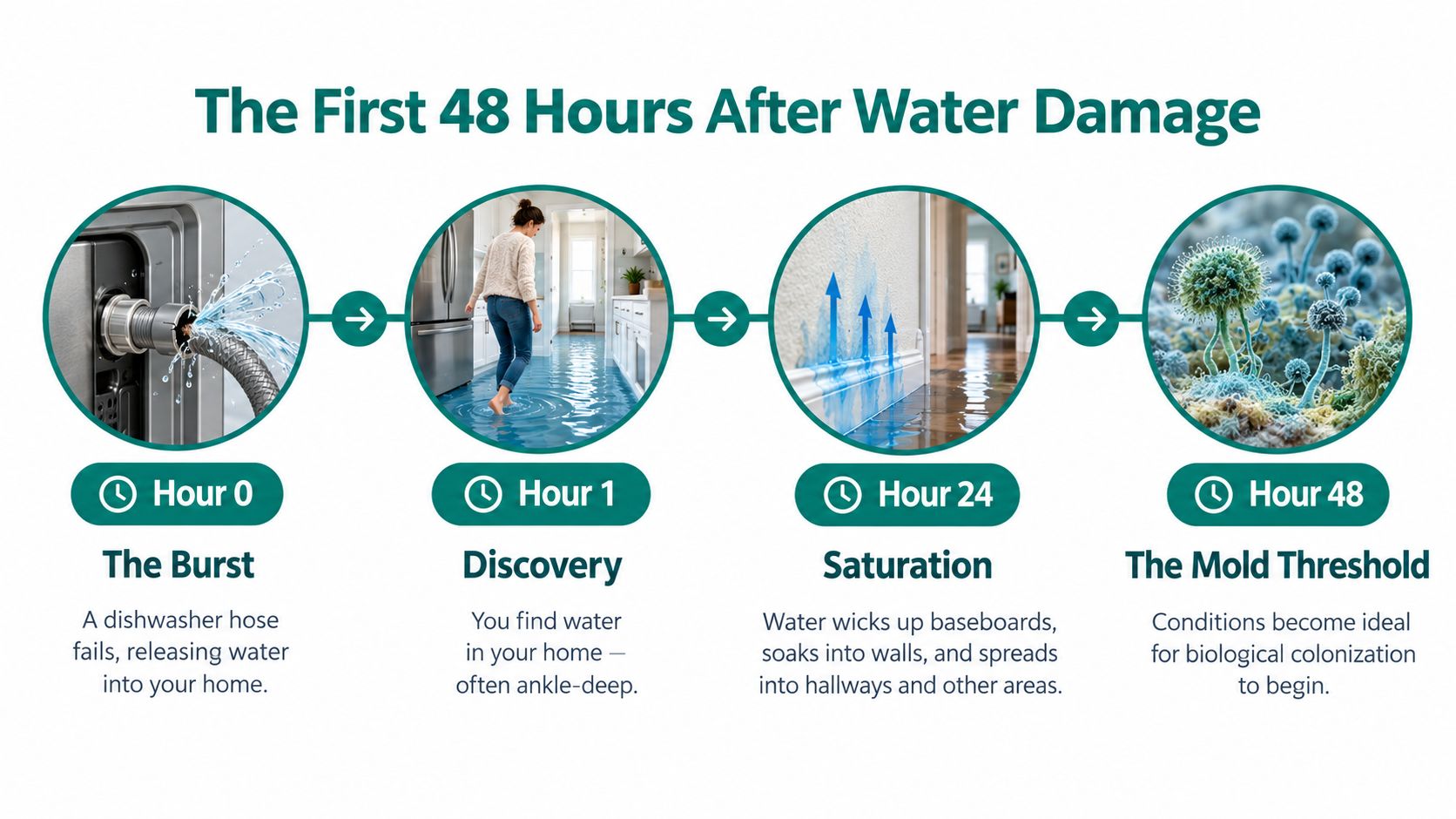
A homeowner steps into the living room after a dishwasher hose bursts overnight. Water has spread across the floor, reached the hallway, and started soaking the lower edges of the walls. The first reaction is usually practical: grab towels, find a wet vacuum, move furniture, and hope the visible puddles are the whole problem.
They rarely are. Water extraction removes accessible water, but structural drying determines whether the property is actually dry. Carpet padding, subfloors, baseboards, drywall, insulation, and wall cavities can hold moisture long after the floor looks clean. The decisions made during the first two days often affect what can be saved, what must be removed, and how strong the documentation will be for an insurance claim.
The First 48 Hours After Water Damage
The homeowner in that soaked living room has several decisions to make at once. The water source needs to be stopped if it can be done safely, electricity to affected areas may need to be shut off at the panel, and valuable contents should be moved away from wet materials without creating an electrical or contamination hazard.
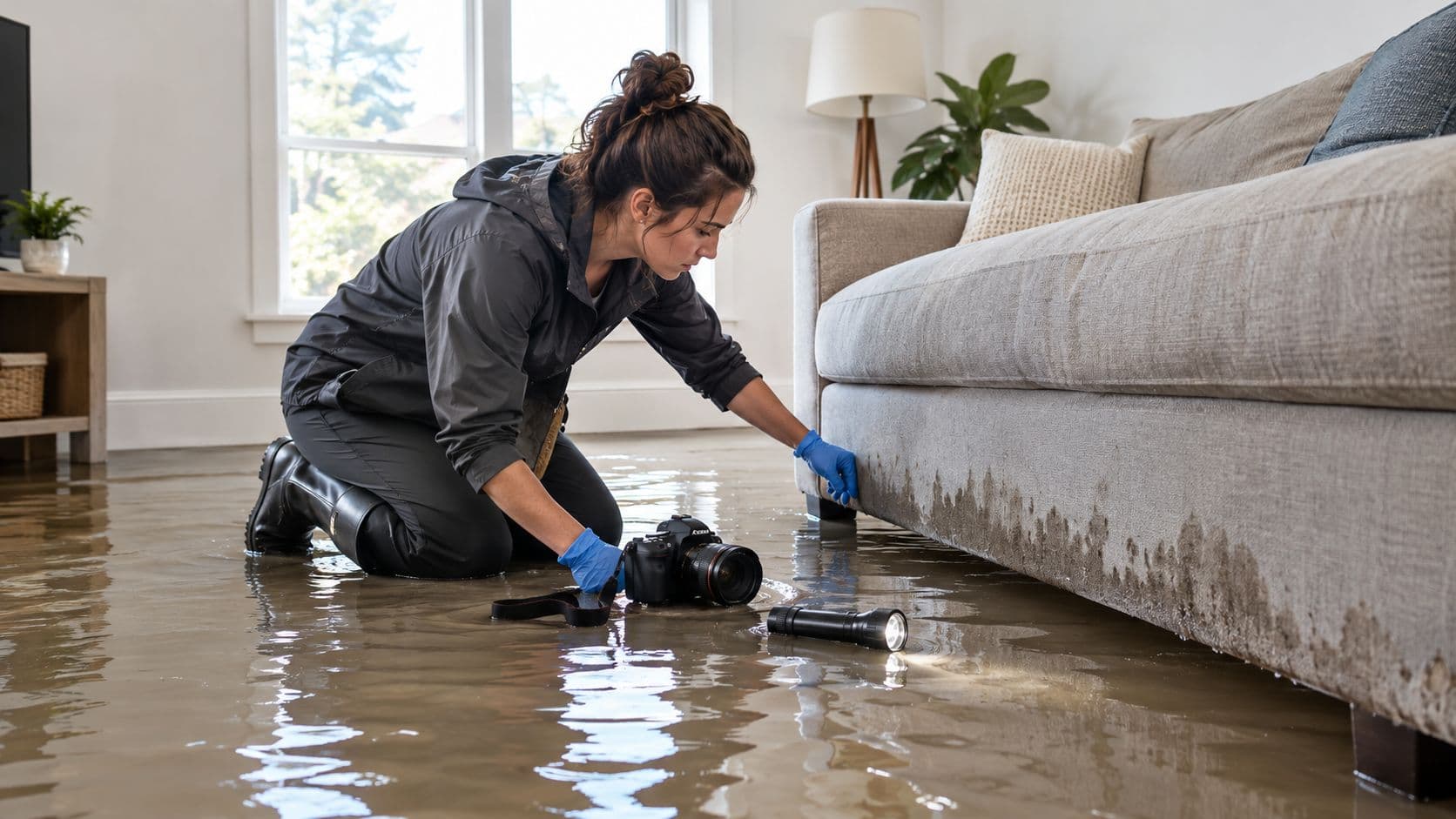
Before furniture and belongings are moved, the property owner should take timestamped photographs and videos. Images should show the source of the loss, the depth and spread of standing water, affected rooms, damaged contents, flooring transitions, baseboards, ceilings, and visible staining. A short written record of when the leak was discovered and what actions followed can also help explain the sequence to an insurer.
Why the clock matters
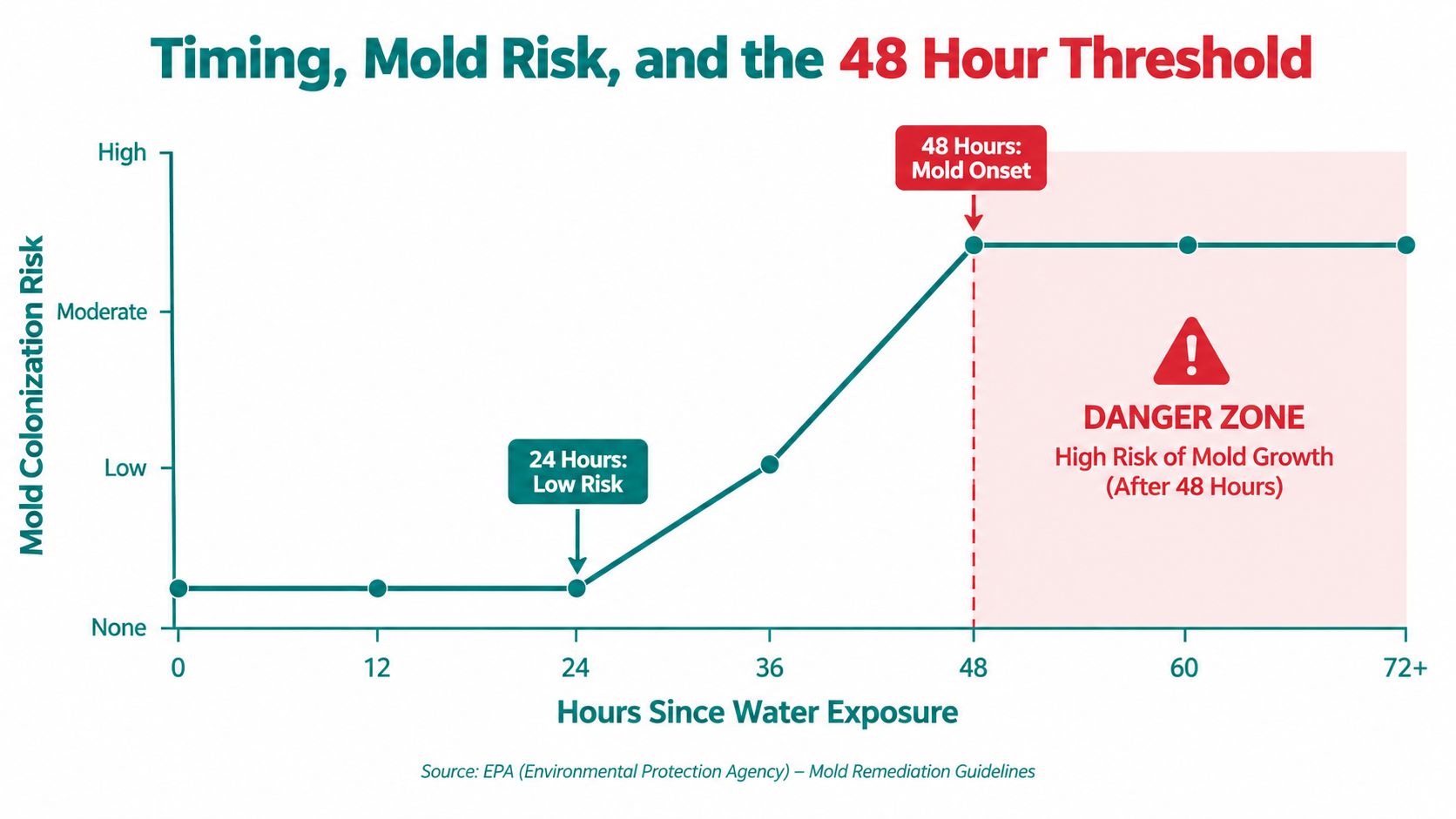
The U.S. Environmental Protection Agency advises drying water-damaged areas and items within 24 to 48 hours to help prevent mold growth. The agency also explains that drying within that window usually prevents mold growth in most cases, but it doesn't guarantee that growth hasn't already occurred. EPA guidance on moisture and water damage treats the window as a practical threshold, not a promise that every material will survive.
The National Institutes of Health describes the first 24 to 48 hours after water infiltration as critical. Its facility guidance recommends water extraction, dehumidification, and air movement, and says that when the duration of wetness can't be established, the material should be treated as though it has been wet for more than 48 hours. NIH moisture remediation guidance also gives a specific drywall decision: if wallboard can't be dried within 48 hours, the affected section should be measured 12 inches above the water mark and removed below that line.
What should happen first
- Protect people first: Avoid wet electrical areas, contaminated water, unstable ceilings, and rooms where the source can't be controlled safely.
- Stop additional water: Close a supply valve or arrange emergency plumbing help when the leak continues.
- Preserve evidence: Photograph the scene before discarding damaged materials or moving major contents.
- Remove easy-to-save items: Raise furniture and move contents to a dry area when doing so won't spread contamination.
- Arrange assessment quickly: Standing water needs mechanical removal before the longer drying process can work properly.
A towel can collect surface water, but it can't pull moisture out of a carpet pad or subfloor. The first technical step is water extraction, and it marks the beginning of the restoration process, not the end.
What Water Extraction Actually Means
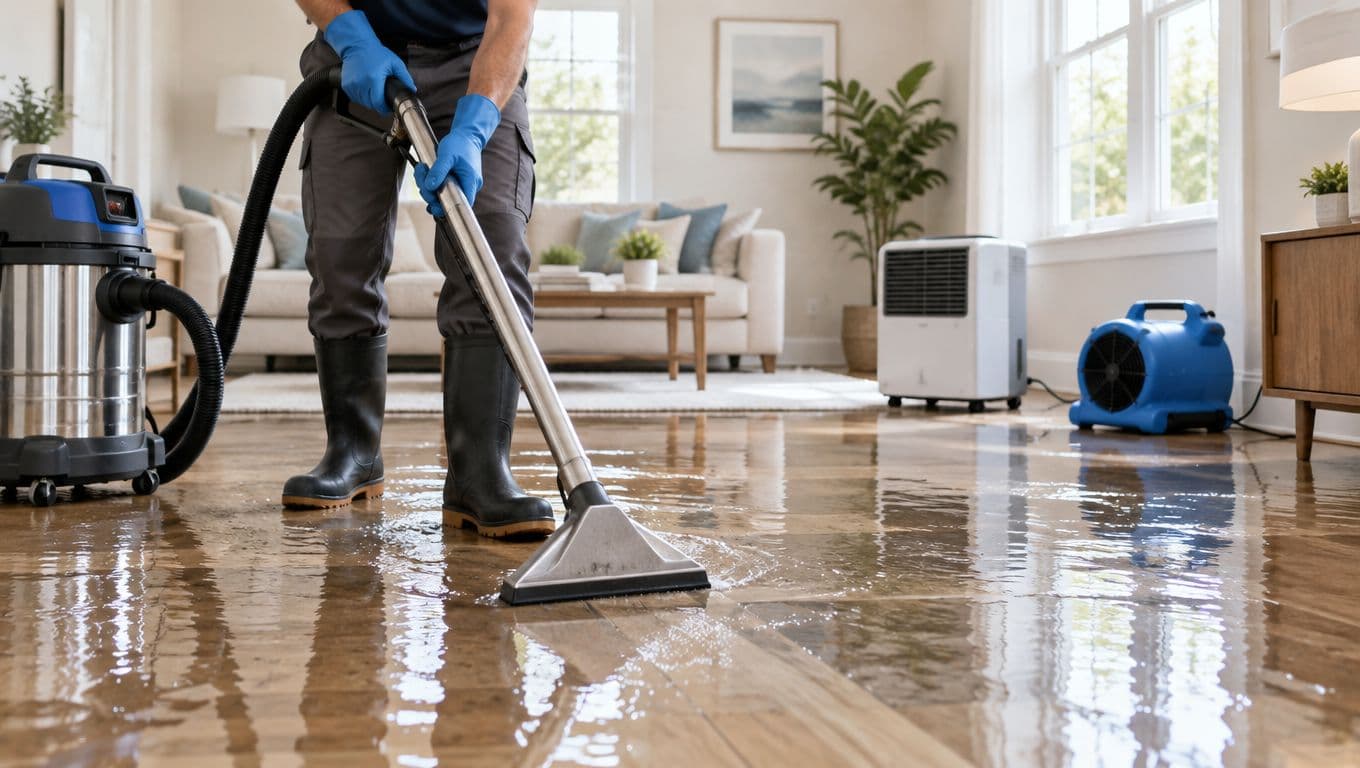
Water extraction is mechanical water removal. Pumps, wet vacuums, extraction wands, and truck-mounted equipment pull standing water and accessible moisture out of a building. The work is fastest where water is pooled, but professional equipment can also remove water held in carpet, padding, and other absorbent materials.
Drying is different. A useful comparison is a soaked kitchen sponge. Squeezing it once releases the water that runs out immediately. The sponge still feels heavy because moisture remains trapped in its pores. Extraction is the squeeze. Drying is the controlled process that removes what remains inside the materials and the surrounding air.
The hidden water problem
A room can look dry while moisture remains in places that aren't visible. Water may have migrated:
- Beneath carpet and carpet pad
- Into seams between flooring materials
- Behind baseboards and lower drywall
- Under cabinets and appliances
- Into subflooring and framing
- Inside wall cavities and insulation
That hidden moisture can cause swelling, cupping, staining, odor, loss of adhesion, and deterioration. It can also keep the environment favorable for mold growth. Water extraction guidance from restoration professionals distinguishes extraction from structural drying and explains that air movement and psychrometric controls become effective after bulk water has been removed.
Source and contamination change the decision
Restoration professionals commonly classify water losses by contamination level. A clean supply-line leak presents a different salvage question from an overflowing appliance or a sewage backup. Gray and black water can contain contaminants that make porous materials unsafe or impractical to clean, even when the materials appear physically intact.
The source also affects equipment selection and work boundaries. Truck-mounted extractors provide strong vacuum lift for deep saturation, while portable extractors and wet vacuums can handle smaller losses or areas that equipment can't reach. Large-diameter hoses and repeated extraction passes can improve removal by reducing restrictions and returning to areas that still release water.
Practical rule: A dry-looking surface isn't proof of a dry structure. Moisture readings, material checks, and drying records matter more than appearance.
The EPA's cleanup table recommends drying carpet and backing within 24 to 48 hours and using water extraction with dehumidification. It also says materials that have remained wet beyond that window may require more extensive evaluation. EPA's water-damage cleanup table supports the central distinction: visible water removal is only one part of deciding whether a material has been saved.
How Professionals Extract and Dry a Property
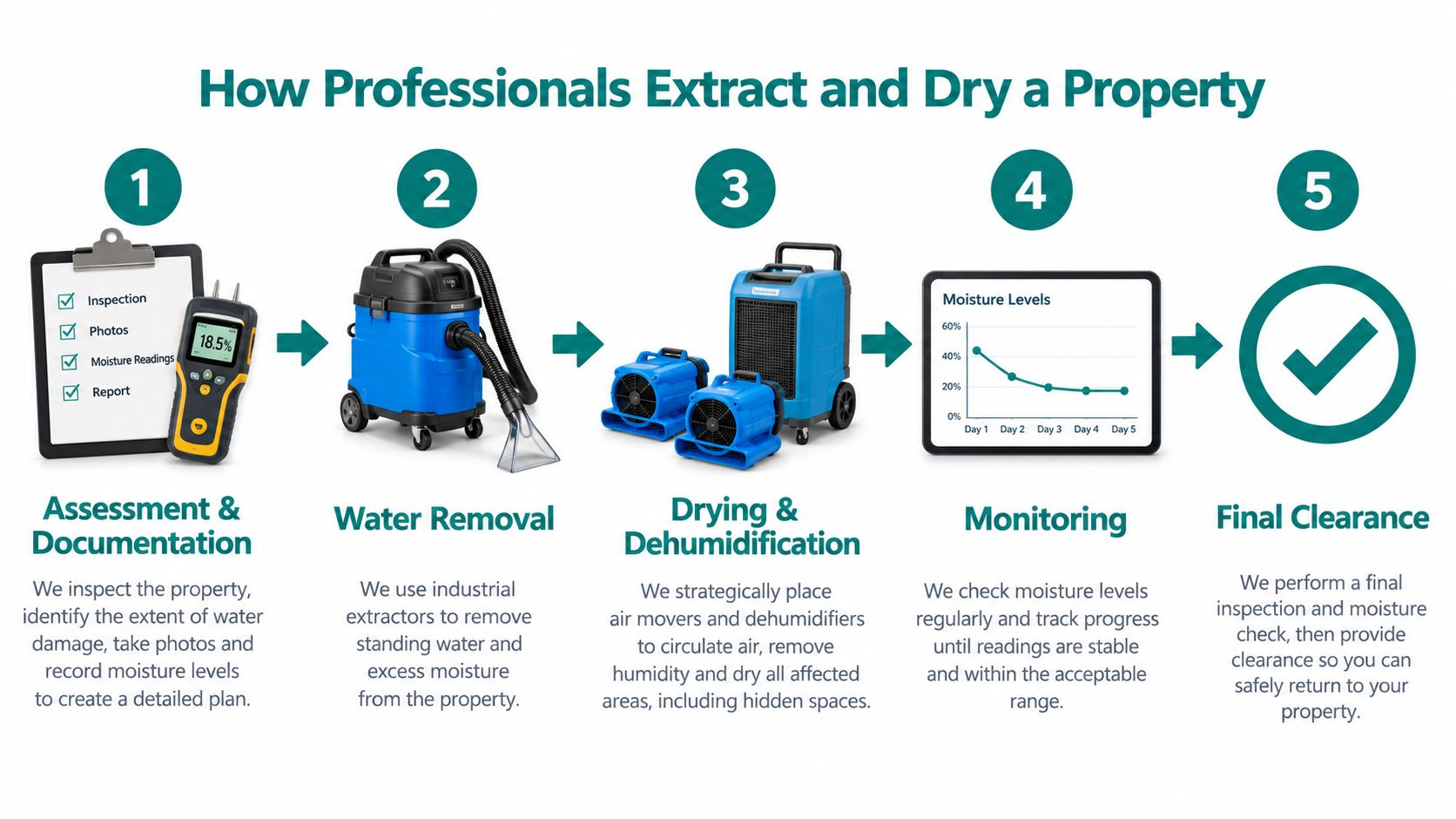
A professional crew starts with documentation rather than immediately placing equipment. The technician records the source, affected rooms, materials, contents, and visible conditions, then creates a moisture map. Pin and pinless meters help identify wet areas behind finishes, beneath flooring, and beside apparently unaffected surfaces.
Assessment and removal
The crew first addresses safety and the source of the loss. Standing water may be removed with submersible pumps, truck-mounted extractors, portable extraction units, or wet vacuums, depending on the volume, access, and contamination category.
Carpet requires more than running a vacuum over the surface. A weighted extraction wand can be pulled across the carpet and pad to apply pressure and draw water upward. Where flooring has lifted or trapped water beneath it, technicians may use specialized methods to access the concealed layer without assuming that the top surface tells the full story.
Professional water mitigation guidance describes mitigation as a connected response that limits ongoing damage rather than treating cleanup as a single isolated task.
Drying and dehumidification
Once bulk water has been removed, air movers increase evaporation from wet materials. Dehumidifiers then collect moisture from the air so evaporation can continue without pushing humidity into other rooms. The equipment arrangement matters. Technicians place air movers to circulate air across surfaces and direct moisture toward dehumidification equipment instead of blowing air randomly.
Containment using polyethylene barriers can focus drying on a defined zone and limit the movement of humid air. Injection drying may direct air into wall cavities through small access points, which can reduce the need to remove otherwise sound drywall. The method depends on the material, moisture level, construction, and contamination.
Monitoring and clearance
A restoration crew takes readings repeatedly, comparing affected materials with unaffected areas or established baseline conditions. Moisture maps show whether the wet zone is shrinking, while daily logs document equipment placement, readings, and changes in material condition.
The job isn't finished when the machines have run for a set period. It is finished when the affected materials have reached an acceptable moisture condition and the readings support clearance. Restoration process guidance emphasizes early, repeated extraction, moisture documentation, and verification before drying goals are set.
What You Can Realistically Do Yourself
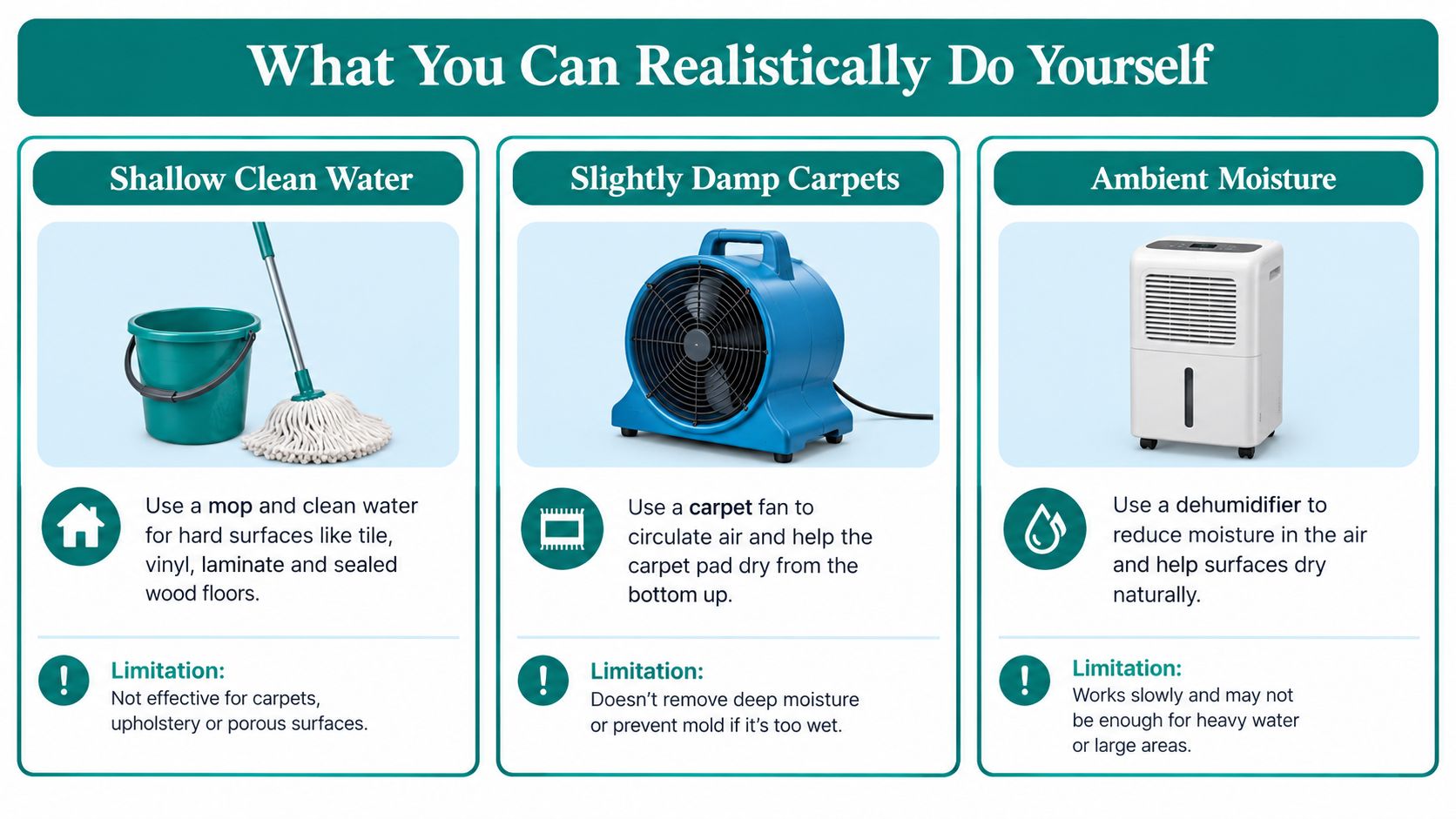
A property owner can often reduce immediate damage, but the right tool depends on the depth, source, and location of the water. A mop is useful for a thin layer of clean water on tile or another hard, nonabsorbent surface. It won't remove water beneath flooring or from a swollen baseboard.
A wet vacuum can collect accessible water from hard floors and shallow losses. It becomes less reliable when the carpet pad feels spongy, water has traveled under flooring, or the loss involves contaminated water. A household dehumidifier can reduce humidity in the room, but it can't replace mechanical extraction from a saturated material.
A realistic tool comparison
| Homeowner method | Useful for | Important limitation |
|---|---|---|
| Mop and towels | Shallow clean water on hard surfaces | Doesn't remove moisture from seams, pads, subfloors, or walls |
| Wet vacuum | Accessible water in small, clean losses | May lack the vacuum lift, capacity, hose reach, or extraction tools needed for deep saturation |
| Carpet fan | Air movement across slightly damp carpet | Can't prove the pad or subfloor is dry |
| Dehumidifier | Moisture suspended in room air | Works best after bulk water has been removed |
| Furniture elevation | Creating airflow beneath contents | Doesn't address hidden moisture in construction |
The boundary becomes clear when water has reached walls, insulation, cabinets, subfloors, or cavities. It also becomes clear when the water came from a sewage backup, floodwater, or another contaminated source. Those conditions call for controlled removal, protective equipment, and a professional assessment rather than repeated household cleanup.
A homeowner dealing with wet drywall can find practical material-specific guidance in this guide to drying wet drywall. The important point is that a surface can feel dry while the back of the board, insulation, or framing remains wet.
DIY should be treated as a bridge
Safe early actions include stopping the source, protecting unaffected contents, removing small amounts of clean surface water, and recording damage. DIY work shouldn't continue as though the job is complete when moisture readings aren't available or when the affected materials can't be accessed.
A shop vacuum can improve the first response. It can't provide final clearance for a structure it hasn't measured.
Professional water extraction usually matters because it removes more water before evaporation begins and reduces the moisture load that air movers and dehumidifiers must handle. That difference can affect whether flooring, drywall, and other materials remain salvageable.
Timing, Mold Risk, and the 48 Hour Threshold
Water extraction speed affects more than convenience. It determines how much moisture remains available to move deeper into a building and how much work drying equipment must perform afterward.
The EPA recommends drying wet areas and items within 24 to 48 hours to help prevent mold growth. It also warns that mold may still have developed even when materials are dried within 48 hours, so the threshold isn't a guarantee. The risk decision depends on the source, material, temperature, humidity, and whether moisture remains hidden.
What changes during the first two days
Early in a loss, standing water is usually the most visible problem. As time passes, absorbent materials continue taking up moisture, water can move through seams and edges, and humid air can affect adjacent rooms. Removing the puddle doesn't stop that process if carpet backing, drywall, insulation, or subflooring remains wet.
The NIH guidance recommends water-extraction vacuums, dehumidifiers, and fans after water infiltration. It also states that if wallboard can't be dried within 48 hours, the affected portion should be removed below a point measured 12 inches above the water mark. That rule illustrates why material decisions depend on both time and moisture location, not just the amount of water visible on the floor.
Porous materials create difficult choices because they can hold contamination and moisture in areas that are hard to inspect. Carpet backing, padding, cellulose insulation, and damaged drywall may need removal when they can't be dried and verified promptly. A professional assessment can separate materials that remain salvageable from materials that have become a continuing source of moisture.
Health and occupancy decisions
Mold growth can aggravate indoor-air concerns, particularly for occupants with respiratory sensitivities. Children, older adults, and residents with existing respiratory conditions may warrant extra caution around rooms with persistent dampness, strong odors, or suspected contamination.
Extraction is therefore a health and building-preservation decision, but it isn't the complete response. When drying can't be confirmed or visible growth is present, professional mold remediation guidance may be relevant alongside the water-damage assessment. The water source must still be corrected, and hidden moisture must still be located.
Cost Ranges and Insurance Documentation
Water extraction and structural drying don't have one reliable flat price. A clean, accessible loss on a hard floor requires a different response from a contaminated event involving carpet, drywall, cabinets, and concealed spaces. The final bill depends on the water category, affected area, number of rooms, access, equipment duration, demolition, disposal, contents handling, and the drying complexity.
Because the available facts don't establish universal dollar ranges, a responsible estimate should be treated as site-specific rather than presented as a fixed price.
| Scenario | Typical range | Key cost drivers |
|---|---|---|
| Small clean-water extraction | Site-specific | Water volume, access, equipment, travel, and labor |
| Carpet and pad extraction with drying | Site-specific | Saturation depth, pad condition, furniture handling, and monitoring |
| Multi-room structural drying | Site-specific | Affected materials, hidden cavities, equipment quantity, and drying duration |
| Contaminated-water cleanup | Site-specific | Protective controls, removal, disposal, cleaning, and access |
| Loss requiring demolition and repair | Site-specific | Drywall, insulation, flooring, cabinetry, disposal, and reconstruction |
What changes the invoice
Emergency response outside normal hours can affect labor and mobilization. Demolition access may add work when drywall, trim, flooring, or insulation must be opened to reach trapped moisture. Specialty drying equipment, containment, contents manipulation, and extended monitoring can also change the scope.
Mold containment or remediation may become a separate issue if growth has already started. It shouldn't be added automatically to every water loss, but it also shouldn't be ignored when materials remained wet or visible growth is present.
Records that support a claim
An insurer generally needs a clear connection between the cause of loss, the damage, the work performed, and the requested payment. A property owner should retain:
- Timestamped photos: Show the source, water spread, damaged materials, contents, and each major stage of cleanup.
- Cause narrative: Record what happened, when it was discovered, and what actions stopped additional damage.
- Moisture records: Keep the technician's moisture maps, readings, equipment logs, and clearance documentation.
- Itemized invoice: Look for line items that identify extraction, drying, demolition, disposal, cleaning, and repairs.
- Written scope: Save the proposed work, material decisions, and changes made after additional moisture is found.
- Contents inventory: List affected items and preserve purchase records or photographs when available.
The restoration estimate and the insurance claim serve different purposes. The estimate describes work and cost. The claim file must also establish timing, cause, condition, mitigation steps, and evidence.
When to Call a Professional and Next Steps
Professional help becomes the sensible choice when water has moved beyond a small, accessible surface loss. A restoration firm should be contacted promptly when any of these conditions apply:
- Significant standing water: The water is deep, spreading, or difficult to remove with available equipment.
- Broad affected areas: More than one room, hallway, floor assembly, or wall system is involved.
- Contaminated sources: Sewage backups, floodwater, or other visibly unsanitary water are present.
- Electrical or HVAC exposure: Water has reached electrical panels, outlets, heating and cooling equipment, or ductwork.
- Hidden saturation: Flooring, drywall, insulation, cabinets, or wall cavities remain damp after surface cleanup.
- Delayed discovery: Moisture has remained for longer than the EPA's 48-hour threshold.
- Uncertain completion: The property owner can't verify drying with moisture readings and documented comparisons.
A professional assessment is also appropriate when a ceiling, wall, floor, or subfloor has changed shape, when flooring feels soft underfoot, or when an odor persists after visible water is removed. These signs suggest that the water traveled farther than the first inspection revealed.
The property owner should stop DIY work when contaminated water, electrical risk, concealed moisture, or structural damage appears. Commercial extraction, air movement, dehumidification, moisture detection, and controlled removal can address conditions that towels and household equipment can't verify.
PostDamage helps homeowners, landlords, and small businesses describe a water-damage incident, understand the appropriate next step, and connect with local professionals when the situation requires documented assessment or restoration work.
Property owners can use PostDamage to describe the water loss, organize the next decision, and connect with an appropriate local water-extraction professional. A documented assessment can help clarify what needs immediate removal, what requires drying, and what records should be preserved for an insurance claim.