For the 2020 to 2024 period, the FEMA National Flood Insurance Program media toolkit reports an average NFIP claim amount of $63,691 and a median claim amount of $20,272. That gap matters. A smaller number of severe losses pulls the average far above the middle claim, so a typical payment tells a property owner very little about a serious one.
A water damage insurance claim turns on two questions that are often confused. The first is causation, meaning where the water came from and how it entered. The second is scope, meaning what the water damaged, including damage hidden inside walls and floors.
Those questions need separate evidence. A burst pipe, a backed-up drain, groundwater, and floodwater can leave similar wet drywall while triggering different grants, endorsements, sublimits, or exclusions. Careful drying, dated photographs, and a written coverage position help keep those pieces from being merged into one vague denial or one low estimate.
Why Water Claims Are Common and Costly
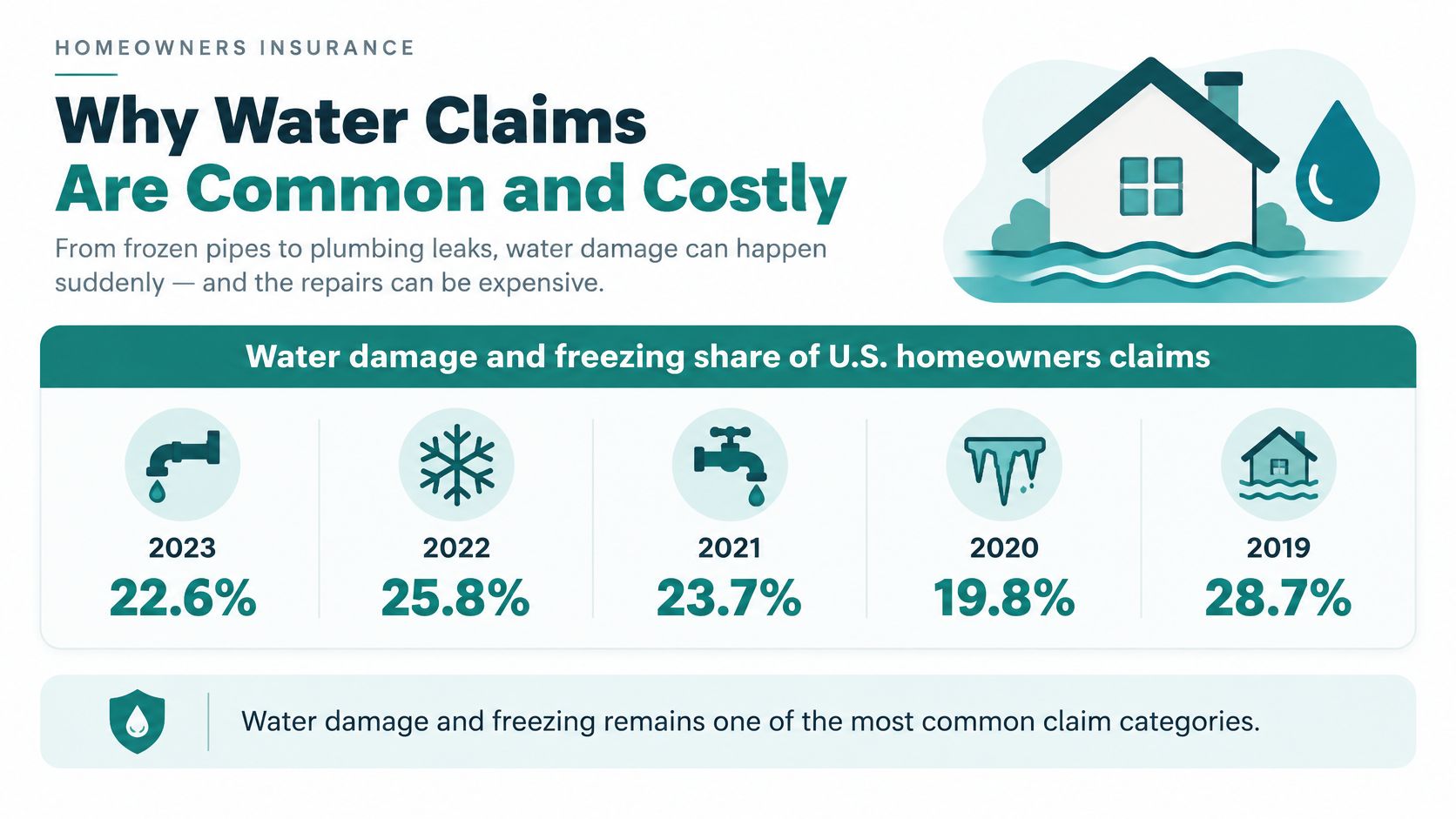
The Insurance Information Institute homeowners and renters insurance facts show that water damage and freezing represented 22.6% of all homeowners claims in 2023, compared with 25.8% in 2022, 23.7% in 2021, 19.8% in 2020, and 28.7% in 2019. The same dataset reports 5.33 homeowners claims per 100 policies across all causes in 2023, with an average claim severity of $20,062. Water is therefore both frequent and capable of producing a large single loss.
Say a supply line leaks above a kitchen ceiling. The first sign is a stain. The claim can then grow to include wet drywall, cabinets, flooring, damaged contents, mold remediation when the policy covers certain mold losses, and temporary housing while the kitchen is unusable.
That growth explains why early labels mislead. A small stain describes appearance, not moisture inside the ceiling assembly or the rooms below.
Frequency still doesn't create coverage. The cause of loss, exclusions, endorsements, deductibles, maintenance conditions, and applicable law control payment. The practical sequence is to sort the water by cause, dry and photograph the property, file and host the adjuster visit, split mixed causes carefully, and then test any short or delayed payment against the documented repair scope.
Which Water Events Are Covered and How Mixed Losses Split
Insurers start with the causation test, then turn to the damaged material. The central distinction is whether water arrived through a sudden and accidental event, gradual deterioration or maintenance-related seepage, a sewer or drain backup, or a flood. Each category can lead to a different coverage grant, endorsement, sublimit, or exclusion.
The NAIC consumer insight on common coverage gaps states that standard homeowners and renters policies generally don't cover flood losses, while sewer backup and other water-related protections may require separate coverage or endorsements. So the same wet floor can be a covered discharge, an excluded backup, or an uninsured flood, and the answer depends entirely on where the water came from. Readers comparing policy types can review whether homeowners insurance covers water damage after identifying the source in a specific loss.
How Common Water Sources Are Usually Treated
| Water event | Typical treatment | Evidence to keep |
|---|---|---|
| Burst pipe or sudden supply-line failure | Often covered as sudden accidental discharge; the failed part itself may be excluded | Failed fitting if safe to keep, photos, plumber invoice |
| Slow leak, seepage, or long-term moisture | Often excluded as gradual deterioration or maintenance | Date noticed, prior repair history, moisture pattern |
| Appliance or water-heater discharge | Often covered when sudden; wear of the unit may be excluded | Appliance, supply line, time it started |
| Sewer or drain backup | Often excluded unless a backup endorsement applies, sometimes with a sublimit | Endorsement, backup point, affected rooms |
| Flood, surface water, or storm surge | Usually requires a separate flood policy; standard homeowners forms generally exclude it | Flood policy, waterline, whether rain entered from outside |
| Wind-driven rain through a storm opening | May be covered if a covered peril created the opening | Opening, weather timing, interior pathway |
| Groundwater or foundation seepage | Often excluded as groundwater or seepage | Pathway photos, whether an opening was sudden |
Use the table as a sorting tool. Condo, landlord, homeowners, and commercial forms can define flood, backup, deductibles, and sublimits differently, and applicable law varies by jurisdiction.
Three Mixed Losses Told the Same Way
Burst pipe. Source: a supply pipe ruptures without warning. Pathway: clean water runs through a ceiling and soaks flooring and drywall below. Coverage split: resulting floor and drywall damage may be claimed as ensuing damage, even when the insurer won't pay to replace the failed pipe itself.
Foundation entry after heavy rain. Source: rainwater collects outside the building. Pathway: water pushes through a foundation without a sudden storm-created opening. Coverage split: that pathway is often treated as flood, surface water, or groundwater, which may fall outside a homeowners form and belong, if insured at all, under separate flood coverage.
Basement drain backup. Source: a drain reverses during the same storm. Pathway: water rises through the drain into a finished basement. Coverage split: backup protection, if purchased, usually comes from an endorsement with its own limit. It shouldn't be assumed to come from either a flood policy or the sudden-discharge grant.
Practical rule: Name the source first, trace the pathway second, and price the damage third. Reversing that order makes unlike causes look like one event.
Water quality changes both safety and documentation. The EPA mold remediation guide for schools and commercial buildings, Chapter 4 treats ordinary indoor leaks and spills differently from flood water, sewage, or other contaminated water, and states that its 24 to 48 hour clean-water drying recommendations aren't designed for heavily contaminated losses. Sewage or floodwater may require containment, personal protective equipment, specialized remediation, and structural assessment.
A defensible file therefore identifies the source and pathway, whether water was clean or contaminated, when the event began, what was damaged, and whether ensuing damage followed an excluded cause. The onset date deserves special care, because insurers often use it to decide whether a loss reads as sudden or gradual. Commercial owners also need separate records for inventory, equipment, tenant improvements, and documented interruption periods, because physical damage and time-element loss are usually analyzed under different provisions.
The clear next action is a written request asking the insurer to state which cause is accepted, which cause is denied, and which policy language supports each position. Policy wording and jurisdiction control the final outcome, so a verbal summary shouldn't substitute for that written split.
How to Dry and Document Before Repairs
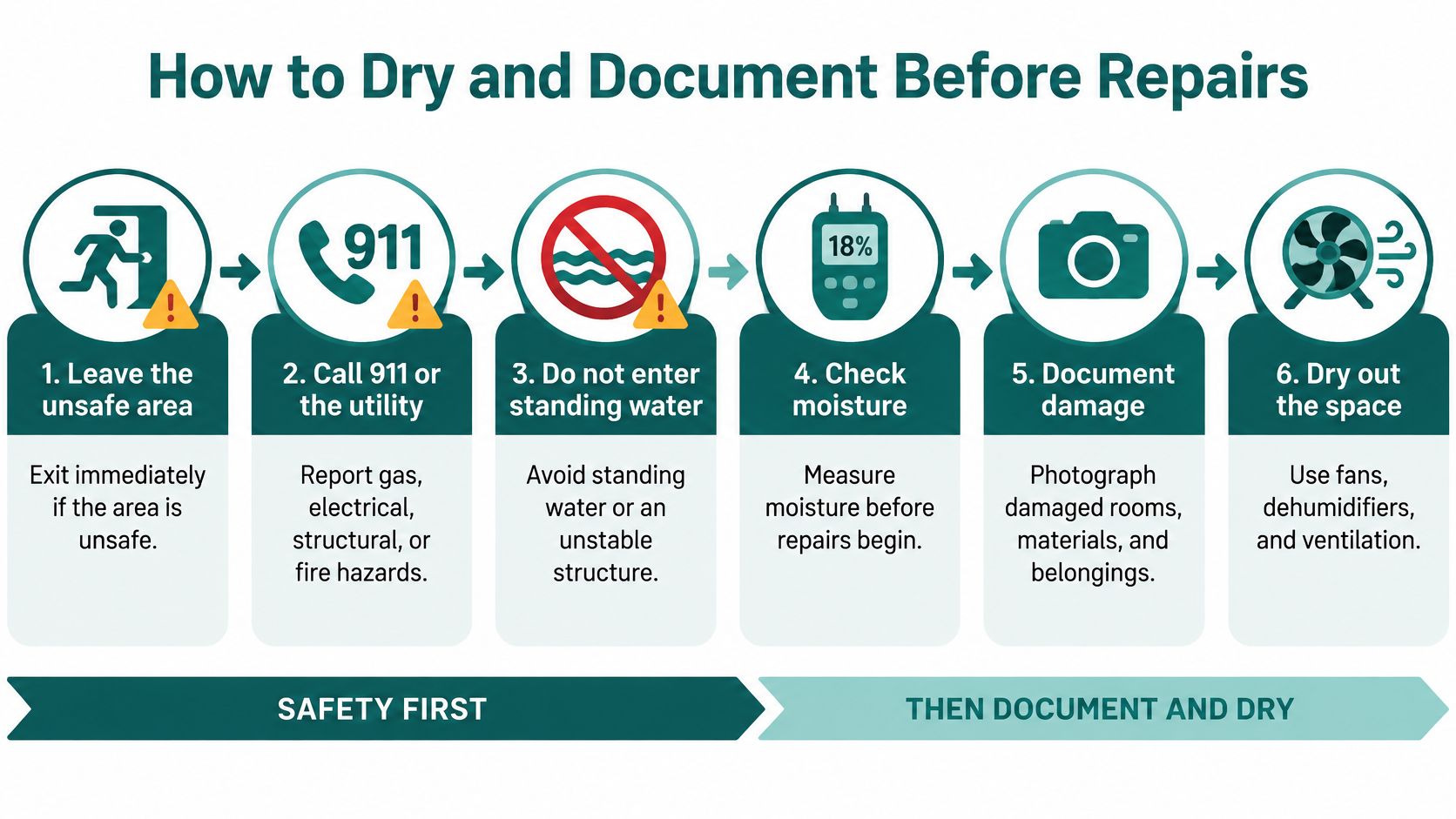
Safety comes before photographs. PostDamage advises property owners to leave unsafe areas before documenting damage and to call 911 or the appropriate utility for fire, gas, electrical, structural, or other immediate hazards, and never to enter standing water or an unstable structure. A wet ceiling that sags, a sparking outlet, or a gas odor ends the documentation exercise until qualified responders clear the area.
After the area is safe, the technical priority is controlling moisture, not merely removing visible standing water. The U.S. Environmental Protection Agency brief guide to mold, moisture, and the home recommends drying wet or damp materials within 24 to 48 hours because prompt drying generally reduces the likelihood of mold growth. The agency cautions that this window is a guideline, not a guarantee.
Six Actions in Order
- Stop the source if safe. Closing a shutoff valve prevents clean water from continuing to enlarge the affected area.
- Photograph and video every room. Time-stamped images taken before disposal show the original condition, the suspected source, and the rooms affected.
- Extract standing water. Extraction, fans, dehumidifiers, and ventilation appropriate to the material remove moisture faster than air movement alone.
- Check concealed assemblies. Wall cavities, subfloors, carpet backing, insulation, and other building assemblies can remain wet after surfaces look dry.
- Keep a drying record. Moisture readings or drying logs, equipment invoices, and a list of removed materials show what was done and when.
- Separate dry-out from rebuilding. Emergency mitigation stops further damage, while permanent demolition and reconstruction need a documented scope first.
More detail on the physical cleanup sequence appears in the guide to water damage cleanup. That process shouldn't be confused with authorization to rebuild. Removing a swollen baseboard to dry a cavity is mitigation. Replacing cabinets, flooring, and finishes is permanent repair.
Fast drying protects materials and creates a record of mitigation. It doesn't create coverage for a cause the policy excludes.
Porous materials that can't be thoroughly cleaned and dried may require replacement. Carpet padding, saturated insulation, and some composite boards often fall into that category, while framing and some solid surfaces may dry in place when readings confirm progress. Records should identify which materials were removed, which remained, and the readings supporting that choice.
Sewage and floodwater need a different level of caution from a clean supply-line leak. Contamination can affect what workers wear, how an area is contained, and whether porous contents can be cleaned safely. Photographs should capture the entry point and waterline before cleaning changes those facts.
The drying file supports a water damage insurance claim by showing reasonable steps to limit further damage. It isn't the repair estimate. Keeping mitigation invoices separate from reconstruction bids prevents an adjuster, contractor, or property owner from treating emergency work as the full cost of restoration.
How to File and Host the Adjuster Visit
Filing works best after emergency mitigation is underway and the basic facts are organized. A rushed call made while water is still spreading often produces an incomplete source description. A call delayed until repairs are finished creates a different problem, because the insurer loses the chance to inspect original conditions.
The Filing Order
- Report the loss promptly. The property owner should ask how the insurer wants notice and note any proof-of-loss deadline printed in the policy rather than assuming a universal number of days.
- State the core facts. The notice should give the date discovered, the apparent source, the rooms affected, and a clear statement that emergency dry-out is being separated from permanent repairs.
- Send copies, not originals. The submission should include the photo set, drying invoices, and a contents list with approximate age and cost for each damaged item.
- Confirm the claim setup. The owner should obtain the claim number and assigned adjuster, then ask whether additional living expense applies to a residence or extra expense applies to a business.
Contents need more than a room total. A useful inventory names the item, where it was located, approximate age, purchase cost when known, and whether cleaning or replacement is being claimed. Receipts, serial numbers, and pre-loss photographs strengthen the list but shouldn't delay notice when they're unavailable.
Walking the Property With the Adjuster
The visit should follow the same path the water took. Starting at the source helps the adjuster connect a failed fitting or appliance line to ceilings, walls, flooring, and contents along the pathway. Saved failed parts should be available for inspection unless unsafe conditions required immediate removal.
Rooms that haven't been opened deserve explicit attention. The adjuster should be asked to note unopened wall cavities, flooring that hasn't been lifted, and areas that remain too wet or unsafe to inspect. Without that note, a later discovery can look like a new claim rather than concealed damage from the reported event.
Payment mechanics should be clarified during the visit. Key questions include the amount of the deductible, whether payment starts at actual cash value, and whether withheld depreciation becomes payable as replacement-cost holdback after work is completed and documented. Answers should be confirmed against the policy rather than treated as policy language themselves.
At the visit: Don't sign a release or agree that the first inspection sheet is final before concealed areas have been checked and the full scope is known.
Landlords and commercial owners need additional separation. Building damage, tenant improvements, landlord-owned contents, tenant property, and income loss shouldn't be blended into one figure. Lease language and separate policy provisions can assign those categories differently.
If the visit is brief, or if the adjuster won't enter a wet area, a written follow-up should list what wasn't seen. The message can identify rooms, assemblies, contents, and equipment that still require inspection, and attach dated photographs of each area. That record is more useful than a later argument about what was said at the door.
The adjuster visit records the loss at one point in time. It doesn't settle damage that can only be verified after drying, selective opening, or contractor inspection, so unresolved areas should remain identified in writing.
When the Estimate Falls Short of Repairs
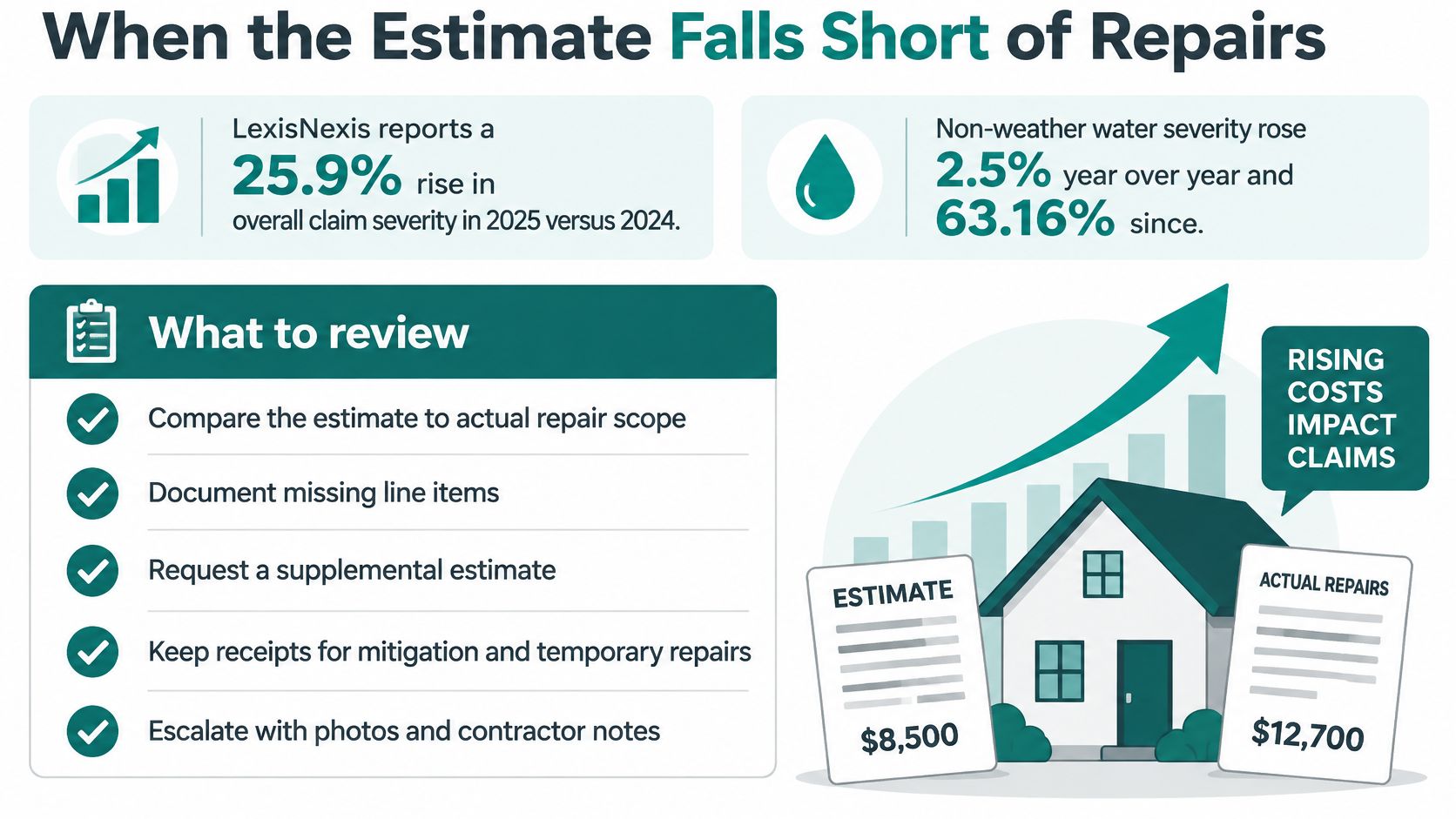
A low estimate is usually a scope problem that supplements, depreciation, or concealed damage can change. Pricing moves too. Reporting on LexisNexis Risk Solutions in Reinsurance News cited a 25.9% increase in overall claim severity in 2025 versus 2024, while non-weather water-damage severity rose 2.5% year over year and 63.16% since 2019, attributed in part to higher labor and material costs. An estimate that matched the damage at inspection can underprice the same repairs months later, before hidden conditions are even counted.
Gaps That Make a Water Estimate Too Low
An estimate works like a grocery list: the total only reflects what is written down. These are the entries most often left off.
| Gap | Why it appears | What to send |
|---|---|---|
| Concealed wet materials | Cavities stay wet after surfaces look dry | Open-up photos and moisture readings |
| Code or ordinance upgrades | Repairs must meet current code | Code note and contractor line items |
| Depreciation holdback | Actual cash value paid before replacement | Policy replacement-cost terms and paid invoices |
| Missing line items | Adjuster scope shorter than the bid | Side-by-side estimate comparison |
| Mold or remediation cap | Sublimit or exclusion on ensuing mold | Drying log and endorsement language |
| Commercial time element | Income or extra expense analyzed apart from the building | Interruption dates, inventory, and equipment lists |
A supplement is the standard tool for newly documented scope. Comparing the insurer's sheet to a contractor's bid works like reconciling a receipt against the full shopping list: each missing entry gets identified, priced, and photographed. The owner or contractor should document newly opened areas before they are closed back up, then request a supplemental estimate in writing. Missing quantities, omitted demolition, matching issues, and code-required work belong as separate items, because a documented line is harder to reject than one lumped higher total.
Depreciation follows its own track. Under a replacement-cost policy, the first payment often reflects actual cash value, the depreciated figure, even when finished repairs will cost more. The withheld amount becomes payable only after the work is completed and documented, and the recoverable amount, the deadline, and the required proof all come from the policy's replacement-cost terms. Paid invoices and completion photographs should arrive in exactly the form the policy requires, since a missed deadline can leave the holdback unrecovered.
Delay and denial call for different responses. For delay, a short dated status request should list the documents already sent, the decision still outstanding, and the policy's time limits for payment after proof of loss, alongside any applicable state prompt-payment rules. For denial, the response should separate the excluded cause from any ensuing damage the policy may still cover and ask for the specific language relied upon.
Amount, coverage, and timing are three different disputes. A missing line item needs a revised estimate, a coverage denial needs the policy language relied upon, and a stalled payment needs a dated status request.
An appraisal clause, where the policy includes one, addresses only the amount of loss. Each side names an appraiser under the policy procedure. Coverage questions stay with the insurer and, when necessary, other legal processes, so appraisal fits a pricing disagreement rather than a dispute over the cause.
If the insurer stalls or denies without a written reason, a complaint can be filed with the state insurance department. The department typically requests the insurer's file and a written response. Copies of letters, estimates, photographs, and a call log should be retained either way.
A demand letter, an appraisal, a regulatory complaint, and a licensed public adjuster are separate steps. Choosing among them starts with naming the dispute, and none guarantees a higher settlement.
Decide When to Ask for Claim Help
Staying with the insurer's process makes sense when the cause is clearly sudden, the written estimate matches a qualified contractor's scope, and payment is moving. In that situation, organized photographs, invoices, and prompt written follow-up may be enough to complete a water damage insurance claim without additional representation.
Licensed help becomes more relevant when the loss is large or the cause is mixed. Warning signs include a denial that doesn't separate causes, long silence after documents are sent, omitted open-up damage or code work, disputed contents, and unaddressed business income.
Homeowner signal: A residence remains partly unusable while the estimate covers only visible finishes and ignores wet cavities documented by moisture readings.
Commercial signal: Building repairs are priced, but damaged equipment, inventory, extra expense, and interruption dates haven't been analyzed under their separate provisions.
A public adjuster represents the policyholder only as state law allows and may help with documentation, estimates, and negotiation. Hiring one is optional and may not be appropriate for every claim, particularly a small loss with a clear cause and an estimate that already matches the repair scope.
PostDamage is not an insurance company, public adjusting firm, law firm, or restoration contractor, and it doesn't directly adjust, negotiate, or settle insurance claims. Its primary focus is connecting property owners who need insurance claim assistance with licensed public adjusters, and its insurance claim help service is intended for owners whose claim was denied, delayed, or paid less than expected.
Need help with a homeowners insurance claim? PostDamage can help connect you with a licensed professional. Need help with a commercial property insurance claim? PostDamage can help connect your business with an experienced, licensed professional. Policy wording and local law still decide payment, and one request shouldn't mean a pile of sales calls.
A property owner facing a mixed water cause, missing repair scope, or an unexplained delay can use PostDamage to request a connection with a licensed professional who can review the documentation and next steps. The request should include the source, photographs, estimate, and any written coverage position so the conversation starts with evidence rather than a general description of wet damage.