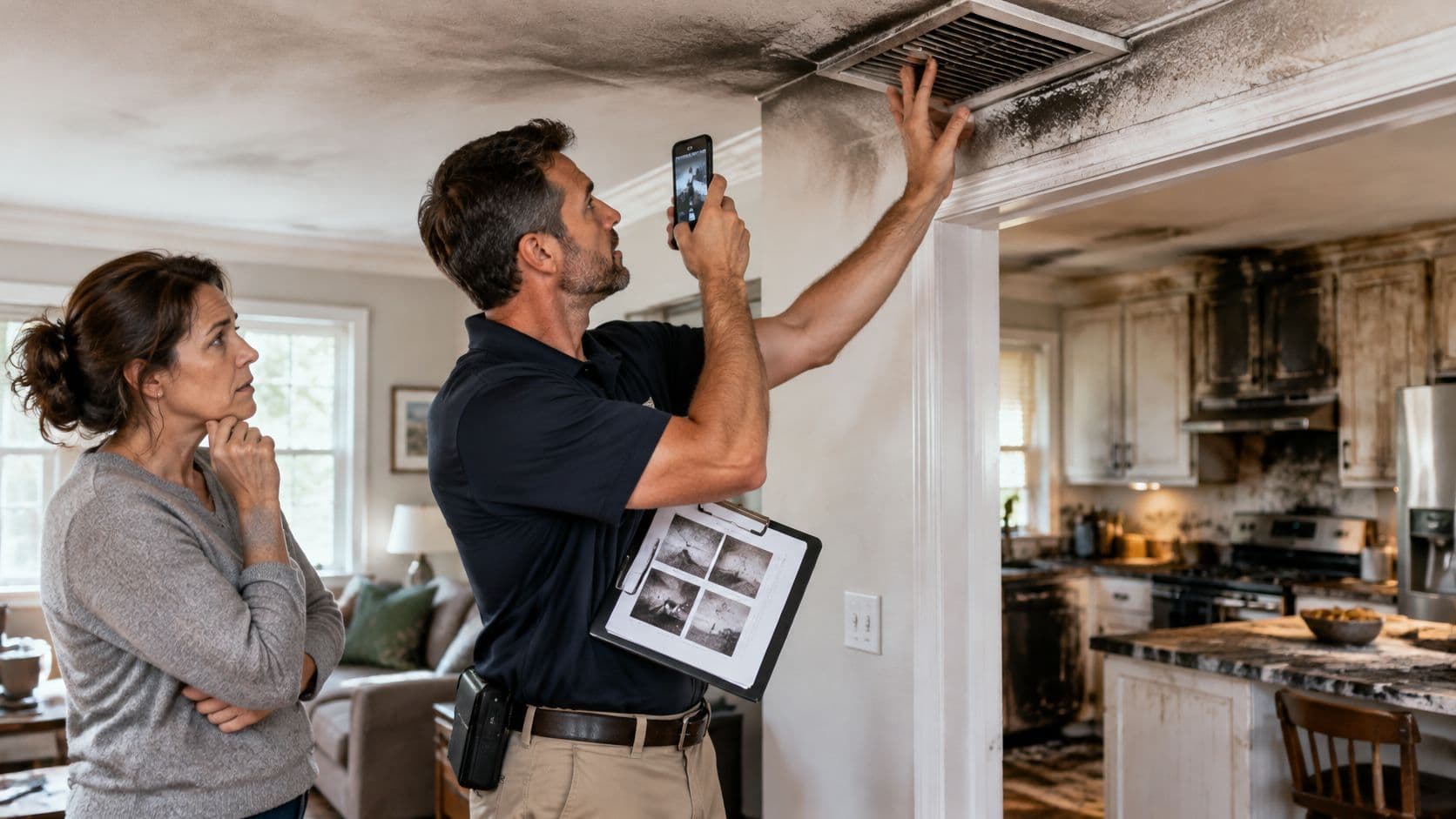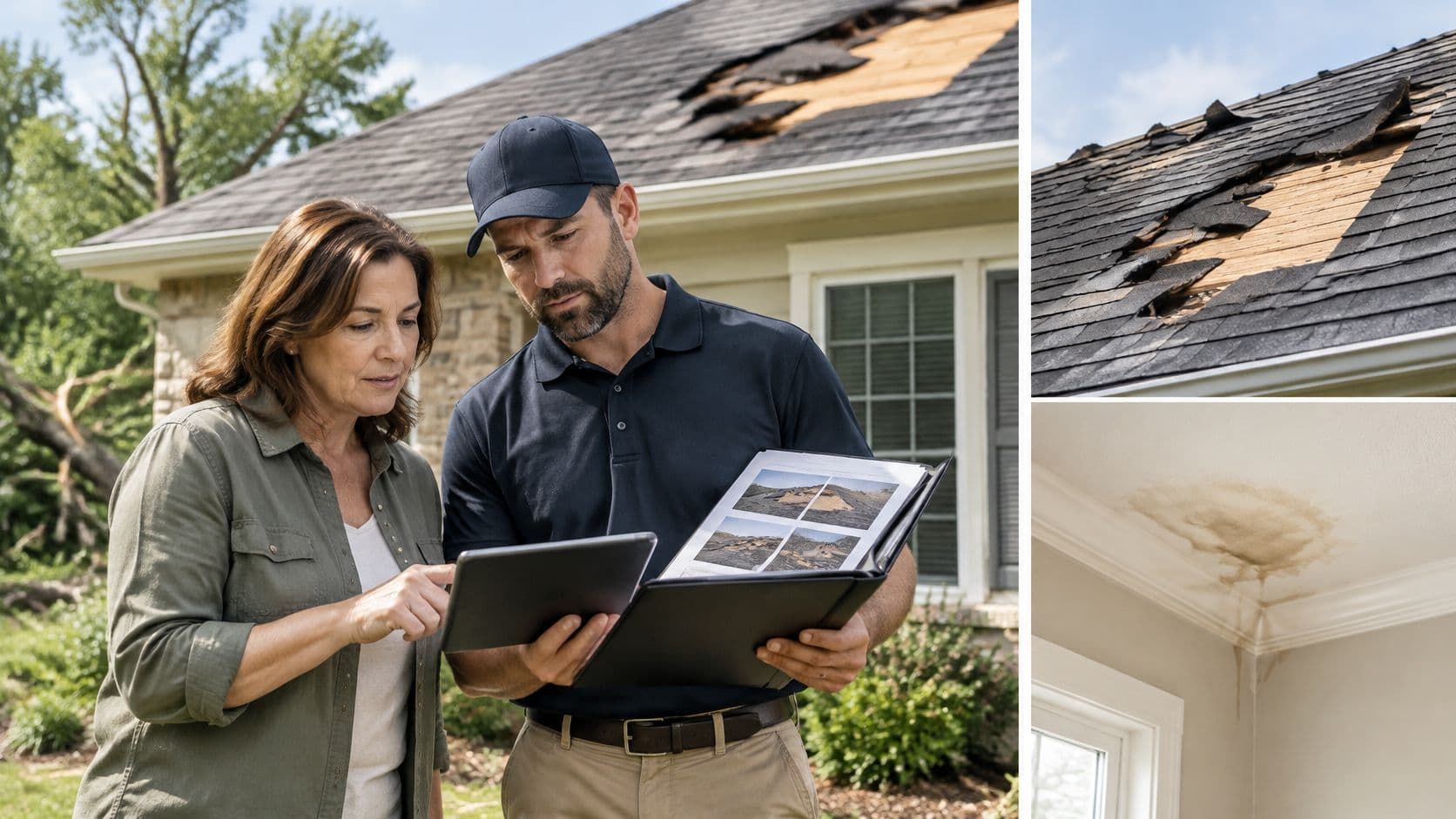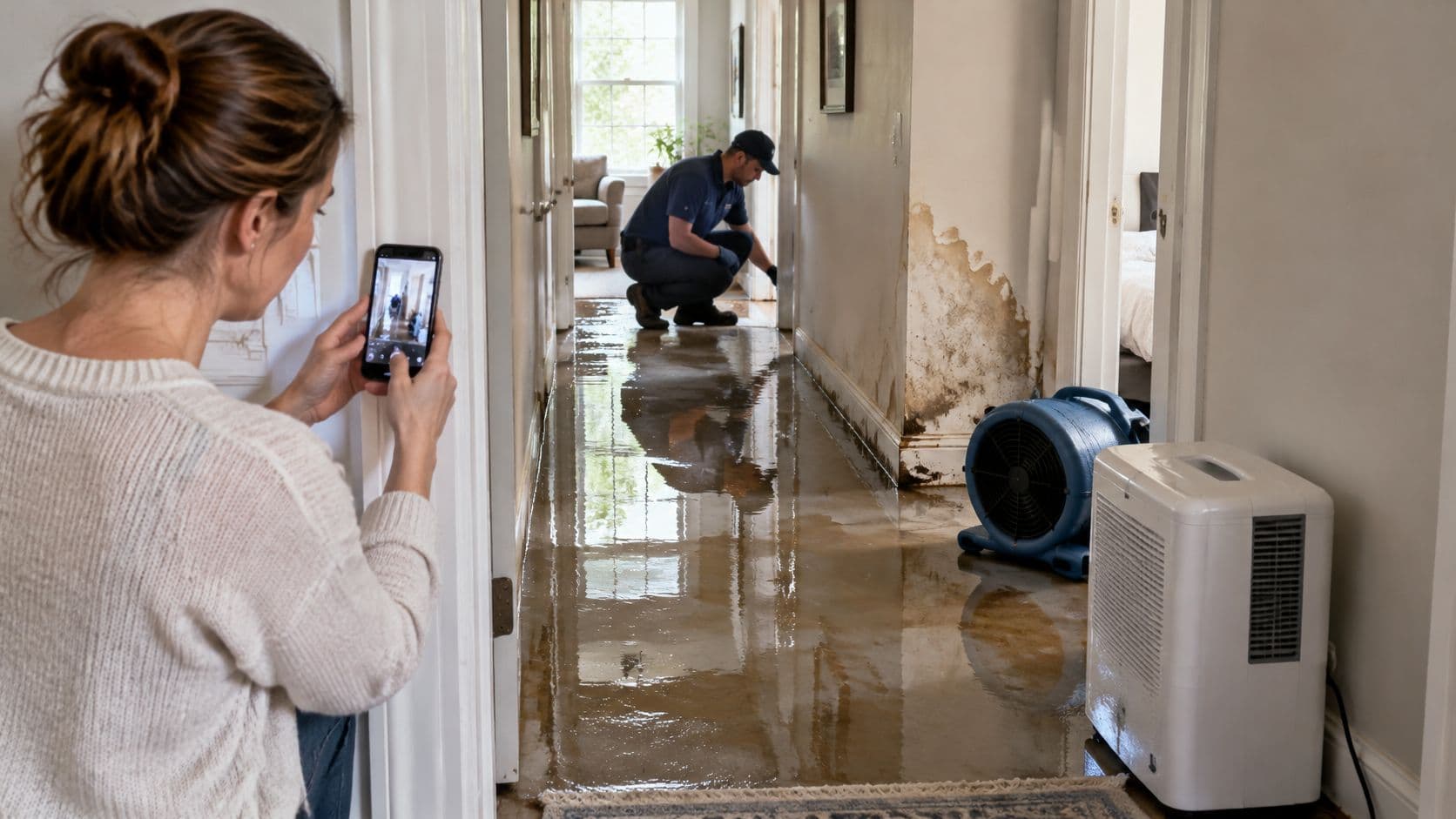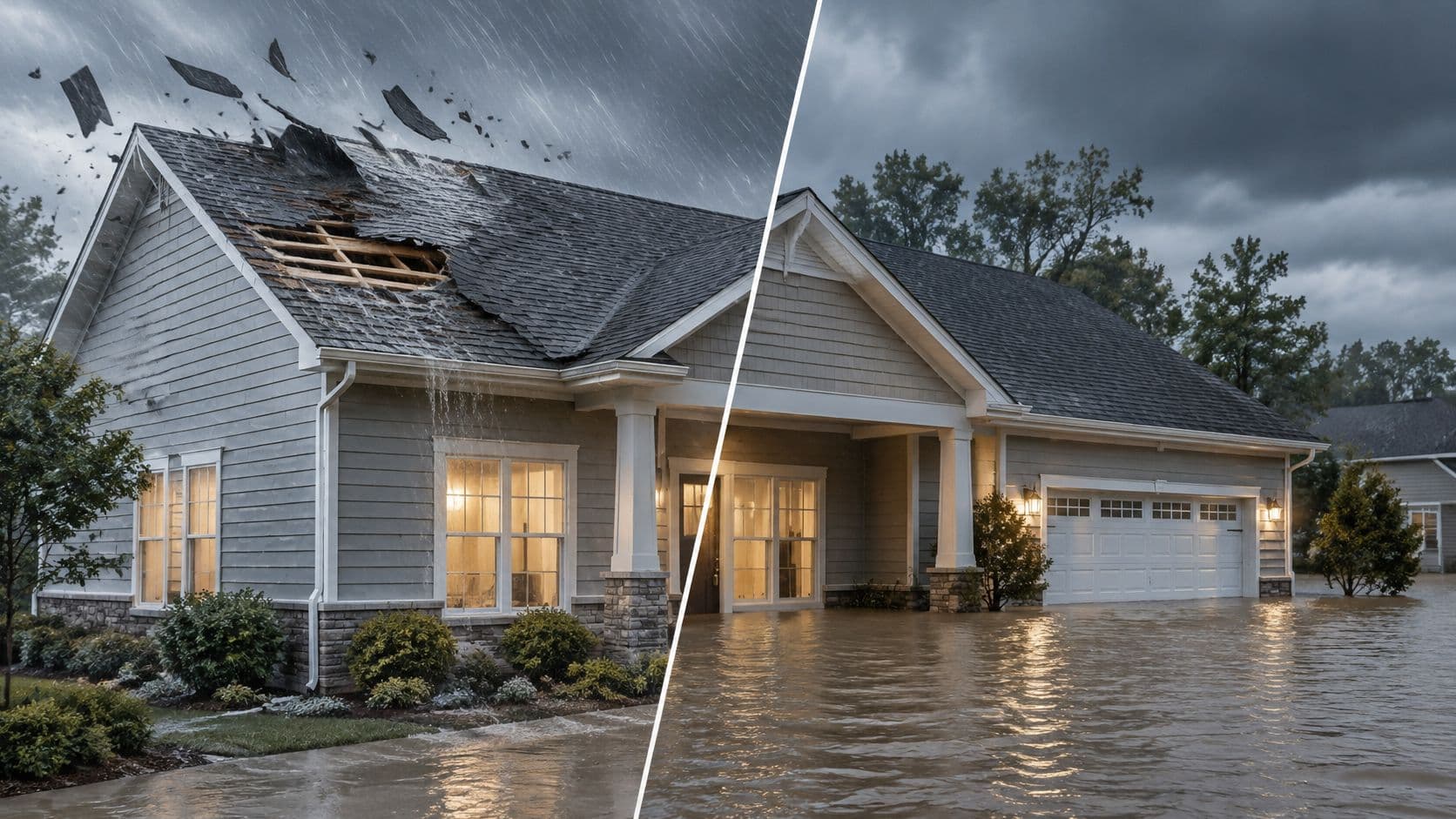
A standard homeowners policy generally covers sudden damage from wind, hail, lightning, and falling trees, while rising floodwater is usually excluded and requires a separate flood policy. Coverage still depends on the policy's terms, exclusions, limits, and applicable deductible.
If storm damage is covered, why might the homeowner receive little or no payment? The answer usually requires more than identifying the storm. What caused the damage, how water entered, and how the insurer calculates the settlement can matter more than the weather event's name.
For a homeowner facing a damaged roof or wet basement, those distinctions aren't technicalities. They determine which policy might respond, which evidence matters, and what expenses may remain unpaid.
Short Answer by Type of Storm Damage
Homeowners insurance generally covers sudden, accidental damage from covered storm perils, but coverage follows the cause of loss, not the word storm.
The following comparison is a starting point, not a coverage determination. Each covered entry remains subject to the actual contract, including exclusions and deductibles.
| Damage cause | Standard homeowners policy | What to check |
|---|---|---|
| Wind damage to roof, siding or gutters | Generally covered | Often subject to a separate wind or hail deductible |
| Hail damage to roof, siding or windows | Generally covered | Whether a wind/hail deductible applies |
| Lightning strike causing fire or electrical damage | Generally covered | Applicable property coverage, exclusions, and limits |
| Tree or branch falling onto the home | Generally covered | Tree removal from the yard is a separate coverage question |
| Wind-driven rain entering through a storm-created opening | Usually covered | Whether a covered peril caused the opening |
| Rising water, storm surge or flood | Generally excluded | Separate flood insurance is typically needed |
| Surface water, runoff, groundwater or snowmelt | Typically excluded | Flood coverage, applicable exclusions, and drainage evidence |
| Sewer or drain backup | Usually excluded without added coverage | Whether a water backup endorsement applies |
| Wear, deterioration or pre-existing damage | Generally excluded | Evidence separating prior condition from new storm damage |
These distinctions reflect the policy-dependent treatment described in the National Association of Insurance Commissioners' homeowners insurance guidance. A tree striking the house and a fallen tree lying harmlessly in the yard shouldn't be treated as identical claims merely because both followed high winds.
A covered peril still requires a covered loss
Lightning illustrates the difference between recognizing a peril and determining an individual payment. U.S. insurers paid $1.04 billion across 55,537 lightning-related homeowners claims in 2024, according to the Insurance Information Institute's lightning claims report, but those totals don't establish coverage for any particular appliance or electrical system.
Water requires especially careful classification. A wet ceiling and a wet basement can look like versions of the same problem while involving different policy provisions. PostDamage's explanation of whether homeowners insurance covers water damage provides additional context for that distinction.
The useful first task is to match each damaged area to the most likely row. When several rows apply, the homeowner needs a separate explanation for each cause rather than a single label for the entire property.
Split Losses and the Add-Ons That Close Gaps
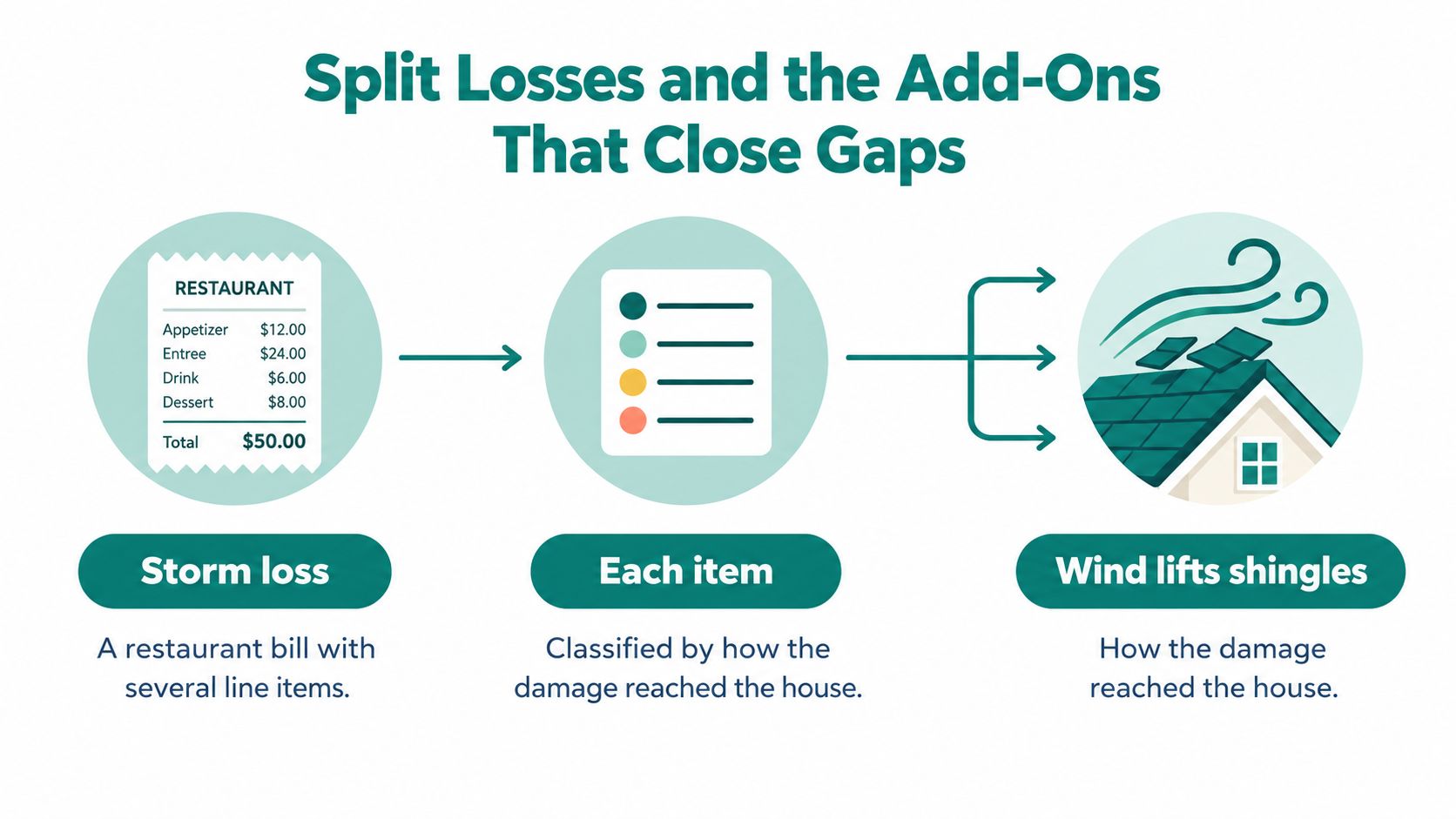
A storm loss resembles a restaurant bill with several line items. The event is the whole bill, but the insurer evaluates each item according to how the damage reached the house.
Consider a hypothetical sequence. Wind lifts shingles, rain enters through the opening, and the ceiling becomes saturated. Later, a nearby river rises across the yard and water enters the basement through an exterior wall.
The ceiling damage may follow the covered wind loss. The basement damage raises a separate flood question, even though both happened during the same storm.
The water's pathway matters more than its appearance
The relevant distinction isn't just whether the water began outdoors. Rain can enter from outside through a wind-damaged roof, while floodwater can enter from outside at ground level. The entry point and sequence of events help distinguish those losses.
FEMA states that most homeowners and renters policies don't cover flood damage and that about 40% of National Flood Insurance Program claims come from outside designated high-risk flood zones, as explained in its flood insurance preparedness guidance. A location outside a high-risk zone therefore isn't a substitute for reviewing flood protection.
For the hypothetical house, useful evidence would include roof openings, ceiling stains beneath those openings, exterior water lines, and photographs showing the river's route across the property. Contractor observations and a timeline can help separate the upstairs rain damage from the basement flooding.
A basement's location alone doesn't establish the cause. Water entering through a wall, backing up through a drain, or escaping after sump-pump failure should prompt different questions. An endorsement addressing backup shouldn't be assumed to cover every kind of basement water.
Practical rule: Describe where the water entered and what happened immediately beforehand. “The basement flooded” describes the result, not the cause.
Compare protection by the gap being addressed
Additional protection should match the specific exposure. A higher dwelling limit doesn't remove a flood exclusion, and flood insurance shouldn't be assumed to replace a backup endorsement.
The following options are subjects for a policy review, not promises that every insurer offers them or that every version provides identical protection.
| Add-on or policy | What it covers or changes | Gap it closes |
|---|---|---|
| Separate flood policy, NFIP or private | Eligible rising-water, storm-surge, and surface-flood losses under its own terms | Addresses the standard homeowners flood exclusion; effective dates and any waiting period require confirmation |
| Water backup endorsement | Specified sewer, drain, or sump-pump losses | Addresses eligible backup losses excluded from the base policy |
| Wind or hail deductible buy-down | May reduce the applicable wind or hail deductible | Addresses a large deductible; availability and terms require confirmation |
| Ordinance or law coverage | Specified code-required rebuilding work | Addresses eligible upgrade expenses that need separate treatment |
| Higher dwelling limit | Increases the available dwelling coverage amount | Addresses a potential rebuilding-cost shortfall, not an excluded cause |
For flood coverage, the homeowner should compare the separate policy's terms rather than assuming every water-related loss qualifies. For backup coverage, the important questions include which events are listed and what limits apply. For a deductible buy-down, the key issue is whether the proposed change reduces the deductible applicable to the relevant peril.
Ordinance or law coverage deserves its own review because restoring damaged materials and meeting a rebuilding requirement aren't necessarily the same expense. Similarly, a higher dwelling limit addresses the amount available for an eligible loss, not whether the cause is insured.
Reconstruct the event without guessing
The homeowner's recollection should be separated from confirmed observations. If the timing of the roof opening is uncertain, the file should say so rather than present an assumption as an established fact.
A short reconstruction can begin with these questions:
- What broke first? Identify observed damage and distinguish it from a contractor's later conclusion.
- Where did water enter? Connect each wet area to visible openings, drains, walls, or exterior water lines.
- Did water rise or fall? Record evidence of ground-level accumulation separately from rain entering above.
Any unreviewed add-on represents an unverified protection gap until the declarations page and attached forms establish what exists. Even when coverage appears on the declarations page, its wording still needs review before anyone assumes it applies.
How Deductibles Decide What You Actually Receive
A home with $400,000 of dwelling coverage and a 2% wind deductible has an $8,000 deductible, using the example in the NAIC's hurricane deductible guidance. That amount can substantially reduce payment even when the insurer accepts that wind caused the damage.
The important distinction is the base used for the calculation. A percentage deductible may apply to the dwelling coverage limit, not the repair bill. A homeowner who calculates a small percentage of the contractor's estimate may therefore underestimate the out-of-pocket amount.
Flat deductibles and percentage deductibles work differently
A flat deductible is a stated dollar amount. A percentage deductible requires the homeowner to identify both the applicable percentage and the coverage amount to which the policy applies it.
Hurricane deductibles may also depend on a contractual trigger. A policy might instead use a windstorm or wind/hail deductible, so a homeowner shouldn't assume that every storm activates the same provision.
The following figures are arithmetic illustrations, not quoted deductible options or evidence that any particular policy offers them. Each cell uses the formula dwelling limit × stated percentage.
| Dwelling coverage | 1% deductible | 2% wind deductible | 5% wind deductible |
|---|---|---|---|
| $250,000 | $2,500 | $5,000 | $12,500 |
| $400,000 | $4,000 | $8,000 | $20,000 |
| $600,000 | $6,000 | $12,000 | $30,000 |
The table isolates the deductible calculation. It doesn't calculate a final settlement, which also requires the insurer's accepted covered amount and the policy's settlement provisions.
“Covered” identifies an eligible loss. It doesn't establish that the insurer will pay the entire repair invoice.
Review the applicable line before judging the payment
The declarations page is the starting point for locating the ordinary deductible and any separate wind, hail, hurricane, or named-storm deductible. The attached forms explain how those entries operate.
A useful deductible review asks:
- Which deductible applies? The insurer should identify the provision used for the reported cause.
- What activates it? A hurricane or named-storm provision may have a specific trigger.
- What amount is the percentage based on? The calculation should match the policy's stated basis.
- Does the accepted loss exceed it? A covered repair below the applicable deductible may produce no payment.
The deductible is generally the homeowner's retained share of an eligible loss, not an extra benefit available for repairs. It also shouldn't be confused with depreciation or an excluded repair item. Those are separate parts of the settlement calculation and deserve separate explanations.
Before accepting a payment as correct, the homeowner should be able to trace the deductible from the policy to the insurer's written calculation.
How to Document Storm Damage Before Repairs
What can a reviewer learn from the damage before cleanup changes the scene? A useful claim record connects what was damaged with evidence of how it happened. That distinction matters because “storm damage” describes the event broadly, while coverage can depend on the specific cause and pathway of water. Even when a loss is covered, the deductible and the policy's settlement terms affect what the insurer pays.
Safety comes first. Don't enter an unstable area or climb onto a damaged roof to take pictures. If conditions make documentation unsafe, wait for qualified help and record what you can safely observe.
Preserve the scene, then track the work
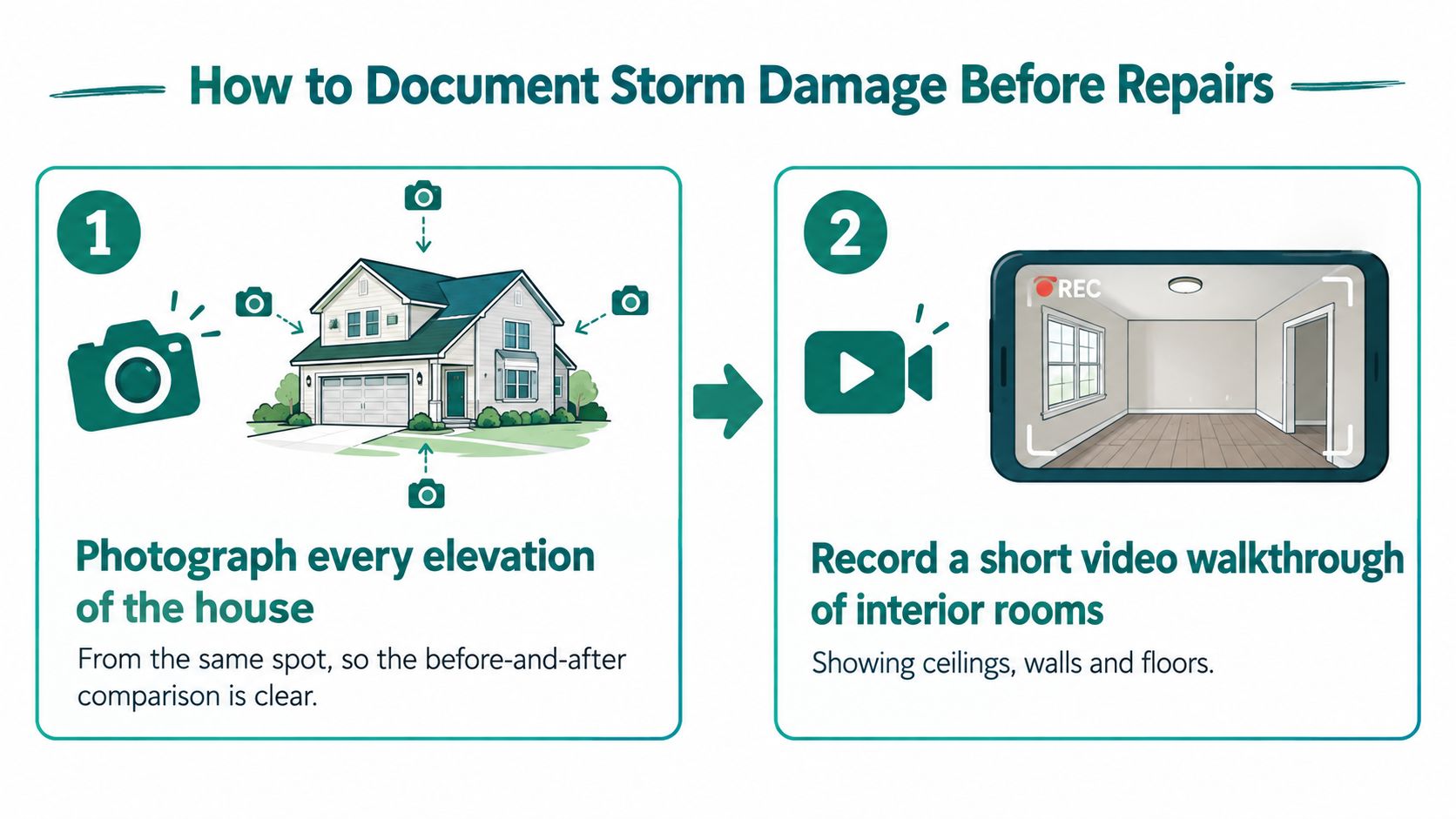
Photograph every exterior elevation. Take wide views from safe, repeatable positions, followed by close-ups of visible damage. Similar viewpoints help a reviewer compare areas and understand where damage sits on the property.
Record an interior walkthrough. Show ceilings, walls, floors, and how damaged areas relate to one another. Keep the original files and their recording information, rather than relying only on edited clips.
Capture visible water lines. Include nearby features to establish the line's location, and note when you observed it. Drying and cleanup can erase details that may help explain where water traveled.
Arrange safe emergency mitigation. Temporary roof protection, secured openings, and drying can limit further damage. When circumstances allow, document conditions before and after the work.
Keep emergency invoices and receipts. Record what the contractor did and why the work could not reasonably wait. If permanent repairs happen before inspection because safety or circumstances require them, document the reason and the work performed.
Preserve damaged materials when safe. A shingle or damaged interior material may help explain its condition and possible cause. Do not retain materials that are unsafe or contaminated.
Create a contents inventory. Describe damaged belongings, including brands and approximate ages, and keep available purchase records. Link photographs to the listed items so their condition and location are clear.
Record the event timeline. Note the storm date, when you found the damage, and any local weather information you consult. Separate what you personally observed from details learned later.
Report promptly and maintain a contact log. Save the claim identifier, adjuster's name, inspection arrangements, and correspondence. A dated record helps clarify which documents were requested and which questions remain unanswered.
Keep a usable file
Store photographs, recordings, the timeline, emergency-work records, contents details, and insurer correspondence together. Use clear filenames and brief descriptions so the evidence is easy to review.
For water-related losses, guidance on filing a water damage insurance claim explains steps for organizing claim information. A well-kept file gives a reviewer a clear account of the property, the observed damage, and the work completed.
Claim Steps When the Payout Is Low or Denied
A first estimate is an offer to review, not the final word. To understand what the payment covers, identify whether the dispute concerns coverage, repair scope, pricing, depreciation, or the deductible. The word “storm” alone does not determine the amount: the deductible, how water entered, and the policy's settlement terms can each affect the check.
Each issue calls for different evidence. An omitted damaged material may require photographs and a repair explanation, while an exclusion or deductible dispute calls for the relevant policy wording and calculation.

Separate the estimate from the settlement
The claim process generally includes reporting the loss, arranging an inspection, receiving the insurer's written estimate, and comparing it with a supported contractor scope. Compare specific work items, quantities, and locations, rather than relying on competing totals.
Actual cash value generally accounts for depreciation. Replacement-cost coverage may provide additional payment for eligible replacement expenses, subject to the policy's conditions. Those conditions may require completed repairs and supporting records.
A depreciation holdback may be payable after eligible repairs and documentation. Whether it can be recovered depends on the policy and claim facts. The NAIC's consumer homeowners insurance guide offers general information about homeowners coverage. Use the policy itself to confirm the specific settlement terms, limits, and deductibles that apply.
| Disputed item | Useful response |
|---|---|
| Missing damaged materials | Submit photographs and a contractor's explanation of the required work |
| Different repair quantities | Compare measurements and identify the affected location |
| Depreciation deduction | Request the calculation and applicable recovery conditions |
| Code-related work | Provide the identified requirement and request review under the relevant coverage |
| Excluded damage | Request the policy provision and factual basis for the exclusion |
Request a specific written review
A supplement request should name each omitted or differently calculated item and include the evidence supporting a change. A contractor's higher total, by itself, does not establish that the insurer owes the difference.
Review standard: Give each disputed line a stated reason, supporting evidence, and a request for a written response.
Check whether the dwelling limit reflects rebuilding needs and whether additional living expenses may apply if the home is uninhabitable. Review appraisal provisions and filing deadlines in the actual policy and under applicable state law; another homeowner's claim may follow different terms.
If a low, delayed, or disputed estimate remains unresolved, an independent review may help clarify the disagreement. Public adjusters may assist with documentation, estimates, and negotiations within the scope permitted by their license and applicable law. Hiring one is optional and may not suit every claim. PostDamage provides general information about the claim process and insurance claim assistance options. It is not a public adjusting firm and does not guarantee approval, a larger settlement, or any particular outcome.
Confirm Your Storm Coverage Before the Next Event
Before storm season, make the policy easier to use under pressure. Save the documents you may need, note where to find them, and record the questions that still need an answer. A storm can cause several kinds of loss, but the word “storm” alone does not determine what the insurer pays. The deductible, how water entered the home, and the policy's settlement terms all affect the final amount.
Prepare your records
- Photograph the declarations page and all attached endorsement forms, and keep the original files.
- Save a copy of the full policy somewhere you can access if you cannot return home.
- Record the insurer's claim-reporting contact details and the policy number with your emergency documents.
- Take current photos of the home's exterior and interior, including rooms and belongings that could be affected by a storm.
- Keep receipts and records for repairs or protective steps taken before a storm.
These steps make it easier to compare the home's condition before and after damage and locate the relevant policy language when time is short. They do not change what the contract covers or how a claim is settled.
A clear claim with well-documented damage may be manageable directly with the insurer. If a dispute over the cause, repair scope, or delay remains unresolved, a licensed public adjuster may be an option. Hiring one is optional, and assistance does not guarantee a particular claim outcome.
PostDamage provides general information about property insurance claims and can help connect property owners seeking claim assistance with licensed professionals. Its content is not legal, insurance, or claims advice, and it does not guarantee a payout. Homeowners with a low, delayed, or disputed storm claim can review PostDamage's insurance claim assistance information and consider what support may suit their situation.