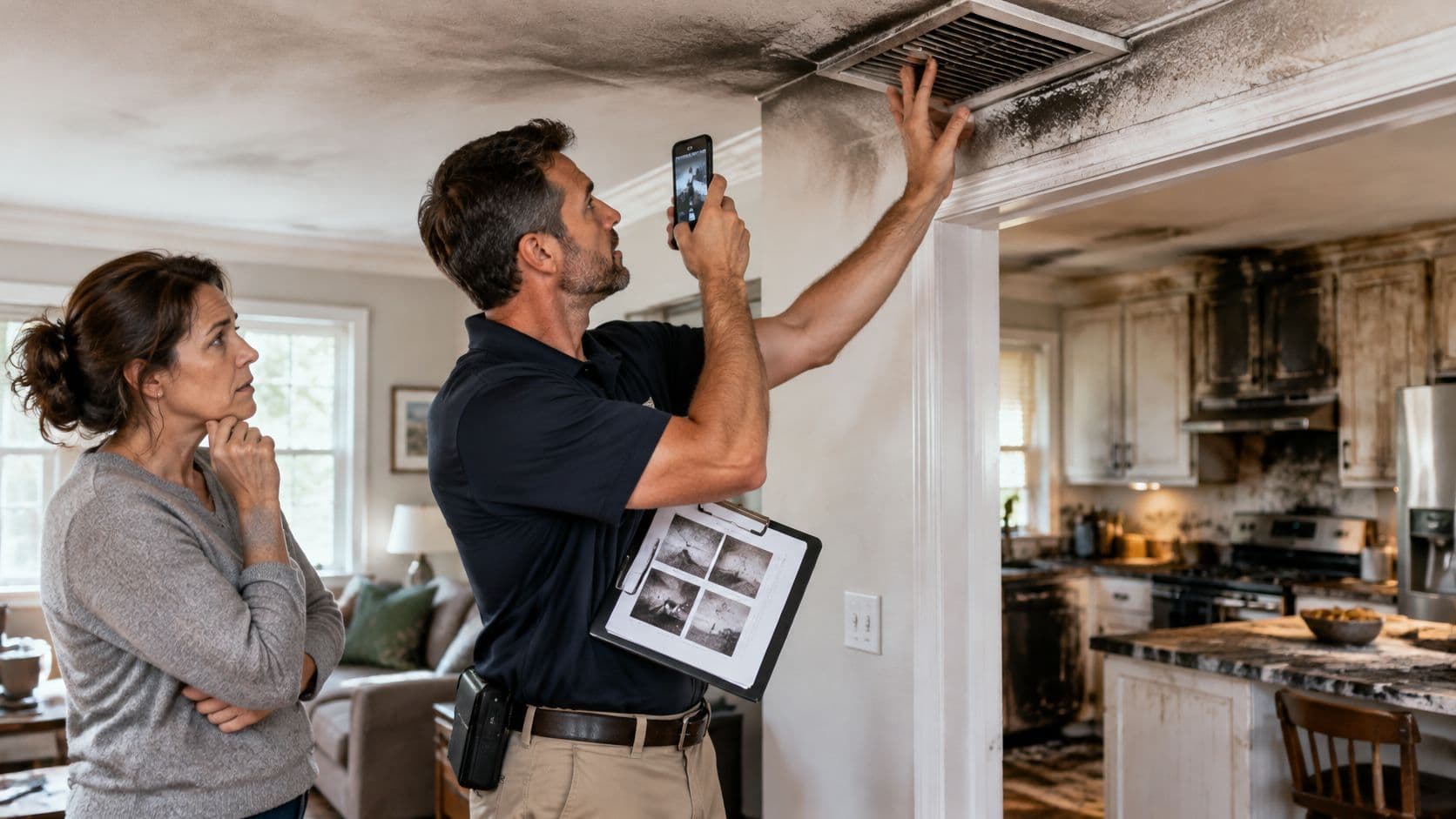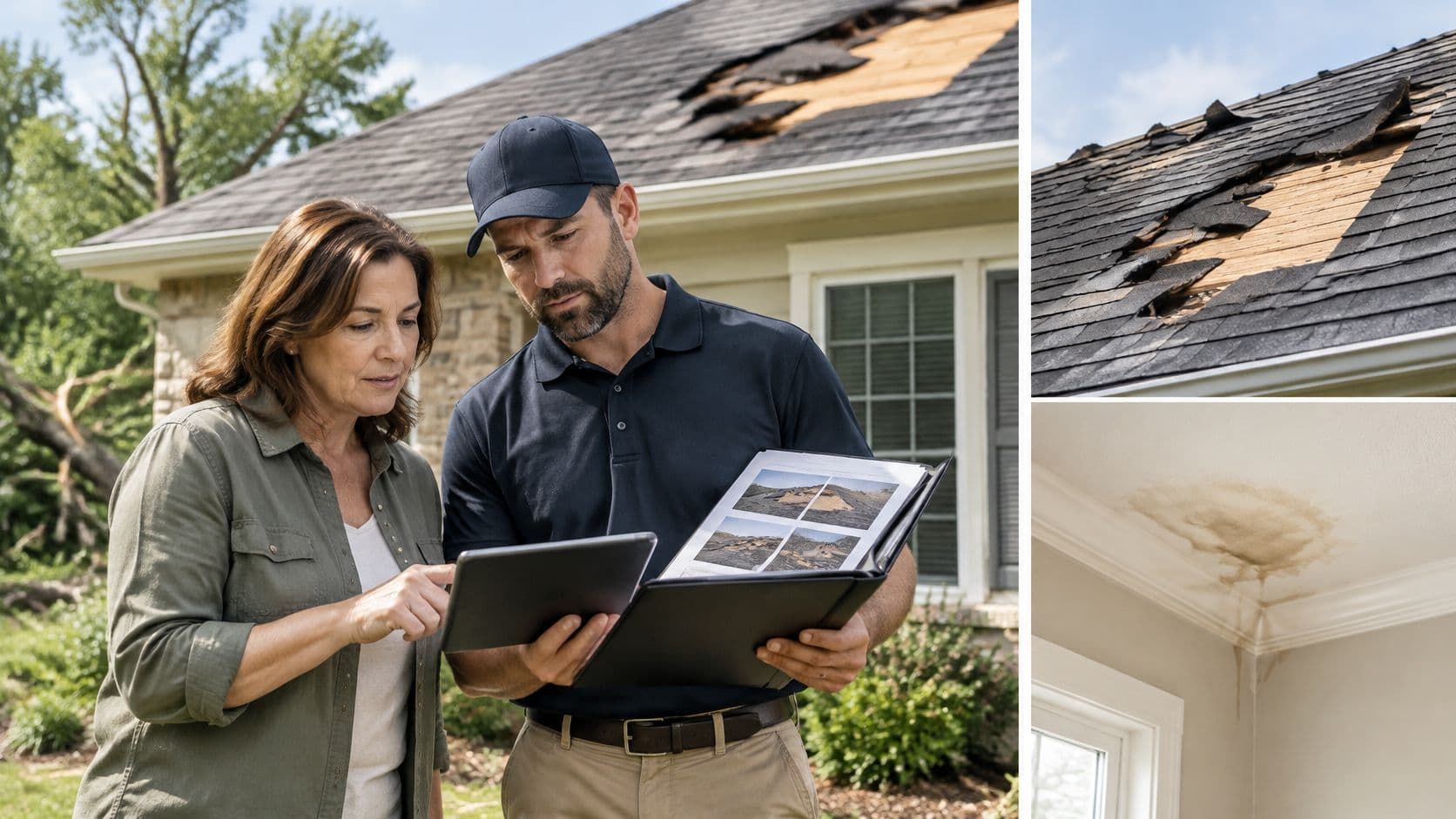
The morning after a storm, a homeowner may find shingles in the yard and a damp ceiling below. A landlord may hear from a tenant about a leak, while a facility manager sees no damage from the parking lot but knows water is entering a building. In each case, the first challenge is the same: protect people and property without changing or discarding evidence that may matter to the claim.
Roof insurance claim help starts with a safe first response, then a clear record of what happened. A quick view from the ground can't establish whether the roof has hidden damage, and a first conversation with the insurer doesn't resolve every question about coverage or payment. The policy, deductible, cause of damage, roof condition, and applicable law all matter.
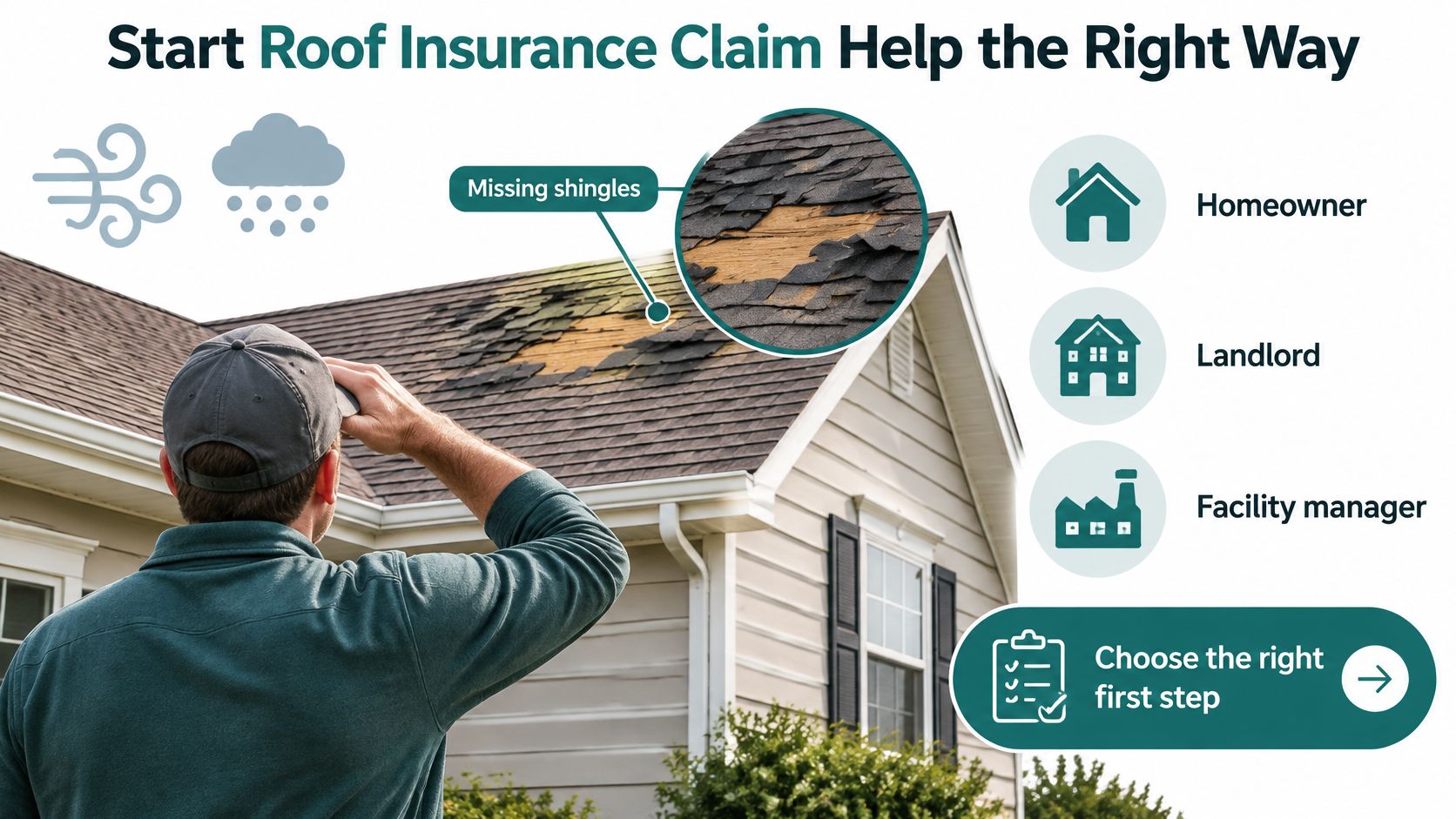
Start Roof Insurance Claim Help the Right Way
A homeowner who sees missing shingles after a storm shouldn't climb onto the roof to check for more. Loose materials, wet surfaces, and concealed structural damage can make a roof unsafe. The same caution applies to tenants, property staff, and anyone without the training and equipment to assess it.
Wind and hail are major drivers of homeowners property claims. From 2018 through 2022, wind and hail made up approximately 41.5% of reported homeowners claims, and about 2.9% of insured homes had a wind or hail claim in an average year. The average claim amount was $13,511, but those figures don't mean every such claim involves a roof or will be covered. Coverage depends on policy terms and the circumstances of the loss. Insurance reporting on common homeowners claims
Put safety and temporary protection first
If there's an immediate threat to life or safety, occupants should leave the affected area and contact emergency services. When it's safe, a qualified contractor can assess whether temporary measures such as tarping or interior protection are needed to prevent further damage. Keep emergency mitigation separate from permanent repairs: temporary work may protect the property, but it doesn't establish that every repair is covered.
For a house, that could mean keeping people away from a ceiling that's bulging with water and arranging safe interior protection while a contractor evaluates the roof. For a rental building, the landlord or manager may need to coordinate access, tell tenants how to avoid the affected area, and document any interruption to occupancy. A commercial facility manager may also need to consider whether damage affects operations or business income, subject to the policy.
First-day order: Make the property safe, limit further damage, preserve what can be observed safely, and keep records of emergency work.
A storm can damage shingles, flashing, structure, interior finishes, contents, or more than one of these. NOAA recorded 203 U.S. severe-storm disasters causing at least $1 billion in damage each from 1980 through 2024, after inflation adjustment. These events included hailstorms, tornado outbreaks, derechos, and other storms capable of damaging buildings. The losses span residential and commercial property, infrastructure, vehicles, agriculture, and interruption-related costs, so they aren't roof-claim totals or insurance payouts. NOAA's severe-storm disaster data
A ground-level look can miss hail damage or roof damage that allows water in later. The useful first move isn't to decide whether the roof needs repair or replacement. It's to protect people, prevent additional loss where safe, and start preserving evidence before conditions change.
Document Storm Damage Before Anything Changes
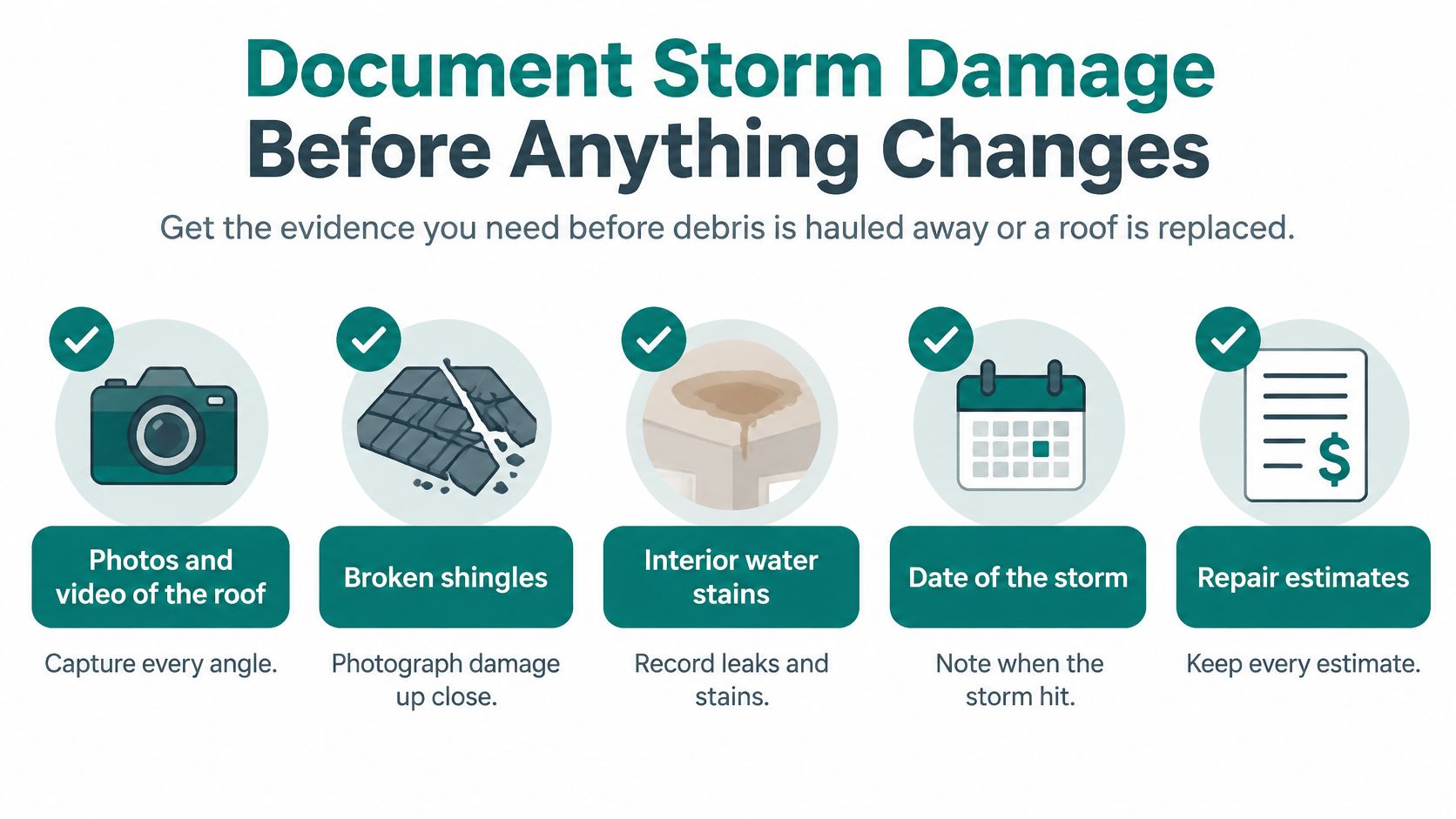
A claim file should let another person understand what was damaged, where it was, and how the estimate relates to it. Broad photos and a single lump-sum roofing bid usually don't do that well. A mapped, timestamped record gives the insurer and the property owner a clearer basis for discussing each claimed item.
Build the record in a useful order
Capture what can be seen safely. Photograph and video the roof from safe vantage points, as well as the attic, ceilings, exterior elevations, and affected contents. Take wide shots to show location and close-ups to show detail. Don't put anyone at risk to get a better image.
Keep the original files. Preserve photos and videos with their timestamps rather than relying only on copies inserted into messages or documents. Organize them by area, such as front slope, rear slope, attic, or room, so each image can be matched to a location.
Create a simple damage map. Mark roof sections and affected interior rooms. If a ceiling stain appears below a particular roof area, note that relationship without claiming it proves causation. Record the storm date and the date each condition was observed.
Gather the policy and condition history. Save the declarations page and endorsements. Add available records about the roof's age, prior inspections, maintenance, and repairs. Include emergency mitigation invoices and communications about the work.
Keep estimates itemized. A useful estimate identifies quantities, unit costs, materials, labor, and code-related work. It should distinguish roof sections and interior repairs rather than presenting the entire project as one total.
FEMA's claim-documentation guidance identifies records such as clear photographs, policy information, detailed inventories, adjuster reports, contractor estimates, and proof of loss as supporting documents. That guidance is useful as a recordkeeping framework, but flood procedures don't automatically govern a wind or hail claim. FEMA's policyholder claim-documentation guidance
A good file can be audited without a site visit. Each estimate line should connect to a location, observed condition, measurement, or policy question.
Where safe, retain damaged samples and note where they came from. If the cause is disputed, record the question rather than presenting an unsupported conclusion: wind, hail, wear, installation, and pre-existing damage may require further review. Keep a communication log with dates, participants, requests, and responses.
For related steps to protect a property after a storm, the storm damage repair guidance can help frame the difference between immediate protection and permanent work. The point is not to accumulate paperwork for its own sake. It's to make the chain from storm, to observed damage, to requested repair scope easy to follow.
Handle the Adjuster Visit and Insurer Messages
Once the evidence is organized, the next task is to use it in communications. A company adjuster works on behalf of the insurer, so the property owner should be ready to identify observed damage and ask how the inspection and estimate will address it. The discussion is more productive when it stays specific.
Before the visit, gather the policy pages, damage map, photos, mitigation records, and contractor estimates. If the roof is unsafe or inaccessible, say so and ask how the insurer will document the areas that can't be inspected. During the inspection, walk through the loss by roof section, attic, and affected interior area where access is safe and permitted. A brief view from the ground may not answer what happened on each slope or whether water entered the building.
Ask for observations, not conclusions
Useful questions focus on what was examined and recorded:
- Which roof sections and interior areas were inspected?
- What measurements or photographs support the estimate?
- Which areas weren't accessed, and why?
- Which conditions are attributed to wear, prior damage, wind, or hail?
- What claim-related records, estimates, or measurements can the insurer provide?
An underwriting photograph, drone image, prior inspection, or roof-age note may become central if the insurer says damage existed before the storm. Those records can conflict with dated maintenance photos or repair invoices. No single image automatically establishes when damage occurred or what caused it, so the response should point to the specific discrepancy and offer relevant records rather than relying on a general objection.
Keep a communication log. Record the date, the person contacted, the request made, and the response received. If a conversation raises a new question, send a concise follow-up that identifies the area or estimate line at issue.
The right decision-maker also depends on the property. A homeowner may handle a personal claim directly; a landlord may need to coordinate with an owner, tenants, or a property manager; an HOA may have separate responsibilities for common areas; and a commercial claim may involve both property repairs and possible lost income. Deductibles, policy terms, authority to approve work, and any business-interruption coverage can differ.
For damage involving water inside the property, the water damage insurance claim guidance offers related claim-filing information. The key is to keep roof damage and resulting interior effects connected in the record, while letting the policy and evidence determine what's claimed.
Read the Roof Estimate Line by Line
An insurer's first payment isn't necessarily the roof's full replacement value, and the total alone doesn't show whether the scope is complete. The estimate should be separated into replacement-cost value (RCV), actual-cash value (ACV), depreciation, deductible, exclusions, and any recoverable depreciation.
The National Association of Insurance Commissioners explains that ACV reflects depreciation, while RCV coverage generally allows payment for repair or replacement without depreciation, subject to policy terms. Its example uses a $15,000 roof replacement and a $1,000 deductible, producing a $14,000 payment when no depreciation applies. That example isn't a promise of payment on another claim; the actual policy and loss control. NAIC's post-disaster claims guide
Reconcile scope before comparing totals
| Line to check | What to compare | Payment risk if missed |
|---|---|---|
| Dimensions and waste | Measurements by roof section and the estimate's material quantities | The scope may not account for the measured roof area |
| Steep or high charges | Roof access and pitch shown in the estimate versus site conditions | Necessary labor allowances may be absent |
| Tear-off and disposal | Existing layers, removal work, and debris handling | Removal or disposal costs may fall outside the written scope |
| Underlayment | Observed layers and the proposed replacement materials | Required materials may be omitted |
| Flashing | Damaged or affected transitions and penetrations | A roof covering may be priced without related components |
| Ventilation | Existing components and work included in the proposed scope | Needed roof-system work may be overlooked |
| Gutters | Observed damage and included repair or replacement | Related exterior damage may remain unaddressed |
| Interior water damage | Affected ceilings, attic areas, finishes, and contents | The estimate may stop at the roof and miss resulting damage |
| Permits and code items | Applicable requirements and whether the estimate includes the work | Necessary work may be excluded from the estimate |
| Matching | The policy and the documented uniform-appearance issue | A repair scope may not address a documented mismatch |
| Overhead and profit | Whether the policy or applicable law allows it for the work involved | A potentially applicable estimate component may be missing |
| Deductible | The amount and the way it's applied | The expected net payment may be misunderstood |
| Depreciation entries | Each deduction, its basis, and whether the policy permits recovery | The initial payment may be mistaken for the final amount |
The table is a prompt to verify, not a list of items automatically owed. For every questioned line, identify the supporting measurement, photograph, invoice, policy provision, or code-related documentation. A contractor estimate can help identify differences, but a higher bid by itself doesn't establish coverage.
Some policies hold depreciation back until covered repairs are completed and documented. When the policy allows recovery, the owner may need to submit invoices, photographs, paid receipts, completion records, or other proof of replacement before requesting the withheld amount. Deadlines and eligibility depend on the policy, and depreciation isn't automatically returned just because repairs occurred.
A line-by-line supplement is stronger than a request based only on the difference between two totals. Before authorizing permanent or irreversible work, consider whether the insurer has had a reasonable opportunity to inspect, while still taking appropriate temporary steps to prevent further damage.
Decide When a Public Adjuster Fits the Claim
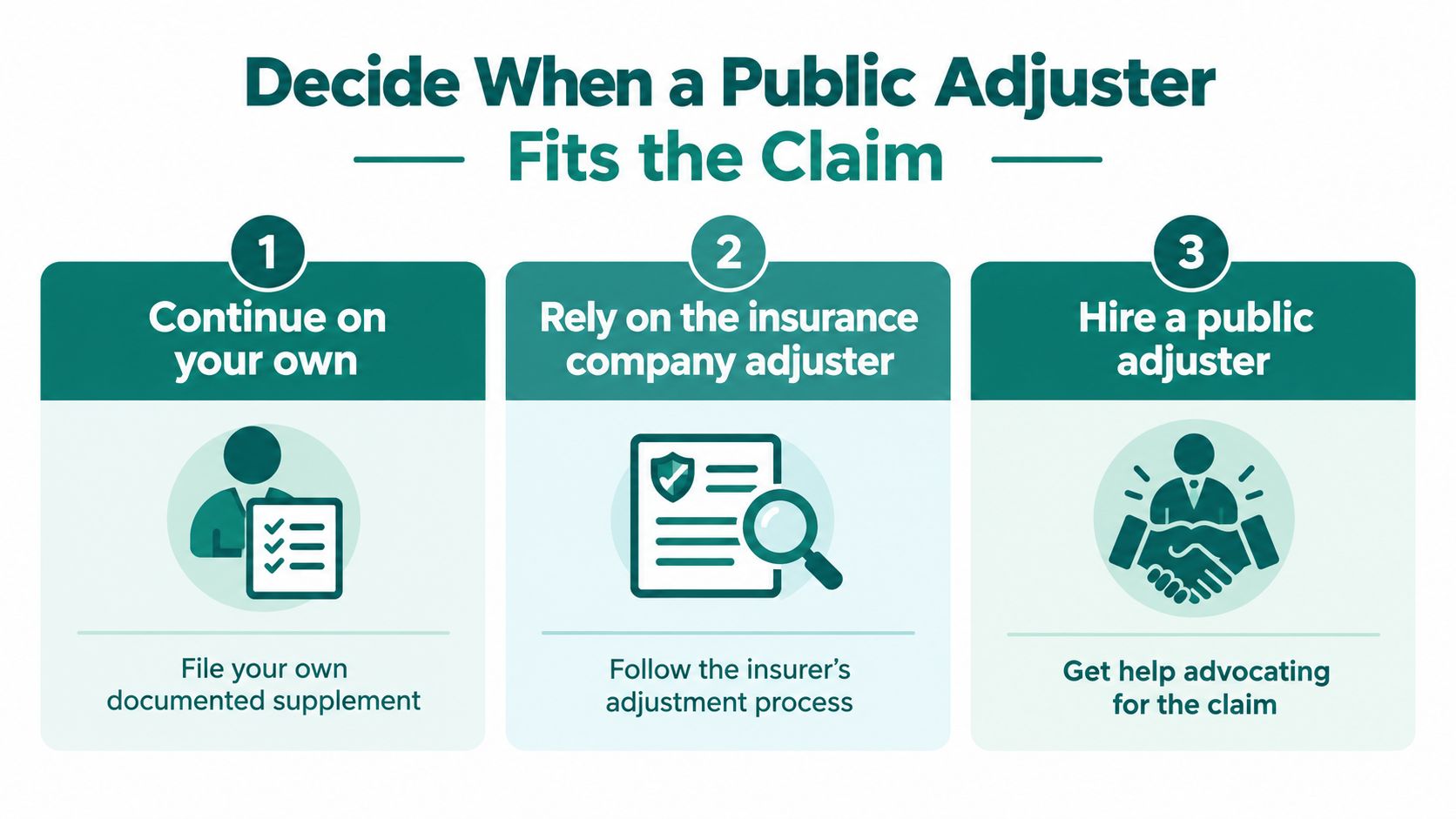
Finding gaps in an estimate and deciding who should present them are separate decisions. A property owner may handle a documented supplement independently, continue through the insurer's adjustment process, or speak with a licensed public adjuster. Hiring one is optional and may not make sense for a small, clearly scoped repair.
Match the approach to the dispute
Continue on your own when the damage is limited, the estimate is understandable, and the missing items can be supported with clear measurements, photos, invoices, or policy language. A concise supplement that identifies each disputed line may be enough to move the discussion forward. The trade-off is that the owner remains responsible for organizing the evidence and following the insurer's requests.
Rely on the insurance company adjuster for the insurer's inspection and estimate process. The company adjuster assesses the claim on behalf of the insurer, not the policyholder. The owner can provide evidence, ask factual questions, and request clarification, but should still review the written scope rather than assuming a visit resolved every issue.
Hire a public adjuster when the loss is large or complex, spans multiple buildings, or remains disputed after the owner has assembled a clear record. A conversation may also be useful when an estimate omits items such as tear-off, underlayment, flashing, ventilation, permits, code-related work, or matching, or when the insurer attributes storm damage to age or wear. A public adjuster represents the policyholder within the scope of that person's license and applicable state law. The role differs from that of the insurer's adjuster.
Roof repair and replacement costs make scope review consequential, but they don't predict an individual claim payment. Verisk-reported data put the average U.S. residential roof replacement cost at $17,631 in 2025 and the average repair cost at $4,699, respectively 33% and 25% above the prior four-year averages. Those market averages aren't estimates for a particular property and don't establish coverage. Reporting on Verisk roof-cost data
For a house, the owner may be the decision-maker. A rental property may require coordination with its owner or manager; an HOA may need to follow its governing process; and a commercial property may require approval from an owner, operator, or other authorized representative. No professional can guarantee coverage or a higher settlement. PostDamage helps visitors understand when hiring a public adjuster may be appropriate, explains that hiring one is optional, and can connect qualified inquiries with licensed professionals where available. It doesn't adjust claims itself.
Take the Next Step on a Stuck Roof Claim
For a claim that's open, delayed, denied, or paid below the documented repair scope, the next useful move is to identify the exact point of disagreement. The file should include the photos, relevant policy pages, insurer's estimate, contractor invoices or estimates, and a short note explaining what remains disputed. That makes it easier to describe the problem without promising that any particular record will change the outcome.
A homeowner with a disputed roof estimate may need help understanding what kind of professional could review the claim. A landlord, property manager, HOA decision-maker, or commercial owner may also need to account for authority to act, multiple affected units, or possible interruption to operations. Coverage decisions still depend on the policy and applicable law, and qualified professionals should be consulted for advice within their licensed roles.
PostDamage offers an insurance claim help service for property owners whose claim was denied, delayed, or paid less than expected. The review request is free, takes about one minute, and carries no obligation. Qualified residential and commercial inquiries may be connected with licensed public adjusters where available.
PostDamage is not an insurance company, public adjusting firm, law firm, or restoration contractor. It doesn't directly adjust, negotiate, or settle claims, and it doesn't guarantee an insurance outcome. For a claim involving a legal question, a roof damage lawyer resource may help identify a separate legal-assistance path; a legal professional's role is distinct from claim referral or adjustment.
When submitting a request, describe only what can be safely observed, including the damage type and location. Keep using the policy documents and appropriately licensed professionals for coverage decisions, and don't treat a referral as a promise of payment.
For roof damage that remains disputed, delayed, denied, or underpaid, PostDamage offers a free, no-obligation claim help review request that takes about a minute. Share the safely observed damage and the unresolved claim issue to see whether a connection with a licensed public adjuster is available.