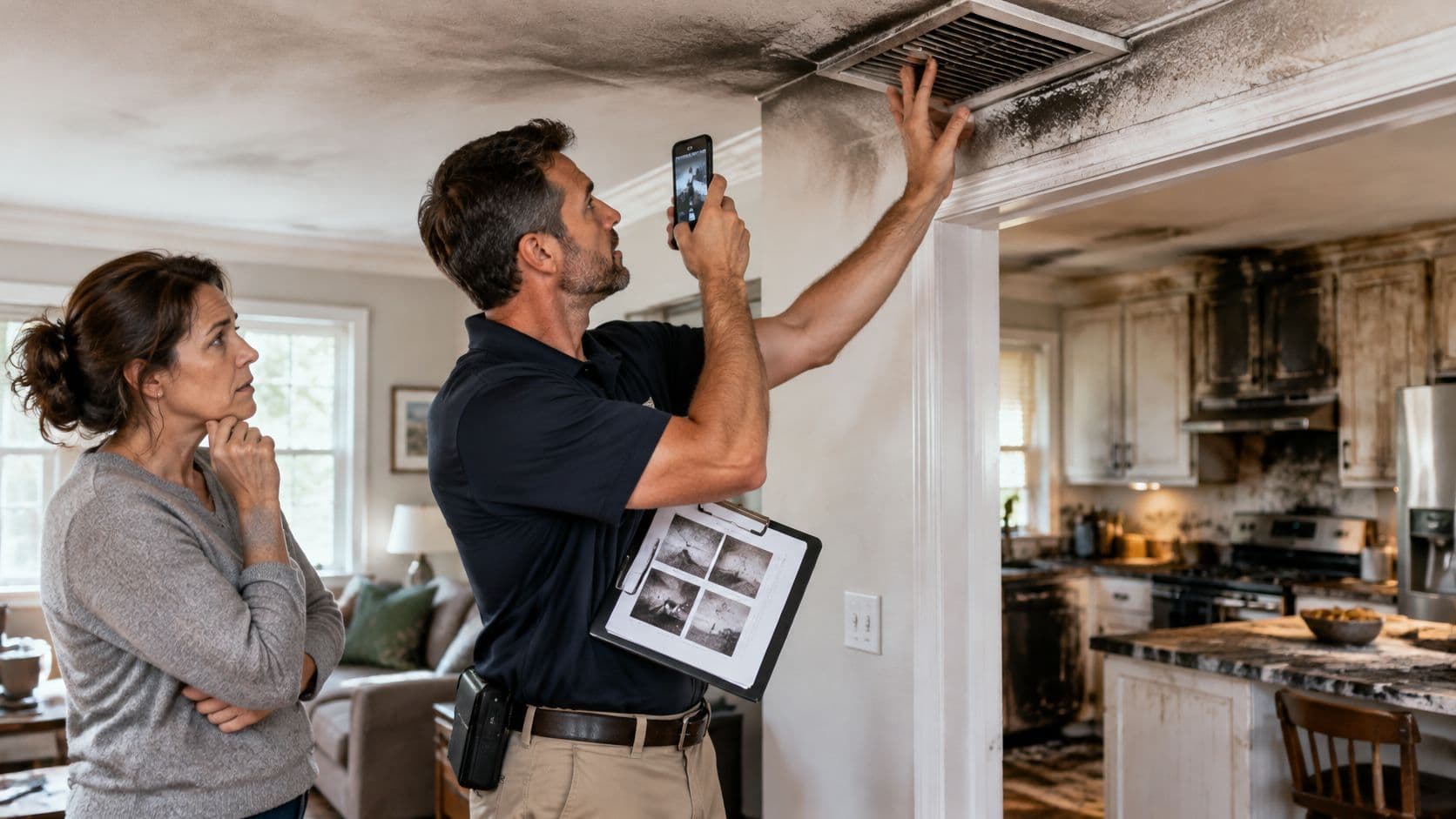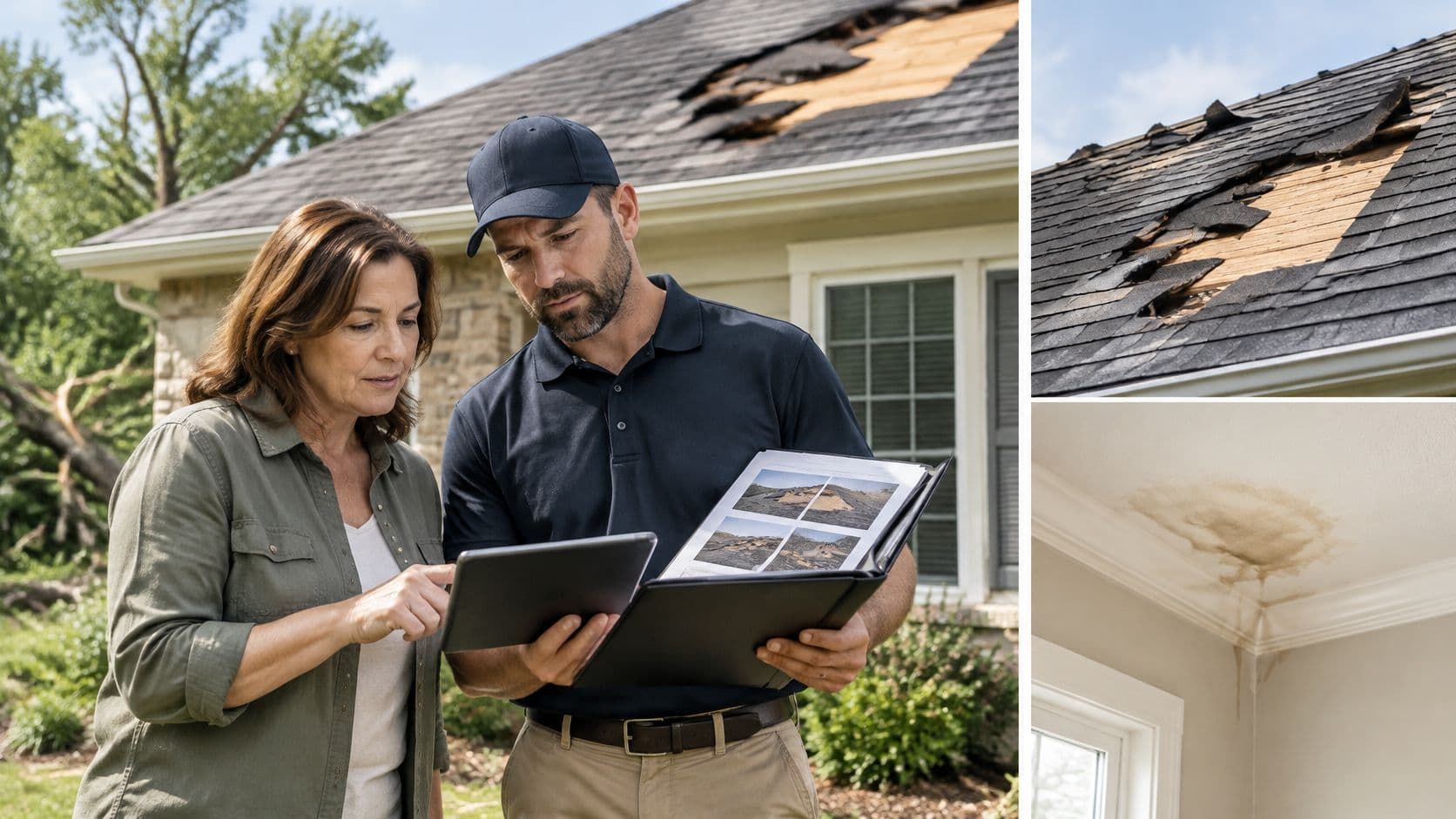
You're standing in a living room that still smells like last night's fire, holding the insurer's first estimate. The walls aren't gone. They're stained, the ducts are full of soot, and a lot of the contents look cleanable rather than burned. That first number can feel like the end of the claim. It often isn't.
Money on a fire claim slips away in two quiet places: a smoke-only loss in a building that's still standing, and a partial payment that looks finished while rebuilding, contents, and lost use stay open. A fire damage public adjuster is one way to document and present those gaps. Hiring one is optional, and it isn't the right fit for every loss. What gets paid still turns on the policy and the law that applies to the property.
Who Handles a Fire Claim and What Each Person Does
The person who handed you that first estimate doesn't work for you. Knowing who does, and who gets paid by whom, keeps the next conversation from turning into a pile of competing invoices.
From 2019 through 2023, U.S. fire departments responded to an estimated average of 328,590 home-structure fires a year, causing about $8.9 billion in direct property damage annually, according to the National Fire Protection Association's home structure fire report. One- and two-family homes, including manufactured homes, accounted for 79% of that direct property damage.
Those figures cover direct physical damage only. They don't include temporary housing, contents replacement, debris removal, code-upgrade costs, or lost rent. Smoke contamination, water used to put the fire out, and time out of the building can all sit inside the same claim. Policy terms, exclusions, limits, deductibles, and applicable law decide which of those pieces are covered.
Four roles, four paychecks
| Role | Works for | Main job on a fire claim | How they are paid |
|---|---|---|---|
| Insurance company adjuster | The insurer | Inspects the loss and writes the carrier's estimate | Salaried by the insurer, not by the policyholder |
| Licensed public adjuster | The policyholder | Documents the loss, writes an independent estimate, and negotiates with the insurer | Usually a percentage of the settlement set by contract; state rules may limit it |
| Restoration contractor | The property owner | Performs board-up, soot and smoke cleaning, demolition, and rebuilding | Contract price for the work; not a claim representative |
| Attorney | The policyholder | Handles coverage disputes, appraisal issues, and litigation | Hourly or contingency fee; check state rules |
PostDamage provides information about public adjusters, licensed professionals who represent policyholders within the scope state law allows. They aren't the same people as insurance company adjusters, who work on the insurer's behalf.
The carrier's adjuster inspects and prices the loss for the company that will pay it. A licensed public adjuster builds the policyholder's file and negotiates that file. A restoration contractor cleans and rebuilds under a work contract, and shouldn't be treated as the person arguing coverage. An attorney steps in when the fight is about the policy itself or a lawsuit, not about a missing line item.
Practical rule: Two adjusters can walk the same rooms and write different estimates. The policy language, not the larger number, decides which scope carries weight.
Safety First, Then Documenting the Loss Before Cleanup
Leave any area that isn't safe. If there's fire, gas, an electrical hazard, or a structure that may fail, get out and call 911, the fire department, or the utility that owns the hazard. Don't walk into standing water or an unstable building, and don't photograph a room you shouldn't enter. Documentation starts only after the space is cleared.
Capture the loss before anyone wipes a wall
- Photograph and video every affected room before cleaning. Shoot wide views, then close-ups of residue on walls, ceilings, contents, and inside supply registers. Once a crew wipes a surface, that proof is gone, and a later dispute over how far smoke traveled gets much harder.
- Don't dry-sweep or shove debris around. The U.S. Environmental Protection Agency's wildfire guidance warns that smoldering materials can keep producing pollutants and that exposure can harm children, older adults, and people with respiratory conditions. Dry sweeping and uncontrolled debris handling can push soot back into the air. Damp methods, proper respiratory protection, and HEPA filtration are the cleanup approach that guidance supports, which is why a household sponge understates the work.
- Build an itemized contents list, not a category. FEMA's personal property checklist asks for the date and address of the loss, pre- and post-loss photographs, an itemized inventory, and estimated costs or vendor quotes. For an item valued at $1,000 or more, receipts, comparable replacement estimates, or financial records showing replacement cost are the support it prefers. Model numbers, quantity, age, condition, and where it was bought turn "electronics" into something a reviewer can price.
- Keep every emergency receipt. Lodging, plastic, tarps, board-up, and temporary repairs belong in their own envelope. A cost with no receipt is easy to drop from a later payment.
- Don't throw items out before they're photographed and listed, unless safety requires it. Bag and label what you must move, and note why it couldn't stay.
- Write smoke odor and residue on their own lines, separate from charring and heat damage. A sofa that didn't burn can still be a total loss, and folding it into "fire damage" lets a reviewer treat it as cosmetic.
For a business, extend the same list to equipment, stock, tenant improvements, records, and downtime, and tie the downtime to accounting records rather than a rough guess of lost days.
A clean file supports a claim. It doesn't create coverage the policy doesn't grant.
Ordinary wiping also hides how far residue migrated through the building. Fire damage restoration guidance covers fire, smoke, soot, and odor cleanup as its own scope, which is why cleaning, demolition, HVAC, odor control, and personal property should each be their own line items rather than one lump sum called "fire."
How a Public Adjuster Works a Fire Claim Step by Step
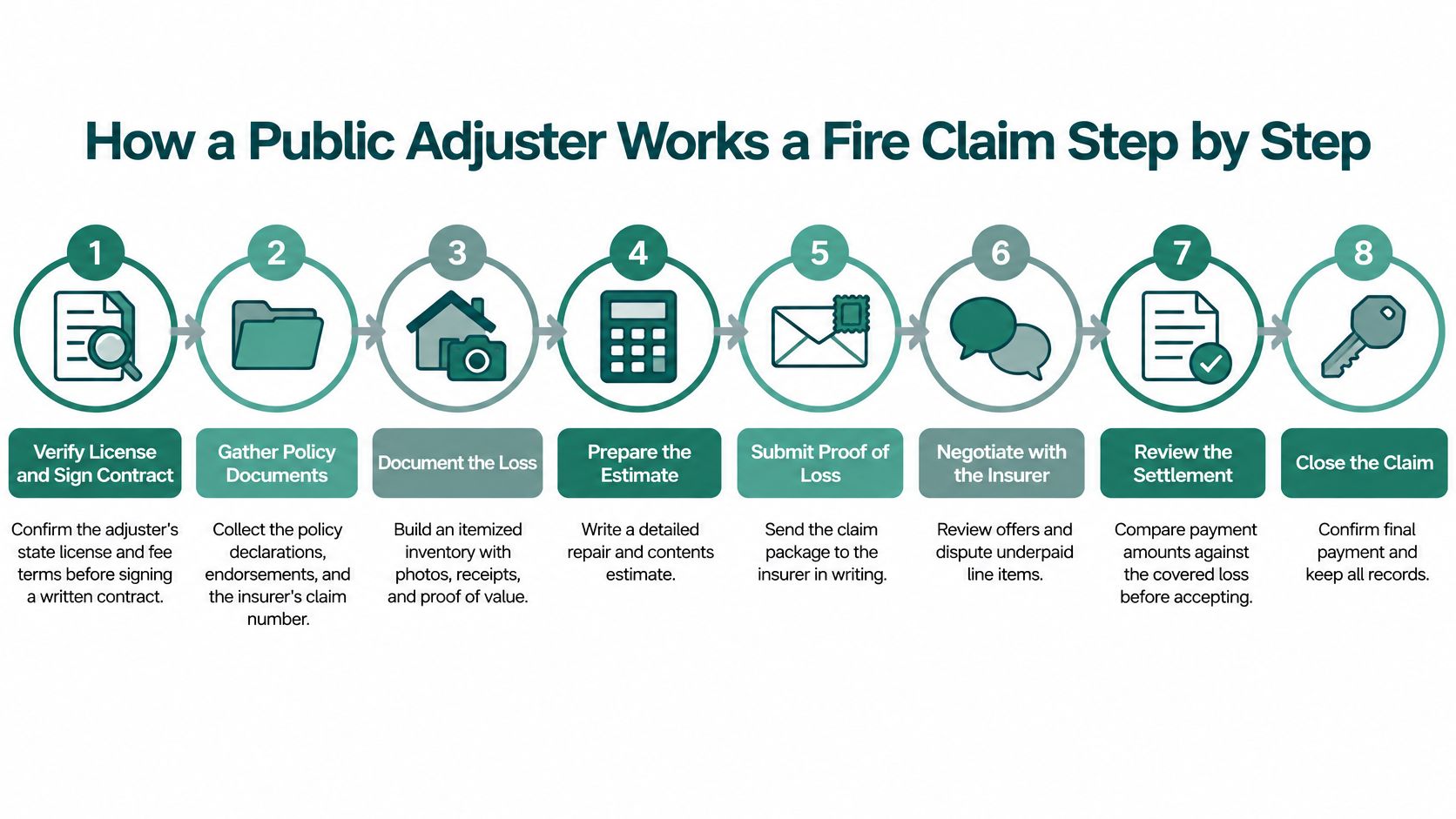
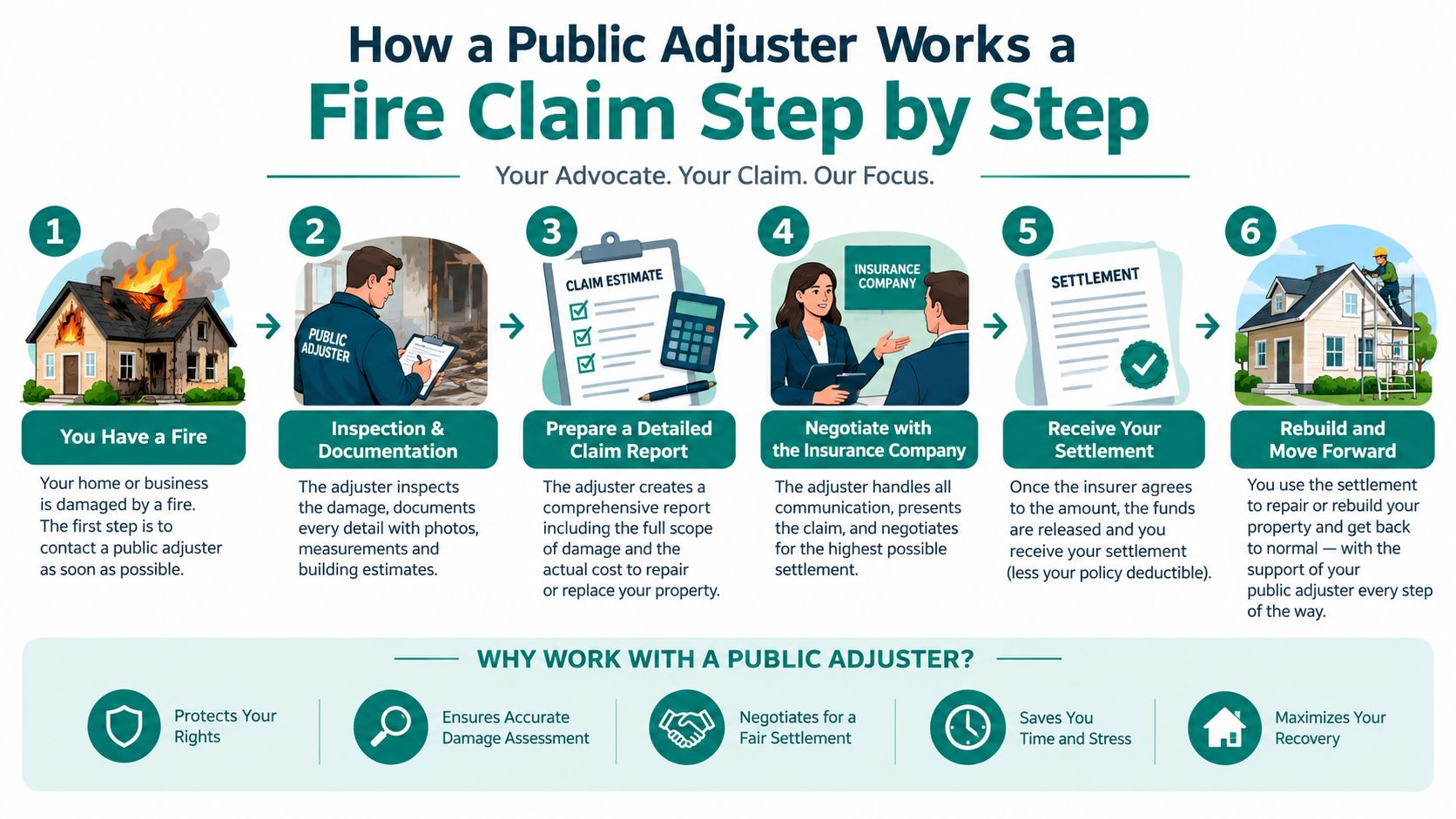
A fire damage public adjuster earns the fee by turning a messy loss into a numbered file the carrier has to answer. The value is clearest when the insurer has paid something, but smoke, water, code, contents, or downtime lines are still short.
- Confirm the license, then sign. Check the adjuster's license in the state where the property sits, and read the fee in the written contract before you sign. The common mistake is signing a percentage without comparing it with the dollars still in dispute.
- Pull the policy, not just the declarations page. Collect declarations, endorsements, and the insurer's claim acknowledgment. Note limits and any deadline for a proof of loss. Missing an endorsement is how ordinance-or-law or extended replacement cost never makes the file.
- Walk the inspection with both sides present. Join the carrier's adjuster and the restoration contractor. Mark where smoke migrated past the burn area and where suppression water reached. The expensive miss is an insurer estimate that prices charred drywall and skips smoke-affected HVAC, insulation, and contents in rooms that never saw flame.
- Price the loss line by line and find the gap. The independent estimate should sit next to the carrier's estimate so you can see which lines are missing, thin, or labeled cosmetic. A business-interruption file uses this same step, with sales, payroll, and a written timeline of when operations stopped added to the package. Insurance claim help is aimed at owners whose claim was denied, delayed, or paid less than expected, which is the moment this comparison earns its keep.
- Submit the proof of loss, then supplement it. Send the package in writing. When demolition opens a wall and exposes wet insulation, soot in the cavity, or damaged wiring, add that discovery as a supplemental line with the photo, the demo invoice, and the added quantity. A note saying more damage was found gives the reviewer nothing to price.
- Negotiate in writing, clause by clause. Each disputed line should name the policy wording it relies on, plus a photo, invoice, or quote. If the carrier prices the burned kitchen and leaves smoke-cleaned bedroom contents at zero, answer that line with the contents clause, the inventory entry, and the cleaning or replacement quote. A phone agreement you cannot find later is not a negotiation.
- If talks stall, use the path the policy already names. Before escalating, send a short list of each unpaid line and the document that supports it. Appraisal, where the contract provides it, or a referral to an attorney are the usual next routes. Which one fits depends on the policy and state law, and neither replaces missing proof.
What closes a gap
A disputed item moves when three things sit on the same page: the clause, the photo or test result, and a price from an invoice or quote. An estimate with none of those attached is an opinion. An estimate with all three is a file the carrier has to answer.
A partial payment is a marker of the remaining gap, not the finish line. Expect the first carrier scope to be narrower than the building. The work is to show, in writing, what that scope left out.
Fire Coverage Lines Worth Checking and Where Money Gets Missed
A fire claim is a bundle of coverage lines, not one burned room. In 2024, an estimated 329,500 home-structure fires caused about $11.4 billion in direct property damage and made up 23% of all reported U.S. fires, according to the NFPA's fire loss report. A single repair bid rarely prices that kind of loss.
A full review can touch the building, contents, smoke and soot, water damage, code compliance, additional living expenses, lost rent, or commercial interruption. A licensed public adjuster can help document and present covered losses. What can be settled still depends on the policy and the jurisdiction.
Lines to read one at a time
| Coverage line | What it covers | Valuation or limit to check | Common gap |
|---|---|---|---|
| Dwelling or building | Structural repair and rebuilding | Replacement cost or actual cash value, depending on the policy | Repair scope stops at visible burn damage |
| Personal property | Damaged or smoke-affected contents | Replacement cost or actual cash value; itemized inventory | Smoke-cleaned items written off without testing |
| Additional living expenses | Temporary housing and added living costs while displaced | Policy limit and time period | Receipts not kept |
| Debris removal | Hauling away burned material | Often a sublimit; check the stated amount | Removal costs folded into other lines |
| Ordinance or law | Code-upgrade costs during rebuilding | Separate limit in many policies; read the stated amount on this policy | Missed until rebuild triggers code requirements |
| Smoke and soot cleaning | Specialized cleaning, HVAC cleaning, and odor control | Scope and method documented in the estimate | Treated as cosmetic when it is contamination |
| Business interruption and extra expense | Lost income and added operating cost for businesses | Waiting period and period of restoration stated in the policy | Commercial records not tied to downtime |
Three gaps that hide inside one total
Contents get "cleaned" on paper. A contents line that says wipe and return, with no note on odor, residue, or whether an item can be restored, writes off property that may be a total loss. Testing and a clean-versus-replace call belong on the schedule.
Code costs show up late. Ordinance-or-law money often isn't visible on day one. It appears when the building department requires upgrades the old structure didn't have. If that limit isn't on the estimate before demolition, the owner finds it on a change order.
Business income has no paper trail. Lost income and extra expense are their own lines, with a waiting period and a period of restoration. Sales and payroll that aren't tied to the dates operations stopped don't support the line, no matter how obvious the closure felt.
Each line needs its own estimate and its own documents. One grand total hides which line is the one being underpaid.
When a Public Adjuster Is Worth Considering
Hire only when the likely gap between the insurer's estimate and the full covered loss is larger than the fee plus the time the claim will take. The size of the outstanding gap decides whether the help pays for itself, and PostDamage's role is helping owners see when that hire may fit.

Where the balance shifts
| Situation | Evaluate a public adjuster? | Why |
|---|---|---|
| Total loss or major rebuild | Strong consideration | Many line items and larger estimate gaps to contest |
| Smoke-only loss, structure still standing | Consider if the insurer omits smoke-affected systems or contents | Physical damage disputes are technical and often need documented proof |
| Partial payment with the claim still open | Consider after listing what remains outstanding | Partial payment can leave major losses unpaid |
| Denied claim | Read the denial letter first, then decide on help | The stated reason determines the next step |
| Commercial loss with business interruption | Consider with a commercial-experienced adjuster | Income proof and longer timelines add complexity |
| Small kitchen fire, quick undisputed payment | Usually handle directly | The likely recovery gap may be smaller than the fee |
Partial payment is the situation owners misread most often. Howden Re's 2025 wildfire analysis put pre-2025 California wildfire claims at roughly $200,000 to $300,000 for residential losses and $400,000 to $500,000 once commercial claims were included, and cited a July 2025 California update counting 93% of filed Los Angeles wildfire claims as partially paid, totaling $20.4 billion. A claim marked paid can still carry open reconstruction, contents, and income lines. The same analysis treats business interruption, smoke damage, and access denial as loss categories of their own.
A first check can ease the pressure and still leave reconstruction, contents, or income unaddressed. List what remains outstanding before you treat the claim as closed. On a denial, read the letter first, because the stated reason sets whether the next step is more proof, a coverage argument, or counsel.
Run the numbers before signing anything. Total the lines still unpaid, apply the adjuster's fee percentage to that amount, and compare the cost against the gap you are trying to recover. If the unpaid amount is smaller than the fee, handle it yourself. Where the gap is large, particularly on smoke-affected systems or income the insurer has left out of scope, that is the hire that earns its percentage.
Fees, Contracts and State Rules to Verify
Public adjuster rules are set state by state. The same fire can carry a different fee cap, cancellation window, and licensing rule depending on where the building sits. Nothing in a general article sets those numbers. The contract and the state insurance department do.
What to verify before you sign
| Check | Why it matters | Where to verify |
|---|---|---|
| Public adjuster license in the property's state | Representation rules depend on state licensing | State insurance department |
| Fee basis and percentage | Sets how much of the settlement the owner keeps | Written contract |
| Fee cap or limit, if any | Some states limit fees, especially after declared catastrophes; confirm the cap that applies in the property's state | State insurance regulator |
| Whether the fee applies to advance or undisputed payments | Changes the net recovery on partial payments | Contract wording |
| Cancellation window | Lets the owner exit if plans change; confirm the window in the contract and with the state regulator | State rules and contract terms |
| Smoke claim standards | Regulators may set rules on smoke denials and testing | State insurance department and published claim reports |
| Appraisal or dispute route | Alternative path when estimates differ | Policy declarations and state regulator |
The fee basis is the dollar decision. A percentage of the full settlement is a different bill from a percentage of the amount above the insurer's first offer. On a large advance that's already undisputed, a fee that attaches to that advance can consume money you were counting on for repairs. Read that sentence in the contract twice.
Smoke rules are a state example, not a national rule
After the 2025 Los Angeles fires, California created a Smoke Damage Claims and Remediation Task Force to address disputes over inspection, testing, remediation, and restoration standards, according to the California Department of Insurance smoke claims report. The state also alleged that the FAIR Plan improperly denied smoke claims using an arbitrary "permanent physical damage" requirement, after an investigation identifying at least 418 alleged consumer-protection violations. Those are allegations and one state's response, not a rule you can cite in another state.
Testing can document a loss. It doesn't decide payment. Policy language, causation, exclusions, endorsements, and applicable law do. When an insurer's scope leaves out smoke-affected systems or contents, that's a documentation problem first. When the dispute is a coverage denial you can't resolve with more proof, fire damage legal resources are a separate path from adjusting.
Confirm the license and the fee in writing with the state insurance department and the agreement itself. This article doesn't set fees or state rules.
Confirm Your Next Step Before Signing an Agreement
Start with the paper you already have. Before any call about representation, assemble a packet that makes the shortage visible: declarations page, carrier letters, the insurer estimate, proof-of-loss forms, your photo log, contents inventory, contractor scopes, and receipts for temporary lodging or emergency mitigation. Put every deadline and inspection date on one calendar.
- Pull the exact documents, not a memory of them. Ask the carrier for the estimate breakdown and any stated basis for denial, delay, or reduced scope.
- Turn omissions into one number. Compare missing, thin, smoke-cleaning, contents, and loss-of-use lines against bids and inventory. The unsigned difference is the gap a fee would need to beat, especially on a smoke-only claim or partial payment.
- Set a paper rule for the claim. Every phone call gets a follow-up email, every new opening gets photos, and supplements stay in one dated file.
- Give yourself a signature pause. If the scope, price, or deadline pressure feels unclear, sleep on it and re-read the documents the next morning.
This is general information, not legal, insurance, or claims advice. PostDamage is an independent information and referral platform, not an insurer, public adjusting firm, law firm, or restoration contractor; it does not adjust, negotiate, settle, or guarantee outcomes. If the outstanding gap is larger than you can document alone, PostDamage can connect residential and commercial property owners with licensed public adjusters.