The fire trucks have left, the building smells of smoke and wet char, and a hotel room, a relative's couch, or a closed business is now the base for everything that follows. That's the point where most property owners start cleaning, throwing damaged items away, and hoping a single phone call will start a payment. A fire damage insurance claim doesn't work that way. It's an evidence-controlled reconstruction of the loss, built from photos, inventories, estimates, and receipts that prove what burned, what smoke reached, and what displacement cost.
Claim Steps in Order, From Safety to Settlement
| Step | When | What You Produce | Keep in Your Claim File |
|---|---|---|---|
| 1. Safety and shelter | Immediately | Confirmed safe exit and temporary shelter plan | Receipts for emergency lodging |
| 2. Notify the insurer | As soon as possible | Claim number, policy details, date of loss, adjuster contact | Call log and written confirmation |
| 3. Document the damage | Before any cleanup | Photos, video and timestamped original files | Original files and a claim diary |
| 4. Protect the property | Right after the fire | Board-up, tarps and cleaning of salvageable items | Mitigation invoices and before-and-after photos |
| 5. Build the inventory | Within the first weeks | Room-by-room list with age, price and serial numbers | Receipts, estimates and replacement sources |
| 6. Gather itemized estimates | Before the adjuster inspection | Quantities, labor, materials and code-related work | Copies of every estimate submitted |
| 7. Meet the adjuster | At the scheduled inspection | Walkthrough with inventory and notes | Adjuster notes and any measurements taken |
| 8. Review the settlement | When the offer arrives | Line-by-line comparison and any supplement | Written offer, payment records and supplement letters |
The scale explains why insurers examine these files closely. The U.S. Consumer Product Safety Commission, using National Fire Protection Association estimates for 2021 to 2023 in the National Fire Protection Association home structure fires report, reported an annual average of approximately 365,300 residential structure fires and $10.4 billion in property losses. Those figures cover residential structures, so they're directly relevant to homeowners, landlords, condo owners, and multifamily operators.
A claim also reaches well beyond the burned room. Smoke contamination, water from firefighting, debris removal, temporary housing, code upgrades, and contents replacement can all sit inside the same loss, even though direct burn damage is the easiest part to see. Coverage still depends on the policy, exclusions, limits, deductibles, and applicable law.
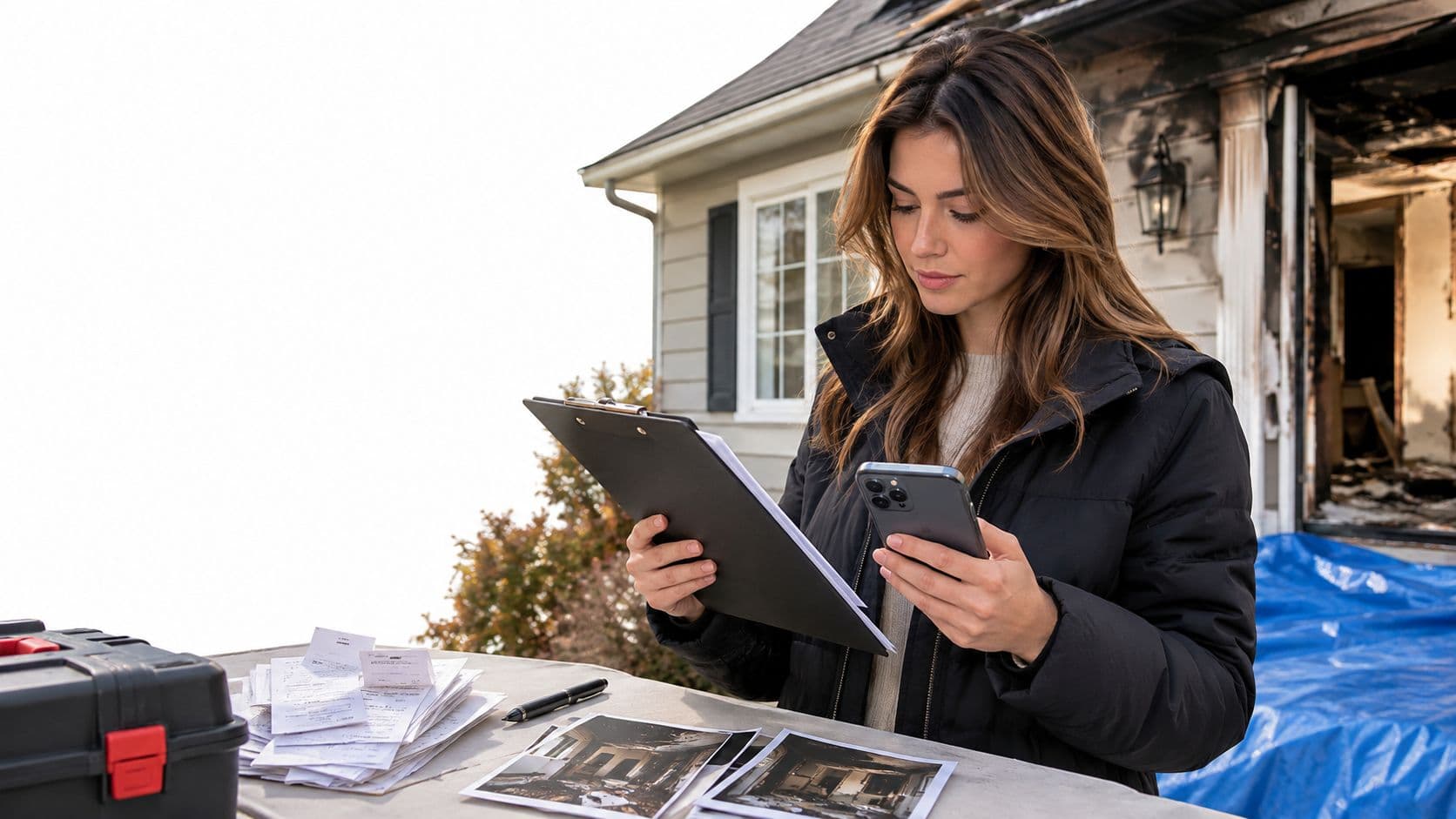
Open one claim file on the first day and add to it at every step. That file becomes the record the adjuster reviews, the insurer prices, and any later dispute relies on. Loose photos, missing receipts, and undated notes create gaps that are hard to close months later.
Notifying the Insurer and Preparing for the Adjuster
First, confirm everyone is out of danger. Then make the first call before cleanup begins, because early notice creates the claim record and starts the insurer's inspection process.
Give the policy number, the date of loss, and the cause as far as it's known. State whether anyone was injured and describe what's been secured so far, such as boarded openings or shut-off utilities. Don't guess at a cause that hasn't been determined. A short factual account protects credibility if fire department findings differ later.
Ask for the claim number, the adjuster's name and direct contact, and written confirmation that the claim was opened. Then work through a fixed set of questions.
- Coverage parts: Which parts apply to this loss, building, contents, additional living expenses, or business income?
- Reinspection: Will the adjuster return after cleanup or demolition exposes hidden damage?
- Smoke evaluation: How will smoke and odor damage be inspected and tested?
- Partial payments: When are advance or partial payments issued, and what paperwork triggers them?
- Supplements: How are supplemental items submitted, and who receives them?
Preparing for the Inspection Visit
Bring the room inventory, independent estimates, and a list of specific items that need checking, such as a smoke-filled attic or a water-damaged electrical panel. Add a one-page contact sheet with phone numbers, temporary address, contractor details, and the claim number. Organized material gets reviewed. A shoebox of unsorted receipts usually gets priced conservatively or set aside.
The adjuster works for the insurer, so the claim file should make every claimed item easy for that adjuster to verify, measure, and approve.
Keep notes factual during the visit. Record who attended, which rooms were entered, what was measured, and what the adjuster said would happen next. Read any document before signing it. A signed proof of loss or release can close items that are still unresolved, and reopening closed items is far harder than pausing to read two pages.
How to Stay Safe and Document the Damage Before Cleanup
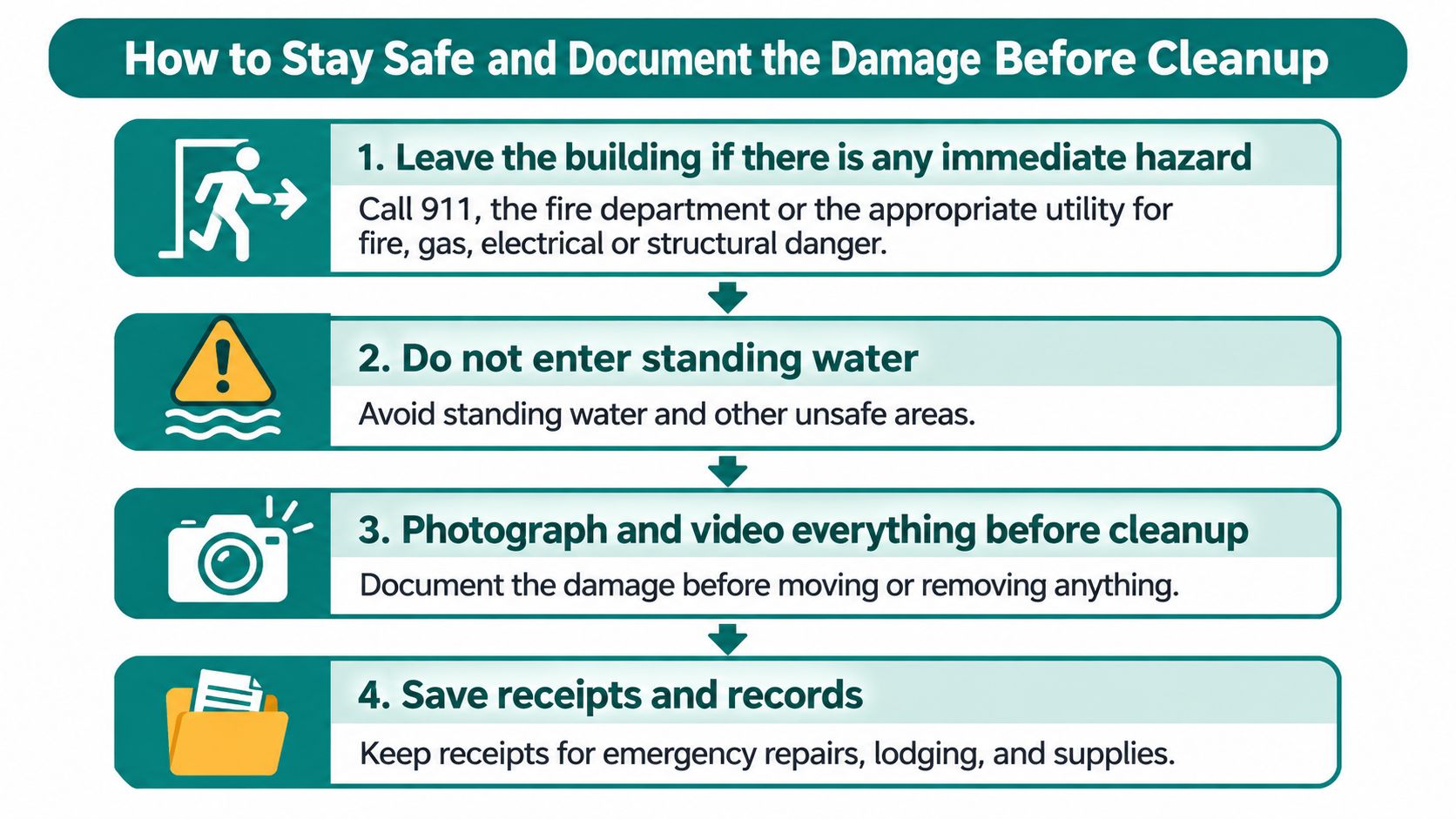
- Leave the building if there's any immediate hazard. PostDamage advises anyone in immediate danger to leave the area and call 911, the fire department, or the appropriate utility for fire, gas, electrical, or structural danger.
- Don't enter standing water or an unstable structure. PostDamage also advises leaving unsafe areas before documenting damage and never entering standing water or an unstable structure, because weakened floors and live wiring don't announce themselves.
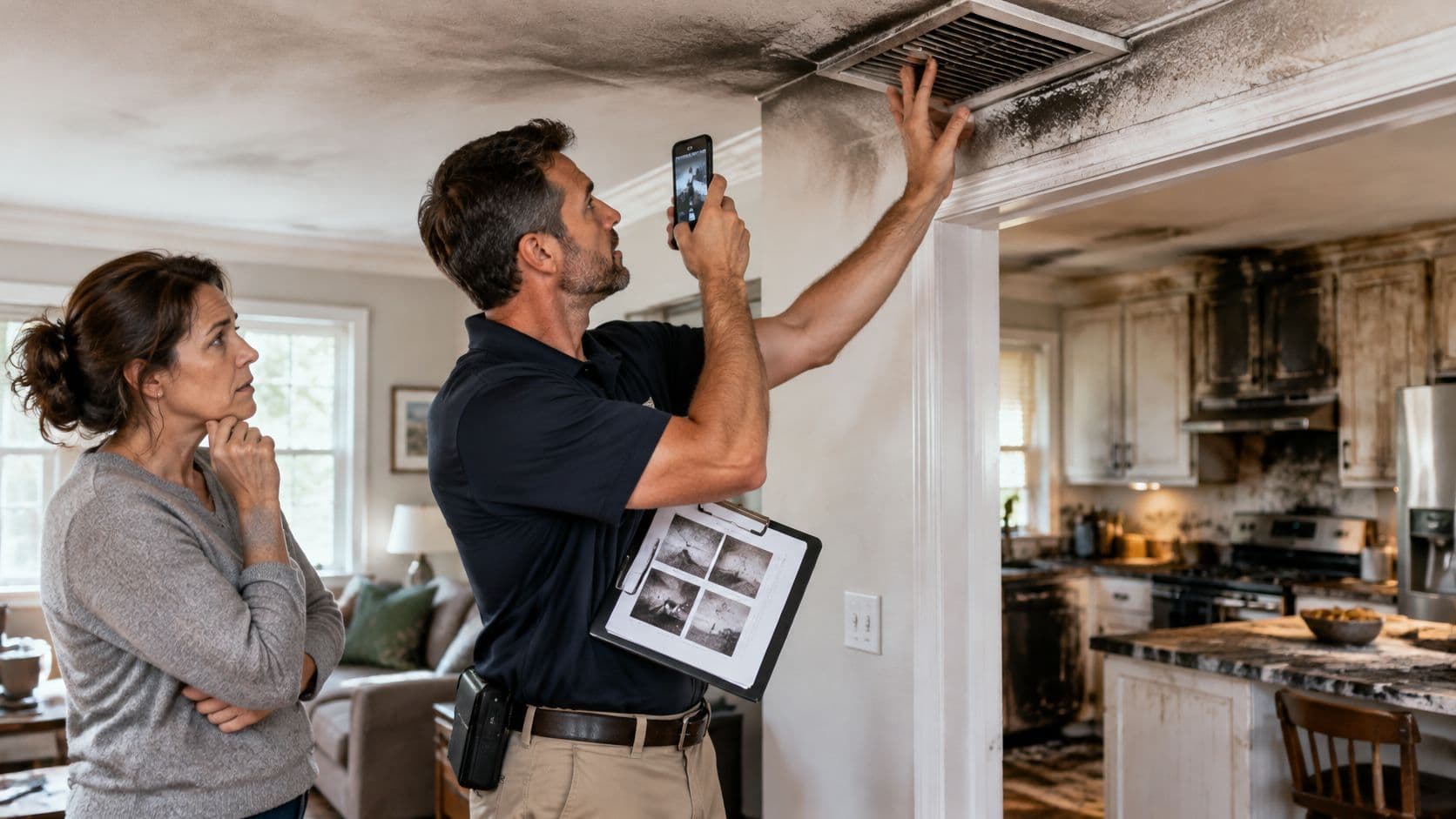
- Photograph every room once the area is cleared as safe. Use wide, medium, and close-up shots, then cover elevations, roof areas, attic spaces, utilities, and each damaged item with its serial plate visible.
- Record a narrated video walkthrough. Name each room and state the date on camera, so the sequence is clear when the file is reviewed weeks later.
- Preserve original files with timestamps. Don't edit, crop, or filter the originals, because altered files invite questions about what changed.
- Start a claim diary immediately. Log the date, time, person spoken to, and what was said after every call and visit.
- Photograph damaged contents before moving them. Keep damaged property available for inspection unless the insurer authorizes disposal, since discarded items are difficult to value or verify.
- Document smoke and soot separately from burn damage. Photograph residue on walls, vents, and ducts, and preserve notes on any testing method and wipe-test results.
State guidance in the Montana Commissioner of Securities and Insurance fire guidance identifies photographs, receipts, estimates, and other evidence as necessary to prove loss. That same guidance warns that unsupported handwritten estimates may be inadequate and that exaggeration can constitute insurance fraud. Accuracy matters more than aggressive rounding.
Mistakes That Weaken the Record
Photos without room identification are the most common failure. Two hundred close-ups of charred objects prove very little if nobody can tell which room held them. Cleaning before photographing runs a close second, because washed soot and discarded contents can't be inspected afterward.
For broader cleanup context after documentation is complete, the fire damage restoration guidance covers fire, smoke, soot, and odor cleanup in more detail.
Complete documentation before cleanup includes:
- Room coverage: Wide, medium, and close-up photos for every room, plus roof, attic, and utilities
- Original files: Unedited, timestamped photos and video stored in one folder
- Written record: A claim diary with dates, names, and decisions
- Preserved property: Damaged contents held for inspection until disposal is authorized
- Smoke evidence: Photos of vents and ducts, testing notes, and wipe-test results where testing occurred
Building the Inventory and Checking the Insurer's Estimate
| Claim Category | Evidence to Gather | Common Gap |
|---|---|---|
| Structure and building | Itemized repair estimate, room photos and measurements | Hidden damage behind walls not listed |
| Contents | Room inventory with age, purchase price, serial numbers and receipts | Items listed without proof of ownership |
| Debris removal and emergency protection | Invoices for board-up, tarping and hauling | Costs paid without invoices |
| Smoke and soot cleaning | Test results, cleaning scope and photos of vents and ducts | Odor and residue never inspected |
| Code-upgrade work | Local code citation and contractor quote | Upgrade costs left out of the estimate |
| Additional living expenses | Hotel and meal receipts, lease or rent records | Expenses not separated from normal costs |
| Business income (commercial) | Sales history, payroll, lease obligations and restoration-period calculation | Lost income not tied to physical damage |

Start by separating the loss into categories. Building damage, contents, debris removal, emergency protection, additional living expenses, and business income losses each carry different limits and proof requirements. Combining them into one lump estimate hides shortfalls and makes line-by-line comparison impossible.
Next, build a cause-and-origin chronology from fire department records, photographs, utility information, contractor findings, and policy language. Then map each category to its applicable limit, deductible, sublimit, depreciation treatment, and replacement-cost conditions. That mapping shows whether a missing payment reflects missing evidence or a genuine coverage cap.
Comparing Estimates Line by Line
Independent estimates should identify quantities, dimensions, labor, materials, code-related work, debris handling, temporary protection, and taxes. Compare each line against the insurer's estimate and flag differences in measurement, material grade, and scope. The FEMA Hermit's Peak claim guidance describes proof of loss as a detailed accounting supported by documentation, with itemized direct expenses and losses, repair estimates, depreciated value, and insurance coverage information. Totals without quantity-level support rarely survive review.
Practical rule: Traceability beats totals. Every dollar claimed should trace back to observed damage, a coverage part, a measured quantity, and a price source.
Three gaps appear most often. Hidden damage behind walls never reaches the estimate because nobody opened the wall before pricing. Contents get listed without proof of ownership, age, or purchase price. Smoke damage gets folded into fire damage with no testing, so cleaning scope becomes guesswork.
An omitted line is often a documentation gap, but it can also reflect a limit or sublimit. Check the policy before assuming more paperwork fixes the problem. Commercial losses need additional records, including equipment schedules, inventory counts, lease obligations, payroll records, and sales histories tied to the policy's period of restoration.
Smoke, Soot and Business Income Triggers
Lost revenue doesn't automatically equal a payable claim. That's the assumption that catches commercial policyholders off guard, because a business can lose a week of income and still fail the policy's trigger for payment.
Smoke travels far from flames. It enters ductwork, settles into inventory, and leaves odor in units the fire never touched. Whether that damage gets paid depends on causation and policy wording, not on how disruptive the closure felt.
Coverage Triage Checklist
- Source: Identify where the smoke came from and how it entered the building
- Physical damage: Separate direct physical damage from odor or surface contamination
- Systems and stock: Document HVAC impacts and any smoke exposure to inventory or equipment
- Preservation: Photograph and test before cleaning removes the evidence
- Separate provisions: Evaluate business income, extra expense, and civil authority coverage as distinct triggers
Coverage analysis in Insurance Business reporting on smoke damage and the business interruption gap explains that business-income coverage often requires qualifying direct physical damage. Lost revenue caused only by poor air quality, restricted operations, or customer avoidance may not trigger payment, even when the revenue loss is severe.
Say a fire stays inside one restaurant kitchen, but odor closes the dining room for a week. Without qualifying physical damage to the premises, that lost revenue may not trigger business income coverage. The cleaning scope, testing results, and any physical damage to surfaces or systems become the deciding evidence.
Contrast that with a multifamily landlord whose smoke infiltrates neighboring units. There, room-by-room documentation of each affected unit, including ducts and soft goods, establishes where physical damage occurred and which units lost occupancy. The linked smoke damage guidance explains how smoke and soot effects are documented for cleanup purposes.
Civil authority coverage can also be narrower and shorter than expected, and renewal changes or endorsements may remove or limit smoke coverage without anyone noticing. Check the declarations page and endorsements before assuming smoke losses are covered. Policy wording, exclusions, limits, and applicable law control the outcome.
Handling Partial Payments and Supplemental Claims
A partial payment is a checkpoint, not a verdict. It isn't proof of a fair settlement, and it isn't proof of bad faith. It means the insurer has paid part of the loss while other parts remain unpriced, disputed, or unsupported.
Recent California data shows how common staged payment has become. The California Department of Insurance Los Angeles recovery update reported that by November 17, 2025, 42,121 claims connected to the Los Angeles fires had been filed, 39,677 had received partial payments under laws requiring advance payments, and total insurer payments reached $22.4 billion.
Steps After a Partial Payment Arrives
- Read the offer closely. Identify which coverage part each amount pays and what remains unpaid.
- Compare line by line. Match each paid line against the inventory, estimates, and receipts, then list every gap.
- Check depreciation and limits. Confirm how depreciation was applied and what conditions release withheld amounts.
- Gather proof for each gap. Add new contractor quotes, code citations, invoices, or testing results that support the missing items.
- Submit a written supplement. Cite the claim number, name each specific item, and attach the supporting documents.
- Read release language before signing. Don't sign anything that closes unresolved items in exchange for a partial amount.
- Escalate in writing if disagreement continues. Request a written explanation, review the dispute steps in the policy, and contact the state insurance department, since NAIC consumer guidance confirms policyholders can file complaints there.
Deadlines deserve the same attention as dollar amounts. Many policies require a sworn proof of loss within a set period after the insurer requests it, and suit or appraisal windows can be shorter than expected. Find those dates in the policy and state rules, then write them into the claim diary where they won't be missed.
Property owners working through a denied, delayed, or underpaid claim can review the insurance claim help options for information on next steps.
Decide Whether a Public Adjuster Fits Your Claim
Hiring a public adjuster is optional, and PostDamage states that it may not be appropriate for every claim. Straightforward losses with clear scope and a responsive insurer often settle without one.
Consider professional help when several coverage parts are involved, scope is disputed, contents valuation is complex, or business interruption forms part of the loss. A denial or repeated low offers also change the calculation. Public adjusters are professionals who represent policyholders in insurance claim matters within the scope permitted by applicable state law, and they may help with documentation, estimates, and negotiation depending on license and law.
Confirm the license and get fee terms in writing before signing any contract. No professional can guarantee approval or a higher settlement, and any promise of a guaranteed outcome should end the conversation.
Three actions move any claim forward this week. Pull the policy declarations and endorsements, check the status of the room inventory, and save the insurer's written offer with every letter that came with it. Property owners who want a second look at a claim file can request an information review through PostDamage, which is an information platform, not an insurer, adjusting firm, or law firm, and doesn't guarantee any outcome. That review request is free, takes about one minute, and carries no obligation.
A fire damage insurance claim gets stronger when the file proves the full loss, from structural damage and contents to smoke, displacement, and any disputed partial payment. PostDamage provides claim information and helps connect property owners with licensed public adjusters who may assist with documentation, estimate review, and disputed claims. Visit the site to request a free, no-obligation review of the claim file and decide on the next step with the documents in hand.